
Best Helpdesk Software in 2026: 8 Tools I'd Actually Recommend

Key facts8 tools compared: Freshdesk, Zendesk, Intercom, Help Scout, Zoho Desk, Gorgias, Front, Hiver
- 8 tools compared: Freshdesk, Zendesk, Intercom, Help Scout, Zoho Desk, Gorgias, Front, Hiver
- Freshdesk (best for: Most teams / best value): Free, then $19/agent/mo
- Zendesk (best for: Mid-market & enterprise): $55/agent/mo
- Intercom (best for: AI-first support): $29/seat/mo + $0.99/resolution
- Help Scout (best for: Small teams who hate clutter): Free, then $25/user/mo
Most helpdesk roundups read like a wall of feature checkboxes. That tells you nothing about what it's like to run support on these tools at 2pm when the queue is on fire.
I compared pricing pages, documentation and public user reviews across half a dozen of these platforms. The thing nobody says out loud: the "best" helpdesk depends almost entirely on your team size and what you're supporting. A five-person SaaS startup and a 200-agent contact center have nothing in common, and a tool that's perfect for one is a tax on the other.
Short version: Freshdesk is the best all-around pick for most teams in 2026. It does most of what Zendesk does at roughly half the price, with AI included instead of bolted on as a surcharge. But pricing models shifted hard this year (per-resolution AI billing is everywhere now), so the right answer changes if you're a tiny team, an e-commerce brand, or an enterprise. Here's how I'd actually choose.
Quick comparison
| Tool | Best for | Starting price | Standout |
|---|---|---|---|
| Freshdesk | Most teams / best value | Free, then $19/agent/mo | AI agent included, fair pricing |
| Zendesk | Mid-market & enterprise | $55/agent/mo | Feature depth, ~2,000 integrations |
| Intercom | AI-first support | $29/seat/mo + $0.99/resolution | Fin, the best AI agent on the market |
| Help Scout | Small teams who hate clutter | Free, then $25/user/mo | Feels like email, not a ticket system |
| Zoho Desk | Budget-conscious teams | Free, then $7/agent/mo | Cheapest serious option |
| Gorgias | Shopify / e-commerce | From $10/mo | Deep store + order integration |
| Front | Collaborative inbox teams | $25/seat/mo | Shared inbox done right |
| Hiver | Teams living in Gmail | From ~$19/user/mo | Helpdesk inside Google Workspace |
Freshdesk: the best value for most teams
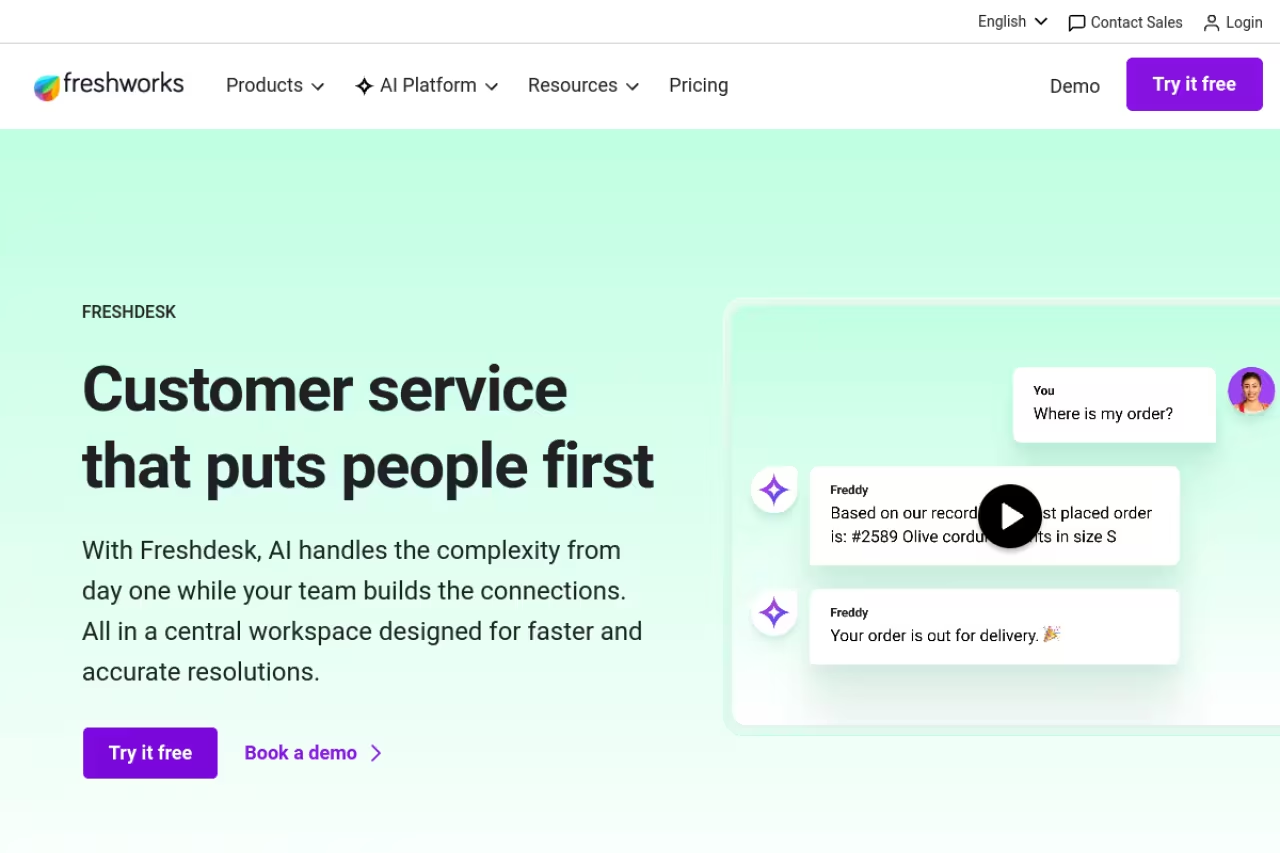
Freshdesk is what I point most people to when they ask where to start. It's a full ticketing system with multichannel support (email, chat, phone, WhatsApp, social), automation, a knowledge base, and Freddy AI baked in.
The sensible starting point for growing support teams of 5 to 50 that want real capability without enterprise pricing. The value math beats Zendesk's entry tier, but the interface can feel busy and the free tier is only 1-2 agents.
Pricing: there's a genuinely usable free tier (up to 2 agents). Paid plans run $19/agent/month for Growth, $55 for Pro, and $89 for Enterprise, billed annually. The Freddy AI Agent comes with 500 sessions on Pro and Enterprise, then $49 per 100 additional sessions.
The standout is the value math. You get the AI copilot, automations, and SLA management on plans that cost less than Zendesk's entry tier, and for a mid-size team that gap compounds into thousands a year.
The catch: the interface can feel busy, and past a few dozen agents you hit the same complexity tax that pushes big teams toward Zendesk anyway. The free tier also quietly changed to 1-2 agents (not the old 10), so don't plan a real operation around it.

Zendesk: the enterprise default
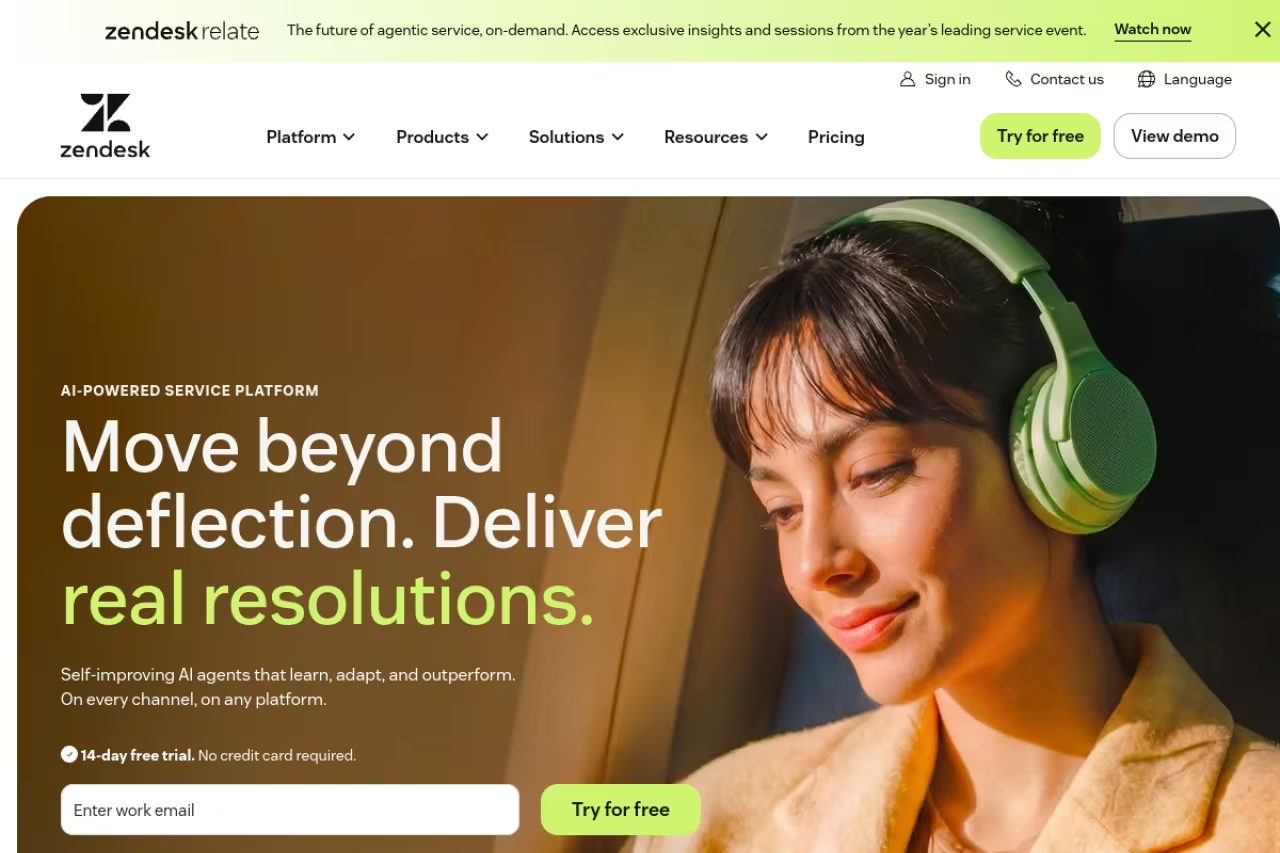
Zendesk is the tool everyone benchmarks against, and there's a reason it's the default at companies past a few hundred agents. The depth is real: omnichannel routing, skills-based assignment, a workflow engine, analytics, and an app marketplace with close to 2,000 integrations.
The enterprise default for mid-market teams that need configurability and have a part-time admin. The breadth is real, but cost and complexity are steep, the AI add-on is extra, and a team under 20 will use 10% of it.
Pricing: the Suite plans run $55, $89, $115, and $169 per agent/month (Team, Growth, Professional, Enterprise) billed annually. The generative AI add-on is another $50 per agent per month on the higher tiers, which is the part that surprises people.
The standout is sheer breadth. If a workflow exists in customer support, Zendesk can probably model it, and if it can't, there's an app for that.
Where it falls short: cost and complexity. The sticker price is steep, the AI is a separate line item, and the platform is heavy. For a team under 20 people it's overkill. I've watched small teams buy Zendesk because it's the "serious" choice and then use 10% of it.

Intercom: the AI-first pick
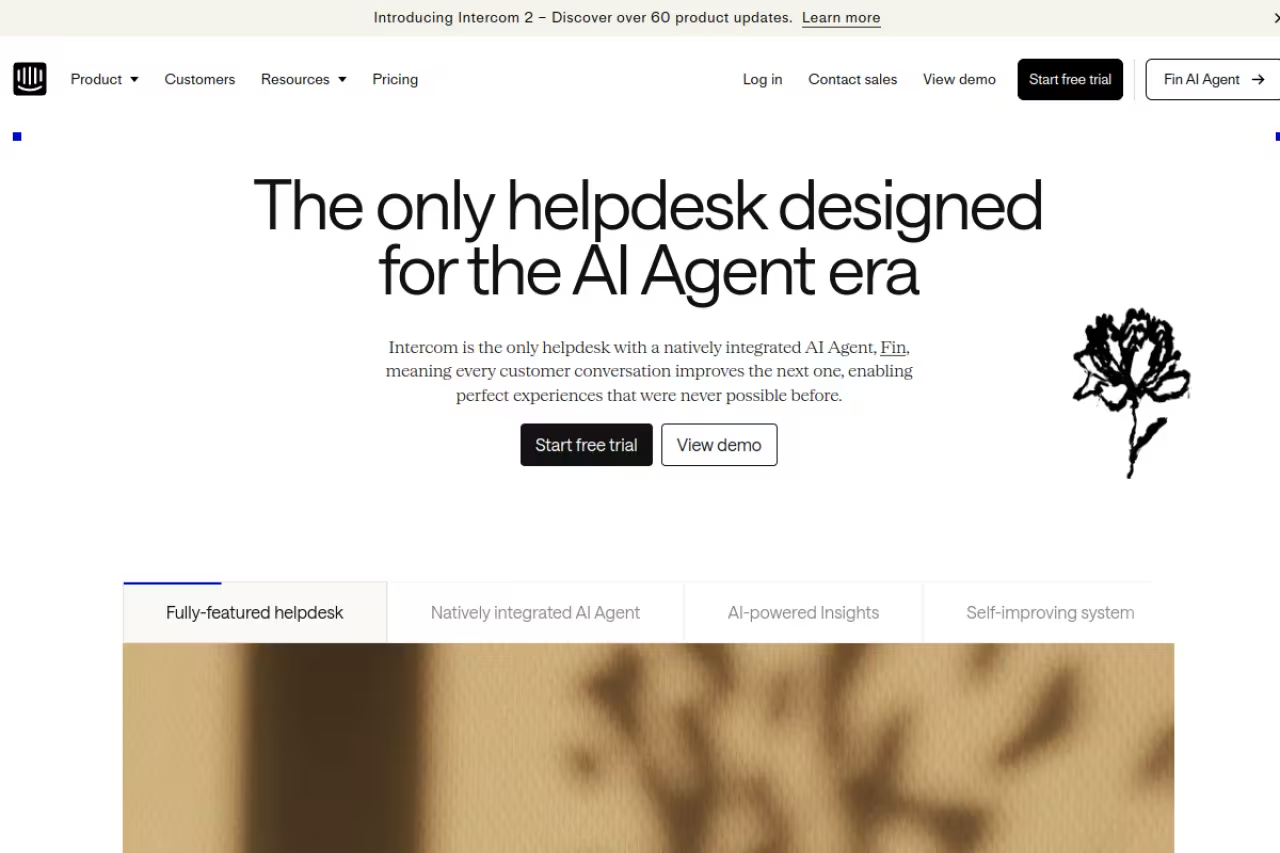
Intercom made a bet years ago that AI would do most of the front-line answering, and in 2026 that bet looks right. Its Fin AI agent is the one I'd trust most to actually resolve tickets without a human, not just deflect them.
Pick Intercom if you want AI to handle the bulk of incoming volume, especially in product-led SaaS. Fin's outcome-based pricing at $0.99 per resolution is honest, but costs get hard to forecast at high volume, so model your tickets first.
Pricing: seats run $29, $85, and $132 per seat/month (Essential, Advanced, Expert) billed annually. The headline number is Fin at $0.99 per resolution, and you're only charged once per conversation even if it answers several questions. That outcome-based model is honest: you pay when it works.
The standout is Fin's resolution quality. Of the tools on this list, it's reported to have the strongest grasp of context and the cleanest handoffs to humans, and per-resolution pricing scales with value instead of headcount.
The catch: the math gets unpredictable at high volume. If Fin resolves 30,000 conversations a month, that's $30,000 on top of seats, harder to forecast than a flat per-agent bill. Model it against your actual ticket volume before you commit.
This is also where teams blur the line between a helpdesk and a chatbot. If pure conversational automation is your goal, my guide to the best AI chatbots for business covers the tools built for that.

Help Scout: the anti-Zendesk
Help Scout is the one I recommend to small teams who recoil at the word "ticket." Customers reach a shared inbox, replies look like normal email, and there's no portal making people feel like a case number.
The anti-Zendesk for small teams of 2 to 15 who want professional support without the weight of a big platform. Setup takes an afternoon, but advanced routing, deep reporting and granular SLAs are not its strengths and phone teams will outgrow it.
Pricing: Help Scout moved to per-user pricing in 2026. There's a free plan for up to 5 users, then $25, $45, and $75 per user/month (Standard, Plus, Pro) billed annually. AI Answers, its autonomous resolution feature, is a separate $0.75 per resolution.
The standout is how little it gets in the way. Setup takes an afternoon, the AI drafting is quietly useful, and the whole thing respects the customer's time instead of routing them through a self-service maze.
Where it falls short: it's deliberately not built for scale or complexity. Advanced routing, deep reporting, and heavy automation aren't its strengths, and if you're running phone support or need granular SLAs, you'll outgrow it.
Zoho Desk: the budget champion
Zoho Desk is the answer when budget is the hard constraint. It's startlingly cheap and still includes real features, not a hollowed-out trial.
The budget champion for cost-sensitive teams and anyone already in the Zoho ecosystem, starting at $7 per agent per month. The experience is more dated than Freshdesk or Intercom, and the best AI features sit on the top plan.
Pricing: a free plan covers 3 agents. Paid tiers are $7, $14, $23, and $40 per agent/month (Express, Standard, Professional, Enterprise) billed annually. That $7 entry point is the lowest of any serious helpdesk here.
The standout is obvious: price. You get ticketing, a help center, and automations for less than a streaming subscription per agent. Zia, Zoho's AI assistant with sentiment analysis and auto-tagging, lands on the Enterprise tier.
The catch: the experience is more dated and less polished than Freshdesk or Intercom, and the best AI features sit on the top plan. If you're not already in the Zoho world, the integration pull that makes it great mostly disappears.

Gorgias: built for e-commerce
Gorgias isn't trying to be a general helpdesk. It's purpose-built for online stores, with Shopify, Klaviyo, and 150+ commerce integrations wired in so agents see orders, refunds, and subscriptions right next to the conversation.
Go with Gorgias if you run a DTC or e-commerce brand, especially on Shopify, since agents can refund or edit orders inside the ticket. Ticket-based pricing punishes high-volume stores, and outside retail there are better picks.
Pricing: plans start around $10/month and scale by ticket volume rather than agents, up to $900/month on Advanced. Tickets beyond your plan run $0.32 to $0.40 each, and the AI Agent charges around $0.90 to $1.00 per resolved conversation.
The standout is commerce context. An agent can refund an order or edit a subscription without leaving the ticket, which saves real minutes per conversation on a busy store.
Where it falls short: ticket-based pricing punishes high-volume stores, and you can pay both a ticket fee and an AI fee on the same conversation. It's also weaker for non-Shopify or non-retail use. This is a specialist tool, and outside e-commerce there are better picks.

Front: the shared inbox done right
Front sits between a team email client and a helpdesk. Conversations land in shared inboxes, teammates comment internally without messy CC chains, and the whole thing keeps a human, email-like feel while adding assignment, automation, and analytics.
Best when support, sales and ops all touch the same conversations, such as agencies, logistics and B2B services. Collaboration beats a traditional ticket queue, but seat caps force upgrades early and it is less specialized for pure customer support.
Pricing: $25, $65, and $105 per seat/month (Starter, Professional, Enterprise) billed annually. Starter caps at 10 seats and Professional at 50, so plan tier around team size. AI Copilot, Smart QA, and Smart CSAT come included on Enterprise.
The standout is collaboration. If multiple departments work the same threads, Front handles internal coordination better than a traditional ticket queue ever does.
The catch: it's pricier than its raw feature count suggests, and the seat caps on lower tiers can force an upgrade sooner than you'd like. As a pure customer-support helpdesk it's less specialized than Zendesk or Freshdesk.

Hiver: a helpdesk inside Gmail
Hiver takes the most pragmatic angle of the bunch: it turns Gmail and Google Workspace into a helpdesk. No new app, no migration, no retraining. Shared inboxes, assignments, SLAs, and analytics live right inside the inbox your team already uses.
A pragmatic fit for small and mid-size teams on Google Workspace that want helpdesk structure without leaving Gmail. Adoption is near-instant, but you are tied to Workspace and lose the deeper omnichannel and reporting of dedicated platforms.
Pricing: plans start around $19 per user/month and scale by features and automation limits. Check the current tiers before committing, since Hiver adjusts them periodically.
The standout is zero friction. Adoption is near-instant because there's nothing new to learn, which is the biggest reason helpdesk rollouts stall.
Where it falls short: you're tied to Google Workspace, and the deeper omnichannel and reporting features of dedicated platforms aren't here. Great fit for its niche, poor one outside it.
How to choose without overthinking it
Match the tool to your situation, not to a feature list.
- Under 15 people, want simplicity? Help Scout or Hiver. Both stay out of the way and onboard in a day.
- Most teams, want the best balance? Freshdesk. Strong features, fair price, AI included.
- AI should do the heavy lifting? Intercom with Fin, but model the per-resolution cost against your real volume first.
- Running a Shopify store? Gorgias, full stop. The commerce integration pays for itself.
- Enterprise with real complexity and an admin? Zendesk. You'll use the depth.
- Budget is the wall? Zoho Desk at $7/agent is hard to beat.
One trap to avoid: buying the most powerful tool you can afford. Unused capability isn't a safety net, it's a cost and a complexity drag. The right helpdesk is the one your team actually uses well, not the one with the longest feature page.
Before you commit, get a few of these out into the open and let your agents try the real workflow for a week. Want a wider view of the category first? My roundups of the best AI customer support tools and the broader best customer support software go deeper on adjacent options, and the best AI agents guide covers the automation layer that increasingly sits on top of all of these.
If you're a founder or operator trying to keep up with how fast this AI tooling moves, Dupple X tracks the tools and shifts worth your attention so you're not finding out about a pricing change three months late.
FAQ
What is the best helpdesk software in 2026?
For most teams, Freshdesk offers the best balance of features, price, and included AI. Intercom leads on AI-first automation with its Fin agent, Zendesk wins for enterprise depth, and Help Scout is the cleanest choice for small teams. The best pick depends mostly on your team size and whether you're supporting a SaaS product, an online store, or internal users.
How much does helpdesk software cost per agent?
Most platforms run from about $7 to $115 per agent per month. Zoho Desk starts at $7, Freshdesk at $19, Help Scout at $25, and Zendesk Suite at $55, all billed annually. The newer wrinkle is AI billing: many tools now charge per resolution (Intercom at $0.99, Help Scout at $0.75, Gorgias around $0.90 to $1.00) on top of seat costs.
Is there a free helpdesk option worth using?
Yes. Freshdesk, Zoho Desk, and Help Scout all have free tiers that are genuinely usable for small teams. Zoho Desk's free plan covers 3 agents and Help Scout's covers 5 users. Freshdesk's free plan now covers 1-2 agents, so it's better for testing than for running a real operation long-term.
What's the difference between a helpdesk and a chatbot?
A helpdesk is the full system for managing support: ticketing, multichannel inboxes, routing, reporting, and a knowledge base. A chatbot is one channel within that, the automated layer that answers questions or deflects tickets. Modern helpdesks like Intercom and Freshdesk bundle AI agents in, but if you mainly want conversational automation, a dedicated chatbot builder may be a better fit.
Does AI in helpdesk software actually improve customer satisfaction?
It helps, with caveats. AI-handled tickets average a CSAT of 4.10 out of 5 versus 4.30 for human agents, a gap that nearly closes with good escalation flows, according to Zendesk's CX Trends 2026 data. AI handles structured requests like password resets and refund status well, but struggles with sentiment-heavy issues like complaints, where a human handoff still matters.
Which helpdesk is best for a small e-commerce store?
Gorgias is the strongest pick for Shopify and DTC stores because it wires order, refund, and subscription data directly into each conversation. If your store is smaller or not on Shopify, Freshdesk or Help Scout give you solid general support at a more predictable price without the ticket-based billing.
Related guides
Some offers on this page may be paid placements or contain affiliate links.
Across our whole catalogue the median is $24 a month and 33% of tools advertise a free tier. Figures are the lowest recurring monthly price quoted in our own review of each tool, read on 2026-08-19. Full method and every category.
