
The 8 Best AI Chatbots for Business in 2026

Key facts8 tools compared: Fin (Intercom), Tidio (Lyro), Chatbase, Zendesk AI Agents, Gorgias…
- 8 tools compared: Fin (Intercom), Tidio (Lyro), Chatbase, Zendesk AI Agents, Gorgias, Salesforce Agentforce, HubSpot AI, Ada
- Fin (Intercom) (best for: General support automation): $0.99 / resolution
- Tidio (Lyro) (best for: SMB & small e-commerce): Free, then ~$39/mo for 50 AI chats
- Chatbase (best for: DIY bot on your own docs): Free, paid from ~$40/mo
- Zendesk AI Agents (best for: Teams already on Zendesk): $1.50-$2.00 / resolution + $50/agent
Most "AI chatbot" roundups still describe 2022 tools: decision-tree bots that match keywords and dump people into a contact form. That category is basically dead. What businesses buy in 2026 is an AI agent that reads your help docs and past tickets, reasons through a messy question, and actually closes the conversation without a human touching it.
The catch is that this new generation prices itself per resolution, not per seat. A bot that "resolves" 62% of your volume sounds great until you do the math at a dollar a pop on 10,000 monthly conversations. So picking the right one isn't about features on a comparison grid. It's about matching the automation rate, the pricing model, and the setup effort to how your support actually works.
I compared these tools on their pricing pages, documentation, and the fine print on billing. If you want the short answer: Fin by Intercom is the strongest general-purpose support agent right now, Tidio is the best value for small e-commerce and SMBs, and Chatbase is the one to grab if you just want to train a bot on your own content and embed it this afternoon. Everything below explains when each makes sense, and where each one will frustrate you.
Quick comparison
| Tool | Best for | Price | Standout |
|---|---|---|---|
| Fin (Intercom) | General support automation | $0.99 / resolution | Highest published resolution rates |
| Tidio (Lyro) | SMB & small e-commerce | Free, then ~$39/mo for 50 AI chats | Live chat + AI in one cheap plan |
| Chatbase | DIY bot on your own docs | Free, paid from ~$40/mo | Fastest to embed, no help desk needed |
| Zendesk AI Agents | Teams already on Zendesk | $1.50-$2.00 / resolution + $50/agent | Native ticket handoff |
| Gorgias | Shopify stores | ~$0.90 / resolution + plan fee | Cancels orders, edits shipping |
| Salesforce Agentforce | Salesforce shops | ~$2 / conversation or Flex Credits | Deep CRM actions |
| HubSpot AI | HubSpot users | $0.50 / resolved conversation | Cheap per-outcome, CRM-native |
| Ada | Large enterprise | Custom (~$70K+/year) | Omnichannel at scale |
Fin by Intercom
Fin is the agent everyone else gets benchmarked against, and it's easy to see why. Intercom built a dedicated AI team of 60-plus researchers and engineers around it, and it shows in how the bot is designed to handle ambiguity: when a question references two different products, it's built to ask a clarifying question instead of guessing, then pull the right answer from the connected docs.
Who it's best for: Mid-market and growing SaaS teams that want one agent to cover chat, email, voice, and social without stitching together separate tools.
The agent everyone else is benchmarked against, suited to mid-market SaaS teams wanting chat, email, voice and social covered by one bot. The $0.99 per outcome definition favors Intercom, so audit transcripts before trusting the resolution rate on your invoice.
Fin charges $0.99 per outcome, where an outcome is a resolution or a successful handoff procedure. Standalone Fin (bolted onto your existing help desk) has a 50-outcome monthly minimum, so $49.50/month floor. Run it inside Intercom and there's no resolution minimum, but you need at least one paid seat ($29 to $139/month).
The standout is the resolution rate. Intercom publishes a 62% figure, and independent reviewers report real-world rates landing somewhere between 42% and 50% depending on how clean your knowledge base is. Even the conservative number beats most competitors on this list.
The catch: the $0.99 outcome definition is generous to Intercom. If a customer reads Fin's answer and simply doesn't reply, that counts as a resolved outcome you pay for, even if they walked away unsatisfied. At scale, audit your transcripts before trusting the resolution percentage on your invoice.

Tidio (Lyro AI)
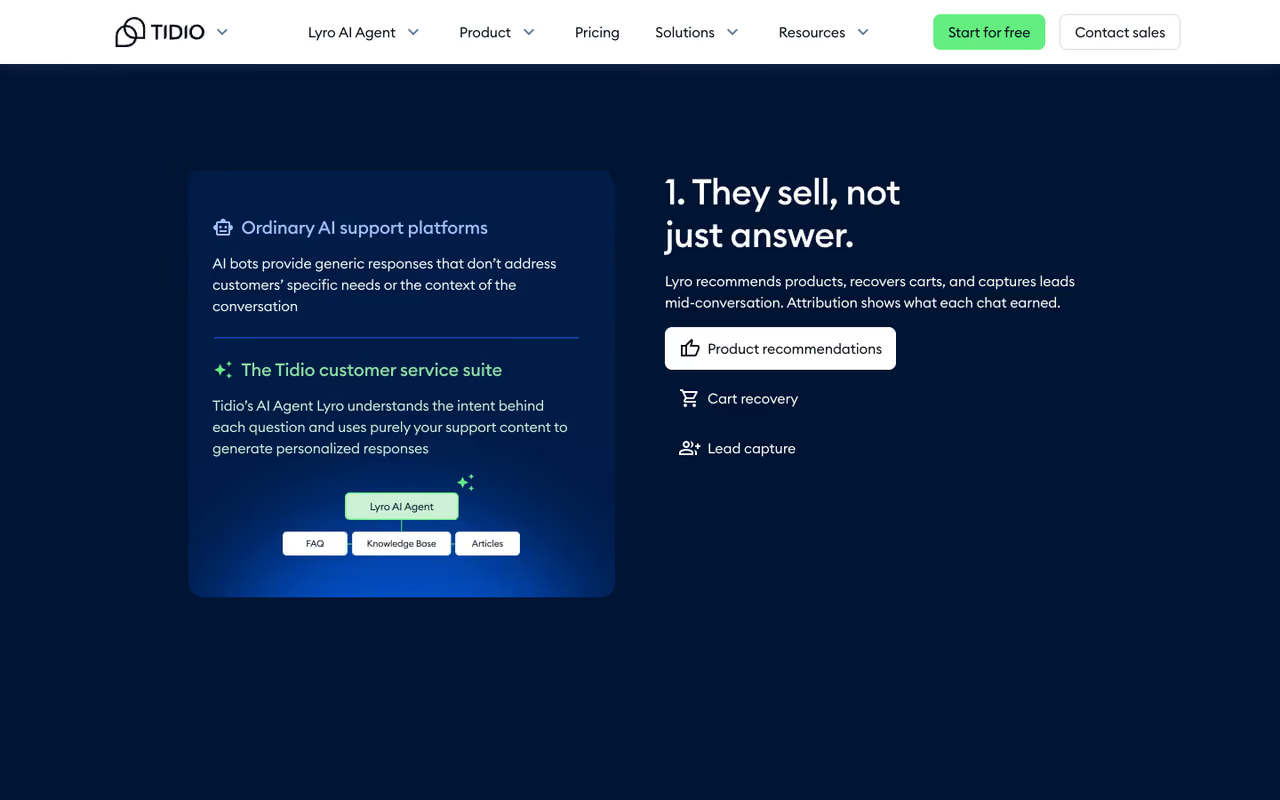
Tidio is what suits a 5-person e-commerce team that has never run automated support. Live chat, a help desk, and the Lyro AI agent all live in one dashboard, and you can be answering customers the same day. Lyro resolves up to 64% of requests on its own according to Tidio, and it's built to handle order-status and return-policy questions once it's pointed at a few help articles.
Who it's best for: Small and mid-size online stores that want live chat and an AI agent together without enterprise pricing.
A starter-friendly pick for small online stores that want live chat and an AI agent together, and you can run real automated support for well under $100 a month. Lyro is metered separately, and costs climb quickly at real volume.
the base plans run free, then $29/month (Starter) and $59/month (Growth). The thing to understand is that Lyro is metered separately. Every account gets 50 free Lyro conversations as a one-time allocation, not monthly. After that, AI conversations are an add-on starting around $39/month for 50.
The standout is honestly the price floor. You can run real automated support for under $100/month total, which is unthinkable on Ada or Salesforce.
Where it falls short: that one-time 50-conversation trial confuses people, and the AI add-on cost climbs fast if you have real volume. Past a few thousand monthly conversations, the per-resolution agents start looking cheaper. Tidio is a starter tool you may outgrow, and that's fine.

Chatbase
Chatbase is the odd one out here, in a good way. It isn't a help desk. It's a build-your-own-agent platform: point it at your website, PDFs, and docs, configure a few actions, and embed the widget. Over 10,000 businesses use it, and I had a working bot trained on a documentation site in under 20 minutes. No sales call, no implementation timeline.
Who it's best for: Teams without a dedicated support stack who want a custom AI bot on their site, plus developers who want API access and full control over training data.
A build-your-own-agent platform, ideal for teams without a support stack and developers who want API control. I had a bot working in under 20 minutes, but credit costs vary wildly by model, and extras like badge removal stack up.
there's a free tier (limited credits, one agent), then paid plans roughly from $40/month (Hobby) up to $400/month (Pro), with Enterprise on quote. Pricing runs on a credit system where different models burn credits at wildly different rates.
The standout is speed and flexibility. You can deploy across a website widget, WhatsApp, Slack, and email from one place, and swap the underlying model.
The catch: the credit math is genuinely hard to predict. A premium model can burn 5x to 20x the credits of a standard one per response, so a chatty month on a powerful model can blow past your plan. Add-ons stack up too: removing the "Powered by Chatbase" badge is ~$39/month, extra agents are billed separately. Read the credit table before you commit. If you're weighing this category broadly, our guide to the best AI agents covers where DIY builders fit.
Before the rest of the list: if you're evaluating AI tools across your whole stack, not just support, Dupple X gives your team access to the top models and tools in one subscription, so you're not paying for five overlapping plans. Start a yearly trial here.
Zendesk AI Agents
Zendesk makes sense for exactly one buyer: a team already living in Zendesk Suite. The AI agents resolve Level 1 tickets using the same knowledge base, macros, and workflows your humans use, and the native handoff preserves ticket history, sentiment, and SLA timers when it escalates. That continuity is the real selling point.
Who it's best for: Established support orgs already standardized on Zendesk.
Makes sense for exactly one buyer: a team already living in Zendesk Suite, where AI and human agents share one system of record. As a standalone chatbot it is not price-competitive, and a billing change turned on overage charges without notice.
the Advanced AI add-on is $50 per agent per month on top of your Suite plan, and automated resolutions run $1.50 (committed) to $2.00 (pay-as-you-go) each. A 20-agent team resolving 3,000 tickets a month realistically lands in the $6,000-$8,000/month range all-in.
The standout is the unified hybrid model: AI and human agents share one system of record, so nothing falls through the cracks at handoff.
Where it falls short: the cost. Evaluated as a standalone chatbot, Zendesk AI isn't price-competitive against Fin or Gorgias. And a billing change in January 2026 turned on automatic overage charges without prior notification, so watch your committed volume carefully.

Gorgias
If you run a Shopify store, Gorgias probably beats every general-purpose tool on this list. It's built around e-commerce workflows, and its AI Agent can take real actions: cancel an order, change a shipping address, remove an item, all from inside the conversation. That's the difference between deflecting a question and actually solving the problem.
Who it's best for: Shopify and e-commerce brands that want support tied to order data.
Probably the best fit for Shopify stores, because its AI Agent actually cancels orders and changes addresses instead of just deflecting. Pricing is $1.00 per automated resolution on top of your help desk plan, which adds up at volume.
each fully automated resolution is $1.00 monthly or $0.90 on an annual contract, on top of your help desk plan. Automation rates land between 26% and 56% depending on your catalog and docs.
The standout is those order actions. Most agents can only point a customer to a self-service page. Gorgias does the task.
The catch: the billing has a quirk. Each AI resolution also counts as a help desk ticket, and overage interactions beyond your allowance cost $1.50 each. On the Pro plan ($360/month for 2,000 tickets), resolving 1,000 with AI adds roughly $900 in automation fees, landing near $1,260/month before overages. Model your volume first.

Salesforce Agentforce
Agentforce is the answer if your business already runs on Salesforce. It plugs straight into your CRM data and can take governed actions across your org, which no standalone bot can match. For complex B2B support tied to account records, that depth is hard to replicate.
Who it's best for: Mid-market and enterprise teams deep in the Salesforce ecosystem.
The answer if your business already runs on Salesforce, since it takes governed actions on your actual CRM records. The credit model is opaque, and it is overkill for a small team given the implementation lift.
Salesforce moved to Flex Credits, around $500 per 100,000 credits. A standard agent action is 20 credits (~$0.10), so a conversation with 20 actions costs about $2. There's also a flat $2-per-conversation model. You pick one or the other per org.
The standout is the CRM-native action layer. Agentforce reasons over your actual customer records, not just a knowledge base.
Where it falls short: the credit model is opaque, and forecasting spend takes real effort. This is overkill for a small team, and there's a meaningful implementation lift before it earns its keep.
HubSpot AI
HubSpot is the practical pick for teams already on its CRM, and it has the cheapest per-outcome price here. The free rule-based chatbot (Chatflows) ships on every plan, and the AI-powered Customer Agent handles real resolutions on top.
Who it's best for: HubSpot users who want CRM-connected support without a separate vendor.
The practical pick for teams already on HubSpot, with the cheapest per-outcome price here at $0.50 per resolved conversation. That price needs a Professional Service Hub plan and its onboarding fee, so it only pencils out if you are already in the platform.
since April 2026, Customer Agent costs $0.50 per resolved conversation and requires a Professional ($90/seat/month) or Enterprise ($150/seat/month) Service Hub plan. That $0.50 per resolution is half what Fin or Gorgias charge.
The standout is the price-per-outcome paired with native CRM context. Every resolved conversation already knows the customer's history.
The catch: the cheap resolution price only unlocks above the Professional tier, which carries a $1,500 onboarding fee. The free chatbot is rule-based, not AI. You're really buying into the HubSpot platform, so this only pencils out if you're already there or planning to be.

Ada
Ada is the enterprise end of the spectrum. It powers omnichannel, multilingual support at companies like Pinterest, Monday.com, and Verizon, with a codeless platform non-technical CX teams can run. Ada reports automated resolution rates above 80% for tuned deployments, which is the top of the field.
Who it's best for: Large enterprises with high ticket volume and multiple languages or channels.
The enterprise end of the spectrum, with omnichannel, multilingual support and top-of-field automated resolution rates. There is no self-serve path, contracts start high and need a sales call, and teams under a few thousand tickets a month should look elsewhere.
Ada doesn't publish numbers. You fill out a form and get a quote. Reported deals start around $30,000/year, sit near $70,000/year at the median, and exceed $300,000/year for big deployments.
The standout is scale. Ada is engineered for high-volume, omnichannel operations where a percentage point of automation is worth real money.
Where it falls short: there's no self-serve path. Every contract needs a sales call, a custom quote, and usually an annual commitment before you can even test it. Full deployment runs 8 to 16 weeks. If you're under a few thousand tickets a month, look elsewhere.
How to choose
Skip the feature grids and answer three questions in order.
What stack are you already on? This decides more than anything. On Salesforce, use Agentforce. On HubSpot, use HubSpot AI. On Zendesk, use its AI agents. On Shopify, use Gorgias. The native handoff and CRM context are worth more than a few cents per resolution.
What's your monthly volume? Under a few hundred conversations, Tidio or Chatbase keep you cheap and let you avoid per-resolution billing. From a few hundred to several thousand, Fin's resolution rate usually wins on total cost. Past tens of thousands with multiple languages, Ada earns its enterprise contract.
How much setup can you stomach? Chatbase and Tidio are same-day. Fin takes a week or two of knowledge-base tuning. Ada and Agentforce are multi-month projects. Be honest about who's doing the work.
One more thing: every per-resolution tool's headline automation rate assumes a clean, current knowledge base. Budget time to write and prune your docs first. A great agent on bad content resolves nothing. For more on stacking AI across your operation, see our top tools roundup and the guide to the best AI agents for business.
FAQ
What is the best AI chatbot for business in 2026?
For most businesses, Fin by Intercom is the strongest general-purpose option thanks to its high resolution rate and multi-channel coverage. But the best choice depends on your stack: Gorgias wins for Shopify, HubSpot AI for HubSpot users, and Tidio for small e-commerce teams on a budget. Match the tool to where your data already lives.
How much do AI chatbots for business cost?
Pricing has mostly shifted to per-resolution billing. Expect roughly $0.50 (HubSpot AI) to $2.00 (Zendesk pay-as-you-go) per resolved conversation, often on top of a platform fee. Budget tools like Tidio start free with AI add-ons around $39/month, while enterprise platforms like Ada start near $30,000 a year. Always model your monthly volume before signing.
What's the difference between an AI chatbot and an AI agent?
A traditional chatbot follows scripted rules and matches keywords to canned answers. An AI agent reads your knowledge base, reasons through context, and can take actions inside your systems, like processing a refund or editing an order. Almost every tool worth buying in 2026 is an agent, even if it's still marketed as a "chatbot."
Can AI chatbots really handle customer support without humans?
Partly. The best agents resolve 40% to 65% of routine conversations on their own, and tuned enterprise deployments like Ada report over 80%. The remaining tickets still need humans, which is why native handoff that preserves context matters. Treat AI as deflection for repetitive questions, not a full replacement for your support team.
Which AI chatbot is best for a Shopify store?
Gorgias, by a clear margin. It's built around e-commerce workflows and its AI Agent can cancel orders, update shipping, and edit carts directly inside Shopify. Tidio is the cheaper runner-up for smaller stores that mainly need order-status and return answers.
Do I need a help desk to use an AI chatbot?
No. Tools like Chatbase let you train a bot on your own documents and embed it on your site without any help desk software. But if you want native ticket handoff, CRM context, and a shared inbox for human agents, a help-desk-based tool like Fin, Zendesk, or Gorgias is the better fit.
Related guides
Some offers on this page may be paid placements or contain affiliate links.
