
Best Ecommerce Accounting Software (2026): 8 Tools I'd Actually Recommend

Key facts8 tools compared: QuickBooks Online, Xero, A2X, Link My Books, Synder, Zoho Books, Wave…
- 8 tools compared: QuickBooks Online, Xero, A2X, Link My Books, Synder, Zoho Books, Wave, NetSuite
- QuickBooks Online (best for: The default US ledger): $38 to $275/mo
- Xero (best for: International + multi-user teams): $25 to $90/mo
- A2X (best for: Accurate marketplace settlements): $29 to $1,039/mo
- Link My Books (best for: A2X alternative, flat pricing): $21 to $136+/mo
If you sell on Shopify, Amazon, or both, you already know the ugly truth: your bank deposit never matches your sales. A $10,000 Amazon settlement lands in your account as $7,300 after fees, refunds, reserves, and FBA reimbursements you can barely trace. Your accountant either spends 15 hours a month untangling it or just books the net deposit as "sales" and hopes for the best. Both are wrong.
Generic accounting software wasn't built for this. The fix is a two-part stack: a general ledger (where your books live) plus a connector that translates marketplace settlements into clean journal entries. Get both right and your P&L ties to your bank to the cent.
My short answer: most sellers should run QuickBooks Online or Xero as the ledger, then bolt on A2X or Link My Books for the settlement math. Below I break down eight tools, who each one fits, what they actually cost in 2026, and where each one annoyed me.
Quick comparison
| Tool | Best for | Price (2026) | Standout |
|---|---|---|---|
| QuickBooks Online | The default US ledger | $38 to $275/mo | Biggest app + accountant ecosystem |
| Xero | International + multi-user teams | $25 to $90/mo | Unlimited users, native multi-currency |
| A2X | Accurate marketplace settlements | $29 to $1,039/mo | COGS + accrual-grade journal entries |
| Link My Books | A2X alternative, flat pricing | $21 to $136+/mo | Cheaper at volume, fast setup |
| Synder | Multi-channel + payment platforms | $65 to $275/mo | Per-transaction sync, 30+ integrations |
| Zoho Books | Budget sellers in the Zoho stack | $0 to $240/mo | Free under $50K revenue |
| Wave | Side hustles and pre-revenue | Free / $16/mo | Genuinely free core accounting |
| NetSuite | $5M+ multi-entity operations | ~$2K+/mo | True ERP with inventory + ecommerce |
QuickBooks Online: the safe default
QuickBooks Online is the ledger most US ecommerce businesses end up on, and there's a good reason for that. It holds a dominant share of the small-business accounting market, which means almost every bookkeeper, every app, and every connector you'll ever want already speaks QuickBooks. When something breaks, you can find someone who knows how to fix it within an hour.
Who it's best for: US-based sellers who want the path of least resistance and plan to hire (or already have) an accountant.
The safe default for US sellers who want the path of least resistance and an accountant who knows the tool. The integration library is unmatched, but on its own it is terrible at marketplace accounting, so budget for a connector.
Per Intuit's pricing, plans run $38/mo (Simple Start), $75/mo (Essentials), $115/mo (Plus), and $275/mo (Advanced) in 2026. You need Plus for inventory and class tracking, which most ecommerce sellers do. Intuit usually offers 50% off for three months if you skip the free trial.
The standout: the integration library. A2X, Link My Books, Synder, your inventory system, your 3PL, your sales tax tool all plug in without custom work.
The catch: QuickBooks alone is terrible at marketplace accounting. Connect Amazon directly and it imports a single net deposit, hiding your real revenue, fees, and COGS. You essentially have to pair it with a connector to get usable books, so budget for the second tool. The jump from Essentials to Plus also stings if you only need it for inventory.

Xero: the better pick for global teams
Xero is what I recommend to sellers outside the US or anyone with a growing team. The interface feels more modern than QuickBooks, and the pricing model is friendlier: every plan includes unlimited users at no extra cost, so adding your bookkeeper, your VA, and your business partner doesn't change the bill.
Who it's best for: international sellers, teams that share access widely, and founders who sell in multiple currencies.
The better pick for international sellers, shared-access teams and multi-currency founders, with unlimited users on every plan. The Early plan is almost a toy, multi-currency starts at the $90 tier, and you still need a connector for marketplace settlements.
as of March 2026, Xero's US plans are $25/mo (Early), $55/mo (Growing), and $90/mo (Established). Multi-currency only shows up on the $90 Established tier, so if you sell internationally, that's your floor.
The standout: native multi-currency on Established, plus unlimited users across the board. For a five-person ecommerce team, that alone can save you what you'd pay QuickBooks in per-seat or upgrade costs.
The catch: the Early plan is almost a toy. It caps you at 20 invoices and 5 bills a month, which any real store blows past in a week, so you're realistically on Growing or Established. Xero's US sales tax handling is also weaker than QuickBooks', so most US sellers still add a dedicated tax tool. And like QuickBooks, it needs A2X or Link My Books to handle marketplace settlements properly.
A2X: the connector that gets your COGS right
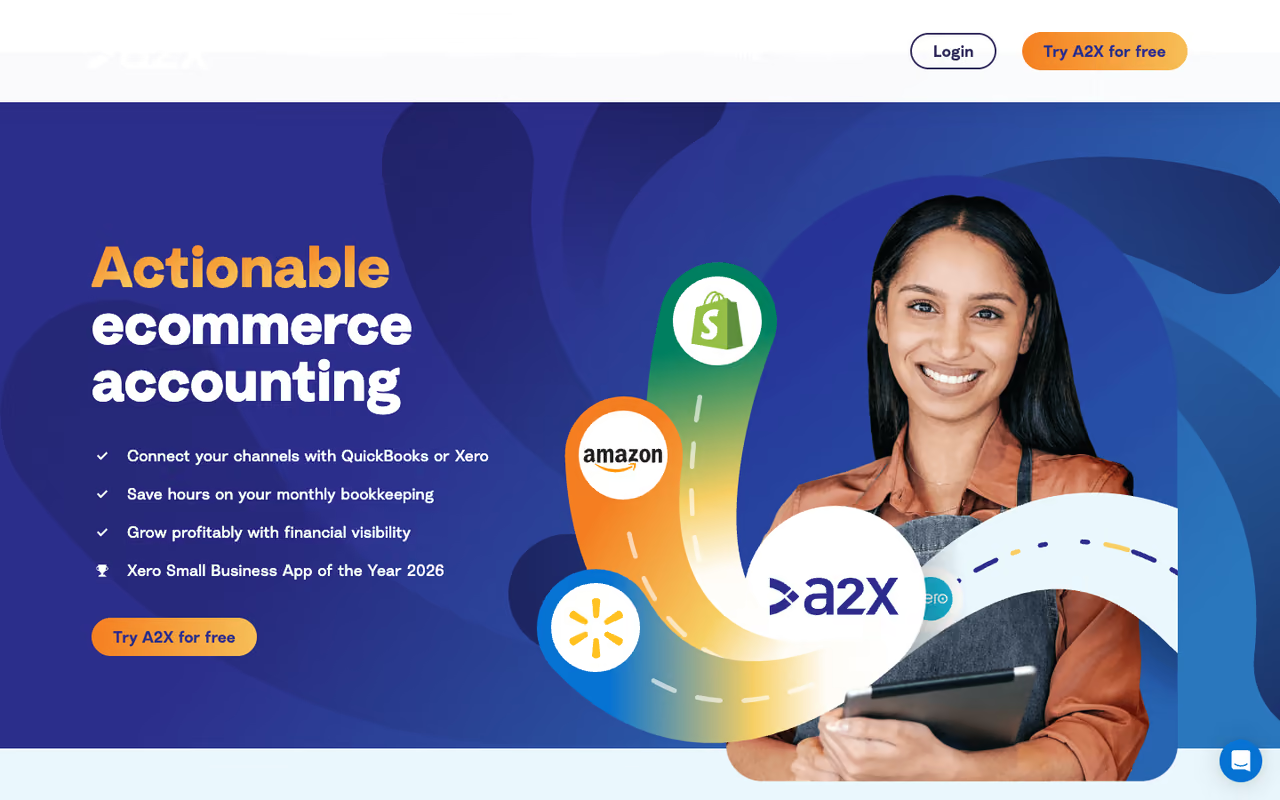
This is the tool that fixes the deposit-doesn't-match-sales problem. A2X pulls each Amazon, Shopify, Etsy, eBay, or Walmart settlement, breaks it into sales, refunds, fees, shipping, and tax, then posts a clean summary journal entry into QuickBooks, Xero, Sage, or NetSuite that reconciles exactly to the bank deposit. It also does accrual accounting and cost of goods sold properly, which matters the moment you want real margins instead of a rough net number.
Who it's best for: serious sellers and the accountants who serve them, especially anyone doing FBA where reimbursements and reserves get messy.
The reference standard for serious sellers and their accountants, especially FBA sellers, because its accrual and COGS accounting is the most rigorous in the category. Order-based pricing grows with you, and setup is daunting for a solo founder.
plans start at $29/mo per channel and climb by order volume up to around $1,039/mo for high-volume multi-channel setups, per A2X's pricing. Multiple marketplaces mean stacking channel fees.
The standout: the accrual + COGS accounting is the most rigorous in this category. If you care about month-by-month margin accuracy, A2X is the reference standard, which is why so many ecommerce bookkeepers default to it.
The catch: order-based pricing means your bill grows as you succeed, and adding channels multiplies the cost fast. A three-marketplace seller can easily pay several hundred dollars a month here on top of the ledger. Setup also has a learning curve. You're configuring tax mappings and ledger accounts, which is fine for an accountant but daunting for a solo founder.
If you're building the rest of your AI and ops stack while you set this up, Dupple X bundles the tools founders lean on day to day. Worth a look once your books are sorted.
Link My Books: the cheaper A2X alternative
Link My Books does the same core job as A2X, connecting Amazon, Shopify, TikTok Shop, eBay, Walmart, WooCommerce, Square, and Etsy to Xero or QuickBooks, and posting summary entries that reconcile to your payouts. The pitch is simpler pricing and faster setup, with guided tax wizards that hold your hand through the part most people get stuck on.
Who it's best for: sellers who want A2X-style accuracy without A2X's per-channel price escalation, and founders setting it up themselves.
Pick Link My Books for A2X-style accuracy without per-channel price escalation, with guided tax wizards and faster setup. It supports fewer destinations (no Sage or NetSuite), and its COGS handling is less deep for complex inventory.
flat monthly tiers by order volume, roughly $21/mo (Starter, 200 orders) up to $136/mo (15K orders) and beyond, per Link My Books' pricing. Note prices nudged up on July 1, 2026.
The standout: at higher order volumes it's usually cheaper than A2X, and the onboarding is genuinely quicker. The benefit-cost analysis in the app even shows the fees it's recovering for you.
The catch: it supports fewer accounting destinations than A2X. No native Sage or NetSuite, so enterprise-leaning shops are out. The COGS handling, while solid, isn't quite as deep as A2X's for complex inventory scenarios. For most small-to-mid sellers that difference won't matter, but it's real.

Synder: built for payment-platform chaos
Synder takes a different angle. Instead of batching settlements like A2X, it can sync individual transactions from Stripe, PayPal, Square, Shopify, Amazon, Etsy, and 30-plus other sources into QuickBooks, Xero, or Sage Intacct. If your revenue comes through a tangle of payment processors and subscription billing, Synder is built for exactly that mess.
Who it's best for: multi-channel sellers and SaaS-flavored ecommerce with lots of Stripe and PayPal volume.
Built for multi-channel and SaaS-flavored sellers with lots of Stripe and PayPal volume, syncing individual transactions from 30-plus sources. It can bloat your ledger with line items, and pure marketplace sellers keep cleaner books with a summary approach.
$65/mo (Basic, 500 transactions), $115/mo (Essential, 3,000 transactions, unlimited integrations), and $275/mo (Pro, 50,000 transactions), with a 15-day free trial and no card required, per Synder's pricing.
The standout: per-transaction detail and the widest payment-platform coverage here. It also does smart reconciliation that catches duplicates across overlapping sources.
The catch: per-transaction sync can bloat your ledger with thousands of line items, which some accountants hate. Pricing is transaction-capped, so a busy month can push you into the next tier. For pure marketplace sellers, A2X or Link My Books' summary approach usually keeps cleaner books.
Zoho Books: the budget pick that's actually good
Zoho Books is the value play. It's genuinely free for businesses under $50,000 in annual revenue, and the paid tiers undercut QuickBooks and Xero while still covering inventory and international transactions. If you already live in the Zoho ecosystem (CRM, Inventory, Commerce), it all connects.
Who it's best for: cost-conscious small sellers, and anyone already using other Zoho apps.
The budget pick that's actually good, free under $50K revenue with paid plans that undercut QuickBooks and Xero. The connector ecosystem is thinner, and A2X and Link My Books don't post into it.
Free ($0, under $50K revenue), Standard ($20/mo), Professional ($50/mo), with higher Premium and Elite tiers, per Zoho's pricing. Annual billing knocks roughly 20% off. The Elite tier ($150/mo) targets inventory-heavy ecommerce.
The standout: the free tier is real, not a trial, and the paid plans are the best price-to-feature ratio in this list.
The catch: the third-party connector ecosystem is thinner than QuickBooks or Xero. A2X and Link My Books don't post into Zoho Books, so your marketplace settlement options are more limited, and you'll lean on Zoho's own tools. Outside the Zoho world, finding a bookkeeper who knows it well is harder.

Wave: free, for when you're just starting
Wave is where I'd point someone running a side hustle or pre-revenue store who needs clean books without a monthly bill. The core accounting (invoicing, expense tracking, bank connections, reports) is free, and it's perfectly capable for low-volume sellers.
Who it's best for: solopreneurs, side projects, and stores doing under a few thousand dollars a month.
Where I'd point a side hustle or pre-revenue store that needs clean books without a monthly bill. It has no real inventory or COGS tracking and no marketplace connector, so you'll outgrow it within a quarter or two of real volume.
free Starter plan, or Pro at $16/mo for auto-imported bank transactions and multiple users, per Wave's pricing. Payment processing runs 2.9% + $0.60 per card transaction, so factor that in if customers pay invoices online.
The standout: you genuinely pay nothing to keep books. For a brand-new store testing product-market fit, that's the right call.
The catch: Wave doesn't do real inventory or COGS tracking, and there's no marketplace connector. Once you're moving meaningful volume across channels, you'll outgrow it within a quarter or two. Think of Wave as a starting point, not a destination.
NetSuite: ERP for when you've made it
NetSuite isn't accounting software so much as a full ERP, and I only recommend it for ecommerce companies past roughly $5M in revenue, especially multi-entity or multi-warehouse operations. It unifies financials, inventory, order management, and ecommerce in one system, with real-time reporting and multi-currency baked in.
Who it's best for: larger, complex operations that have outgrown QuickBooks and Xero entirely.
An ERP for ecommerce companies past roughly $5M in revenue, especially multi-entity or multi-warehouse operations that have outgrown QuickBooks and Xero. Cost and complexity are high, and anyone smaller is better off with QuickBooks plus A2X.
there's no public price list. Real-world estimates from ERP Research put base platform fees around $999 to $5,000/mo plus roughly $99 to $199 per full user per month, before implementation. A mid-market rollout can run $10K+/mo all in.
The standout: one source of truth across finance, inventory, and ecommerce. At scale, killing your patchwork of separate tools is worth real money.
The catch: cost and complexity. Implementation alone can take months and cost tens of thousands of dollars, and you'll likely need a consultant. For anyone under a few million in revenue, NetSuite is overkill. The QuickBooks-plus-A2X stack does the job for a fraction of the price.
How to choose without overthinking it
Start with your revenue and channels, not the feature list.
Under $50K and one channel: Wave (free) or Zoho Books free tier. Don't pay for tooling you don't need yet.
$50K to $5M selling on marketplaces: this is the sweet spot for the two-part stack. Pick QuickBooks Online (US, want maximum support) or Xero (international, big team), then add a connector. Choose A2X if accrual and COGS precision matter most, or Link My Books if you want lower cost at volume and faster self-setup. If your revenue runs through many payment processors, Synder instead.
Over $5M, multi-entity, multi-warehouse: NetSuite, and budget for implementation.
One rule that saves people from buyer's remorse: never connect a marketplace directly to your ledger. The connector isn't optional. It's the whole reason your books will be accurate. Spending $30 to $150 a month on A2X or Link My Books is cheaper than the hours your accountant burns cleaning up raw deposits, and far cheaper than filing taxes on numbers that are quietly wrong.
If you're assembling the rest of your founder toolkit alongside your accounting setup, Dupple X is worth a look. And if you want to compare more options, our top tools directory and guides like the best AI tools for small business and the best AI agents cover adjacent parts of the stack.
FAQ
What is the best accounting software for Shopify sellers?
For most Shopify sellers, QuickBooks Online or Xero as the ledger plus A2X or Link My Books as the connector. Shopify Payments, gift cards, and discounts create reconciliation gaps that a connector cleans up automatically. If you're tiny and just starting, Wave's free plan handles basic Shopify bookkeeping fine.
Do I really need a connector like A2X or can I just use QuickBooks?
You need the connector if you sell on marketplaces. QuickBooks alone imports a single net deposit from Amazon or Shopify, which hides your true revenue, fees, and COGS and makes accurate margins impossible. A2X or Link My Books breaks each settlement into proper journal entries that reconcile to the penny. Direct-to-consumer stores with simple Stripe checkouts can sometimes skip it.
How much should ecommerce accounting software cost per month?
Budget two line items. A ledger (QuickBooks $38 to $115/mo or Xero $25 to $90/mo for most sellers) plus a connector ($21 to $150/mo depending on order volume). So a realistic all-in range is $60 to $250 a month for a small-to-mid ecommerce business. Side hustles can run on Wave or Zoho's free tier for $0.
What is the best accounting software for Amazon FBA sellers?
A2X is the common favorite for FBA because it handles the messy parts well: reserves, FBA reimbursements, and the gap between order date and payout date through proper accrual accounting. Link My Books is a strong, often cheaper alternative. Pair either with QuickBooks Online or Xero as your ledger.
Is Xero or QuickBooks better for ecommerce?
QuickBooks wins on US support, the app ecosystem, and sales tax. Xero wins on price for teams (unlimited users on every plan) and international selling (native multi-currency). If you're US-based and plan to hire a bookkeeper, lean QuickBooks. If you have a growing team or sell across countries, lean Xero. Both need a settlement connector either way.
Can I use free accounting software for my online store?
Yes, if you're small. Wave's core accounting is genuinely free, and Zoho Books is free under $50,000 in annual revenue. Both work for low-volume stores. The limits show up with inventory, COGS, and marketplace reconciliation, where you'll eventually need a paid ledger plus a connector. Treat free as a starting point.
Related guides
Some offers on this page may be paid placements or contain affiliate links.
Across our whole catalogue the median is $24 a month and 33% of tools advertise a free tier. Figures are the lowest recurring monthly price quoted in our own review of each tool, read on 2026-08-19. Full method and every category.
