
The 9 Best AI Agents in 2026 (Compared and Ranked)

Key facts9 tools compared: Claude Code, Manus, n8n, Cursor, ChatGPT Agent, LangGraph, CrewAI, Devin…
- 9 tools compared: Claude Code, Manus, n8n, Cursor, ChatGPT Agent, LangGraph, CrewAI, Devin, Perplexity Comet
- Claude Code (best for: Engineering work in the terminal): From $20/mo
- Manus (best for: Open-ended general tasks): From $20/mo
- n8n (best for: Repeatable agentic workflows): Free self-hosted / €24/mo cloud
- Cursor (best for: In-editor coding speed): From $20/mo
The phrase "AI agent" got stretched to mean almost nothing in 2025. Every chatbot with a function call slapped the word on its landing page. By 2026 the gap between marketing and reality has finally narrowed, and a handful of agents actually do what the brochures promised: take a goal, plan the steps, use tools, and come back with finished work instead of a wall of suggestions.
I compared the main contenders on documentation, benchmarks, and public user reports: how each one handles a task like refactoring a codebase, pulling competitor pricing into a spreadsheet, or running a multi-step lead pipeline unattended. Some hold up on jobs like that. Others are reported burning through credits, hallucinating a file path, and quitting halfway.
If you want the short answer: Claude Code is the agent I trust most for anything technical, and Manus is the one I reach for when I want a general-purpose worker to handle a fuzzy, open-ended task. The rest of this list covers the agents worth knowing depending on what you actually need to get done. This is written for founders, operators, marketers, and developers who want to ship work, not read another think-piece about AGI.
One newer name worth watching is Hermes Agent, Nous Research's open-source agent that keeps a single persistent memory across Telegram, Slack, email, and the CLI.
Quick comparison
| Tool | Best for | Price | Standout |
|---|---|---|---|
| Claude Code | Engineering work in the terminal | From $20/mo | Depth on large, messy codebases |
| Manus | Open-ended general tasks | From $20/mo | Runs full jobs from one prompt |
| n8n | Repeatable agentic workflows | Free self-hosted / €24/mo cloud | Visual builder, you own the data |
| Cursor | In-editor coding speed | From $20/mo | Fast inline agent inside the IDE |
| ChatGPT Agent | Web tasks for non-developers | $20 (Plus) / $200 (Pro) | Browses and clicks for you |
| LangGraph | Custom production agents | Free OSS / paid cloud | Graph control over agent state |
| CrewAI | Multi-agent Python systems | Free OSS / $25/mo | Role-based agent crews |
| Devin | Hands-off async coding | From $20/mo | Works tickets without you watching |
| Perplexity Comet | Research inside a browser | Free | Agentic actions across your tabs |

Claude Code: the agent I trust with real code
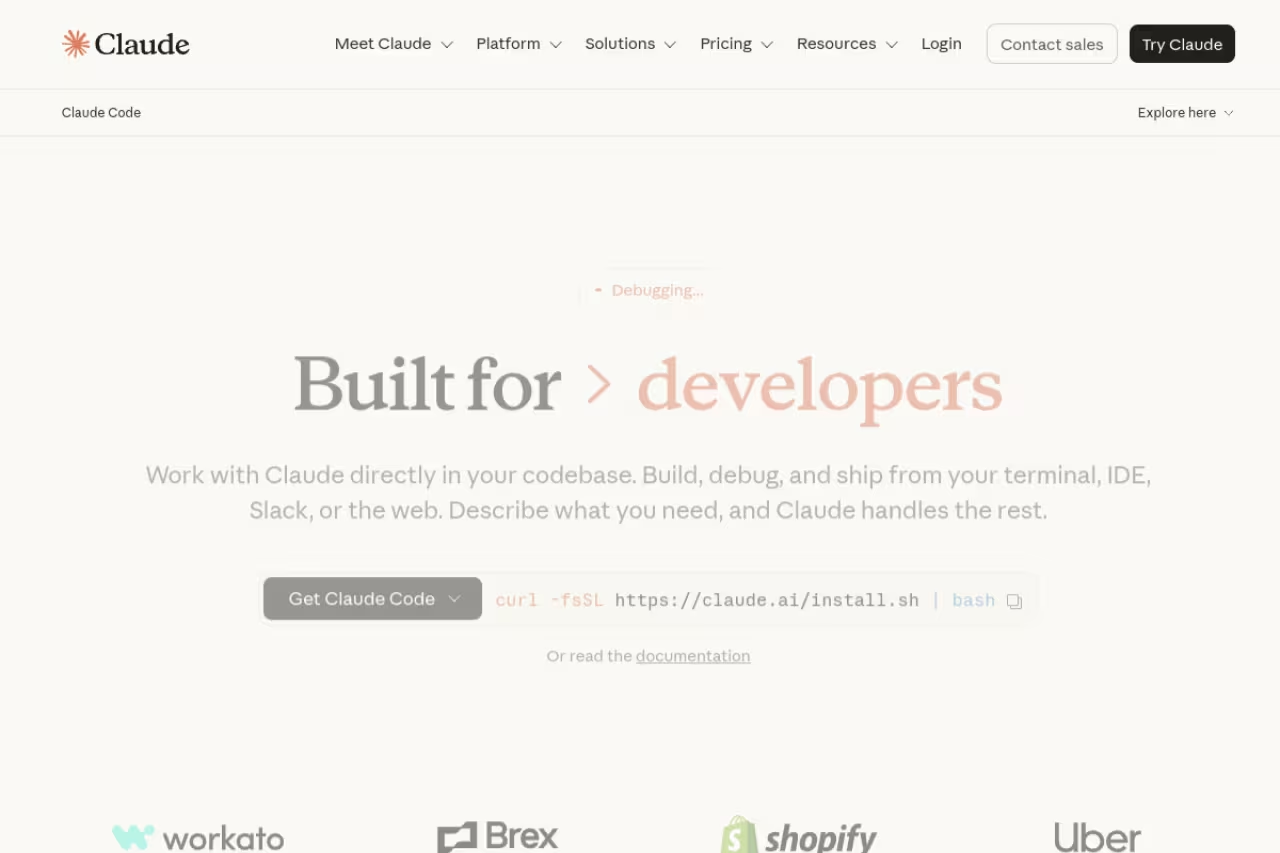
Claude Code is Anthropic's terminal-first coding agent. You point it at a repository, describe what you want, and it reads files, edits them, runs tests, and iterates until the task is done. No editor lock-in, no special UI. It lives in your shell and plugs into whatever you already use.
The agent I trust with real code, for developers on real projects rather than toy scripts. It holds context across a 40-file change, but usage limits bite on the $20 plan and the terminal-native setup frustrates anyone wanting a graphical IDE.
Where most agents lose the plot on a 40-file change, Claude Code holds context, traces the dependency chain, and makes edits that actually fit the existing style. On the SWE-bench Verified benchmark, Claude's models have stayed at the top of the autonomous-coding leaderboard through 2026.
Pricing is tied to your Claude subscription, not a separate bill. It's $20/month on Pro, $100/month on Max 5x, and $200/month on Max 20x, with the heavier plans giving you far more usage before you hit limits. Power users running it all day tend to land on Max 20x or move to pay-per-token via the API.
The standout is depth. It handles ambiguity better than anything else on this list. Give it a vague bug report and it'll investigate before it acts.
The catch: usage limits bite hard on the $20 plan if you run long sessions, and you'll get throttled mid-task more than you'd like. It's also terminal-native, so if you want a polished graphical IDE experience, you'll feel the friction. For a deeper breakdown, see our guide to the best AI coding agents.

Manus: the closest thing to a general worker
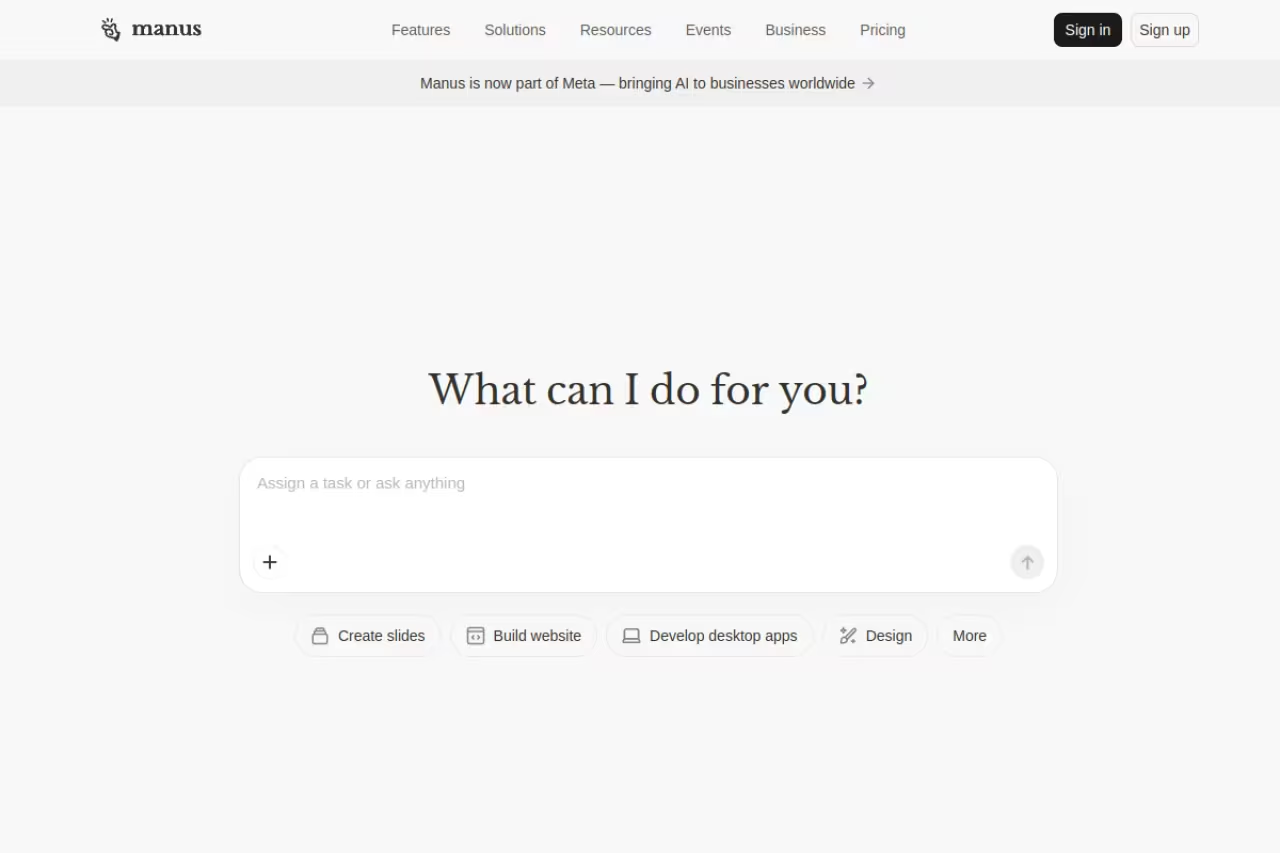
Manus is a general-purpose autonomous agent. You give it one prompt, and it plans the subtasks, browses the live web, writes and runs code, analyzes data, and hands back a finished deliverable. It's the agent that comes closest to "go do this thing for me" working the way you'd hope.
The closest thing to a general worker for open-ended jobs that cross tools, like researching a market and building the spreadsheet. The credit model makes costs unpredictable, credits do not roll over, and it is slower than a focused tool on narrow jobs.
Tasks that would take you an afternoon of tab-switching.
Pricing runs on credits. The free plan gives 300 daily refresh credits, Standard is $20/month for 4,000 credits, Customizable is $40/month for 8,000, and Extended is $200/month for 40,000. Simple chats cost 5 to 15 credits; a heavy overnight research agent can chew through 5,000 to 20,000 in a single run, so budgeting matters.
The standout is autonomy. It genuinely runs the whole job without you babysitting each step, and the deliverable is usually something you can use, not a draft you have to rebuild.
Where it falls short: the credit model makes costs unpredictable, and credits don't roll over month to month. A few complex tasks can drain a Standard plan fast. It's also slower than a focused tool when the job is narrow. If you mostly need agents that run a defined process, look at platforms instead, which I cover in our best AI agent platforms rundown.

n8n: agents you actually own
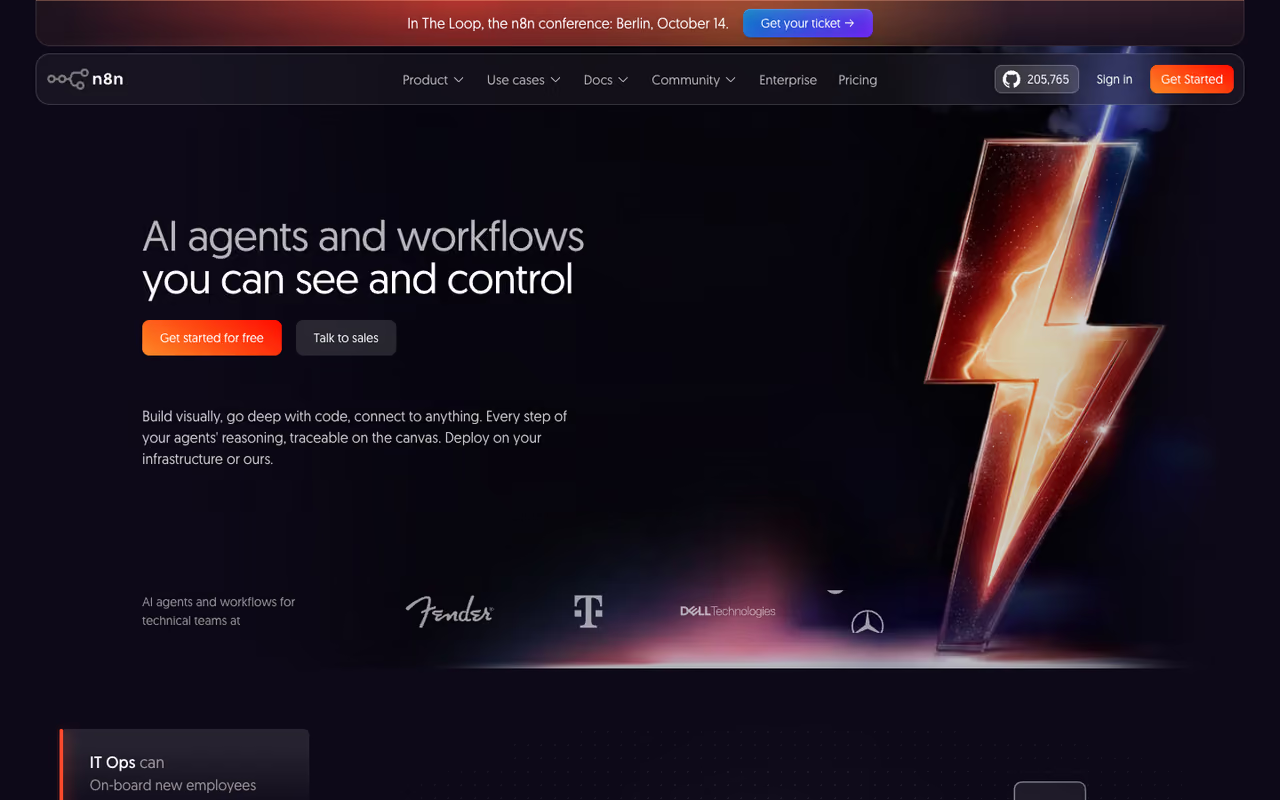
n8n is a visual workflow automation tool that turned into one of the most practical ways to build AI agents. You drag nodes onto a canvas, wire up an AI agent node, connect it to tools and data sources, and you've got a repeatable agentic process that runs on a trigger or a schedule.
It's best for operators and technical marketers who want agents tied to real business workflows: enrich every new signup, triage support tickets, monitor a feed and act on it. The kind of thing that should run forever without you in the loop.
The big draw is ownership. The Community Edition is free and self-hostable, which usually means $5 to $20/month for a small VPS and zero per-execution fees. Cloud plans start at €24/month for the Starter (2,500 executions), with Pro at €60/month for 10,000. n8n bills per execution, so a 20-step AI workflow costs the same as a 2-step one. As of 2026 there are no active-workflow limits on any plan.
The standout is the 70-plus AI nodes built on LangChain, plus connections to 12+ LLM providers including OpenAI, Anthropic, Gemini, and local models through Ollama. You're not locked to one brain.
The catch: it's more builder than agent. You design the logic; it won't improvise the way Manus does. Self-hosting also means you own the maintenance, updates, and the 3am pager when something breaks.
The practical way to own your agents if you are an operator or technical marketer tying them to real business workflows, with a free self-hostable Community Edition. It is more builder than agent, and self-hosting means you carry the maintenance.
If you're assembling a stack of these to run your day-to-day, Dupple X tracks the agents and AI tools worth your attention so you're not testing every new launch yourself.

Cursor: the fastest agent inside your editor
Cursor is a fork of VS Code where the AI is a first-class citizen instead of a bolted-on extension. Its agent can plan and execute multi-file changes, but the real appeal is speed: inline edits, tab completions, and an agent that feels woven into how you already write code.
Pick Cursor if you want agentic help without leaving your editor and value flow over hands-off autonomy. It is fast for tight feedback loops, but it is not built for handing off a ticket and walking away.
You stay in the driver's seat and the agent works alongside you.
Pricing is a free Hobby tier, then $20/month for Individual (extended agent limits, frontier models, MCPs, cloud agents) and $40/user/month for Teams with shared context and SSO. Heavy users sometimes hit credit ceilings on the $20 plan and upgrade for the larger pool.
The standout is responsiveness. For tight feedback loops, it's faster than a terminal agent because you see and accept changes inline.
Where it falls short: for fully hands-off work that runs without you, Cursor isn't built for that. It shines when you're actively coding, not when you want to hand off a ticket and walk away. See our best AI coding assistant comparison for how it stacks up against Copilot.
ChatGPT Agent: web tasks for everyone else
ChatGPT's agent mode (formerly Operator) lets the model browse the web, click through sites, fill forms, and complete multi-step tasks on your behalf. It's the most accessible agent here because it lives inside an app millions already pay for.
The most accessible agent here for non-developers who want structured web work handled inside an app they already pay for. It gets shaky on fuzzy or visually complex tasks, and the good limits sit behind the $200 Pro tier.
Agent mode comes with ChatGPT Plus at $20/month, with far higher limits on Pro at $200/month (up to 400 tasks a month). For autonomous coding specifically, OpenAI's Codex agent runs on the same plans and hits 85.5% task completion on SWE-bench with GPT-5-Codex.
The standout is reach. If you already live in ChatGPT, agentic actions are right there with no new tool to learn.
The catch: it's reliable on structured tasks with predictable steps and gets shaky on anything fuzzy or visually complex. The good limits are gated behind the $200 Pro tier, which is steep if web automation is occasional.
LangGraph: when you build the agent yourself
LangGraph is LangChain's framework for building agents as graphs, where you control the state, the branches, and how the agent moves between steps. It's not a product you chat with; it's the infrastructure you write production agents on top of.
The layer to reach for when an off-the-shelf agent will not cut it and engineering teams need reliable, debuggable, version-controlled logic. It is code with a real learning curve, so the wrong tool for a team without engineering bandwidth.
When an off-the-shelf agent won't cut it and you need full control over the logic, this is the layer you reach for.
The open-source library is MIT-licensed and free forever. Production usually adds LangSmith for observability (free dev tier with 5,000 traces, Plus at $39/user/month for 100,000) plus LangGraph Cloud deployment. A realistic production setup lands around $175 to $375/month once you add moderate LLM costs.
The standout is control. The graph model makes agent behavior inspectable, so you can see exactly where a run went wrong and fix it.
Where it falls short: it's code, with a real learning curve. You're building, not buying. For a team without engineering bandwidth, it's the wrong tool. We go deeper in our best AI agent frameworks guide.

CrewAI: agents that work as a team
CrewAI is an open-source Python framework for orchestrating multiple agents that play distinct roles and collaborate on a task. You define a researcher, a writer, and an editor, give each a goal, and they hand work between each other.
A role-based framework for developers who want something lighter than LangGraph to start building multi-agent systems. The multi-agent pattern adds overhead that a single well-prompted agent often avoids, and it is Python-only.
The framework is MIT-licensed and free. The managed platform adds a Professional tier at $25/month and custom enterprise pricing. CrewAI has real traction: 47.8k GitHub stars and around 2 billion agent executions powered in the prior year as of early 2026.
The standout is the role abstraction. Thinking in crews maps naturally to how you'd split work among people, which makes complex orchestration easier to reason about.
The catch: the multi-agent pattern adds overhead, and for many jobs a single well-prompted agent does the same work with less coordination cost. It's also Python-only, so it's developers-only.
Devin: the async coding agent
Devin is Cognition's autonomous software engineer. You assign it a ticket and it works asynchronously, opening a pull request when it's done, the way you'd delegate to a junior engineer. After Cognition acquired Windsurf, Devin gained an IDE alongside the cloud agent, and that editor has shipped as Devin Desktop since June 2026.
The async option for teams that want to offload well-scoped, repetitive engineering like dependency bumps and small fixes, then just review the PR. It struggles with ambiguous, architecture-level work, so it is a delegation tool, not senior judgment.
Pricing is Free for light use, Pro at $20/month, Max at $200/month for much higher quotas, and Teams at $80/month base plus $40 per developer seat. The 2.0 release dropping the entry price to $20 made it far easier to try.
The standout is true hands-off async work. You don't watch it; you review the PR.
Where it falls short: it does best on bounded, clearly-defined tasks and struggles with ambiguous, architecture-level work. Hand it something underspecified and the output needs heavy review. It's a delegation tool, not a replacement for senior judgment.
Perplexity Comet: the agentic browser
Comet is Perplexity's AI browser, and in 2026 it went free across iOS, Android, Windows, and Mac. The agent knows which tab you're on, can act across your tabs, and runs multi-step research tasks. The March 2026 update lets Deep Research generate finished deliverables (slides, spreadsheets, dashboards) directly from a prompt.
A strong fit for research-heavy, browser-centric people like analysts and marketers who live in 30 open tabs, since the agent acts on what you are actually viewing. Adopting it means switching your default browser, and it is lighter than Manus as a pure agent.
The browser is free. Comet Plus is a $5/month add-on for premium publisher content, included for Pro and Max subscribers. The jump is notable because Comet launched in 2025 as a $200/month product.
The standout is context. Because the agent sits in the browser, it acts on what you're actually looking at, not a fresh blank prompt.
The catch: it's a browser first, so adopting it means switching your default browser, which is a real ask. As a pure autonomous agent it's lighter than Manus. For more, see our best AI browser breakdown.
How to choose
Skip the feature matrices. Pick based on the work in front of you.
If the work is code, your default is Claude Code for depth, Cursor if you want speed inside your editor, or Devin when you want to delegate tickets and review PRs later. Most engineers end up using two of these for different moods.
If the work is a one-off, fuzzy task, Manus is the pick. It improvises across tools and hands back a deliverable. ChatGPT Agent is the cheaper, more accessible option when the task is clearly structured web work.
If the work is a repeatable process that should run forever, you want n8n. Build it once, own the data, let it run. Reach for LangGraph or CrewAI only when you have engineers and the off-the-shelf version isn't enough.
If the work is research, Comet if you live in the browser, Manus if you want a packaged report.
One honest note: most people overbuy. You don't need a multi-agent framework to enrich some leads. Start with the simplest agent that fits, and graduate up only when you hit a real wall.
FAQ
What is the best AI agent in 2026?
For technical work, Claude Code is the strongest agent on this list, holding context across large codebases better than anything else. For general open-ended tasks, Manus comes closest to a true autonomous worker. The "best" depends on the job: there's no single winner across coding, automation, and research.
What is the difference between an AI agent and a chatbot?
A chatbot responds to messages. An AI agent takes a goal, plans the steps, uses tools (browsing, code, APIs), and acts to complete the task with minimal supervision. The agent does work; the chatbot gives answers. The line blurs because most agents are built on the same underlying models as chatbots.
Are there free AI agents worth using?
Yes. n8n's Community Edition is free to self-host, Perplexity Comet is fully free, and Manus, Cursor, Devin, and ChatGPT all have free tiers with light usage. The free tiers are enough to evaluate whether an agent fits before you pay for higher limits.
How much do AI agents cost per month?
Entry pricing clusters around $20/month for Claude Code, Cursor, Manus, Devin, and ChatGPT Plus. Heavy users move to $100 to $200/month tiers. Credit-based agents like Manus can cost more or less depending on usage. Self-hosted n8n can run for $5 to $20/month in infrastructure alone.
Can AI agents replace developers or employees?
Not yet. The best agents handle well-scoped, repetitive tasks reliably and save real hours, but they still need human review on anything ambiguous or high-stakes. Treat them as force multipliers that take the grunt work, not autonomous replacements for judgment.
Which AI agent is best for non-technical users?
ChatGPT Agent and Manus are the most approachable. ChatGPT Agent lives inside an app most people already use and handles structured web tasks; Manus takes a plain-English prompt and returns a finished result. Neither requires writing code. For a broader view, our best AI assistant guide covers everyday options.
Ready to build a stack of agents that actually earns its keep? Start a Dupple X trial and skip the months of testing every new launch yourself.
Related guides
Some offers on this page may be paid placements or contain affiliate links.
