
Best Ecommerce CRM Software in 2026: 8 Tools I'd Actually Recommend

Key facts8 tools compared: Klaviyo, Omnisend, HubSpot, Drip, Zoho CRM, Pipedrive, Salesforce Starter…
- 8 tools compared: Klaviyo, Omnisend, HubSpot, Drip, Zoho CRM, Pipedrive, Salesforce Starter, Microsoft Dynamics 365
- Klaviyo (best for: DTC Shopify/Woo brands): Free, then ~$20/mo at 500 contacts
- Omnisend (best for: Small stores watching budget): Free, then $11.20/mo intro
- HubSpot (best for: Stores with a B2B/wholesale arm): Free, then $15/seat/mo
- Drip (best for: $1M-$50M retention-focused brands): $39/mo for 2,500 people
Most ecommerce founders buy a CRM to chase new customers. That's usually the wrong instinct. Acquiring a buyer now costs 5 to 7 times more than keeping one you already have, and roughly 65% of revenue in a mature store comes from repeat buyers, according to 2026 retention benchmarks. The CRM that pays for itself is the one that turns first-time orders into second and third orders.
That's the lens for this guide. An ecommerce CRM is not the same animal as a B2B sales CRM. You care less about deal pipelines and more about customer profiles tied to order history, abandoned-cart flows, segmentation by purchase behavior, and email plus SMS that fire automatically. Some tools on this list are built natively for that. Others are general CRMs that bolt on a store integration, which works for a wholesale sales team but feels clunky for a pure DTC brand.
If you run a Shopify or WooCommerce store and want one answer: start with Klaviyo. It's the closest thing to a purpose-built ecommerce CRM, and it's Shopify's official partner. If you sell B2B or wholesale alongside your store, skip down to HubSpot or Pipedrive. Here's the full breakdown, with real 2026 pricing and where each one falls short.
Quick comparison
| Tool | Best for | Starting price | Standout |
|---|---|---|---|
| Klaviyo | DTC Shopify/Woo brands | Free, then ~$20/mo at 500 contacts | Sub-200ms Shopify data sync |
| Omnisend | Small stores watching budget | Free, then $11.20/mo intro | SMS in the free plan |
| HubSpot | Stores with a B2B/wholesale arm | Free, then $15/seat/mo | Full CRM + marketing in one |
| Drip | $1M-$50M retention-focused brands | $39/mo for 2,500 people | Every feature unlocked, no gates |
| Zoho CRM | Custom workflows on a budget | Free (3 users), then $14/user/mo | Cheapest serious CRM |
| Pipedrive | Wholesale/B2B sales teams | $14/user/mo | Clean visual sales pipeline |
| Salesforce Starter | Stores that will scale to enterprise | $25/user/mo | Room to grow into the full platform |
| Microsoft Dynamics 365 | Mid-market and enterprise retail | ~$65/user/mo | Deep data + ERP integration |

Klaviyo: the default for DTC brands
If you've shopped from any indie brand recently, you've probably gotten a Klaviyo email without knowing it. It's the B2C CRM most DTC stores reach for, and for good reason. Klaviyo unifies customer data, then automates messaging across email, SMS, push and WhatsApp off the back of store behavior.
What sets it apart for ecommerce is the sync. Klaviyo is Shopify's official CRM partner, and store data lands in your profiles in under 200 milliseconds. That means an abandoned cart, a browsed product, or a placed order can trigger a flow almost instantly. The built-in customer data platform consolidates behavioral, transactional and profile data so your segments actually reflect how people shop.
Who it's best for: DTC brands on Shopify, WooCommerce or BigCommerce that live and die by retention and lifecycle email.
The default for DTC brands on Shopify, WooCommerce or BigCommerce that live on retention and lifecycle email, thanks to its near-instant store sync. Suppressed profiles still count toward your tier, so the bill can outrun the value below roughly $500K in GMV.
The free plan covers up to 250 active profiles, 500 monthly email sends, and 150 SMS credits. Paid email runs about $20/month at 500 contacts, $100 at 5,000, and $400 at 25,000, per Klaviyo's published tiers. SMS is billed separately on a credit system.
The catch: Suppressed and unengaged profiles still count toward your tier unless you actively clean your list, so costs creep up faster than you'd expect. At 25,000 profiles you're paying a clear premium over cheaper rivals. Klaviyo earns it once you're above roughly $500K in GMV. Below that, the bill can outrun the value.

Omnisend: the budget-friendly alternative
Omnisend covers most of what Klaviyo does (email, SMS, automation, segmentation, popups) for noticeably less money. It integrates cleanly with Shopify, WooCommerce, BigCommerce and Magento, so you're not boxed into one platform.
The pitch that keeps showing up here: Omnisend gives you multichannel features even on the free tier. SMS and unlimited segments are included from the start, where Klaviyo gates more behind paid plans.
Who it's best for: Small and mid-size stores that want serious automation without a Klaviyo-sized bill, especially below the $500K GMV mark.
Pick Omnisend for most of Klaviyo's email, SMS and automation at noticeably less money, especially for small and mid-size stores below the $500K GMV mark. Klaviyo still owns the deepest predictive analytics and the largest integration catalog.
Free covers 250 contacts and 500 monthly emails. The Standard plan is $11.20/month intro (regular $48) for 500 contacts and 6,000 emails, and Pro runs $41.30/month intro for unlimited emails, per Omnisend's pricing page. At 10,000 subscribers Omnisend lands around $132/month versus Klaviyo's $240, a real gap at scale.
Where it falls short: The deepest predictive analytics and the largest integration catalog still belong to Klaviyo. If you need granular AI-driven segmentation or a specific niche app integration, check Omnisend's directory before you switch.
HubSpot: the all-in-one if you also sell B2B
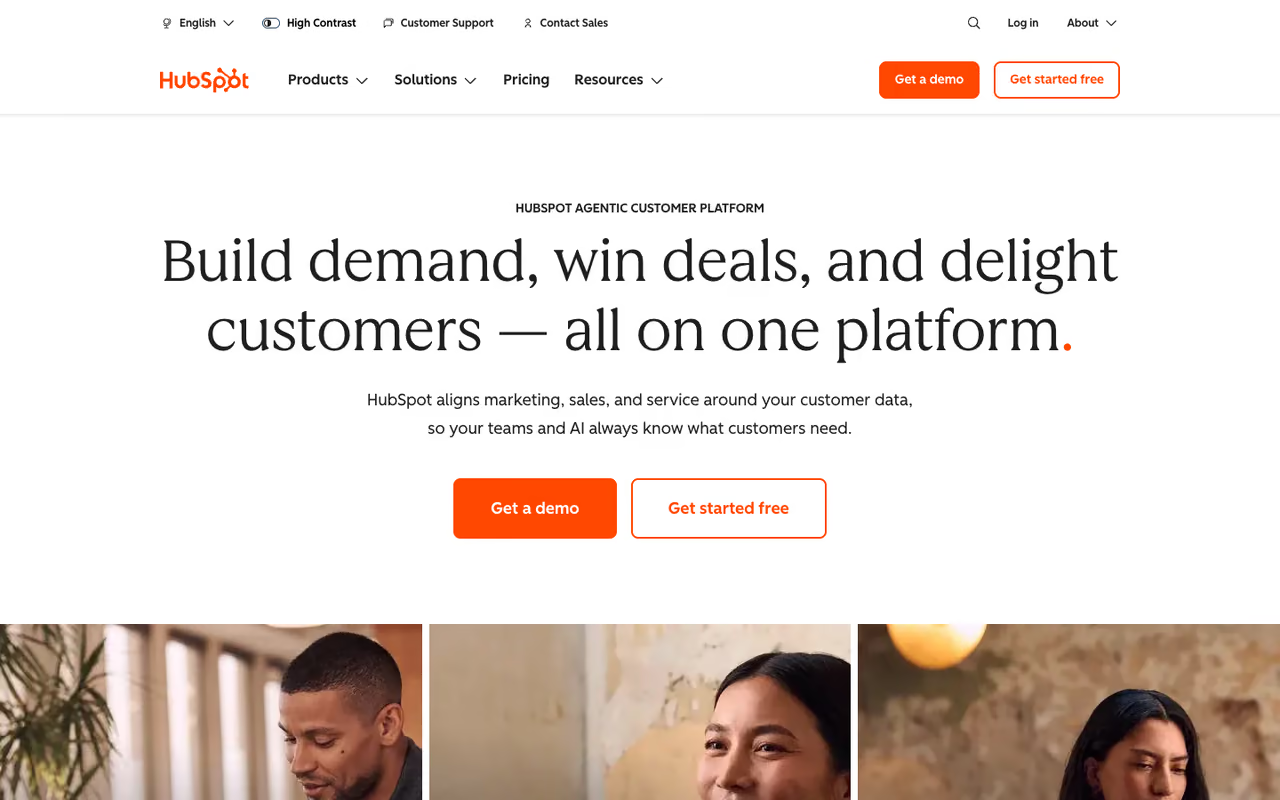
HubSpot is a real CRM first and a marketing tool second, which makes it the pick when your store has a sales side. If you take wholesale orders, handle B2B accounts, or have reps following up on high-value carts, HubSpot gives you a proper pipeline that Klaviyo and Omnisend don't.
The Shopify integration syncs contacts, products, orders and abandoned checkouts with configurable rules, so your store data feeds the same system your sales team works in. That single-source setup is the whole appeal.
Who it's best for: Stores with a B2B or wholesale arm, or any operator who wants CRM, marketing, sales and service under one login.
The all-in-one choice when your store has a B2B or wholesale arm, giving you a proper pipeline that Klaviyo and Omnisend don't. It is overkill for a small pure-DTC store, and costs jump once you want real marketing automation.
The free CRM covers up to 1,000 contacts and 2 users at no cost. Paid starts at $15/seat/month (Starter), $50/seat/month (Professional), and $75/seat/month (Enterprise), per HubSpot's pricing. Marketing Hub is priced separately and gets expensive fast.
The catch: The free tier is genuinely useful, but the moment you want real marketing automation, the cost jumps. HubSpot is overkill for a small pure-DTC store that just needs email flows. You'd pay for sales features you never touch.
Drip: built for retention, no feature gates
Drip calls itself an ECRM, an ecommerce CRM aimed squarely at B2C retailers. The thing I like most is the pricing philosophy: one plan, every feature unlocked from day one. No paying extra to access automation, no surprise upgrade walls.
It's strong on the retention plays that move the needle for a growing store: win-back campaigns, VIP nurturing, cross-sell flows, and granular segmentation through a visual workflow builder.
Who it's best for: Brands roughly between $1M and $50M in revenue on Shopify, WooCommerce or BigCommerce that want retention firepower without a steep learning curve.
Retention firepower with no feature gates, for brands between roughly $1M and $50M in revenue that want win-back and VIP flows without a steep learning curve. There is no free tier, and SMS support is not as deep as Klaviyo's.
Starts at $39/month for up to 2,500 people with unlimited email sends, scaling by contact count. A 14-day free trial runs without a credit card.
Where it falls short: There's no free forever tier, so the smallest stores get more runway from Omnisend. And while Drip nails email automation, its SMS and broader channel support isn't as deep as Klaviyo's. If multichannel is your priority, weigh that.
Zoho CRM: the most flexible budget option
Zoho CRM is the value play. It's a full-featured, highly customizable CRM that costs a fraction of Salesforce or HubSpot, and it plugs into the wider Zoho suite if you already use their tools. For a store that wants custom modules, workflow automation and reasonable pricing, it holds up well in 2026.
Who it's best for: Operators who want to bend a CRM to their exact workflow without paying enterprise rates, and teams already in the Zoho ecosystem.
The flexible budget option for operators who want to bend a CRM to their exact workflow, or teams already in the Zoho suite. Ecommerce integrations are less native than Klaviyo's, and expect a setup curve.
A free plan covers up to 3 users. Paid tiers are $14/user/month (Standard), $23/user/month (Professional), and $40/user/month (Enterprise) on annual billing, per Zoho's pricing. Monthly billing costs 20% to 30% more.
The catch: Zoho's ecommerce integrations aren't as native or instant as Klaviyo's Shopify sync. You'll often route store data through Zoho's connectors or a tool like Zapier, which adds a moving part. The interface also has more depth than a small DTC team usually needs, so expect a setup curve.

Pipedrive: for the wholesale sales team
Pipedrive isn't really an ecommerce marketing tool. It's a clean, visual sales pipeline CRM used by over 90,000 companies. I'm including it because plenty of stores have a genuine sales motion: wholesale buyers, B2B accounts, big-ticket inquiries that need a human to close. For that, Pipedrive is one of the easiest pipelines to run.
Who it's best for: Stores with a sales team managing wholesale or B2B deals alongside the storefront.
One of the easiest pipelines to run for stores with a sales team managing wholesale or B2B deals. The Shopify connection runs through Zapier, so it is the wrong tool for pure DTC retention.
Plans run $14/user/month (Essential), $29/user/month (Advanced), $59/user/month (Professional), $69/user/month (Power) and $99/user/month (Enterprise) on annual billing, per Pipedrive's pricing. Every tier has a 14-day free trial.
Where it falls short: The Shopify connection runs through Zapier, not a native integration, so store data sync is less tight than a purpose-built ecommerce CRM. For pure DTC retention, this is the wrong tool. Pair it with Klaviyo if you do both.
Salesforce Starter Suite: room to grow
Salesforce is the enterprise standard, and historically that meant expensive and complex. The Starter Suite changes the math for smaller stores. At $25/user/month it bundles sales, service, marketing and commerce tools with Slack included, and it's the on-ramp to the full Salesforce platform if you plan to scale hard.
Who it's best for: Ambitious stores that expect to outgrow a lightweight tool and want to start on infrastructure that won't cap out.
A room-to-grow pick for ambitious stores that expect to outgrow a lightweight tool, at $25/user/month with Slack included. Even Starter carries more conceptual overhead than Omnisend or Drip, so skip it if you never need enterprise CRM.
Starter Suite is $25/user/month, billed monthly or annually, per Salesforce's small business pricing. Moving up to the full Sales or Service clouds raises that significantly.
The catch: Even Starter carries more conceptual overhead than Omnisend or Drip. You're buying into the Salesforce way of doing things. If you have no intention of ever needing enterprise CRM, the simpler tools will get you there faster and cheaper.
Microsoft Dynamics 365: for mid-market retail
Microsoft Dynamics 365 is the heavyweight on this list, aimed at mid-market and enterprise retailers that need CRM tied into ERP, inventory and the broader Microsoft stack. If you're running a large multi-channel operation and already live in Microsoft 365, the data integration is hard to beat.
Who it's best for: Mid-market and enterprise retail with complex operations and existing Microsoft infrastructure.
The heavyweight for mid-market and enterprise retail that needs CRM tied into ERP, inventory and the Microsoft stack. For a small or mid-size DTC store it is wildly overpowered, and implementation usually means a consultant.
Sales modules start around $65/user/month and climb based on the apps you license. This is a platform investment, not an impulse buy.
Where it falls short: For a small or mid-size DTC store, this is wildly overpowered. Implementation usually means a consultant and a real project timeline. Don't reach for Dynamics unless your scale truly demands it.
How to choose the right one
Match the tool to your actual sales model, not the hype. Three questions cut through it:
Are you pure DTC or do you also sell B2B/wholesale? Pure DTC stores should start with a marketing-native CRM: Klaviyo, Omnisend or Drip. If you have a sales team closing wholesale or B2B deals, you need a pipeline CRM, so look at HubSpot or Pipedrive. Running both? Pair a marketing CRM with a sales one.
What's your revenue stage? Below roughly $500K GMV, Omnisend gives you the most for the least, and its free tier is a real starting point. Between $1M and $50M, Drip and Klaviyo earn their keep. Heading toward enterprise, Salesforce or Dynamics gives you somewhere to grow.
How much setup time do you have? Klaviyo and Omnisend are live in an afternoon. Zoho, Salesforce and Dynamics reward configuration but demand it. Be honest about whether you'll actually build out the workflows, because an unused CRM is just a line item.
For more on the retention side specifically, our guides to customer retention software and customer data platforms go deeper than I can here. If you're a smaller operation, the best CRM for small business roundup is worth a read too.
If you want our running shortlist of the tools we trust across categories, including marketing and CRM, Dupple X keeps it current so you're not re-researching every quarter.
FAQ
What is the best CRM for an ecommerce business?
For most DTC stores, Klaviyo is the strongest all-around ecommerce CRM thanks to its native Shopify sync and deep lifecycle automation. If your store also sells B2B or wholesale, HubSpot is the better fit because it pairs a real sales pipeline with store data. Budget-conscious small stores should start with Omnisend.
Is Shopify a CRM?
No. Shopify is an ecommerce platform that stores customer and order data, but it isn't a CRM. It lacks the segmentation, automation and lifecycle messaging that a dedicated CRM provides. Most stores connect Shopify to a CRM like Klaviyo or HubSpot to act on that data. You can compare options in our best CRM for ecommerce guide.
How much does ecommerce CRM software cost?
It ranges widely. Klaviyo and Omnisend offer free tiers and scale by contact count, with Klaviyo around $20/month at 500 contacts. General CRMs like Zoho start at $14/user/month and Pipedrive at $14/user/month. Enterprise platforms like Salesforce ($25/user/month and up) and Dynamics 365 (~$65/user/month) cost more but do more.
Do I need a CRM if I already use email marketing tools?
Often the line has blurred. Tools like Klaviyo, Omnisend and Drip are email marketing platforms and ecommerce CRMs at once, since they store unified customer profiles and order history. If you only run basic email blasts today, moving to one of these gives you CRM capabilities and better automation in the same tool. See our best AI email marketing tools roundup for the email-first angle.
What's the difference between an ecommerce CRM and a B2B CRM?
An ecommerce CRM is built around customer profiles, purchase behavior, and automated email/SMS retention flows tied to your store. A B2B CRM centers on deal pipelines, lead stages, and sales-rep workflows. Klaviyo and Drip are ecommerce-native, while Pipedrive and Salesforce lean B2B. HubSpot and Zoho can flex either way.
Which ecommerce CRM has the best free plan?
Omnisend has the most generous free tier for ecommerce, including SMS and unlimited segments at no cost (up to 250 contacts and 500 emails monthly). Klaviyo's free plan covers 250 profiles but limits advanced features. HubSpot's free CRM allows 1,000 contacts and is best if you need pipeline tools rather than marketing automation.
Related guides
Some offers on this page may be paid placements or contain affiliate links.
Across our whole catalogue the median is $24 a month and 33% of tools advertise a free tier. Figures are the lowest recurring monthly price quoted in our own review of each tool, read on 2026-08-19. Full method and every category.
