
Best AI Customer Support Tools (2026)

Key facts8 tools compared: Intercom Fin, Zendesk AI, Gorgias, Sierra, Decagon, Help Scout, Tidio…
- 8 tools compared: Intercom Fin, Zendesk AI, Gorgias, Sierra, Decagon, Help Scout, Tidio (Lyro), Crisp
- Intercom Fin (best for: All-round software/SaaS support): $0.99 per resolution
- Zendesk AI (best for: Teams already on Zendesk): $1.50-$2.00 per resolution + $50/agent
- Gorgias (best for: Shopify and ecommerce): $0.90 per resolution (annual)
- Sierra (best for: Enterprise, voice + chat): ~$150K-$350K/yr, outcome-based
Support volume goes up every year. Headcount does not. That gap is the whole reason this category exists, and in 2026 the tools that close it actually work. The AI agent in front of your help desk now resolves real tickets end to end, not just deflects them into a sad "did this help?" loop.
The catch is pricing. Almost every serious vendor moved to charging per resolved conversation, somewhere between $0.75 and $2.00 a pop, on top of your seat costs. That sounds cheap until you do the math on 3,000 tickets a month. So picking the right tool is less about which has the smartest model and more about which one matches your volume, your channels, and how much of your bill you can predict.
This guide compares the main players. If you want the short version: Intercom Fin is the best all-rounder for most software teams, Gorgias wins for Shopify stores, and if you're a Fortune 500 with a budget to match, Sierra and Decagon are the ones the big logos are buying. Here's how they stack up, and where each one bites you.
Quick comparison
| Tool | Best for | Price | Standout |
|---|---|---|---|
| Intercom Fin | All-round software/SaaS support | $0.99 per resolution | Works standalone on Zendesk/Salesforce too |
| Zendesk AI | Teams already on Zendesk | $1.50-$2.00 per resolution + $50/agent | Native to the biggest help desk |
| Gorgias | Shopify and ecommerce | $0.90 per resolution (annual) | Built around order/refund actions |
| Sierra | Enterprise, voice + chat | ~$150K-$350K/yr, outcome-based | Brand-grade agents at Fortune 50 scale |
| Decagon | Large enterprise, opaque needs | ~$50K+/yr platform fee | Deep customization, voice latency |
| Help Scout | Small teams that hate complexity | $25/user + $0.75/resolution | Clean inbox, AI you can ignore |
| Tidio (Lyro) | Small business chat automation | From $39/mo for 100 AI chats | Cheap entry point for storefronts |
| Crisp | Bootstrapped startups | From $45/mo per workspace | Flat-ish pricing, no per-seat tax |
Intercom Fin: the best default for most teams
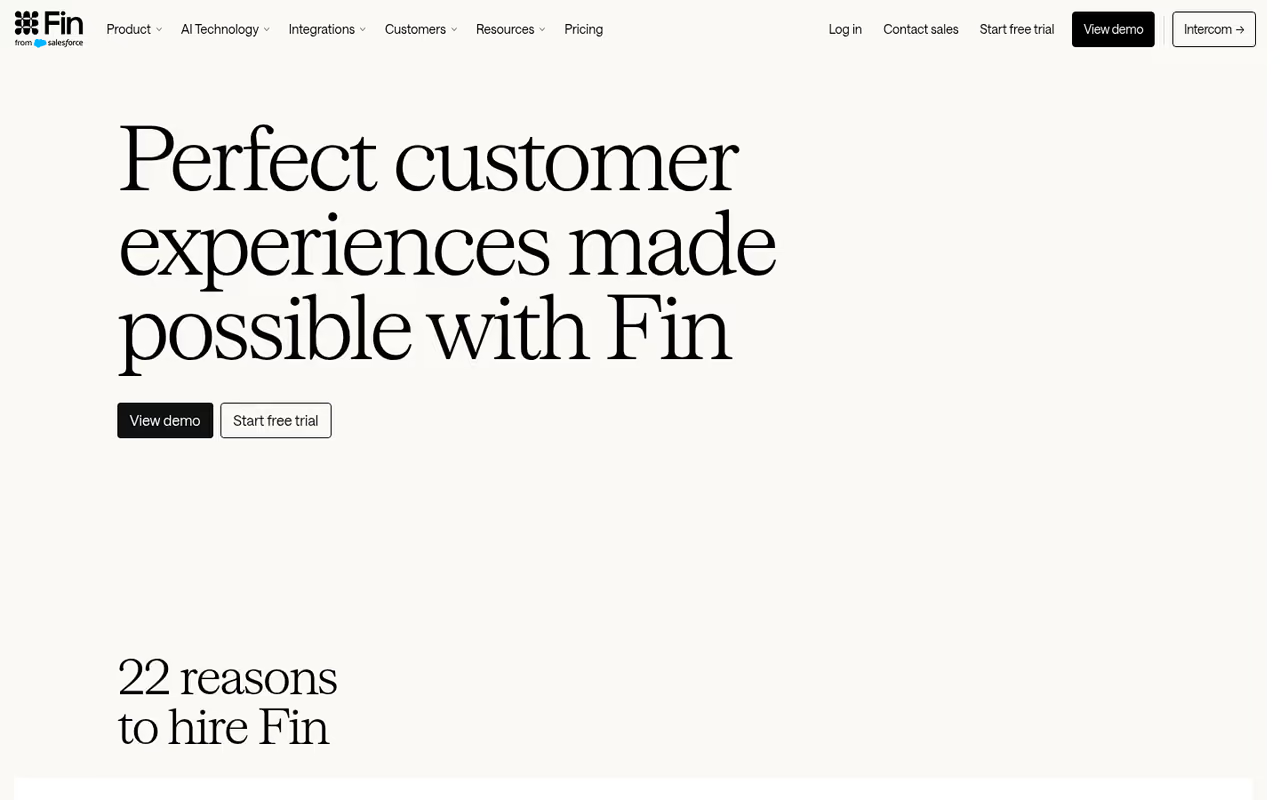
Fin is Intercom's AI agent, and it's the one I'd hand to most software companies without thinking too hard. It reads your help docs, past conversations and any connected sources, then answers customers in a way that genuinely sounds like a competent human rep. It also takes actions: issuing refunds, looking up orders, updating subscriptions, the stuff that used to require a person.
The default I'd hand most software companies, covering chat, email and in-app, with actions like refunds and order lookups. It can sit on top of Zendesk, Salesforce or HubSpot, but real resolution rates land around 42-50% and $0.99 per resolution adds up in busy months.
$0.99 per resolution, charged only when Fin actually closes the conversation. There's a 50-resolution monthly minimum ($49.50) if you run it standalone. Inside Intercom's help desk you also pay seats starting around $29/month. Intercom publishes the $0.99 outcome price right on its pricing page, which I appreciate.
The standout: Fin doesn't trap you in Intercom. You can bolt it onto Zendesk, Salesforce or HubSpot and keep your existing help desk. That portability is rare, and it's why Fin shows up on so many shortlists that started as "we need to replace Zendesk's bot."
The catch: real-world resolution rates land around 42-50%, not the rosy numbers in the demo. Budget for that. You pay $0.99 every time Fin resolves something, so a high-traffic month can get expensive fast, and the only way to know your true bill is to run it for a few weeks first.

Zendesk AI: the safe pick if you already live in Zendesk
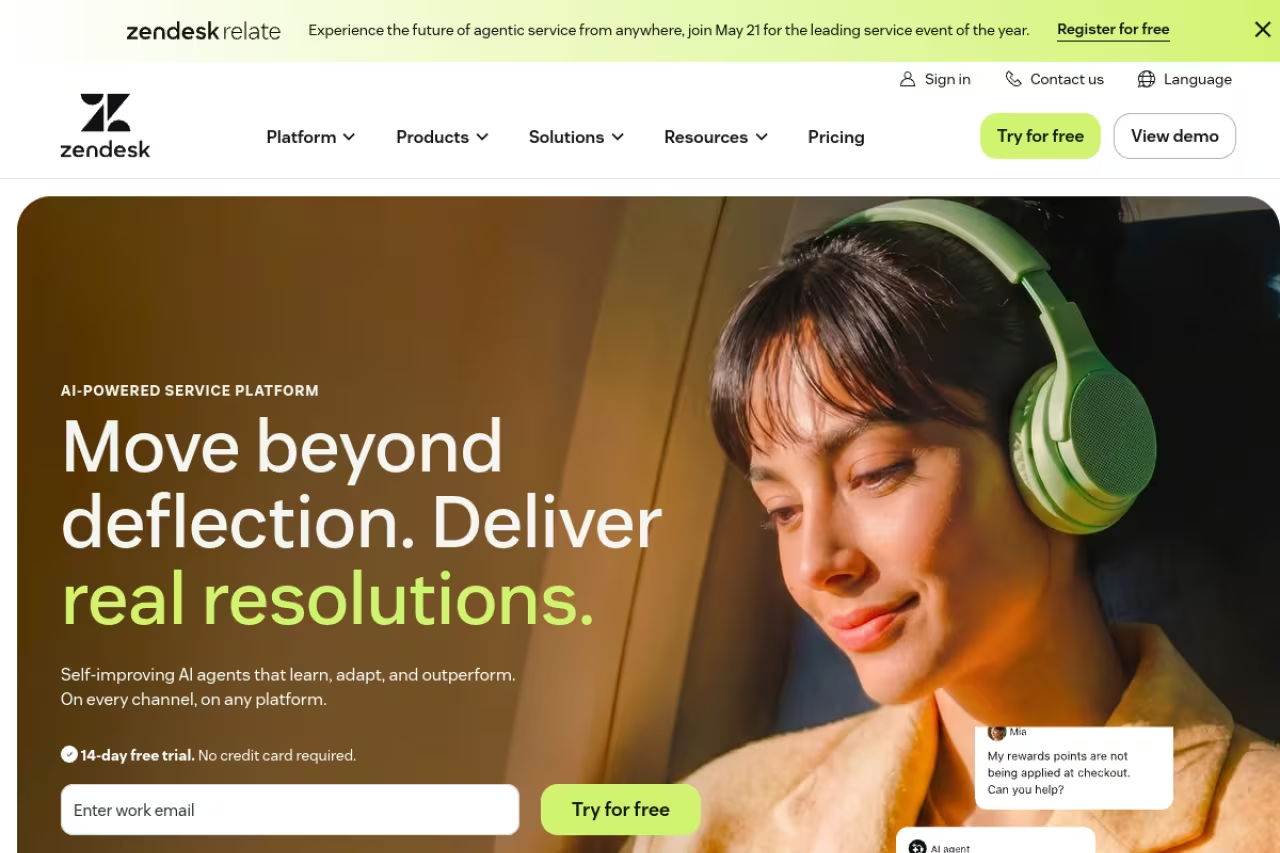
If your team already runs on Zendesk, its native AI agents are the path of least resistance. No new platform to learn, no data to migrate, and the AI plugs straight into the tickets, macros and workflows you've already built. For a lot of teams that "it's already here" factor outweighs everything else.
The path of least resistance if your team already runs on Zendesk, with native AI that triggers your existing automations and routing. Cost predictability is the problem, and at $2.00 pay-as-you-go it is the most expensive per outcome here.
This is where it stings. In 2026 Zendesk moved AI agents to outcome-based pricing: $1.50 per automated resolution on committed plans, $2.00 pay-as-you-go. That's on top of a Suite plan (Professional starts at $55/agent/month) and a $50/agent/month Advanced AI add-on. Each plan throws in a handful of free resolutions per agent, then the meter starts.
The standout: depth. Because the AI is native, it can trigger your existing automations, route by your existing rules, and report inside dashboards your team already reads. Nothing feels bolted on.
Where it falls short: cost predictability. A 20-agent team resolving 3,000 tickets a month realistically spends $6,000-$8,000 all-in once you stack the Suite plan, the AI add-on and per-resolution fees. At $2.00 a resolution pay-as-you-go, Zendesk is the most expensive per-outcome option on this list.

Gorgias: the ecommerce specialist
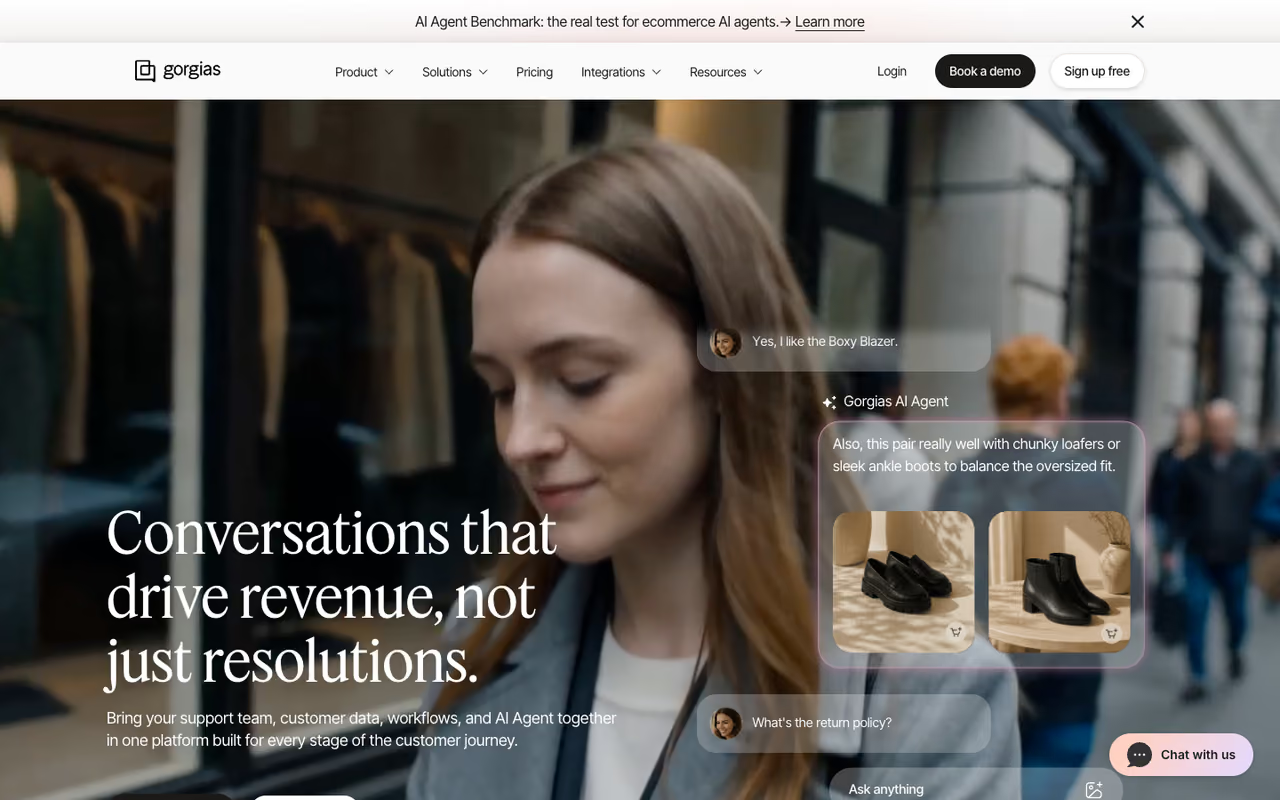
Gorgias is built for one thing: support for online stores. Its AI agent understands orders, refunds, returns and "where is my package" because those are the only conversations it was designed around. If you sell physical products, that focus shows up everywhere, from the integrations to the way the bot phrases a shipping update.
A specialist for Shopify stores and ecommerce brands drowning in order-status tickets, handling orders, returns and store credit in one conversation. Billing compounds because tickets and resolutions are charged separately, and it is a poor fit outside Shopify.
$1.00 per automated resolution on monthly billing, $0.90 on annual. The wrinkle is that each AI resolution also counts as a help-desk ticket, so you pay both the base plan fee and the per-resolution AI fee. On the Pro plan ($360/month for 2,000 tickets) with the AI resolving 1,000 conversations, you're looking at roughly $360 + $900 = $1,260 before any overage.
The standout: action depth on commerce tasks. Gorgias can pull an order, process a return and apply store credit inside one conversation, with automation rates reported around 26-56% depending on how clean your macros are.
The catch: it's Shopify-centric and the billing compounds. Because tickets and resolutions are billed separately, your cost climbs as you grow, and the eesel AI cost breakdown flags a 72-hour reporting delay that makes real-time forecasting during peak season painful. If you're not on Shopify, look elsewhere.
Mid-article aside: if your team is evaluating AI agents across support, sales and ops at once, a Dupple X membership gets your whole crew current on what's actually shipping. Start a yearly trial here.

Sierra: the enterprise heavyweight
Sierra, founded by former Salesforce co-CEO Bret Taylor and ex-Google exec Clay Bavor, is the name showing up at the very top of the market. The company hit $150M+ ARR by February 2026 and counts more than 40% of the Fortune 50 as customers. Its agents handle chat and voice, hold brand voice tightly, and do things like save cancellations and complete upsells, not just answer questions.
Reserved for large enterprises that want a custom, on-brand agent across voice and chat and have the procurement team to match. Pricing of roughly $150K-$350K+ per year with no trial rules out nearly everyone else.
outcome-based and sales-led, roughly $150K-$350K+ per year. You pay when the agent resolves an interaction, saves a churn, or lands an upsell. No self-serve, no trial.
The standout: quality at scale. Sierra agents are built and tuned per company, which is why they hold up on complex, high-stakes conversations where a generic bot would fold.
Where it falls short: it's not for you unless you're enterprise. The pricing floor alone rules out almost every small and mid-size team, and the sales cycle is long. This is a board-level commitment, not a tool you trial on a Tuesday.

Decagon: the customization-first enterprise option
Decagon plays in the same league as Sierra: enterprise AI agents for chat, email and voice, with deep customization and sub-second voice latency. The pitch is that its agents can be shaped to your exact business logic rather than working off a template, which matters when your support involves regulated or genuinely complicated flows.
A customization-first option for enterprises with intricate support logic and the engineering appetite to tune an agent to exact procedures. Pricing is opaque, with no trial, and the per-conversation model can charge you for interactions the AI never resolved.
opaque. There's reportedly a platform fee starting around $50,000/year, then either a per-conversation model (roughly $0.99 each, charged even when the conversation escalates to a human) or a per-resolution model at a higher rate. The Fin AI pricing analysis pegs median annual spend nearer $400K for large deployments.
The standout: control. If you need the agent to behave a very specific way and follow your own procedures exactly, Decagon's customization goes deeper than most self-serve tools allow.
The catch: no public pricing, no free trial, no self-serve signup. Every number above is reconstructed from third-party reporting because Decagon quotes per deal. Watch the per-conversation model, since you can pay for interactions that the AI never actually resolved.

Help Scout: the no-nonsense pick for small teams
Help Scout is the antidote to enterprise complexity. It's a clean shared inbox with a knowledge base, and the AI is there if you want it and invisible if you don't. For a small team that wants to handle email and chat without learning a sprawling platform, it's a relief.
The antidote to enterprise complexity, a clean shared inbox for small teams that value simplicity over maximal automation. AI Answers at $0.75 per resolution is the lowest price here, but it is not built for high-volume automation and add-ons stack up.
plans run $25/user/month (Standard), $45 (Plus) and $75 (Pro), and there's a genuine free plan for up to 5 users. AI Answers, the chatbot that resolves conversations, costs $0.75 per resolution and comes with a 3-month free trial. AI Assist for drafting and translating is included on every plan. The numbers are right on the Help Scout pricing page.
The standout: the lowest per-resolution price here at $0.75, plus AI features you can adopt gradually instead of all at once.
Where it falls short: it's not built for high-volume, complex automation. Add-ons stack up (extra inboxes at $10, extra Docs sites at $20, AI Drafts billed separately), and if you need voice or a deeply customized agent, this isn't the tool. It's deliberately modest, and that's the point.

Tidio: cheap entry point for small storefronts
Tidio and its Lyro AI bot are aimed squarely at small businesses that want live chat plus some automation without an enterprise contract. It's quick to install, sits nicely on a small storefront, and the AI can handle the repetitive questions that eat your day.
A cheap entry point for small businesses and solo operators who mostly need chat deflection, with an AI chatbot live for under $80/month. The pricing is confusing, since human and AI conversations bill separately and the free and Starter plans cap Lyro at 50 conversations total.
base plans start at $29/month, but Lyro AI conversations are a separate meter, from $39/month for 100 conversations, scaling to $79-$149 for 500-1,000. Watch the free and Starter plans: they give you 50 Lyro conversations total, not per month, and Lyro simply stops once they're gone.
The standout: a low floor. You can get an AI chatbot live for under $80/month, which almost nobody else on this list can match.
The catch: the pricing is genuinely confusing. Human conversations and AI conversations bill separately, add-ons multiply, and the jump from the $59 Growth plan to the $749 tier leaves a big gap with nothing in between. Read the line items before you commit.
How to choose
Start with your volume and your stack, not the feature list.
- Under a few hundred tickets a month, simple needs: Help Scout or Tidio. Cheap, fast, and you won't overpay for resolutions you don't generate.
- A Shopify store: Gorgias, full stop. The commerce actions are worth the compounding billing if order tickets dominate your queue.
- A growing SaaS team: Intercom Fin. The $0.99 flat outcome price is the easiest to forecast, and you can run it on top of Zendesk if you're not ready to switch help desks.
- Already deep in Zendesk: use Zendesk AI, but model your bill honestly at $2.00 a resolution before you commit. The convenience is real; so is the cost.
- Enterprise with a real budget and complex flows: Sierra for brand-grade voice and chat, Decagon if you need maximum customization. Both mean six-figure contracts and a procurement process.
The single most useful thing you can do is run a paid pilot and measure your actual resolution rate. Every vendor demo assumes 70%+; reality is closer to 45%. Your true bill is volume times that real rate times the per-resolution price. Get that number before you sign anything.
FAQ
What is the best AI customer support tool in 2026?
For most software teams, Intercom Fin is the best all-round pick thanks to its flat $0.99-per-resolution pricing and the ability to run on top of Zendesk, Salesforce or HubSpot. Shopify stores should use Gorgias, and large enterprises tend to choose Sierra or Decagon. The "best" tool depends on your volume, channels and how predictable you need your bill to be.
How much do AI customer support tools cost?
Most charge per resolved conversation in 2026, from $0.75 (Help Scout) to $2.00 (Zendesk pay-as-you-go), usually on top of monthly seat costs. Enterprise platforms like Sierra and Decagon run into six figures per year with custom quotes. To estimate your bill, multiply your monthly ticket volume by a realistic 42-50% AI resolution rate, then by the per-resolution price.
Can AI actually resolve customer support tickets, or just deflect them?
The good tools genuinely resolve tickets end to end, including taking actions like issuing refunds or updating orders, not just answering FAQs. That said, real resolution rates land around 42-50% for most deployments, not the 70%+ shown in demos. The rest still escalate to a human, so AI augments your team rather than replacing it.
Do I need to replace my current help desk to use AI support?
Not necessarily. Intercom Fin is built to run on top of existing help desks like Zendesk, Salesforce and HubSpot, so you can add AI resolution without migrating. Zendesk and Gorgias bake AI into their own platforms, so those work best if you're already on them. Pick based on whether keeping your current stack matters to you.
Which AI support tool is best for a small business?
Help Scout and Tidio are the strongest small-business picks. Help Scout has a free plan for up to 5 users and the lowest per-resolution price at $0.75, while Tidio lets you get an AI chatbot live for under $80/month. Both avoid the six-figure contracts and complex setup of enterprise platforms.
Is per-resolution pricing better than per-seat pricing?
It depends on your volume. Per-resolution pricing means you only pay when the AI actually closes a conversation, which is fairer for low-to-moderate volumes. But at high volume it can cost more than a flat per-seat model, and it makes your bill harder to predict. Always model your costs at your real resolution rate before choosing.
Looking for more on the tools powering modern teams? See our guides to the best AI chatbots for business, the best AI agents, and AI agent platforms, or browse the full top tools directory. And if you want a weekly read on what's actually shipping in AI, a Dupple X membership keeps your team ahead of it.
Related guides
Some offers on this page may be paid placements or contain affiliate links.
Across our whole catalogue the median is $24 a month and 33% of tools advertise a free tier. Figures are the lowest recurring monthly price quoted in our own review of each tool, read on 2026-08-19. Full method and every category.
