
Best Accounting Software for Startups (2026): 8 Tools I Actually Recommend

Key facts8 tools compared: Puzzle, QuickBooks Online, Xero, Pilot, Wave, Zoho Books, Digits, FreshBooks
- 8 tools compared: Puzzle, QuickBooks Online, Xero, Pilot, Wave, Zoho Books, Digits, FreshBooks
- Puzzle (best for: VC-backed startups): Free to $25/mo, scales to $300+
- QuickBooks Online (best for: US default, accountant-friendly): $38-$275/mo
- Xero (best for: Remote teams, global revenue): $25-$90/mo
- Pilot (best for: Hands-off founders): Software $99/mo, service from $0
Most "best accounting software" lists were written for plumbers and dentists, then stapled the word "startup" onto the title. That's a problem, because a venture-backed SaaS company and a freelance copywriter have almost nothing in common when it comes to books. One needs accrual accounting and a clean month-end close to survive a Series A diligence. The other just wants to send an invoice and not get audited.
So I split this guide by what you actually are. I compared QuickBooks and Xero side by side, looked at founders migrating off Bench in a panic after its 2024 shutdown, and reviewed the newer AI-native tools that didn't exist three years ago. The pricing below is current as of June 2026, pulled from each vendor's own pages, not last year's screenshots.
Short version for skimmers: if you're a venture-backed startup that wants modern software and real-time numbers, Puzzle is my top pick. If you want the safe default every US accountant already knows, QuickBooks Online wins. If you have remote co-founders or international revenue, Xero is usually cheaper and less annoying. The rest of this list covers the edge cases.
Quick comparison
| Tool | Best for | Price (2026) | Standout |
|---|---|---|---|
| Puzzle | VC-backed startups | Free to $25/mo, scales to $300+ | AI accrual books, real-time cash |
| QuickBooks Online | US default, accountant-friendly | $38-$275/mo | Biggest app + CPA ecosystem |
| Xero | Remote teams, global revenue | $25-$90/mo | Unlimited users on every plan |
| Pilot | Hands-off founders | Software $99/mo, service from $0 | Real US bookkeeper, GAAP close |
| Wave | Pre-revenue / bootstrapped | Free, Pro $16/mo | Genuinely free double-entry |
| Zoho Books | Sub-$50K revenue solo founders | Free under $50K, then $20+/mo | Free tier with real automation |
| Digits | AI-first software startups | $100/mo | Agentic general ledger |
| FreshBooks | Service/agency startups | $23-$70/mo | Best invoicing UX |

Puzzle: the AI-native pick for venture-backed startups
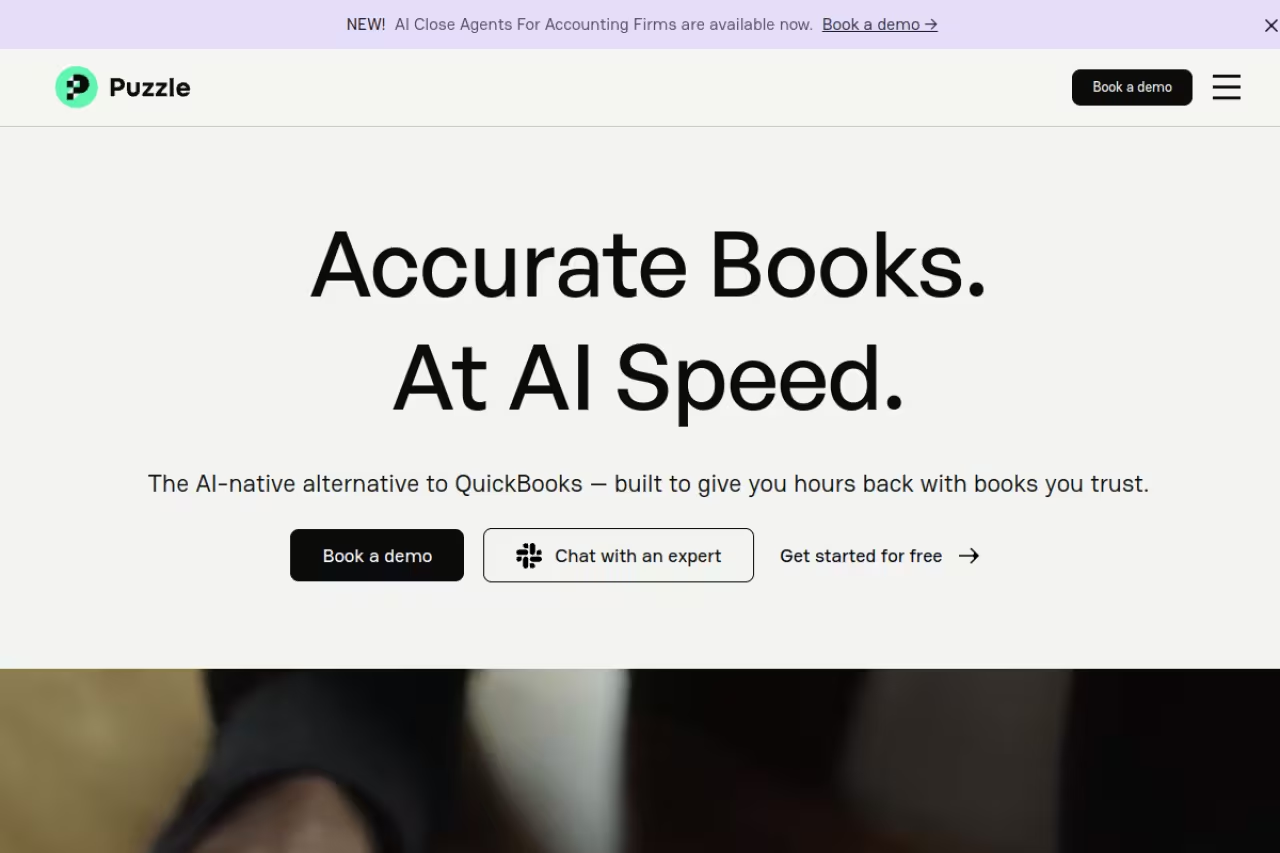
Puzzle was built for the exact company QuickBooks ignores: a startup that took outside money, runs on a fintech stack, and needs accrual books from day one instead of cash-basis bookkeeping bolted on later. It connects directly to Mercury, Stripe, Ramp, Brex, Gusto, Rippling, Rho, and Deel, and pulls everything else through Plaid.
What sold me is the auto-categorization. Puzzle claims up to 98% of transactions get categorized automatically, and in practice the AI drafts your financial statements as money moves, so you're not staring at a pile of uncoded transactions on the last day of the month. You get cash and accrual accounting, real-time cash visibility, and investor-ready reports without paying a bookkeeper to produce them by hand.
The AI-native pick for seed to Series B startups that want to own their books in software, particularly on Mercury or Brex. It is software, not a service, so you or your accountant still drive the close, and it is overkill for a tiny consultancy.
The Starter plan is free until you hit $20K in monthly transaction volume, which covers a lot of pre-seed companies. After that it's $25/mo for Starter, $60/mo for Core, $100/mo for Complete, and $300+/mo for Scale on annual billing. The Complete plan even guarantees a 50% faster month-end close or your money back.
Who it's best for: Seed to Series B startups that want to own their books in software, not outsource them, and that already bank with Mercury or Brex.
The catch: Puzzle is software, not a service. You (or your accountant) still drive the close. If you want a human to just handle everything, that's Pilot's lane, not this one. It's also overkill if you're a one-person consulting shop with 30 transactions a month.
QuickBooks Online: the safe default everyone already knows
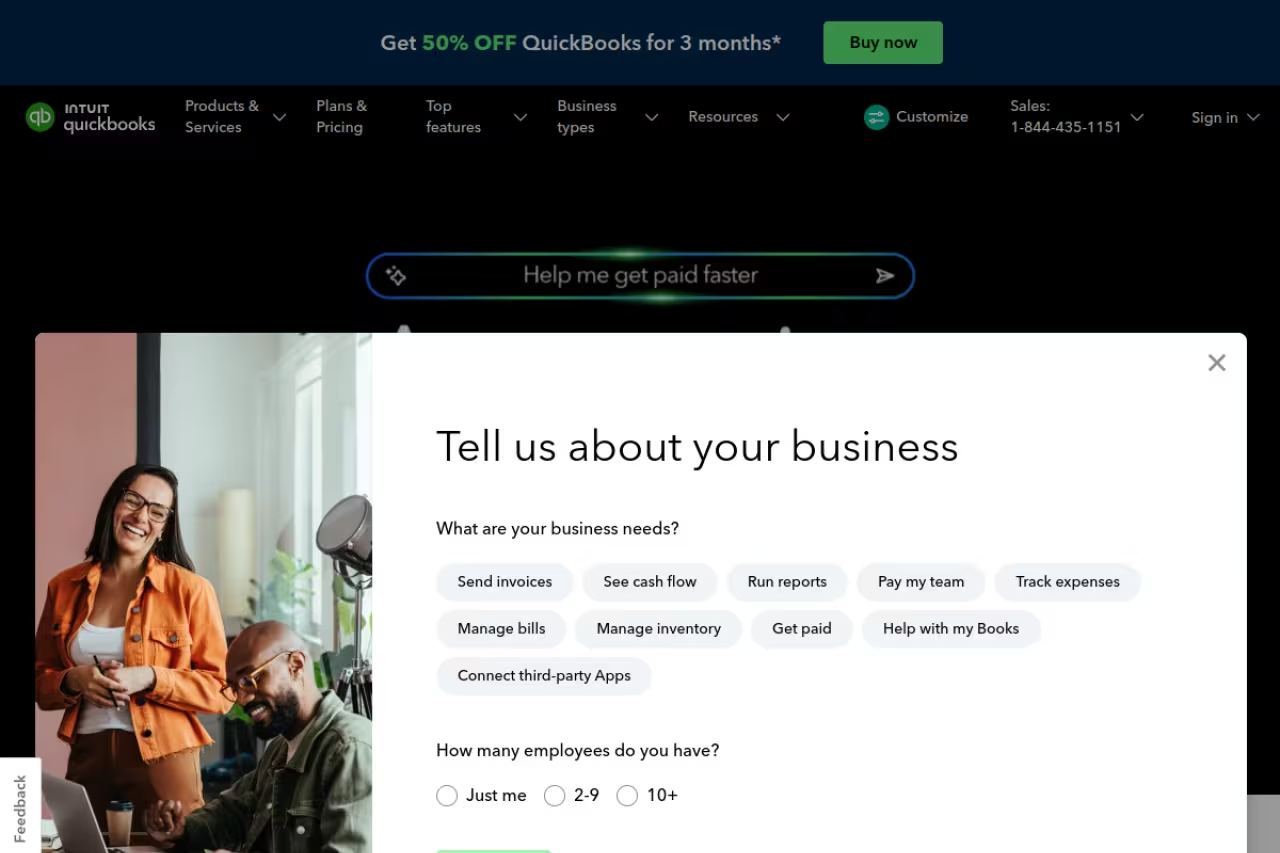
QuickBooks Online is boring in the best way. Every US accountant knows it, every fractional CFO can read it, and it plugs into pretty much every tool you'll ever adopt. If your plan is to hand your books to a CPA at tax time, this is the path of least resistance.
The app ecosystem is the real moat. QuickBooks markets the largest third-party app marketplace in accounting plus direct bank feeds from over 24,000 financial institutions, so whatever payroll, payments, or inventory tool you pick later will almost certainly integrate. Built-in payroll (sold separately) is another reason US teams default here.
Boring in the best way: every US accountant knows it and its app ecosystem is the real moat. Per-seat pricing pushes you up the tiers fast, and it is a competent default rather than the most modern tool here.
As of 2026 it runs $38/mo for Simple Start, $75/mo for Essentials, $115/mo for Plus, and $275/mo for Advanced, with a $20/mo Solopreneur tier for one-person shops. New subscribers usually get 50% off for three months.
Who it's best for: US startups that work with an external accountant and want zero friction handing off the books.
Where it falls short: QuickBooks charges per user. Simple Start is one seat, Essentials caps at three, and Plus at five. If your owner, bookkeeper, accountant, and an ops lead all need access, you're pushed up the tiers fast. Prices have also crept up roughly 12-17% a year since 2023, so budget for that. It's a competent default, not the most modern tool here.

Xero: unlimited users and the best fit for global teams

Xero is QuickBooks' main rival, and it wins on two things that matter to startups specifically: every plan includes unlimited users, and multi-currency support is genuinely good. If you have remote co-founders, contractors in three countries, or revenue in euros and pounds, Xero stops nickel-and-diming you for seats.
The interface is cleaner than QuickBooks too, which sounds trivial until you're the non-finance founder doing reconciliations at 11pm. Bank feeds, Hubdoc receipt capture, and a financial health dashboard come standard.
The strongest choice for distributed teams or international revenue, with unlimited users on every plan and good multi-currency. US accountants may nudge you toward QuickBooks, and the $25 Early plan with its 20-invoice cap is not what a funded startup pays.
Early is $25/mo, Growing is $55/mo, and Established is $90/mo, all with unlimited users. The catch on the cheap Early plan: it caps you at 20 invoices and 5 bills per month, so most funded startups land on Growing.
Who it's best for: Startups with distributed teams, international revenue, or anyone who wants more people in the books without per-seat fees.
The catch: the US app ecosystem and CPA familiarity still trail QuickBooks. Some American accountants will quietly push you toward QuickBooks because that's what their firm runs on. Multi-currency and several reporting features are locked to the top Established plan, so the headline $25 price isn't what a real startup pays.
If you want a soft pause here: figuring out your finance stack is the same muscle as figuring out your whole tool stack. Dupple X curates the AI and SaaS tools founders actually use, so you spend less time testing software and more time building.

Pilot: when you'd rather not touch the books at all
Pilot is the answer when accounting software is the wrong question. It's a managed service: a real US-based bookkeeper closes your books each month, delivers GAAP-compliant financials, and you stay out of the weeds. Founders who use it tend to be Series A and beyond, where a clean close in front of investors is worth more than the fee.
Pick Pilot when accounting software is the wrong question and you want a US-based bookkeeper accountable for the numbers each month. It costs real money and service tiers lock you into annual billing, which is a lot for a pre-revenue team.
Pilot recently split into a software tier and a service tier. The Essentials software plan is $99/mo (AI categorizes and reconciles, you review), while the Core plan adds a dedicated US bookkeeper and is billed annually. Tax filing starts around $1,000/year and only sells alongside bookkeeping; CFO services run $1,750 to $5,250+/mo.
Who it's best for: Funded startups that want hours back every month and a human accountable for the numbers.
Where it falls short: you're paying real money, and the service tiers lock you into annual billing. For a pre-revenue team with 40 transactions a month, that's a lot to spend before you have meaningful books to close.

Wave: the genuinely free option for bootstrappers
Wave is the rare free tool that does real double-entry accounting instead of crippling you into an upsell. The Starter plan costs nothing, with no time limit, and covers invoicing, estimates, and basic bookkeeping. For a bootstrapped founder validating an idea, that's often all you need for the first year.
A genuinely free double-entry option for pre-revenue and bootstrapped founders validating an idea. Reconciliation now sits behind Pro and there is no accrual accounting, so the day you raise a round you will be migrating off it.
Starter is free. The Pro plan is $16/mo (billed annually, or $19 monthly) and adds automatic bank import, receipt scanning, and reconciliation. Payments and payroll are priced separately on top.
Who it's best for: Pre-revenue or side-project founders who want clean books without spending a dollar.
The catch: Wave's free tier got noticeably thinner recently. Bank reconciliation and several reports now live behind the Pro plan, and Wave doesn't do accrual accounting, so the day you raise a round and need accrual books, you're migrating off it. Treat it as a starting point, not a forever home.
Zoho Books: a free tier with real automation
Zoho Books quietly offers one of the better free plans in accounting, and it's a strong pick if you're already living inside Zoho's other apps. The free tier is available indefinitely as long as your annual revenue stays under $50K, and unlike most free tools it includes workflow automation and a client portal.
One of the better free plans around, with workflow automation and a client portal, especially if you already live in Zoho. The $50K revenue cap is low, and US accountants know it less well than QuickBooks or Xero.
Free under $50K revenue, then Standard at $20/mo, Professional at $50/mo, Premium at $70/mo, scaling up to Ultimate at $275/mo. Annual billing knocks roughly 20% off. Extra users are $3/mo each.
Who it's best for: Solo founders and micro-startups under $50K revenue, especially anyone already using Zoho CRM or Zoho Mail.
Where it falls short: the $50K revenue cap on the free plan is low, so a startup with any real traction graduates to paid quickly. US accountant familiarity is also thinner than QuickBooks or Xero, and the deeper you go, the more it pulls you into the broader Zoho ecosystem.

Digits: an agentic ledger for AI-first teams
Digits is the other modern AI-native contender worth a look, with an "agentic general ledger" that auto-categorizes transactions, runs reconciliations, and drafts financials with minimal manual input. It targets US service and software startups under roughly 250 employees running a fintech stack, which is a similar profile to Puzzle.
A polished agentic ledger for software and service startups on a fintech stack that want AI to do the bulk of the bookkeeping. There is no free entry point, so you commit $100/mo from the start, and the fit gets shaky outside that mold.
The Core plan is $100/mo and is the most popular tier. A higher tier adds native Stripe, Ramp, and BILL integrations plus dimensional accounting, and an Advanced plan with custom pricing handles multi-entity and global operations. Digits also rolled out outcome-based pricing aimed at accounting firms in 2026.
Who it's best for: Software and service startups that want AI to do the bulk of the bookkeeping and a polished reporting layer for the team.
The catch: there's no free entry point like Puzzle's, so you're committing $100/mo from the start. It's also narrowly aimed at US fintech-stack companies, so if you're outside that mold the fit gets shaky.

FreshBooks: built for service and agency startups
FreshBooks started as invoicing software and it shows, in a good way. If your startup sells time (an agency, a dev shop, a consultancy), the invoicing, time tracking, and client management here are the smoothest on this list. Accounting features have caught up enough to run a small service business end to end.
The smoothest invoicing and time tracking for agencies, dev shops and consultancies selling their time. It is invoicing first and accounting second, too light for inventory or investor reporting, and per-seat fees add up fast.
Lite is $23/mo, Plus is $43/mo, Premium is $70/mo, with a custom Select tier. The gotcha is billable client caps: Lite covers 5 clients, Plus jumps to 50, Premium is unlimited. Extra team members cost more per seat. There's a 30-day trial but no free forever plan.
Who it's best for: Service startups, freelancers scaling into agencies, and anyone whose main job is invoicing clients cleanly.
Where it falls short: it's invoicing-first, accounting-second. For a product startup with inventory, complex revenue recognition, or investor reporting needs, FreshBooks is too light. The per-seat team fees also add up fast once you're more than a couple of people.
How to choose without overthinking it
Pick based on your stage and who's going to do the work, not on feature lists.
- Pre-revenue and bootstrapped? Start free with Wave or Zoho Books. Don't pay for accounting before you have real transactions.
- Raised money and want modern software you control? Puzzle if you bank with Mercury or Brex, Digits if you want an AI-first ledger. Both give you accrual books investors expect.
- Want the universal default your accountant already speaks? QuickBooks Online. It's not the slickest, but it's the safest handoff.
- Distributed team or global revenue? Xero, for unlimited users and real multi-currency.
- Rather not touch the books at all? Pilot, and accept that hands-off costs real money.
- Selling services and living in invoices? FreshBooks.
One real-world warning: avoid getting locked into a closed platform you can't export from. Bench's abrupt 2024 shutdown left customers scrambling for data, and while it was acquired and revived, it's a reminder to favor tools that let you take your general ledger with you. Whatever you choose, confirm you can export to standard formats before you commit a year of books to it.
For more on building a lean, modern startup stack, the Dupple top-tools directory and our guide to the best AI tools for startups are good next reads. And if you want the whole stack curated for you, Dupple X is the shortcut.
FAQ
What is the best accounting software for a startup in 2026?
For most venture-backed startups, Puzzle is the best fit because it gives you AI-driven accrual books and real-time cash visibility from day one. If you'd rather use the tool every US accountant already knows, QuickBooks Online is the safest default. For distributed teams with international revenue, Xero usually wins on price and unlimited users.
Is there genuinely free accounting software for startups?
Yes. Wave's Starter plan is free with no time limit and does real double-entry bookkeeping. Zoho Books is free as long as your annual revenue stays under $50K. Puzzle's Starter tier is also free until you hit $20K in monthly transaction volume. All three are legitimate for pre-revenue founders, though each pushes you to paid as you grow.
Do I need accrual accounting or is cash-basis fine for a startup?
Cash-basis is fine while you're pre-revenue and bootstrapped. The moment you raise institutional money, investors and your future Series A diligence will expect accrual books. Tools like Puzzle and Digits build accrual accounting in from the start, which saves a painful migration later. If you're on cash-basis QuickBooks now, plan to switch your method as you scale.
How much should a startup expect to spend on accounting software?
A bootstrapped startup can run on $0 to $20 a month using Wave, Zoho Books, or a free Puzzle tier. A funded startup using modern software like Puzzle, Xero, or QuickBooks typically spends $50 to $150 a month. If you outsource the work to a managed service like Pilot, budget several thousand dollars a year once you add a dedicated bookkeeper and tax filing.
Should I use accounting software or hire a bookkeeping service?
Use software if you (or a co-founder) are comfortable reviewing transactions and want to keep costs low and control high. Hire a service like Pilot once your time is worth more than the fee, usually around Series A, or when investor reporting and a clean monthly close become non-negotiable. Many startups start with software like Puzzle and add a fractional bookkeeper later rather than paying for a full service early.
Is QuickBooks or Xero better for a startup?
QuickBooks wins on US accountant familiarity and the largest app ecosystem, which makes it the easier handoff at tax time. Xero wins on price for teams, since every plan includes unlimited users, and on multi-currency support for international startups. If you're US-based and accountant-led, lean QuickBooks. If you have a distributed team or global revenue and care about the interface, lean Xero.
Related guides
Some offers on this page may be paid placements or contain affiliate links.
Across our whole catalogue the median is $24 a month and 33% of tools advertise a free tier. Figures are the lowest recurring monthly price quoted in our own review of each tool, read on 2026-08-19. Full method and every category.
