
The Best Customer Success Software in 2026

Key facts8 tools compared: Vitally, ChurnZero, Gainsight, Custify, Planhat, Totango + Catalyst, HubSpot…
- 8 tools compared: Vitally, ChurnZero, Gainsight, Custify, Planhat, Totango + Catalyst, HubSpot Service Hub, Userpilot
- Vitally (best for: Mid-market, fast-growing CS teams): ~$299/mo, scales by seats + accounts
- ChurnZero (best for: Churn prevention with structured playbooks): ~$12K+/yr, seat-based
- Gainsight (best for: Large enterprise post-sales ops): $50K+/yr, custom
- Custify (best for: Small-to-mid SaaS teams): From ~$999/mo
Most customer success teams I talk to are drowning in the same problem: too many accounts, not enough signal. You find out a customer is unhappy when the renewal email bounces, not three months earlier when usage quietly dropped off a cliff. Customer success software exists to fix that gap, and in 2026 the category has split into two very different camps.
On one side you have the AI-native platforms that promise agents doing the legwork (drafting renewal emails, summarizing accounts, flagging risk before a human notices). On the other, the older enterprise suites that do everything but take three months and a dedicated admin to set up. The honest truth is that most teams overbuy here. They pay for a Gainsight-sized platform and use maybe 20% of it.
If you want the short version: for most mid-market and fast-growing teams, Vitally is the best starting point in 2026. It goes live in weeks, the daily experience is genuinely good, and its AI features are usable instead of bolted on. If you're a large enterprise with complex post-sales ops, Gainsight is still the most capable. This guide is for CS leaders, founders, and ops people who want to pick the right tool without sitting through nine sales demos.
Quick comparison
| Tool | Best for | Price | Standout |
|---|---|---|---|
| Vitally | Mid-market, fast-growing CS teams | ~$299/mo, scales by seats + accounts | Modern UX, fast go-live, strong AI workspace |
| ChurnZero | Churn prevention with structured playbooks | ~$12K+/yr, seat-based | AI agents that act, not just advise |
| Gainsight | Large enterprise post-sales ops | $50K+/yr, custom | Deepest feature set, agentic AI (Atlas) |
| Custify | Small-to-mid SaaS teams | From ~$999/mo | AI-native, fast setup, no bloat |
| Planhat | Data-heavy B2B revenue teams | From ~$1,150/mo | Unified customer platform (CS + CRM + PSA) |
| Totango + Catalyst | Teams wanting a free tier to start | Free; paid from $249/mo | Free-forever plan, expansion focus |
| HubSpot Service Hub | Teams already on HubSpot | $0-$150/seat/mo | Native CRM integration |
| Userpilot | PLG teams optimizing in-app adoption | From $299/mo (per MAU) | In-app onboarding without engineering |
Vitally: the best all-rounder for most teams
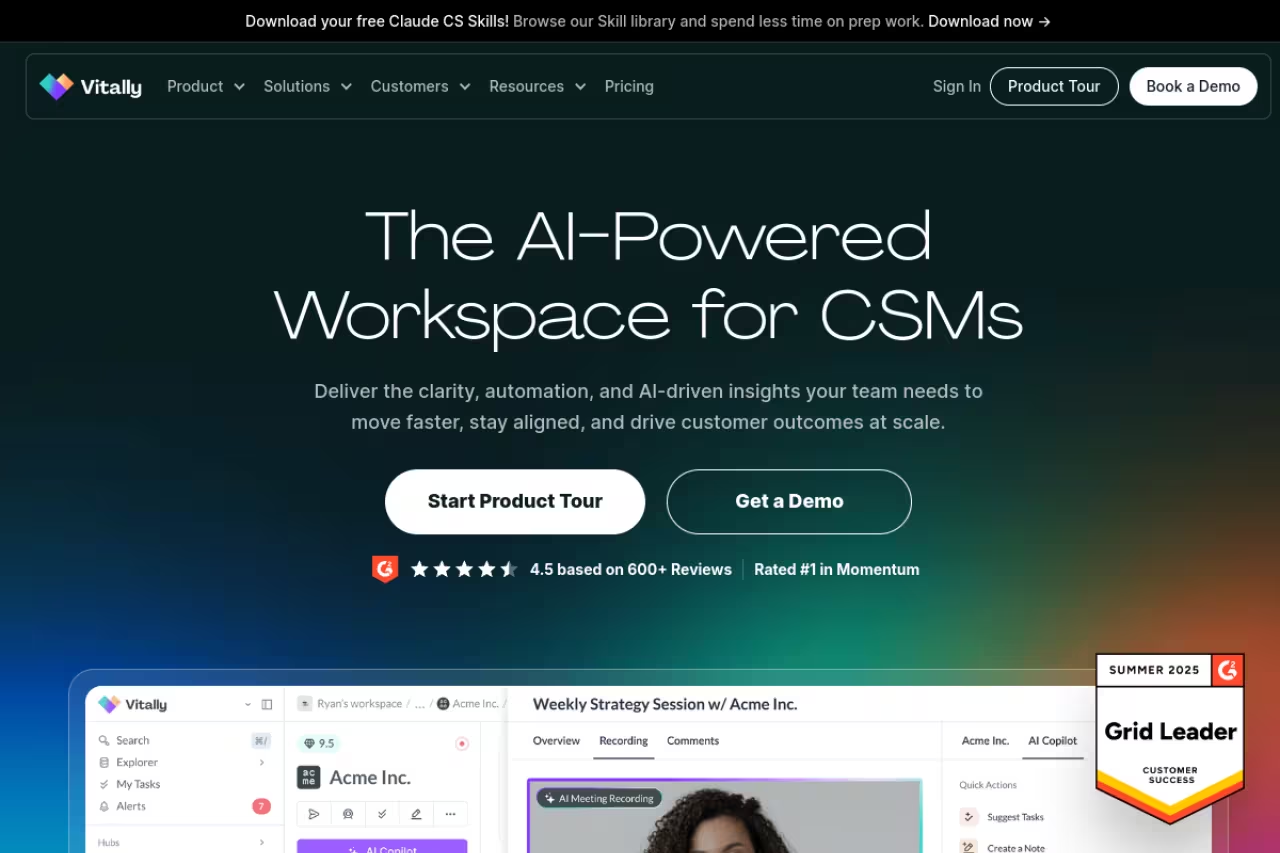
Vitally calls itself "the AI-powered workspace for CSMs," and after spending time in it, that framing fits. Where older tools feel like reporting dashboards you check once a week, Vitally feels like a place your CSMs actually work every day. Accounts, notes, projects, and health scores live in one view, and the interface is fast in a way the legacy suites are not.
Who it's best for: mid-market and growth-stage SaaS teams (roughly 10 to 50 CSMs) who want a modern daily driver without an eight-week implementation.
The modern daily driver for mid-market and growth-stage SaaS teams that want a fast CS workspace without a long implementation. It typically goes live in two to three weeks, but AI add-ons cost extra and the biggest enterprises may need Gainsight.
Vitally doesn't publish list pricing, but third-party marketplaces put the entry point around $299/month, scaling by seats and number of managed accounts. Its tiers (Tech-Touch, Hybrid-Touch, High-Touch) match different coverage models. For a 10 to 15 person team, expect roughly $12K to $50K a year depending on account volume.
The standout: implementation. Vitally typically goes live in two to three weeks instead of two to three months. The "All Features, All Plans" packaging also means you're not constantly hitting a paywall on basic functionality, which is refreshing in this category.
The catch: the AI add-ons are priced separately from the core platform, so the headline price isn't the full picture if you want the agent features. And while Vitally scales well into mid-market, the very largest enterprises with deep Salesforce-native workflows sometimes still need Gainsight's depth.
ChurnZero: built by CS people, for churn prevention
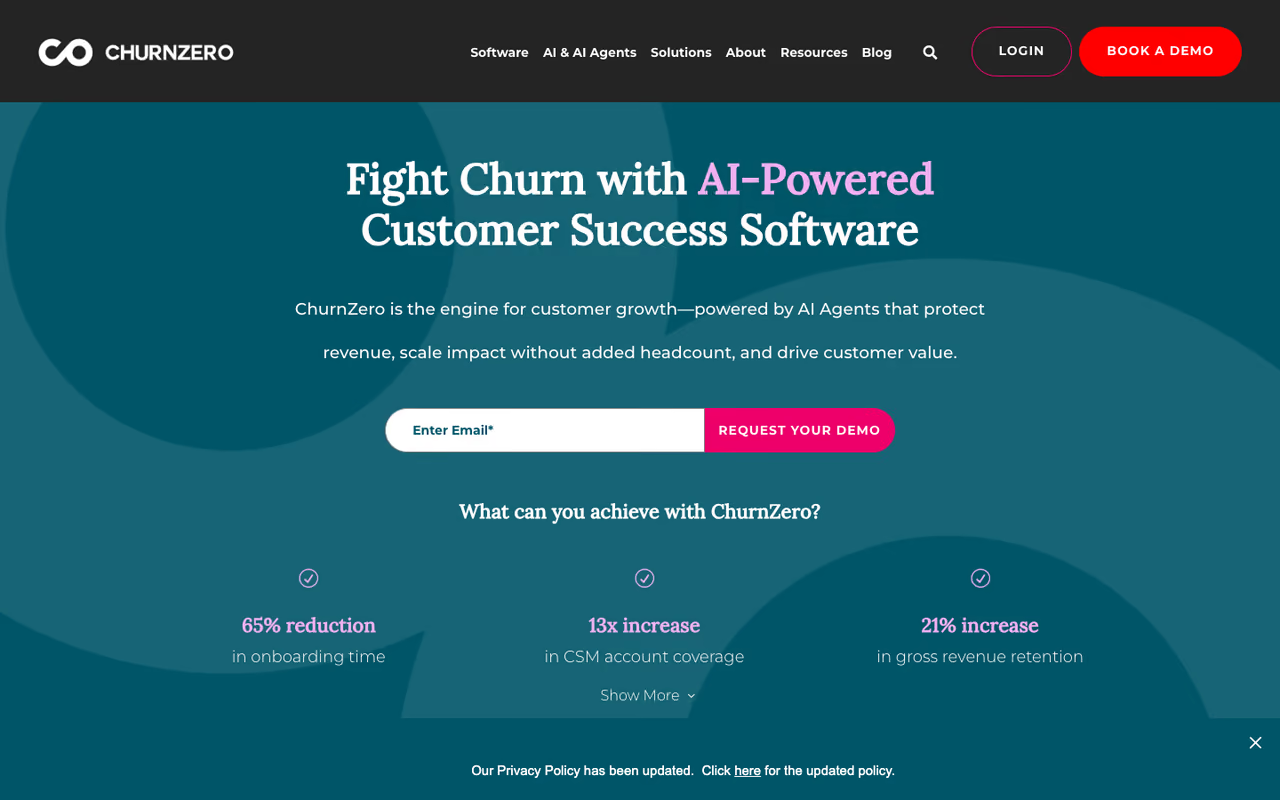
ChurnZero has always been the platform that feels like it was designed by people who actually did the job. In 2026 it leans hard into AI agents that "don't just analyze or advise, they act," handling automation and personalized customer interactions so your team can focus on relationships. ChurnZero claims customers see a 60% decrease in churn and a 13x increase in CSM account coverage, which are vendor numbers, but the playbook structure underneath is real and well-built.
Who it's best for: mid-market teams whose number one mandate is renewals and churn reduction, and who want structured, repeatable playbooks rather than a blank canvas.
Pick ChurnZero if your number one mandate is renewals and churn reduction and you want structured, repeatable playbooks. Real-time health scoring is its strength, but setup fees and seat minimums are a poor fit for very small teams.
ChurnZero is seat-based, starting around $12,000 to $16,000 a year for a basic plan with a default minimum of 10 full users. Overages on managed accounts are billed in blocks of 100. Per Vendr transaction data, buyers managing 2,000+ accounts often see quotes north of $100,000 annually, and onboarding fees can run $5,000 to $25,000.
The standout: real-time health scoring and the depth of its play automation. If your workflow is "detect risk, trigger a sequence, measure the outcome," ChurnZero does that better than almost anyone.
Where it falls short: the setup fees and seat minimums make it a poor fit for very small teams. And the interface, while functional, doesn't feel as modern as Vitally's day to day.

Gainsight: the enterprise gold standard
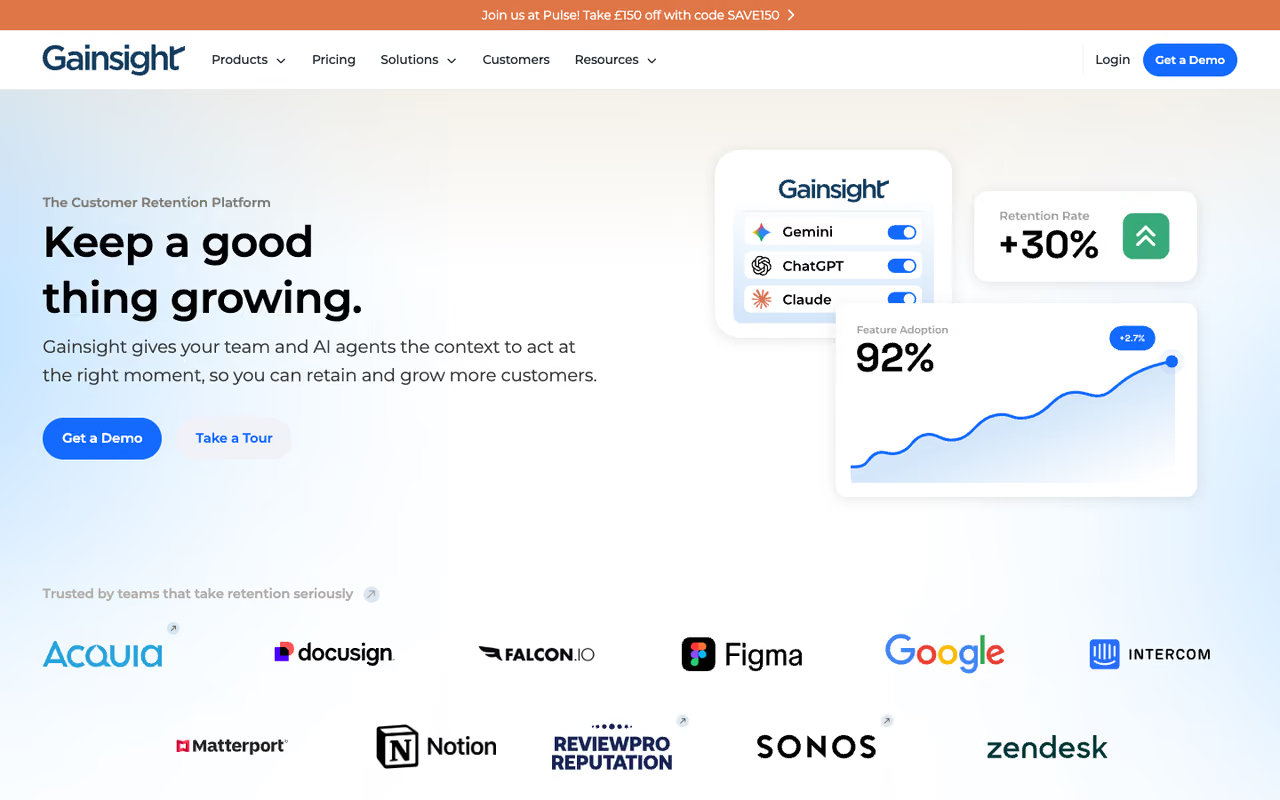
Gainsight is the platform everyone else is measured against. It has the deepest feature set in the category, the broadest journey orchestration, and in 2026 a serious agentic AI push: Atlas AI Agents to cover accounts autonomously, Staircase AI for relationship intelligence across every conversation, and an Agent Studio for building custom agents on your own customer data. It even ships a Model Context Protocol server so you can pipe Gainsight data into tools like Claude.
Who it's best for: large enterprises with complex post-sales operations, multiple product lines, and the headcount to run a powerful tool properly.
The enterprise gold standard for large organizations with complex post-sales operations and the headcount to run it. Nothing matches its depth, but platform fees start around $50,000 a year and a 10-person CS org will not get that value back.
custom and not cheap. Platform fees typically start around $50,000 a year and climb fast. Implementation runs eight to twelve weeks and usually needs dedicated resources.
The standout: nothing else matches its orchestration depth or its breadth across CS, product experience (Gainsight PX), and customer education (Skilljar). If you have a genuinely complex CS motion, this is the tool that won't run out of room.
The catch: it's overkill for small teams, full stop. The cost, the implementation timeline, and the need for a dedicated admin mean a 10-person CS org will spend more time and money than the platform returns. Buy this when you've outgrown the simpler tools, not before.
If you're earlier in your AI tooling journey and want to figure out which categories actually move the needle for your team, Dupple X curates the tools worth your time so you skip the demo treadmill.

Custify: AI-native without the bloat
Custify has quietly become one of the best options for smaller SaaS teams that want serious health scoring and automation without Gainsight-level complexity. It positions itself as AI-native, with CustifyAI handling churn prediction, playbook generation, and sentiment analysis, plus a clean Customer 360 view and 200+ integrations.
Who it's best for: small-to-mid SaaS companies (think early Series A through Series B) that need real CS infrastructure but can't justify enterprise pricing or timelines.
A strong choice for small-to-mid SaaS teams, roughly early Series A through Series B, that want serious health scoring and automation without enterprise pricing. It lacks Gainsight's orchestration depth, but that ceiling is far off for most.
entry-level pricing sits in the $8K to $20K annual range, with sources citing a starting point around $999/month. That undercuts ChurnZero and Vitally while still covering the core jobs.
The standout: speed to value. Custify is faster to implement than the heavier platforms, and teams report meaningful churn and expansion improvements within weeks.
Where it falls short: it doesn't have the orchestration depth or ecosystem of Gainsight, and very large teams will eventually outgrow it. For most SMB SaaS shops, that ceiling is a long way off.

Planhat: one platform for the whole commercial team
Planhat takes a different angle. Instead of being only a customer success tool, it's pitched as a single "customer platform" spanning CS, CRM, and professional services automation, with governed AI agents deployed across the lifecycle. It shows up in Gartner's Magic Quadrant for the category, so it's a credible enterprise contender.
Who it's best for: data-heavy B2B teams that want their commercial functions (success, sales, services) working off one shared customer record rather than three disconnected tools.
Planhat suits data-heavy B2B teams that want success, sales and services working from one shared customer record. The unified data model is genuinely useful, but configuring it well takes real thought.
starts around $1,150/month, with custom enterprise pricing typically landing in the $1,000 to $5,000+/month range depending on scope.
The standout: the unified data model. If you're tired of CS and sales arguing about whose numbers are right, Planhat's single source of truth is genuinely useful.
The catch: that flexibility comes with a learning curve. Planhat can do a lot, which means configuring it well takes real thought. It's less "open the box and go" than Vitally or Custify.

Totango + Catalyst: start free, grow into it
After their 2024 merger, Totango and Catalyst now operate as a combined platform aimed squarely at challenging Gainsight, blending Totango's enterprise hierarchy and governance with Catalyst's slick workflow UX and expansion focus.
Who it's best for: teams that want to start without a budget conversation, and companies focused on expansion and upsell motions alongside retention.
The obvious place to start if you want to begin without a budget conversation, or you focus on expansion and upsell alongside retention. The free-forever plan is rare, but the merger is still settling and you will hit its limits.
there's a genuine free-forever plan, which is rare in this category. Paid plans start at $249/month (2 users) and the Growth tier is $1,099/month (10 users), per Totango's packages.
The standout: that free tier. You can stand up basic health scoring, customer journey templates, and automated plays at zero cost, which makes Totango the obvious place for a brand-new CS function to experiment.
Where it falls short: the merger is still settling, and some users report the combined product roadmap feels in flux. The free plan is generous but you'll hit its limits as you scale.

HubSpot Service Hub: best if you already live in HubSpot
If your company already runs on HubSpot, Service Hub is the path of least resistance. It's not a dedicated CS platform like the others here, but with native CRM data, ticketing, knowledge base, and increasingly capable automation, it covers the basics for teams that don't need specialist health scoring.
Who it's best for: companies already standardized on HubSpot that want service and light CS in the same place as sales and marketing.
The path of least resistance if your company already runs on HubSpot and wants service plus light CS beside sales and marketing. It's not purpose-built for customer success, so dedicated CS teams will outgrow it.
there's a free tier, then Starter at $20/seat/month, Professional at $100/seat/month, and Enterprise at $150/seat/month with a 10-seat minimum (billed annually).
The standout: zero data silos. Because it shares the HubSpot CRM, you don't fight integrations, and the upgrade path from free to paid is smooth.
The catch: it's not purpose-built for customer success. You won't get the predictive health scoring or CS-specific playbook depth of a ChurnZero or Vitally. For dedicated CS teams it's a starting point, not a destination.

Userpilot: for product-led adoption
Userpilot solves a slightly different problem: getting users to adopt and stick inside your product. It's a no-code product growth platform with in-app onboarding flows, product analytics, session replay, and Lia, an AI agent that automates insight generation and experience creation.
Who it's best for: product-led growth teams where CS happens inside the app, and where adoption (not manual outreach) is the lever that drives retention.
Userpilot fits product-led teams where CS happens inside the app and adoption is the retention lever. It lets you ship onboarding tours without engineers, but it has no health scoring or renewals, so pair it with a CS platform.
Starter at $299/month and Growth at $799/month (annual billing), with custom Enterprise pricing. Note it's priced per monthly active user, not per CSM seat, so the math is different from everything else here.
The standout: acting at the product layer without engineering help. CS teams can ship onboarding tours and in-app nudges themselves, which is powerful for self-serve motions.
The catch: it's not a full CS platform. There's no account health scoring or renewal management in the traditional sense, so most teams pair it with one of the tools above rather than replacing them.
How to choose
Skip the feature checklists. Pick based on your stage and motion:
- You're a brand-new CS function with no budget: start on Totango's free plan or, if you're already on HubSpot, use Service Hub. Prove the motion before you spend.
- You're mid-market and growing fast: Vitally is the default. If churn prevention with rigid playbooks is your single biggest priority, ChurnZero is the better fit.
- You're a small SaaS team that wants real CS infrastructure cheaply: Custify.
- You're enterprise with complex post-sales ops: Gainsight, full stop. Planhat if you want one platform across success, sales, and services.
- Your retention lever is in-app adoption: Userpilot, usually alongside a dedicated CS tool.
The most common mistake is buying for the company you'll be in three years, not the one you are today. A platform that takes three months to implement and needs a full-time admin is a tax, not an asset, until you're big enough to absorb it.
For the broader picture of where these tools fit, our guides on the best AI customer success tools and the best customer retention software go deeper on adjacent categories, and you can browse vetted options on Dupple's top tools list.
FAQ
What is the best customer success software in 2026?
For most mid-market and fast-growing teams, Vitally is the best customer success software in 2026 thanks to its modern interface, fast implementation, and usable AI features. Gainsight remains the strongest choice for large enterprises with complex post-sales operations, while ChurnZero is the best pick if churn prevention with structured playbooks is your top priority.
How much does customer success software cost?
It ranges widely. Entry options like Custify start around $999/month and mid-market tools like Vitally and ChurnZero typically run $12K to $50K per year for a 10 to 15 person team. Enterprise platforms like Gainsight start around $50K/year and can exceed $100K once you factor in implementation and seats. Totango offers a free-forever plan if you want to start at zero.
Is there free customer success software?
Yes. Totango offers a genuine free-forever plan that includes health scoring, customer journey templates, and automated plays. HubSpot Service Hub also has a free tier, though it's a service tool rather than a dedicated CS platform. Both are good ways to validate your process before paying for a specialist tool.
Do I need a dedicated customer success platform if I use a CRM?
Not always. If you're early and already on a CRM like HubSpot, its service features may cover the basics. But a CRM tracks deals, not customer health over time. Once you're managing more accounts than your team can watch manually, a dedicated platform's predictive health scoring and automation pays for itself. You can compare general options in our best CRM software guide.
What AI features actually matter in customer success software?
The useful ones in 2026 are predictive health scoring (catching at-risk accounts early), AI agents that take action like drafting renewal outreach or summarizing accounts, and sentiment analysis across customer conversations. Be skeptical of generic "AI summary" features that just restate data you already see. Tools like ChurnZero, Gainsight's Atlas, and Custify lead here, and you can see more in our best AI customer support tools roundup.
Related guides
Some offers on this page may be paid placements or contain affiliate links.
