
The Best AI Customer Success Tools in 2026

Key facts8 tools compared: Vitally, Intercom Fin, Pylon, Gainsight, Planhat, ChurnZero, Totango…
- 8 tools compared: Vitally, Intercom Fin, Pylon, Gainsight, Planhat, ChurnZero, Totango, Perspective AI
- Vitally (best for: Mid-market PLG SaaS): ~$1,500+/mo (quote)
- Intercom Fin (best for: Support-driven churn): $0.99 per resolution
- Pylon (best for: B2B with Slack customers): $59-$139/seat/mo
- Gainsight (best for: Enterprise CS Ops): $1,200-$4,200/user/yr
Most customer success tools were built to tell you an account is unhealthy. They almost never tell you why. You get a red health score, a churn-risk percentage, a dashboard that lights up two weeks before a customer leaves, and then you're scrambling to call someone who has already half made up their mind.
The 2026 generation is different. AI now reads meeting transcripts, support tickets, and product usage in the background, writes the account recap your CSM used to spend an hour on, and in some cases resolves the support question before a human ever sees it. That's the real shift: less manual data entry, more time spent on the conversations that actually save renewals.
I compared the platforms that matter this year, the ones founders, CS leaders, and support teams keep asking about. If you want my short answer: Vitally is the best AI customer success platform for most mid-market B2B SaaS teams, Intercom Fin is the strongest if your churn risk lives in your support queue, and Pylon is the one to watch if your customers live in Slack. Here's the full breakdown.
Quick comparison
| Tool | Best for | Price | Standout |
|---|---|---|---|
| Vitally | Mid-market PLG SaaS | ~$1,500+/mo (quote) | AI Copilot that reads transcripts and notes |
| Intercom Fin | Support-driven churn | $0.99 per resolution | Pay only when AI actually resolves |
| Pylon | B2B with Slack customers | $59-$139/seat/mo | AI-native help desk built around shared channels |
| Gainsight | Enterprise CS Ops | $1,200-$4,200/user/yr | Deepest playbook and journey engine |
| Planhat | Ops-heavy mid-market | ~$25K-$45K/yr | CRM-grade data model and automation |
| ChurnZero | Adoption and in-app | ~$12K-$30K/yr | In-app messaging plus ZoeAI assistant |
| Totango | Scaling CS teams | Quote-based | Unison AI churn engine plus Zoe |
| Perspective AI | Voice-of-customer at scale | Free (100 credits), Pro from $99/mo | AI interviews that capture the "why" |

Vitally
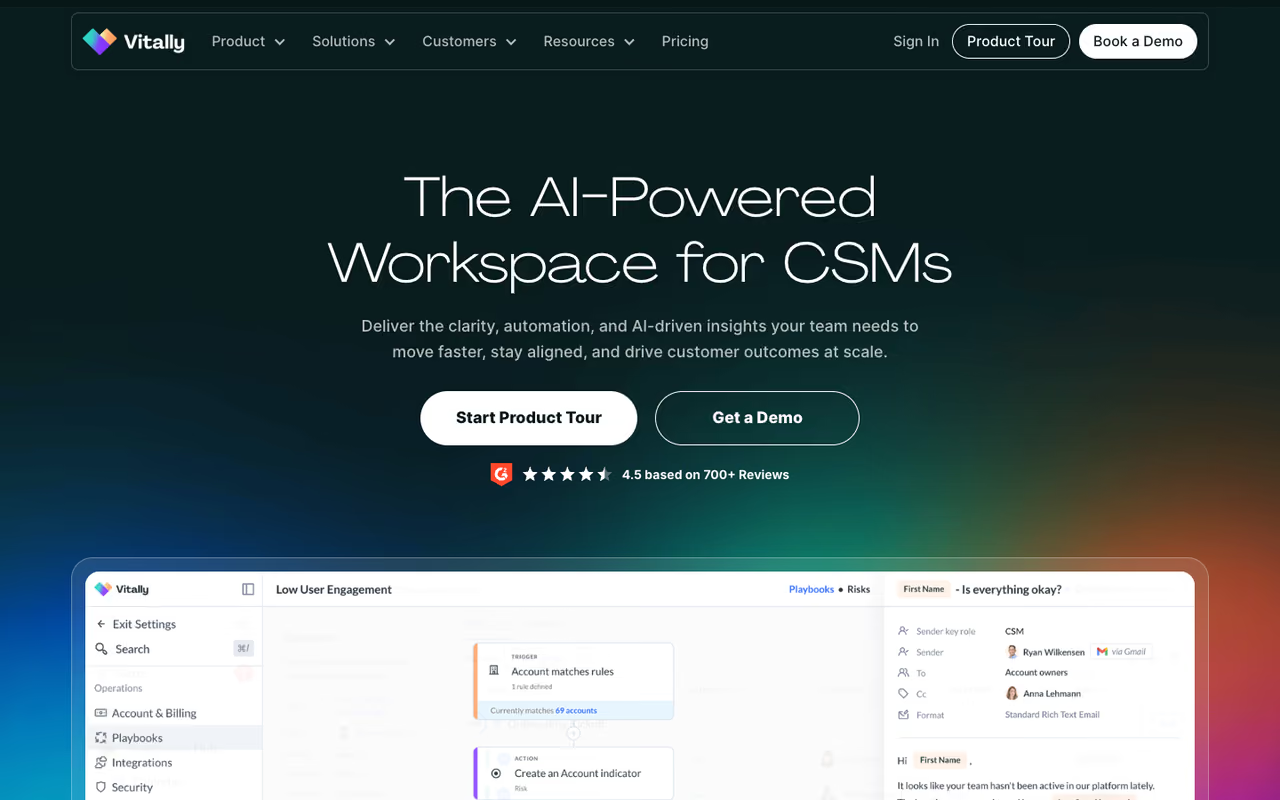
Vitally is the platform I'd hand to most B2B SaaS teams between 20 and 500 employees. It pulls your product usage, CRM data, support tickets, and billing into one workspace, scores account health, and runs Playbooks that assign tasks and trigger the next step automatically. Onboarding, renewals, risk response: the customer data drives the motion instead of a CSM remembering to do it.
The AI piece is the reason it's at the top. Vitally AI is a Copilot built into the platform that reads unstructured data your team never had time to process: meeting transcripts, call notes, survey responses, conversation history. It writes periodic account recaps backed by the actual source data and suggests follow-ups based on recent activity, the kind of pre-call summary work that used to eat a CSM's hour before every account touchpoint.
The platform I'd give most B2B SaaS teams of 20 to 500 employees, with a Copilot that works on real calls and transcripts, not just numbers. Pricing is opaque and quotes can balloon at scale, so negotiate.
Vitally doesn't publish list pricing. Quote-based plans scale by seats and number of managed accounts, with starter tiers commonly landing around $1,500 per month billed annually, per Vendr's marketplace data. Larger mid-market deployments run well past that.
The catch: Opaque pricing makes budgeting hard, and quotes can balloon at scale. You'll need to negotiate, and the value depends on how clean your data integrations are going in.
Intercom Fin
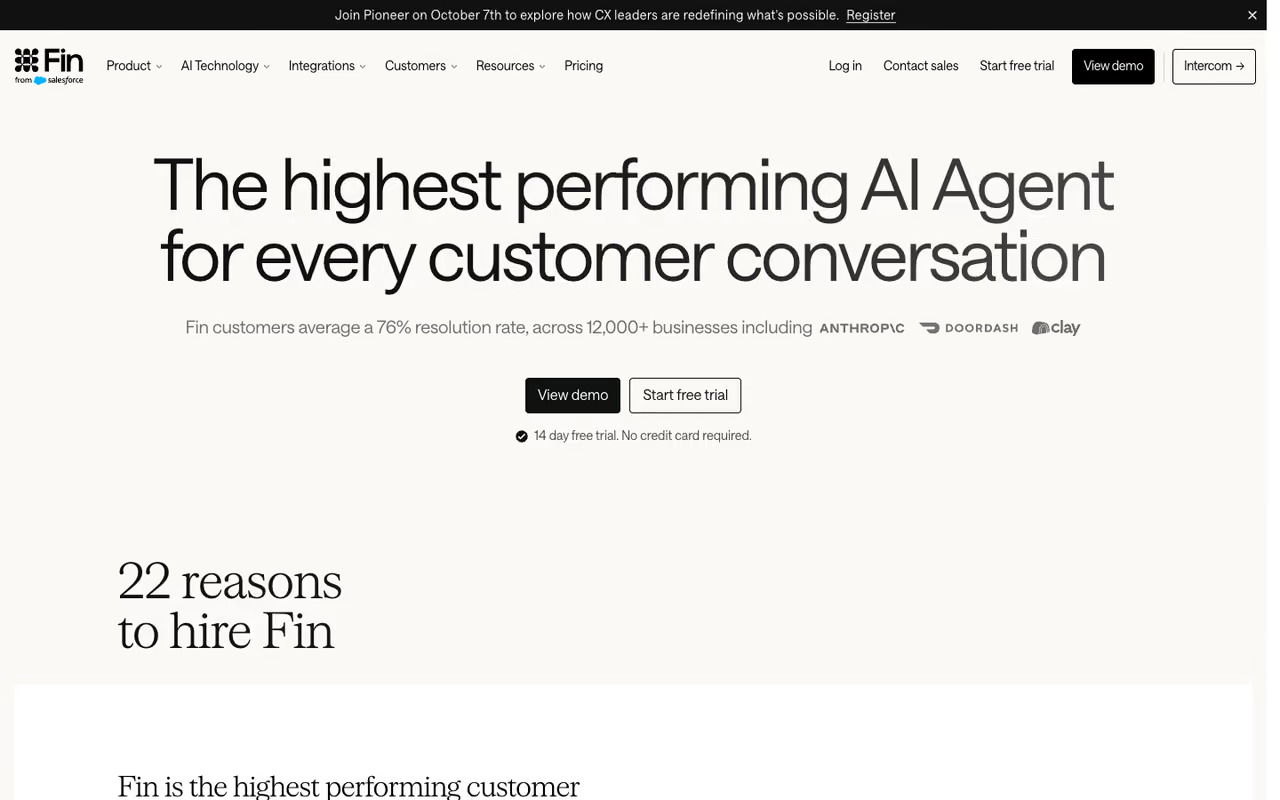
Plenty of churn never shows up in a health score because it starts as a frustrated support ticket nobody answered fast enough. That's where Fin earns its place on this list. Fin is Intercom's AI agent, and it resolves customer questions end to end, either confirming the customer's issue is solved or executing a configured workflow before handing off to a human.
What I like is the pricing honesty: you pay $0.99 per outcome, and only when Fin actually delivers one. No flat per-seat fee for a bot that deflects nothing. Intercom's own pricing page confirms the $0.99 figure with a 50-outcome monthly minimum, and there's a 14-day free trial with unlimited outcomes and no card required. Be realistic about results, though. Intercom's published case studies put real-world resolution rates between 42% and 50%, so plan for humans to still handle half the queue.
A sharp tool for teams whose retention risk lives in the support inbox, priced at $0.99 per outcome so you only pay when Fin delivers. It solves support only, with no health scoring or renewal playbooks, and real resolution rates run 42% to 50%.
$0.99 per resolution on any plan. Run Fin inside Intercom's help desk and you add seat costs of roughly $29 to $132 per seat per month depending on tier. Add-ons include Copilot at $35 per user per month.
Where it falls short: Fin solves support, not the full CS motion. There's no health scoring, no renewal playbooks, no journey engine. It's a sharp tool for one job, not a replacement for a CS platform.

Pylon
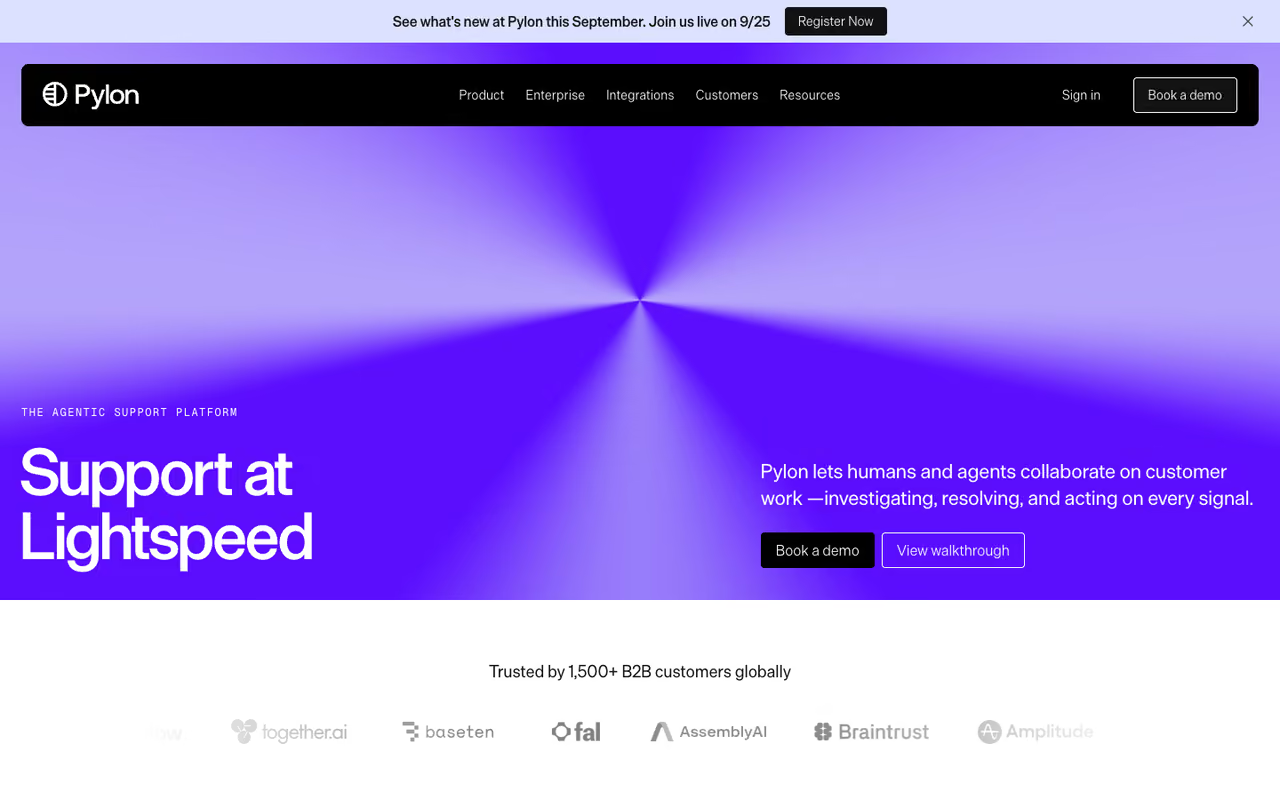
If your customers talk to you in shared Slack channels instead of a ticket portal, Pylon is the most interesting product in this category right now. It's an AI-native B2B help desk that treats Slack, Microsoft Teams, email, and chat as one queue, then layers account intelligence on top so support and CS see the same customer in one view. For early and mid-stage B2B companies, it genuinely replaces a stack of separate tools.
The Account Intelligence add-on is what nudges it from "support tool" into customer success territory. It tracks account health and engagement, and at $10 per account per month it's positioned as a lighter alternative to a full Gainsight Essentials seat. The AI Agents handle repetitive questions across channels; the AI Assistants draft replies for your team.
The most interesting product for B2B teams whose customers talk to them in shared Slack channels, combining help desk and account health. AI and account intelligence are separate paid lines, so the real cost climbs, and it loses appeal if customers don't live in Slack.
Per their pricing page, Starter is $59 per seat per month, Professional $89, and Enterprise $139 (all annual; 3-seat minimum on the lower tiers, 7 on Enterprise). AI Assistants add $50 per seat per month, AI Agents start at $100 per month, and Account Intelligence is $10 per account per month with a 50-account floor.
The catch: The AI features and account intelligence are separate paid lines, not bundled, so the real cost climbs once you turn everything on. And it's strongest for shared-channel support; if your customers don't live in Slack, you lose half the appeal.
Picking the right CS stack is exactly the kind of decision we help teams think through in Dupple X, our research membership for operators who'd rather not test 12 platforms themselves.

Gainsight
Gainsight is still the deepest platform in the category, and for large organizations with a dedicated CS Ops team, it's hard to beat. The journey orchestration, playbook logic, and health scoring go further than anything else here, and Horizon AI sits on top for analytics and recommendations. If you have the headcount to configure it, you can model almost any customer motion.
The deepest platform in the category, hard to beat for enterprises with a CS Ops team and the budget to match. Implementation is a project in itself ($30K to $120K), and Horizon AI feels bolted on, so small teams should skip it.
Per-user, per the breakdown at Oliv's pricing analysis, Essentials runs roughly $1,200 to $2,400 per user per year and Enterprise $2,400 to $4,200, with implementation adding $30K to $120K. Volume discounts kick in at scale.
Where it falls short: It's overkill for small teams, the implementation is a project in itself, and the Horizon AI layer has been criticized as bolted on rather than built in from the ground up. You pay for depth you may never fully use.

Planhat
Planhat competes with Gainsight on power but feels more like a flexible operational workspace than a rigid enterprise suite. It combines a CRM-grade data model, health scoring, analytics, and automation in one place, and its AI layer (Planhat AIP) handles automated health scoring and workflow triggers at configurable autonomy levels. Ops-minded teams who want to shape the data model themselves tend to love it.
A flexible operational workspace for mid-market and enterprise teams with real CS Ops muscle who want to shape their own data model. Without someone who owns configuration it can stall in setup, and quotes land between $15,000 and $60,000 per year.
Quote-based. Most organizations land between $15,000 and $60,000 per year, with mid-market Professional deployments typically in the $25,000 to $45,000 range, according to Vendr's marketplace data.
The catch: The flexibility cuts both ways. Without someone who owns the configuration, Planhat can stall in setup. It rewards teams that invest in it and punishes the ones that don't.
ChurnZero
ChurnZero has long been the go-to for adoption-focused CS, and that's still its strength. In-app messaging, walkthroughs, and engagement nudges let you guide customers inside your product, which matters most for teams where churn comes from low adoption rather than unanswered tickets. Its ZoeAI assistant adds a conversational layer for pulling insights and drafting outreach.
The pick for mid-market SaaS teams where churn comes from low adoption, with in-app messaging and walkthroughs to guide customers inside your product. Pricing is not public and it is less of a true system of record than Planhat or Gainsight.
Quote-based, starting around $12,000 per year. For 100 to 500 accounts, quotes typically run $15,000 to $30,000 annually, per Vendr.
Where it falls short: No public pricing, and the in-app messaging engine, while good, means another script on your product. It's less of a true system of record than Planhat or Gainsight.

Totango
Totango merged with Catalyst in 2024, and the combined product now bundles Totango's workflow engine, Catalyst's product analytics, and a shared data model. The AI story centers on Unison AI, a churn-intelligence and predictive health engine, plus the Zoe assistant for conversational access to customer data right inside Slack. The roadmap is still converging, but the direction is sound.
A reasonable choice for scaling CS teams that want analytics, workflows and engagement under one license after the Catalyst merger. The roadmap is mid-transition, so check which features are live versus promised before you sign.
Quote-based. Totango doesn't publish numbers, and the post-merger packaging is still settling, so get a current quote rather than relying on old figures.
The catch: Two products fused into one means some rough edges and a roadmap that's mid-transition. Worth a close look at exactly which features are live versus promised before you sign.
Perspective AI
Perspective AI takes a different angle from everyone else here. Instead of inferring why an account is at risk from usage data, its Interviewer agent runs AI-moderated interviews at scale, at onboarding, mid-cycle, pre-renewal, and post-churn, and captures the answer in the customer's own words. It can run dozens of conversations at once with the depth of a 30-minute researcher call, then surface the themes. Pair it with a platform like Vitally or Gainsight and you finally get the "why" behind the red score.
A complement, not a CS platform, that runs AI-moderated interviews to give you the why behind a red health score, suited to CS and research teams wanting qualitative voice-of-customer data. It has no health scores, playbooks or renewal workflows, so you still need a core system.
Free to start with 100 credits and no credit card. Pro starts at $99/month with 1,000 credits a month, Flex credits cover pay-as-you-go use, and Enterprise plans are available on request, per Perspective AI's pricing page (checked October 2026).
Where it falls short: It's a complement, not a CS platform. No health scores, no playbooks, no renewal workflows. You still need a core system; this layers on top of it.
How to choose
Start with where your churn actually comes from, not with the longest feature list.
If retention risk shows up as unanswered support tickets, lead with Intercom Fin or Pylon and add a light CS layer later. If it comes from low product adoption, ChurnZero's in-app engine fits. If it comes from renewal and relationship management at scale, you want a true platform: Vitally for mid-market, Gainsight or Planhat for enterprise with CS Ops to run them.
Then weigh your operational maturity. Gainsight and Planhat reward teams with dedicated CS Ops and punish teams without it. Vitally and Pylon get you live faster. And if your current tool tells you what is happening but never why, bolt on Perspective AI rather than ripping out your stack.
One more honest note: nearly every platform here is quote-based and gets expensive at scale. Build in negotiation time, and don't pay for enterprise depth a 10-person team will never configure. For more on the broader AI tooling shift, our roundups of the best AI agents and best AI chatbots for business are good companions, and you can browse vetted picks in our top tools directory.
FAQ
What is the best AI customer success tool in 2026?
For most mid-market B2B SaaS teams, Vitally is the strongest all-around pick because its AI Copilot reads transcripts, notes, and survey responses to surface real insights instead of just health scores. If your churn risk lives in the support queue, Intercom Fin is the better starting point, and enterprises with dedicated CS Ops teams should look at Gainsight or Planhat.
How much do AI customer success platforms cost?
It varies widely. Intercom Fin is usage-based at $0.99 per resolution. Pylon runs $59 to $139 per seat per month. Vitally, ChurnZero, Planhat, and Totango are quote-based, with annual contracts ranging from roughly $12,000 (ChurnZero entry) to $60,000-plus (enterprise Planhat or Gainsight). Most platforms in this space don't publish list pricing.
Can AI customer success tools actually reduce churn?
They help, but they don't do it alone. AI health scoring flags at-risk accounts weeks earlier, and AI support agents like Fin resolve 42% to 50% of tickets without a human. The retention win comes from acting on those signals quickly. The tool surfaces the risk; your team still has to make the save.
What's the difference between a CS platform and an AI support agent?
A CS platform (Vitally, Gainsight, Planhat) manages the full customer relationship: health scores, renewals, playbooks, and account history. An AI support agent (Intercom Fin) resolves individual customer questions in the support queue. They solve different problems, and many teams run both: the agent handles reactive support, the platform manages proactive retention.
Which AI customer success tool is best for startups?
Pylon is the most startup-friendly option, especially if your customers reach you through Slack, since it bundles support and account intelligence starting at $59 per seat per month. Intercom Fin is also accessible thanks to its pay-per-resolution model and free trial. The heavy enterprise platforms like Gainsight rarely make sense before you have a dedicated CS Ops person.
Ready to stop testing tools one at a time? Dupple X gives operators the research and shortlists to pick the right stack the first time.
Related guides
Some offers on this page may be paid placements or contain affiliate links.
Across our whole catalogue the median is $24 a month and 33% of tools advertise a free tier. Figures are the lowest recurring monthly price quoted in our own review of each tool, read on 2026-08-19. Full method and every category.
