
Best Voice of Customer Software in 2026: 8 Tools I'd Actually Recommend

Key facts8 tools compared: Chattermill, Thematic, Qualtrics, Survicate, Sprig, Dovetail, Medallia…
- 8 tools compared: Chattermill, Thematic, Qualtrics, Survicate, Sprig, Dovetail, Medallia, Enterpret
- Chattermill (best for: Mid-market to enterprise CX): ~$50k to $150k+/yr
- Thematic (best for: Insights teams who want theme discovery): From $2,000/mo
- Qualtrics (best for: Large enterprise XM programs): ~$30k median/yr
- Survicate (best for: Startups and SMBs collecting feedback): Free to $569/mo
Most teams already have a voice of customer program. It's just scattered across a survey tool, a spreadsheet of support tickets, a Slack channel of screenshots, and someone's memory of the last 12 sales calls. The feedback exists. Nobody can see the pattern in it.
That's the actual job of voice of customer software: take everything customers say across surveys, reviews, tickets, calls, and app store ratings, and tell you what they keep saying. The good tools do this with AI text analysis that holds up at scale. The bad ones just count NPS scores and call it a day.
I compared the current crop, read the pricing fine print, and looked at what people running these programs day to day report in public reviews. If you want one answer up front: Chattermill is the strongest pure-play VoC platform for most mid-market and enterprise teams, because it unifies every channel and the AI categorization is genuinely accurate. If your budget is closer to a few hundred dollars a month than five figures, Survicate is the better starting point. Here's the full breakdown.
Quick comparison
| Tool | Best for | Price | Standout |
|---|---|---|---|
| Chattermill | Mid-market to enterprise CX | ~$50k to $150k+/yr | Accurate multi-channel AI analysis |
| Thematic | Insights teams who want theme discovery | From $2,000/mo | Auto-surfaced themes, no manual coding |
| Qualtrics | Large enterprise XM programs | ~$30k median/yr | Survey depth and governance |
| Survicate | Startups and SMBs collecting feedback | Free to $569/mo | Fast setup, fair pricing |
| Sprig | Product teams wanting in-app insight | From ~$199/mo | In-product surveys plus replays |
| Dovetail | Research and product discovery | ~$39/user/mo | Qualitative research repository |
| Medallia | Global enterprise CX at scale | Six figures/yr | Real-time signal at huge volume |
| Enterpret | Product-led SaaS feedback ops | ~$36k median/yr | Adaptive feedback taxonomy |
Chattermill: the all-channel VoC platform
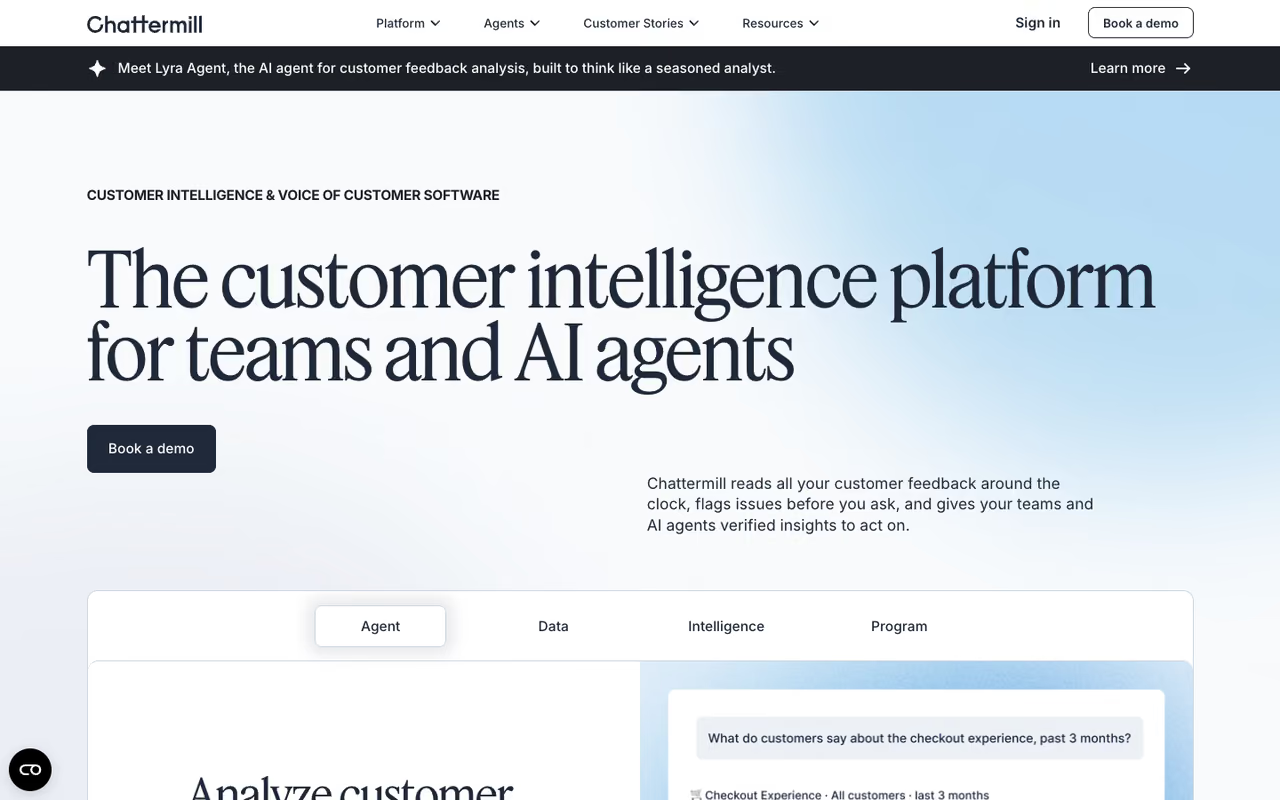
Chattermill is built for one thing: pulling feedback from every channel into a single model and telling you what's driving customer behavior. Surveys, online reviews, social posts, support conversations, and voice calls all land in the same place, and the AI tags themes, sentiment, and intent automatically.
Built for mid-market and enterprise CX and insights teams drowning in unstructured feedback, with accurate AI tagging that holds up on drill-in. There is no public pricing or self-serve tier, with typical commitments of $50,000 to $150,000+ per year.
The company raised a $26M Series B specifically to analyze over a billion pieces of feedback, and that scale shows in how the categorization handles messy, real-world text.
Pricing is quote-based and tied to feedback volume rather than seats. Public benchmarks put typical commitments in the $50,000 to $150,000+ per year range, so this is not a casual purchase.
The standout is accuracy. A lot of VoC tools produce themes that look plausible and fall apart when you read the underlying comments. Chattermill's tagging holds up when you drill in, which is the whole point.
The catch: there's no public pricing and no self-serve tier. You're booking a demo and negotiating a contract, so it's overkill for small teams who just need to start collecting feedback this week.
Thematic: theme discovery without the manual coding
Thematic solves the part of VoC everyone hates: reading thousands of open-text responses and grouping them by hand. Its AI discovers themes directly from your data, tracks how they move over time, and ties them back to metrics like NPS so you can see what's actually moving the number.
Best for dedicated insights and CX analysts who live in qualitative data and want a tool that does the coding for them while staying explainable. You can audit why a comment got a theme, which matters when you're presenting to leadership.
The Starter plan begins at $2,000 per month for up to three users and a couple of data sources. Team and Enterprise scale up to 50,000 and 100,000+ pieces of feedback with more datasets. Third-party transaction data pegs the average annual deal around $35,000.
The standout is theme quality and the ability to keep refining accuracy over time rather than accepting whatever the model spits out on day one.
Where it falls short: it analyzes feedback but doesn't collect it. You bring the data from your surveys, reviews, and tickets. If you want collection and analysis in one tool, this isn't it.
For dedicated insights and CX analysts who live in qualitative data, with explainable theme discovery that does the coding for you. It analyzes feedback but does not collect it, and the Starter plan begins at $2,000 per month.
If you're building a feedback operation from scratch, our guide to the best AI tools for business covers adjacent pieces worth pairing with a VoC platform.

Survicate: the practical choice for smaller teams
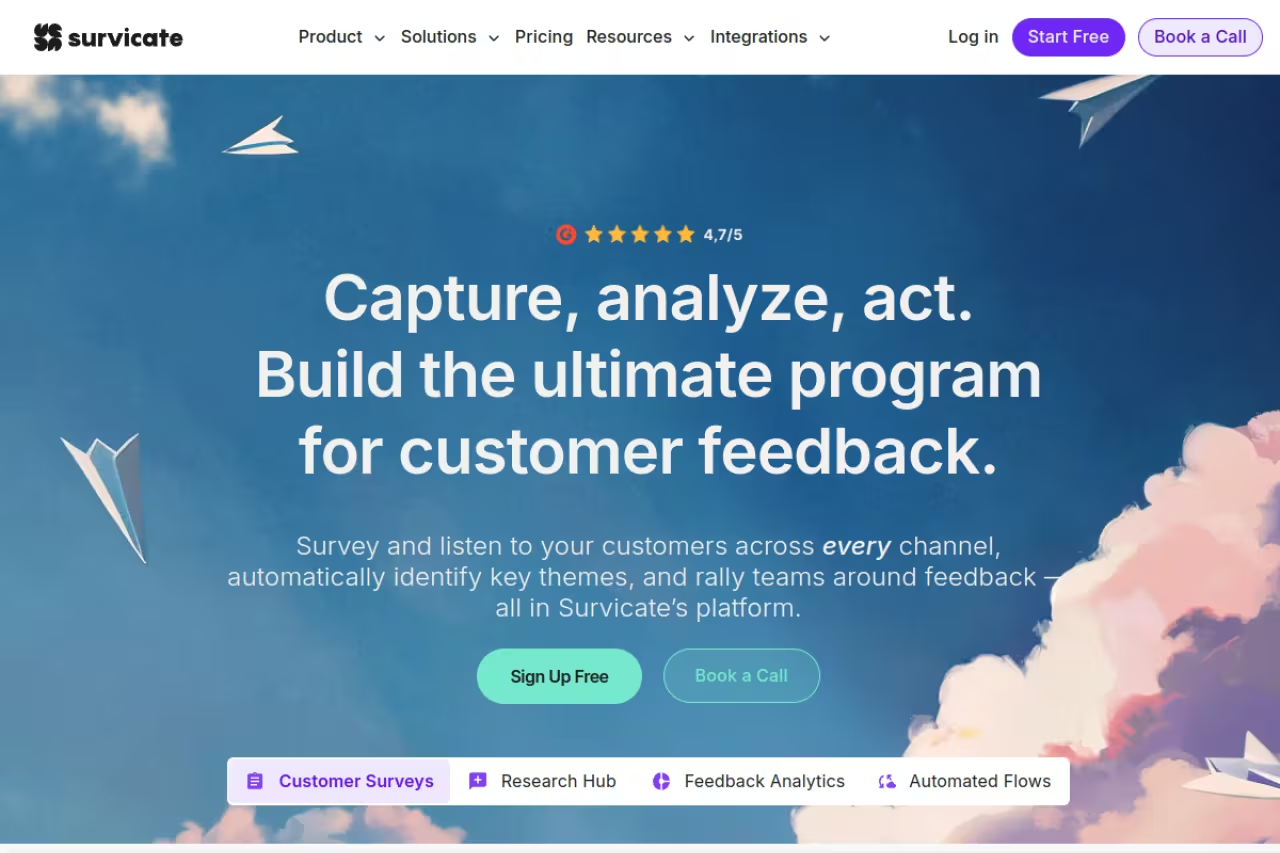
Survicate is where I'd point most startups and SMBs. It collects feedback across web, mobile, email, and link surveys, runs NPS, CSAT, and CES out of the box, and uses AI to surface themes and sentiment from the responses. It's fast to set up and you can run a real program without a procurement cycle.
The practical choice for startups and SMBs that want to start collecting and acting on feedback this week, with multi-channel surveys and AI themes. The AI analysis is shallower than Chattermill or Thematic, and you will feel the ceiling at hundreds of thousands of items.
There's a genuinely usable free plan, then paid tiers from a Growth plan at $114/month billed annually (250 responses/month, 1,000 data points), up to Pro at $349/month and Enterprise at $569/month with custom response pools. A 10-day trial unlocks every feature.
The standout is the price-to-value ratio. You get multi-channel collection plus AI analysis for what enterprise tools charge per seat, which is why it shows up constantly as the affordable Qualtrics alternative.
The catch: the AI analysis is solid but shallower than a dedicated platform like Chattermill or Thematic. Once your feedback volume gets into the hundreds of thousands of items, you'll feel the ceiling.
If reading and acting on customer feedback is eating your week, a tool like Dupple X can help you summarize and draft responses to the patterns these platforms surface. That keeps the loop from feedback to action short.
Qualtrics: the enterprise survey heavyweight
Qualtrics is the experience management platform that defined the category. CustomerXM handles survey design, distribution, text analytics, and closed-loop workflows with the governance and security large organizations require. If your program spans thousands of employees and strict compliance rules, this is the safe default.
The safe default for large enterprises running formal XM programs across customer, employee and product experience, with unmatched survey depth and governance. It is expensive with a steep learning curve, and many buyers question needing the full suite.
Pricing is custom and famously opaque. Marketplace data puts the median annual cost around $30,000, with CoreXM enterprise contracts running roughly $15,000 to $50,000+ and full implementations climbing past $140,000. Professional services often add $5,000 to $20,000 on top.
The standout is survey depth and governance. Nothing else handles complex study design, branching, and permissioning at this level.
Where it falls short: it's expensive, the learning curve is steep, and a lot of buyers in 2026 are questioning whether they need the full suite when AI-native tools cover their actual use case for a fraction of the cost.

Sprig: in-product insight for software teams
Sprig takes a different angle. Instead of emailing surveys, it captures feedback inside your product at the exact moment something happens, then pairs it with session replays and AI analysis. You see what users do and ask them why in the same flow.
Suited to product and growth teams at software companies that want behavioral context alongside feedback, with in-product surveys and replays. It is built around digital product usage, so it is a poor fit for call centers, retail or offline feedback.
Pricing scales with your research program. The free plan covers a single in-product survey or replay per month with AI analysis for up to 5,000 monthly tracked users, and the Starter tier starts around $199/month with higher limits and prototype testing. Enterprise is custom.
The standout is the combination of in-app surveys, replays, and natural-language querying of your user data, which cuts hours off manual analysis.
The catch: it's built around digital product usage, so it's a poor fit if your feedback comes mostly from call centers, retail, or offline channels.

Dovetail: the research repository
Dovetail is less a survey tool and more a home for qualitative research. It stores interviews, transcribes recordings in dozens of languages, tags insights, and uses AI to summarize and search across everything. Teams use it to turn raw customer conversations into reusable insight.
A home for qualitative research rather than a survey tool, ideal for UX researchers and product teams who need a searchable archive. It is not built for high-volume continuous monitoring and complements a VoC platform rather than replacing one.
There's a free tier with one project and basic AI, then a Professional plan at about $39/user/month billed annually with unlimited projects. Enterprise is custom and unlocks semantic search, PII redaction, and unlimited viewers. Automated data channels start around $50/month each.
The standout is the research repository itself. When a new PM asks "what do customers think about onboarding," the answer is already tagged and searchable.
Where it falls short: it's optimized for deep qualitative work, not high-volume continuous feedback monitoring. It complements a VoC platform more than it replaces one.

Medallia: enterprise CX at massive scale
Medallia is the platform for global brands handling enormous feedback volume in real time. It captures signals across digital, voice, video, and in-location touchpoints, then routes them to the right person fast enough to actually recover an unhappy customer.
For large enterprises with mature CX programs and the budget and team to run them, with real-time signal across digital, voice, video and in-location touchpoints. Cost and complexity are the catch, with benchmark averages around $521,000 per year.
Pricing is priced on Experience Data Records and negotiated per contract. Most deals land in the high five to six figures annually, with benchmark averages around $521,000 per year and total cost of ownership driven heavily by services and internal labor.
The standout is real-time signal at a scale almost nothing else matches, plus the operational workflows to act on it across thousands of frontline staff.
The catch: cost and complexity. Buyers in 2026 are openly rethinking the bill, and for anyone outside the global enterprise tier this is far more platform than the problem requires.

Enterpret: feedback ops for product-led SaaS
Enterpret is built for SaaS teams who want every piece of feedback unified and categorized automatically. It connects to 50+ sources and applies an adaptive taxonomy that updates itself as new themes emerge, so your categories don't go stale the way a fixed tag list does.
Suited to product-led SaaS companies that want feedback ops with owners assigned, using a self-maintaining taxonomy over 50+ sources. There is no public pricing or free tier, and it assumes meaningful feedback volume already flows in.
Pricing is custom, based on data volume and integrations with no seat limit. Third-party data reports a median annual contract around $36,000.
The standout is that self-maintaining taxonomy. You're not constantly re-coding your categories as the product evolves.
Where it falls short: like Chattermill and Thematic, there's no public pricing or free tier, and it assumes you already have a meaningful volume of feedback flowing in.
How to choose
Forget the feature checklists for a second. Three questions get you most of the way:
What's your budget tier? Under $1,000/month, look at Survicate, Sprig's lower plans, or Dovetail. Five figures a year buys Thematic or Enterpret. Six figures and a dedicated team gets you Chattermill, Qualtrics, or Medallia.
Do you need to collect feedback, or just analyze it? Survicate and Sprig collect. Thematic and Enterpret mostly analyze what you already have. Chattermill, Qualtrics, and Medallia do both. Don't pay for collection you don't need, and don't buy an analysis tool with no data to feed it.
Where does your feedback actually live? Software product usage points to Sprig. Multi-channel chaos across reviews, tickets, and social points to Chattermill or Enterpret. Formal surveys at scale point to Qualtrics. Match the tool to your real channel mix, not the demo's.
Start with the cheapest tool that covers your top two channels. You can always graduate. For more on stitching these into a working stack, see our roundup of the best AI tools for marketing and browse top tools by category.
FAQ
What is voice of customer software?
Voice of customer software collects feedback from channels like surveys, reviews, support tickets, calls, and social media, then uses AI to analyze themes and sentiment so teams can see what customers consistently want and act on it. It turns scattered, unstructured feedback into clear patterns and priorities.
What is the best voice of customer software in 2026?
For most mid-market and enterprise teams, Chattermill is the strongest pure-play VoC platform because it unifies every channel with accurate AI analysis. Smaller teams are better served by Survicate, which offers multi-channel collection and AI insights starting free. The right pick depends on your budget, channels, and whether you need to collect feedback or just analyze it.
How much does voice of customer software cost?
Pricing ranges widely. Entry tools like Survicate start free and run up to $569/month, while Sprig and Dovetail sit in the few-hundred-dollars-a-month range. Enterprise platforms like Thematic start around $2,000/month, and Chattermill, Qualtrics, and Medallia run from tens of thousands to six figures per year, usually quote-based on feedback volume.
What's the difference between VoC software and survey tools?
Survey tools collect responses to questions you ask. Voice of customer software goes further by aggregating feedback from many sources, including channels where customers speak unprompted like reviews and support tickets, then using AI to analyze it at scale. Many VoC platforms include survey capability, but their real value is the cross-channel analysis layer.
Do I need an enterprise VoC platform like Qualtrics or Medallia?
Probably not, unless you're a large organization with a dedicated CX team, strict governance needs, and high feedback volume. Most companies get what they need from mid-market tools at a fraction of the cost. Many 2026 buyers are actively moving off legacy enterprise suites toward AI-native platforms that cover their actual use case for less.
Ready to act on the feedback these tools surface instead of just reading it? Try Dupple X to summarize patterns and draft responses fast.
Related guides
Some offers on this page may be paid placements or contain affiliate links.
Across our whole catalogue the median is $24 a month and 33% of tools advertise a free tier. Figures are the lowest recurring monthly price quoted in our own review of each tool, read on 2026-08-19. Full method and every category.
