
Best Customer Support Software for Small Business (2026)

Key facts8 tools compared: Help Scout, Freshdesk, Zoho Desk, Gorgias, Intercom, Tidio, Crisp, Zendesk
- 8 tools compared: Help Scout, Freshdesk, Zoho Desk, Gorgias, Intercom, Tidio, Crisp, Zendesk
- Help Scout (best for: Email-first teams who hate clutter): Free (5 users), then $25/user/mo
- Freshdesk (best for: Growing teams that want room to scale): $19/agent/mo
- Zoho Desk (best for: Cost-conscious teams already in Zoho): $7/user/mo
- Gorgias (best for: Shopify and e-commerce stores): $10/mo (50 tickets)
Most "best customer support software" lists were written for companies with a 30-person support team and a procurement budget. That is not you. If you run a small business, you have two or three people answering email between doing six other jobs, and the tool you pick has to be live by Friday.
The hard part in 2026 is not finding a help desk. It is finding one that does not balloon into a $200-per-seat platform the moment you want AI replies, a knowledge base, and live chat in the same place. Pricing pages have gotten sneaky. AI is now a per-resolution upcharge bolted onto a per-seat plan, so the sticker price and the real bill are two different numbers.
We compared the main contenders with a small team in mind: budget under control, setup measured in hours not weeks, and an AI agent that actually deflects tickets instead of annoying customers. My top pick for most small businesses is Help Scout because it stays out of the way and a non-technical person can run it. But the right answer depends on whether you sell to consumers, run an e-commerce store, or just need a shared inbox that does not feel like enterprise software. Here is how they stack up.
Quick comparison
| Tool | Best for | Starting price | Standout |
|---|---|---|---|
| Help Scout | Email-first teams who hate clutter | Free (5 users), then $25/user/mo | Feels like a real inbox, not a ticketing system |
| Freshdesk | Growing teams that want room to scale | $19/agent/mo | 14-day free trial and deep automation |
| Zoho Desk | Cost-conscious teams already in Zoho | $7/user/mo | Cheapest paid tier with a real feature set |
| Gorgias | Shopify and e-commerce stores | $10/mo (50 tickets) | Order data and refunds inside the ticket |
| Intercom | Product-led SaaS with chat-first support | $29/seat/mo | Fin AI agent resolves a big share of chats |
| Tidio | Solo founders who live in live chat | Free, then $24.17/mo | Lyro AI on a genuinely usable free plan |
| Crisp | Bootstrapped teams wanting a flat fee | Free, then $45/mo flat | Per-mailbox pricing, not per-seat |
| Zendesk | Teams that will outgrow everything else | $55/agent/mo (Suite Team) | The deepest platform, if you can afford it |

Help Scout: the one I'd hand a non-technical team
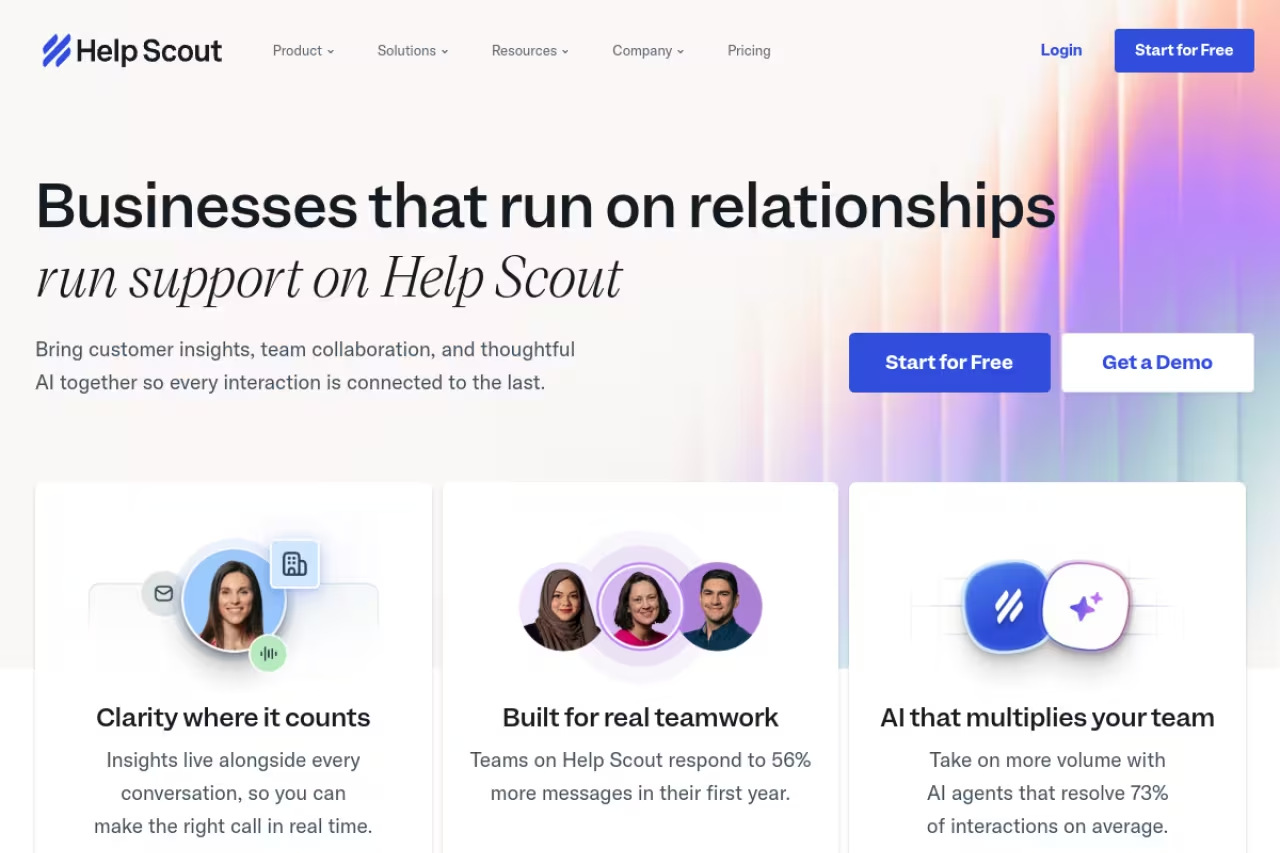
Help Scout is the tool I recommend first because it doesn't look or feel like help desk software. Your team works out of a shared inbox that reads like a normal email client, customers get replies that look like a person sent them (no "Ticket #48291" subject lines), and there is almost nothing to learn on day one.
The one to hand a non-technical team doing mostly email and a bit of live chat. Help Scout feels like a normal inbox with almost nothing to learn, but it's thinner on phone and heavy omnichannel, and the free plan's cap is tight.
Agencies, SaaS startups, and service businesses fit perfectly.
Pricing is clear. There is a free plan for up to 5 users with one inbox and a Docs site, then Standard at $25 per user/month, Plus at $45, and Pro at $75. The AI Answers agent is a usage add-on at $0.75 per resolution, which is fair if you only pay when it actually closes a ticket.
The standout is how little it fights you. Docs (the knowledge base) takes an afternoon to set up and immediately deflects repetitive questions. Saved replies, workflows, and customer profiles are all where you expect them.
The catch: it is email-and-chat first, so if you need phone support or heavy omnichannel routing (WhatsApp, Instagram DMs, SMS all in one queue), Help Scout is thinner than Freshdesk or Zendesk. The 100-contacts-per-month cap on the free plan is also tight, so most teams move to Standard fast.
Freshdesk: the help desk that grows with you
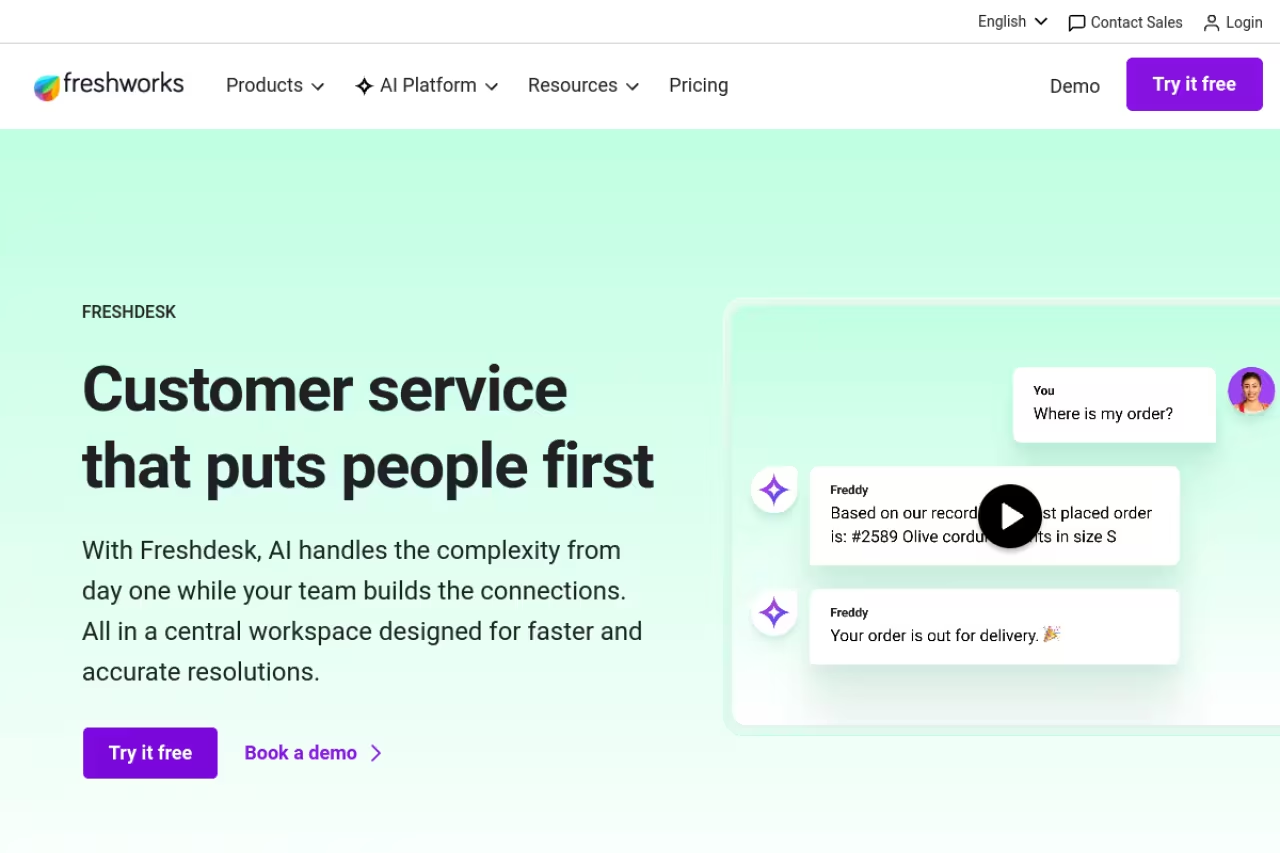
Freshdesk is the safe pick when you want one tool you won't outgrow in a year. It does email, chat, phone, and social in one queue, and its automation engine is more capable than anything else at this price.
The safe pick for small teams that expect to add agents and channels and don't want to migrate later. Automation depth is strong at $19, though the jump from Growth to Pro at $55 is steep and new agents need a short ramp.
The Growth plan is $19 per agent/month billed annually, Pro is $55, and Enterprise is $89 ($23, $66, and $107 on monthly billing). There is no free plan, but a 14-day free trial gives you the Enterprise plan before you pick a tier. The Freddy AI agent is included on Growth, Pro, and Enterprise with 500 sessions, then $49 per 100 sessions after that.
The standout is automation depth. Ticket routing rules, SLA policies, scenario automations, and canned responses are genuinely powerful on the Growth plan, where rivals make you pay up for the same thing.
Where it falls short: the interface has more surface area than Help Scout, so a brand-new agent needs a short ramp. And the jump from Growth ($19) to Pro ($55) is steep. A lot of features people assume are basic, like custom reporting and round-robin routing, sit behind that Pro wall.
Zoho Desk: the cheapest serious option
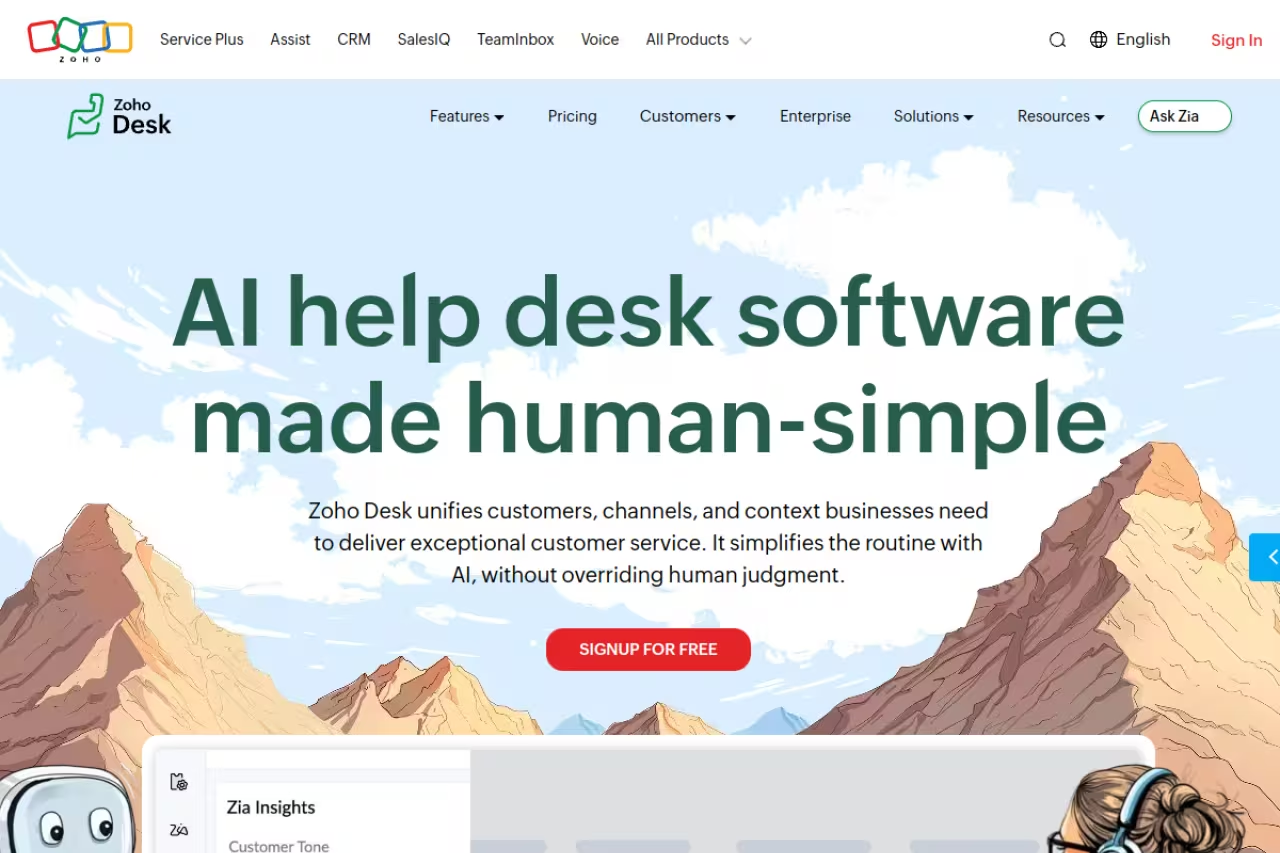
Zoho Desk wins on raw price. Its Express plan runs about $7 per user/month and still gives you email, social, web forms, and ticket management. For a two-person team watching every dollar, nothing else comes close on cost-to-feature ratio.
The cheapest serious option, ideal for budget-first teams and anyone already on Zoho CRM or Zoho One. You get a real multichannel help desk for about $7 per user, but the interface is busy and Zia trails Fin and Freddy.
Pricing (billed annually) is Express at ~$7/user, Standard at ~$14, Professional at ~$23, and Enterprise at ~$40, plus a free-forever plan for 3 users with basic email ticketing. Standard adds live chat, the knowledge base, and generative AI; the Zia AI assistant and AI agents live on Enterprise.
The standout is that you get a real multichannel help desk for the price of a couple of coffees per agent. The free plan for three users is also genuinely usable for a side project or a tiny team.
The catch: the Zoho interface is busy and the AI features (Zia) are weaker than Fin or Freddy. You also feel the pull toward the rest of the Zoho ecosystem. If you are not already in it, the standalone experience is less polished than Help Scout. For more AI-specific options, my roundup of the best AI customer support tools goes deeper on automation.

Gorgias: built for e-commerce
If you run a Shopify, BigCommerce, or WooCommerce store, Gorgias is the obvious answer. It pulls order data, tracking, and refund actions straight into the ticket, so an agent can issue a refund or cancel an order without leaving the conversation.
Best for: online stores where most support tickets are "where is my order" and "I want a refund."
Pricing is ticket-based, not seat-based: Starter is $10/month for 50 tickets, Basic is around $50-60 for 300 tickets, and Pro is around $300-360 for 2,000 tickets. The AI Agent is $0.90 per resolved conversation on annual billing. There is a 7-day free trial with no card required.
The standout is the commerce integration. Macros can update order status, apply discounts, and trigger Shopify actions, which turns support into a revenue tool rather than a cost center.
Where it falls short: the ticket-based pricing punishes high-volume stores. If your support volume spikes during a sale, you can blow through your ticket allowance and the next tier is a big jump. It is also overkill if you don't sell physical products. For a non-store business, Help Scout or Freshdesk is cheaper and simpler.
The obvious answer for Shopify, BigCommerce or WooCommerce stores where most tickets are about orders and refunds. Order actions inside the ticket are the draw, but ticket-based pricing punishes spikes and non-store businesses should look elsewhere.
If you're piecing together a full stack, it's worth pairing your help desk with the right CRM for small business so support and sales see the same customer.

Intercom: chat-first support with a strong AI agent
Intercom practically invented the in-app chat bubble, and in 2026 it is leaning hard into AI. Its Fin agent is one of the better autonomous support agents available, and Intercom reports it resolves a large share of first-line conversations on its own.
A strong choice for product-led SaaS companies where support happens in the app and chat is the main channel. Fin and the Messenger are hard to beat, but cost climbs fast for a small team, and email-heavy support wastes the muscle.
Plans are Essential at $29/seat/month, Advanced at $85, and Expert at $132, all including the Fin AI agent. Fin itself is billed at $0.99 per resolution (an "outcome"), charged once per conversation regardless of how many questions it answers.
The standout is Fin plus the Messenger. The combination of proactive in-app messaging, a polished chat widget, and a capable AI agent is hard to beat for SaaS onboarding and support.
The catch: cost adds up fast. The per-seat price is reasonable, but layer on $0.99 per Fin resolution and add-ons like Copilot and Proactive Support, and the bill climbs quickly for a small team. Intercom is also chat-and-product centric, so if your support is mostly email, you are paying for muscle you won't use. If you mainly want the AI agent piece, compare it against the field in my best AI chatbots for business guide.

Tidio: the free plan solo founders actually use
Tidio is the live-chat-first tool I point solo founders and tiny teams toward. The free plan is real, not a 14-day tease, and the Lyro AI agent can handle a chunk of conversations before a human steps in.
Tidio is the pick for one-person shops and tiny teams whose support lives in a website chat widget. The free plan is real and Lyro adds AI, but conversation metering can surprise you and it's thinner for email-heavy support.
Pricing starts at free with 50 billable conversations a month and 10 seats. Starter is $24.17/month (100 conversations), Growth starts at $49.17/month (up to 2,000 conversations). Lyro AI conversations come bundled in small amounts and scale as a $32.50/month add-on. Tidio says Lyro can resolve up to 67% of customer problems.
The standout is the value at the bottom of the range. You can run a working live-chat-plus-AI setup for free, which no other tool here matches as cleanly for chat.
Where it falls short: it is conversation-metered, so a busy month can push you onto a higher plan unexpectedly. And as a full help desk for email-heavy support, it is thinner than Freshdesk or Zoho Desk. Think of Tidio as a chat and lead-capture tool that also does support, not a ticketing system first.

Crisp: flat pricing without the per-seat tax
Crisp is the contrarian pick: it charges per mailbox, not per agent. That means you can add your whole team to a plan without the bill scaling with headcount, which is a real money-saver for a growing small team.
Crisp suits bootstrapped teams that want predictable flat pricing and a shared inbox with chat, since it charges per mailbox rather than per agent. AI credits are modest and reporting is basic until the higher tiers.
Pricing is a free plan for 2 agents, Mini at $45/month for 4 agents, Essentials at $95/month for 10 agents, and Plus at $295/month for 20+ agents. Each plan includes a pool of AI credits, and extra seats beyond the included count are $10/month.
The standout is the pricing model. Most rivals multiply price by seats; Crisp lets a 10-person team work out of a $95 plan. The product itself covers chat, email, a chatbot builder, and a knowledge base.
The catch: per-mailbox AI credits are modest, so heavy AI use means buying more. The product is also less refined than Help Scout or Intercom in places, and reporting is basic until the higher tiers. But for cost-per-feature, Crisp is one of the better deals in this list.

Zendesk: the deep platform, when you can justify it
Zendesk is the most capable platform here, and also the one I'd warn most small businesses away from on price. It does everything: omnichannel routing, advanced workflows, a strong AI layer, and reporting that satisfies an operations lead.
Zendesk is the deepest platform here, right for small businesses scaling fast that will need enterprise-grade tooling within a year or two. For most others it's more platform than needed, with Suite plans from $55 per agent and real setup time.
Suite Team, the realistic entry point, is $55 per agent/month billed annually ($69 monthly). Suite Professional is $115 billed annually ($149 monthly). The cheaper Support Team plan at $19 per agent/month billed annually ($25 monthly) covers core ticketing but lacks the AI agents, messaging, and live chat most teams actually want, so budget for the Suite.
The standout is depth and ecosystem. With 1,000-plus integrations and the most mature workflow engine in the category, Zendesk handles complexity that breaks lighter tools.
Where it falls short: the price and the setup. At $55 per agent for Suite Team, a three-person team is at $165/month before AI add-ons, and configuring it well takes real time. For most small businesses this is more platform than the problem requires. Pick Zendesk when you have outgrown a simpler tool, not before.
How to choose
Don't start with features. Start with your primary channel and your team's tolerance for setup.
- Email is your main channel and nobody wants to administer software: Help Scout. It is the lowest-friction option and a non-technical person can own it.
- You want one tool to grow into and don't mind a short learning curve: Freshdesk. The 14-day free trial lets you test it before paying and the automation scales.
- Budget is the deciding factor: Zoho Desk at ~$7/user, especially if you already touch the Zoho ecosystem.
- You run an online store: Gorgias, full stop. The order and refund integration pays for itself.
- Support happens inside your app and chat is king: Intercom for the polish, or Tidio if you want the same shape on a near-free budget.
- You want flat pricing that doesn't punish you for adding people: Crisp.
One more rule: count the real cost, not the sticker price. AI agents are almost always billed per resolution on top of the seat price now, so estimate your monthly ticket volume and multiply. A "$25 plan" with 800 AI resolutions a month is not a $25 plan.
If you're assembling a broader stack, browse the Dupple top tools directory for adjacent picks, and consider Dupple X to keep up with what's actually shipping in AI support each week.
Trying to keep up with new AI support tools without reading 40 newsletters? Dupple X gives you the signal in one place.
FAQ
What is the best customer support software for a small business?
For most small businesses, Help Scout is the best all-around pick: a free plan for up to 5 users, a shared inbox that feels like normal email, and almost no setup. If budget is the top priority, Zoho Desk starts around $7 per user/month. If you run an e-commerce store, Gorgias is the better fit because it puts order and refund data inside every ticket.
How much does customer support software cost for a small business?
Entry pricing ranges from free (Tidio, Crisp, Help Scout, Zoho Desk, and Freshdesk all have free tiers or trials) to roughly $7-$29 per agent/month for paid starter plans. The real cost depends on AI usage. Most tools now charge per AI resolution on top of the seat price, between $0.75 and $1.00 each, so a high-volume team can pay far more than the headline number.
Do I need AI in my customer support tool in 2026?
You don't need it, but it pays off fast if you get repetitive questions. AI agents like Help Scout's AI Answers, Freshdesk's Freddy, Intercom's Fin, and Tidio's Lyro can resolve a meaningful share of tickets on their own. The trade-off is per-resolution billing, so it makes sense once you have a knowledge base the AI can draw from and enough ticket volume to justify the cost.
Is there free customer support software for small businesses?
Yes. Help Scout (free for 5 users), Zoho Desk (free for 3 users), Tidio (free with 50 conversations/month), and Crisp (free for 2 agents) all have genuine free tiers. Freshdesk has no free plan, only a 14-day free trial. Free plans are fine to start, but most teams hit a contact or conversation cap and upgrade within a few months.
What's the difference between a help desk and live chat software?
A help desk organizes support into tickets across email, chat, and other channels, with routing, automation, and reporting. Live chat software focuses on real-time conversations through a website widget. Tools like Tidio and Crisp lead with chat, while Help Scout, Freshdesk, and Zendesk are help desks first that also include chat. Pick based on whether your support is mostly asynchronous (email) or real-time (chat).
Which customer support software is easiest to set up?
Help Scout and Tidio are the fastest to get running. Help Scout's shared inbox and Docs knowledge base can be live in an afternoon with no technical help. Tidio's chat widget is a copy-paste snippet. Freshdesk and Zoho Desk take a bit longer because of their automation depth, and Zendesk takes the most setup time of the group.
Related guides
Some offers on this page may be paid placements or contain affiliate links.
Across our whole catalogue the median is $24 a month and 33% of tools advertise a free tier. Figures are the lowest recurring monthly price quoted in our own review of each tool, read on 2026-08-19. Full method and every category.
