
Best Customer Retention Software in 2026: 8 Tools I'd Actually Pay For

Key facts8 tools compared: Vitally, ChurnZero, Recurly, Gainsight, Custify, Chargebee, Mixpanel…
- 8 tools compared: Vitally, ChurnZero, Recurly, Gainsight, Custify, Chargebee, Mixpanel, Userpilot
- Vitally (best for: Mid-market SaaS CS teams): Custom, ~$18k-$30k/yr
- ChurnZero (best for: Account-based customer success): From ~$12k/yr
- Recurly (best for: Subscription/B2C billing): Custom
- Gainsight (best for: Large enterprise CS ops): Custom (high)
Acquiring a new customer costs five to seven times more than keeping one you already have. Every founder has heard that stat. Far fewer act on it, because retention is messy. The signal that a customer is about to leave shows up in a dozen places at once: a support ticket nobody flagged, a usage drop nobody noticed, a failed credit card charge nobody chased.
Retention software exists to catch those signals before the renewal date does. The trouble is the category is a mess. "Customer retention software" lumps together three jobs that barely overlap: customer success platforms that watch account health, billing tools that recover failed payments, and product analytics that tell you why people churn. Buy the wrong one and you spend $30k a year on a tool that solves a problem you don't have.
I dug into the current versions of these tools, checking live pricing and 2026 feature sets. This guide is for SaaS and subscription operators who own a renewal number. My top pick overall is Vitally if you're a growing SaaS team, but the right answer depends entirely on where your churn is actually coming from.
Quick comparison
| Tool | Best for | Price | Standout |
|---|---|---|---|
| Vitally | Mid-market SaaS CS teams | Custom, ~$18k-$30k/yr | AI copilot that drafts the work |
| ChurnZero | Account-based customer success | From ~$12k/yr | In-app messaging + health scoring |
| Recurly | Subscription/B2C billing | Custom | Recovers 70%+ of failed payments |
| Gainsight | Large enterprise CS ops | Custom (high) | 34+ modules, deep automation |
| Custify | Lean B2B SaaS teams | From ~$199/mo | Fast setup, no bloat |
| Chargebee | Self-serve subscription billing | Free to $250k billing | Transparent, smart dunning |
| Mixpanel | Understanding why users churn | Free to 1M events | Retention cohorts |
| Userpilot | Onboarding-driven retention | From $249/mo | In-app flows, no code |

Vitally: the customer success platform I'd start with
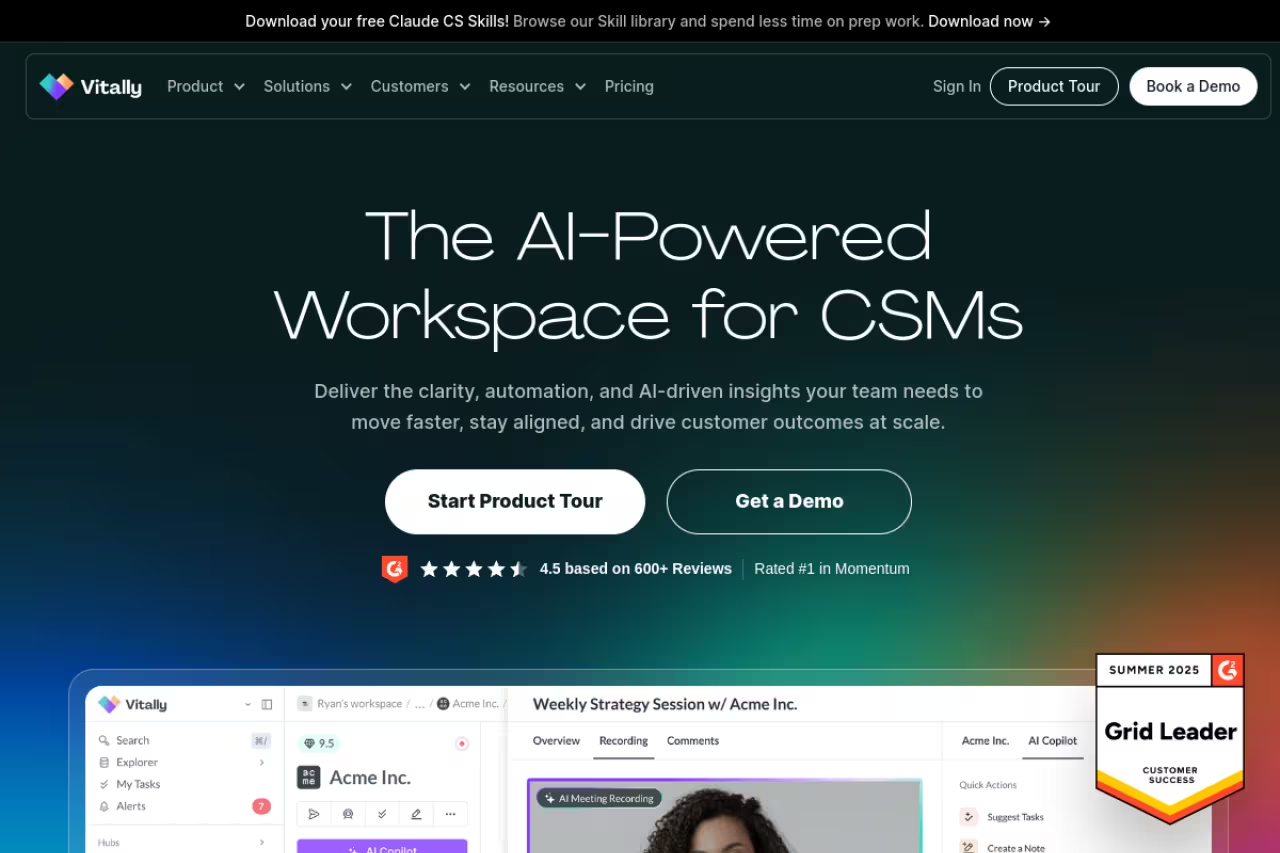
Vitally is the customer success platform I'd hand a growing SaaS team today. It pulls your product usage, CRM data, support tickets and billing into one account view, scores health, and triggers playbooks when an account starts slipping. That's table stakes for the category. What sets it apart in 2026 is the AI copilot baked into the workflow.
The copilot writes the account recaps your CSMs were supposed to write and never did. It transcribes calls, pulls out action items, surfaces risk signals like a sudden drop in logins, and drafts the follow-up email with the account context already filled in. For a team where each CSM owns 40-plus accounts, that's the difference between actually doing the proactive work and just firefighting renewals.
Who it's for: B2B SaaS companies past the seed stage with a real CS function, somewhere between 5 and 50 customer-facing seats.
The customer success platform to start with for B2B SaaS companies past the seed stage with a real CS function. The AI copilot is the draw, but pricing is custom with no free plan, and it's overkill below 50 customers.
Custom only, no public list price. Transaction data points to roughly $18,000 to $30,000 per year for small teams managing 100 to 300 accounts, with multi-year deals shaving 15-30% off. It scores 4.5 on G2.
The catch: No free plan, no transparent pricing, and you'll sit through a sales demo. It's also overkill if you have fewer than 50 customers. At that scale a spreadsheet and a calendar reminder do the same job for free.
ChurnZero: account-level health scoring done right
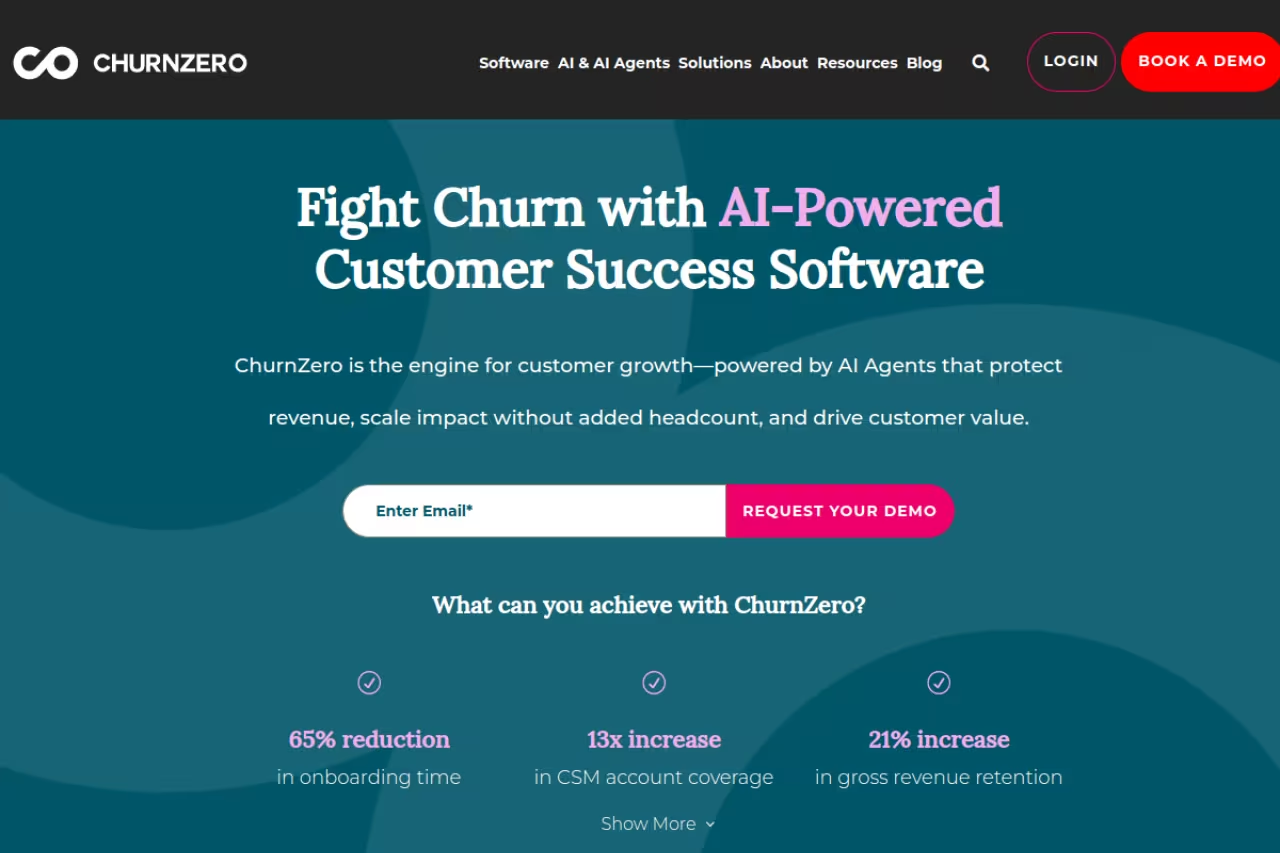
ChurnZero is the platform that made "customer health score" a standard term in SaaS. It tracks how each account uses your product, flags the ones trending toward cancellation, and lets your team intervene with automated email campaigns and in-app messages that fire based on behavior, not a calendar.
The in-app messaging is the feature I'd buy it for. You can drop a targeted message into your product for accounts that haven't touched a key feature, nudging adoption right where the customer already is instead of in an inbox they ignore. Paired with health scoring, it closes the loop between spotting risk and acting on it.
Who it's for: Subscription businesses with a defined customer success team that manages accounts, not individual users.
ChurnZero suits subscription businesses with a defined CS team that manages accounts. Health scoring plus behavior-triggered in-app messaging closes the loop, but onboarding can add $5,000 to $25,000 and the interface feels dated.
ChurnZero prices on the number of customer accounts you manage, not seats. According to a HubSpot Marketplace listing and buyer data, the entry point sits around $12,000 to $16,000 per year, climbing past $100,000 for deployments over 2,000 accounts.
Where it falls short: Onboarding and configuration are billed separately and can run $5,000 to $25,000 on top. Budget for implementation, not just the license. The interface also feels dated next to newer players like Vitally.
Recurly: stop losing money to failed credit cards
Here's the retention problem nobody talks about: a chunk of your churn isn't customers choosing to leave. It's expired cards, insufficient funds, and declined transactions. This is involuntary churn, and Chargebee's own data puts it at 20 to 40% of total attrition. You can have the best CS team alive and still bleed revenue here.
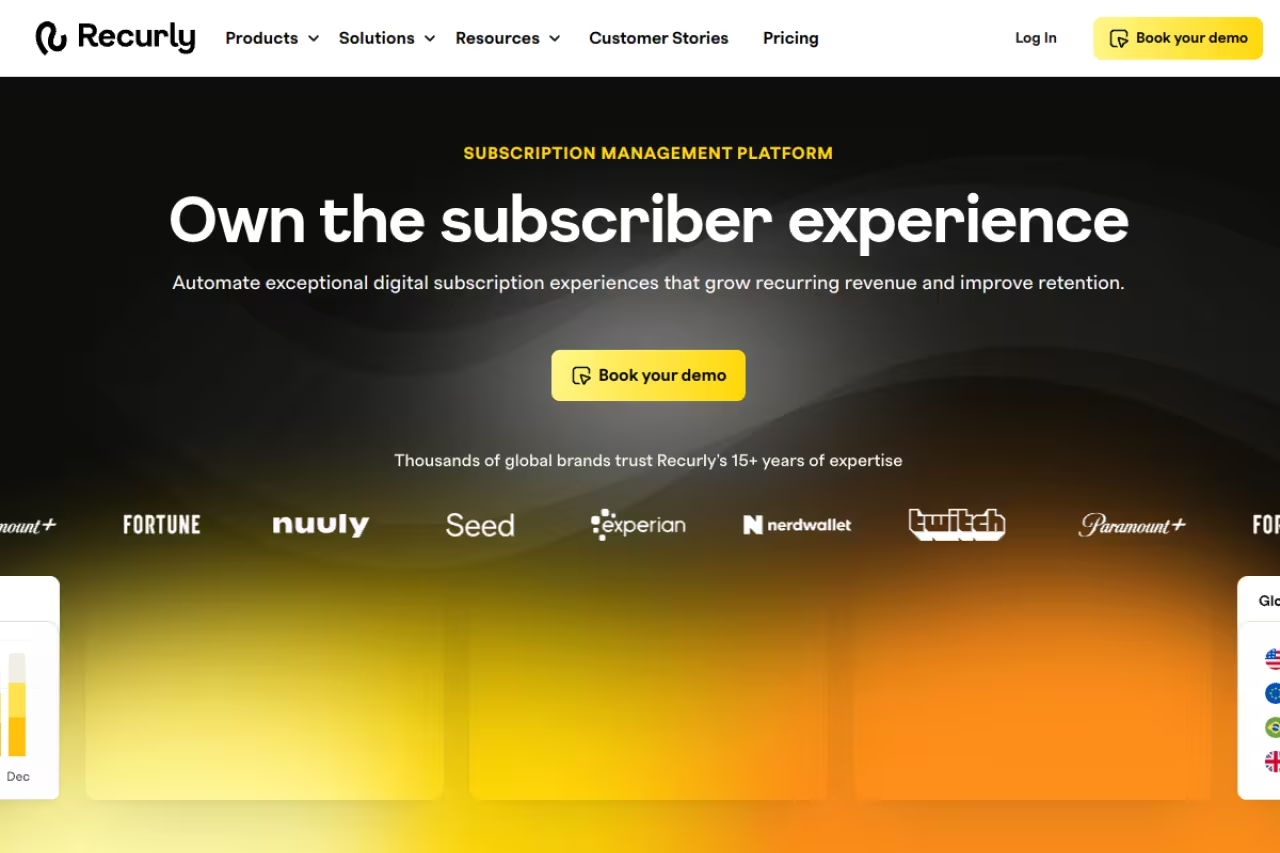
Recurly is built to plug that leak. Its dunning engine retries failed payments using smart logic tuned to card network signals, then runs recovery email campaigns. The company reports recovering over 70% of failed transactions and pushing involuntary churn as low as 1% for some customers. It also handles cancellation flows, offering a pause or discount at the moment a customer clicks cancel.
Who it's for: Subscription and B2C businesses with high transaction volume where failed payments are a meaningful slice of lost revenue.
Pick Recurly if failed payments are a meaningful slice of your lost revenue, especially for subscription and B2C businesses with high transaction volume. It's billing infrastructure, not a CS tool, so pair it with a platform rather than replace one.
Custom quote, and it typically starts higher than Chargebee. You're paying for payment optimization at scale.
The catch: This is billing infrastructure, not a customer success tool. It won't tell you why an engaged customer is unhappy. It only recovers the ones whose cards failed. Pair it with a CS platform, don't replace one.

Gainsight: the enterprise standard
Gainsight is the platform large enterprises run their CS operation on, and Forrester named it a Leader in the category. The flagship product packs 34-plus modules covering health scoring, account 360 views, survey feedback, and heavy automation through its Rules Engine and Journey Orchestrator. Gainsight PX adds in-app product analytics that feed usage data straight back into health scores.
Who it's for: Companies running large-scale, ops-heavy retention programs with a dedicated CS operations team to configure and maintain it.
The enterprise standard for large, ops-heavy retention programs with a dedicated CS operations team. The power is real, but expect six figures and a lot of admin overhead, which makes it a sledgehammer for a 20-person startup.
Custom and firmly enterprise. Expect six figures once you account for modules and implementation.
Where it falls short: The power is real, but so is the overhead. You need someone whose actual job is administering Gainsight. For a 20-person startup it's a sledgehammer for a thumbtack, and newer tools deliver most of the value with a fraction of the setup.

Custify: customer success without the enterprise tax
If Gainsight is the sledgehammer, Custify is the precision tool for lean teams. It does the core CS job well: usage tracking, health scores, automated lifecycle workflows, and clear dashboards, without the modular sprawl and six-month implementation. Teams I've seen adopt it get value in weeks, not quarters.
Who it's for: Small to mid-market B2B SaaS companies that want a real CS platform but don't have an ops team to babysit it.
The precision tool for small to mid-market B2B SaaS teams that want a real CS platform without an ops team to babysit it. Value comes in weeks, but there's no free plan or trial and the integration library is thinner.
No public list price, sold by quote. Reported entry points range from around $199 per month on the low end to roughly $899 per month for about three full seats, scaling with the number of customers you manage.
The catch: No free plan and no self-serve trial, so you're back to booking a demo. The integration library is also thinner than Gainsight's, so check your stack is supported before committing.
Picking the right retention stack is one piece of a bigger growth puzzle. If you want the signal without the vendor spin, Dupple X breaks down the tools and tactics that actually move retention and revenue, with a yearly trial you can test risk-free.

Chargebee: transparent billing with built-in dunning
Chargebee is the subscription billing platform I point self-serve SaaS companies toward, partly because it's one of the few in this guide with public pricing. The Starter tier is free until you cross $250,000 in cumulative billing, then runs 0.75% on overage. The Performance plan is $7,188 per year for up to $100,000 in monthly billing.
On retention specifically, its dunning engine retries failed payments using card network retry recommendations and sends customizable recovery sequences, recovering 20-40% of involuntary churn depending on your payment mix. It also handles flexible billing models, checkout, and 35-plus payment gateways.
Who it's for: Early to mid-stage SaaS running self-serve subscriptions that wants billing plus involuntary-churn recovery in one tool, without an enterprise contract.
Where it falls short: It's billing-first. The retention features are strong on the involuntary side but won't help with engaged customers who are quietly losing interest. For the under-$50k MRR crowd, though, the transparent pricing is hard to beat.
Chargebee suits early to mid-stage SaaS running self-serve subscriptions that wants billing and involuntary-churn recovery in one tool. Transparent pricing is its edge, but it's billing-first and won't help disengaged customers.

Mixpanel: figure out why they're actually leaving
Every tool above acts on churn signals. Mixpanel tells you what the signals mean. It's a product analytics platform, and its retention cohort reports are the clearest way I know to see which features keep users coming back and which onboarding steps lose them. If your churn is a mystery, start here before you buy a CS platform.
Who it's for: Product and growth teams that want to diagnose churn at the behavior level, not just react to it.
Start here if your churn is a mystery and you want product and growth teams diagnosing it at the behavior level. Retention cohorts are clear and the free plan is useful, but it's the X-ray, not the treatment.
The free plan now covers up to 1 million monthly events with 12 months of data retention and full retention analysis, which is genuinely useful for a small product. The Growth tier starts at $20 per month, scaling with event volume. Heavy usage gets expensive fast: 10 million events runs into the low thousands per month.
The catch: Mixpanel diagnoses, it doesn't intervene. There's no health scoring, no playbooks, no dunning. It's the X-ray, not the treatment. Pair it with a CS or billing tool that acts on what you find. For the analytics side of the stack, our guide to the best AI predictive analytics tools goes deeper.

Userpilot: retention that starts at onboarding
The cheapest churn to prevent is the customer who never activated. Userpilot attacks retention at the front of the funnel with in-app onboarding: interactive tours, checklists, tooltips and announcements that you build without writing code. Better activation means fewer customers who sign up, get lost, and quietly disappear before the first renewal.
In 2026 it added Lia, an AI agent aimed at activation and retention, plus multi-channel Workflows for orchestrating in-app messaging alongside email.
Who it's for: Product and growth teams at SaaS companies where onboarding friction and low feature adoption drive churn.
Userpilot is the pick for SaaS product and growth teams whose churn comes from onboarding friction and low adoption. It starts at $249 per month, but it's an adoption tool without health scoring, and costs climb with user count.
Starts at $249 per month billed annually for the Starter plan covering up to 2,000 monthly active users. Growth runs around $749 per month, with Enterprise from roughly $4,000.
Where it falls short: It's an adoption tool, not a full retention platform. No account health scoring or billing recovery here. Pricing also climbs steeply with your monthly active user count, so a high-traffic product can hit Enterprise pricing faster than expected.
How to choose
Don't buy a category. Diagnose where your churn lives first, then buy the tool that fixes that specific leak.
Your churn is failed payments. Recovery is the highest-ROI fix in this whole list because the customer already wanted to stay. Get Recurly for high transaction volume, or Chargebee if you want billing plus dunning with transparent pricing.
You don't know why people leave. Start with Mixpanel and its free tier. Find the behavior that predicts churn before you spend on a platform to act on it.
Customers churn after a weak start. Fix activation with Userpilot. Onboarding is the cheapest churn to prevent.
You have a real CS team managing accounts. This is where the heavyweight platforms earn their keep. Vitally for a modern, AI-forward team. Custify if you want lean and fast. Gainsight only if you're a large enterprise with ops headcount to run it.
The mistake I see most often is buying a $30k CS platform when 30% of churn was failed credit cards a $250-a-month billing tool would have caught. Match the tool to the leak. If you want a wider view of the adjacent stack, our roundups of the best AI customer success tools and best AI customer support tools are worth a look, and you can browse our full top tools directory by category.
Whichever tools you land on, staying ahead of the curve is half the battle. Dupple X tracks the tools, tactics and shifts reshaping retention and growth, so you spend less time researching and more time keeping customers.
FAQ
What is customer retention software?
Customer retention software is any tool that helps you keep existing customers from leaving. In practice it splits into three jobs: customer success platforms (like Vitally and ChurnZero) that track account health and trigger interventions, billing tools (like Recurly and Chargebee) that recover failed payments, and product analytics (like Mixpanel) that diagnose why users churn. Most teams end up using one from at least two of those buckets.
How much does customer retention software cost in 2026?
It ranges enormously. Product analytics like Mixpanel start free and scale with usage. In-app tools like Userpilot start around $249 a month. Full customer success platforms (Vitally, ChurnZero, Gainsight, Custify) are mostly custom-quoted and land anywhere from roughly $12,000 to well past $100,000 per year, driven by how many customer accounts you manage plus separate implementation fees.
What is involuntary churn and why does it matter?
Involuntary churn is when customers leave not by choice but because a payment failed: an expired card, insufficient funds, or a declined transaction. Chargebee estimates it accounts for 20 to 40% of total customer attrition. It matters because it's the easiest churn to recover. The customer still wants your product. Dunning tools in Recurly and Chargebee retry failed payments automatically and recover a large share of that lost revenue.
Do I need a customer success platform if I'm a small startup?
Probably not yet. If you have fewer than 50 customers, a spreadsheet, a shared calendar, and a free Mixpanel account cover most of the job. Customer success platforms earn their cost once you have enough accounts that no single person can keep them all in their head, typically when you've hired dedicated CS staff. Before that, focus your retention budget on fixing onboarding and recovering failed payments.
What's the difference between a CS platform and billing software for retention?
A customer success platform watches engagement: it scores account health, flags accounts that are losing interest, and prompts your team to intervene before renewal. Billing software watches money: it recovers failed payments and manages cancellation flows at checkout. They solve different leaks. CS platforms catch voluntary churn (customers who are unhappy), billing tools catch involuntary churn (payments that failed). Many subscription businesses need both.
Related guides
Some offers on this page may be paid placements or contain affiliate links.
