
Best AI Search Engines in 2026: 8 Tools Compared for Research

Key facts8 tools compared: Perplexity, ChatGPT Search, Google AI Mode, You.com (ARI), Brave Search +…
- 8 tools compared: Perplexity, ChatGPT Search, Google AI Mode, You.com (ARI), Brave Search + Leo, Felo, Exa, Andi
- Perplexity (best for: Everyday cited search): Free / $20 mo
- ChatGPT Search (best for: Search inside a full AI stack): Free / $20 mo
- Google AI Mode (best for: Replacing default Google): Free
- You.com (ARI) (best for: Professional-grade reports): $20 mo / Enterprise
Google still answers 9 out of 10 web searches, but its grip is slipping. Its global share dropped from roughly 92.9% in 2023 to about 89.6% by mid-2025, and the reason is sitting in your other browser tab: an AI that reads ten sources for you and hands back a single answer with citations.
The catch is that "AI search engine" now covers wildly different products. Some are research agents that read 400 sources at once. Some are privacy tools that refuse to log a thing. Some are just a chatbot with a web toggle. Picking wrong means paying $200 a month for something a free tier would have done, or trusting an answer that quietly hallucinated a statistic.
I compared eight of them across factual lookups, deep research capability, coding support, and citation quality, based on documentation and public user reports. The short version: Perplexity is still the default for most people because its inline citations are the easiest to audit. But the right pick depends on what you do all day, so here's the full breakdown. If you want a wider view of what's worth using right now, our top AI tools roundup covers the broader stack.
Quick comparison
| Tool | Best for | Price | Standout |
|---|---|---|---|
| Perplexity | Everyday cited search | Free / $20 mo | Inline citations, model picker |
| ChatGPT Search | Search inside a full AI stack | Free / $20 mo | Web access plus Agent Mode |
| Google AI Mode | Replacing default Google | Free | Gemini answers, zero setup |
| You.com (ARI) | Professional-grade reports | $20 mo / Enterprise | Reads 400+ sources per report |
| Brave Search + Leo | Privacy-first browsing | Free / $14.99 mo | Own index, no tracking |
| Felo | Multilingual research | Free / ~$9.99 mo | Cross-language search |
| Exa | Developers and agents | Free tier / from $40 mo | Neural search API, sub-200ms |
| Andi | Free, no-account search | Free | Conversational, ad-free |

Perplexity: the one most people should start with
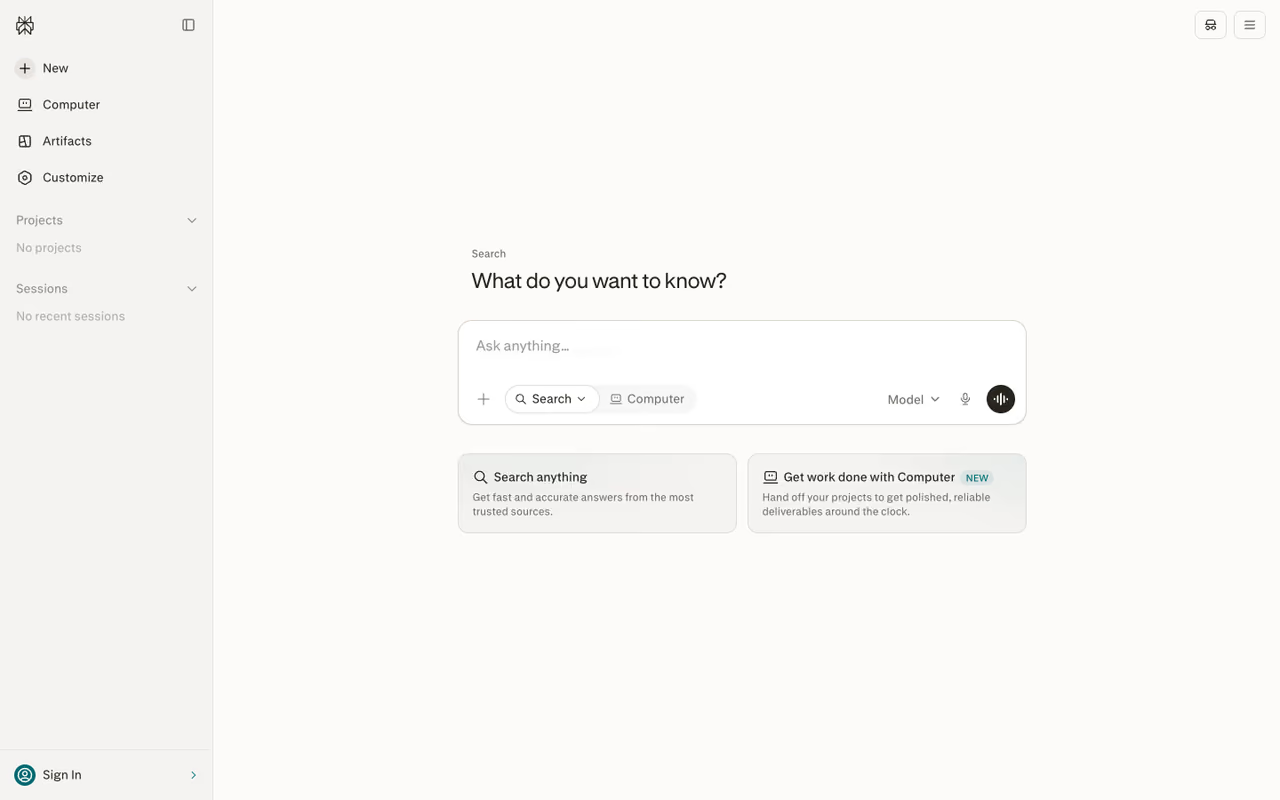
Perplexity is an answer engine. You ask a question, it searches the live web, and it writes a short response with numbered citations next to each claim. Click a number and you land on the source. That auditability is why it became the category default.
The one most people should start with, especially journalists, analysts and founders who do quick factual lookups and want to verify before trusting. The numbered citations are the draw, and the free tier covers unlimited basic searches.
Journalists, analysts, founders checking a market stat. The free tier handles unlimited basic searches plus a small daily allowance of Pro Searches and Deep Research runs (around 3 and 5 per day at the time of writing). Pro is $20/month or $200/year and unlocks the model picker, so you can route a query through GPT-5.6 Terra, Claude Sonnet 5 or Gemini 3.7 Flash, per Perplexity's model list, instead of letting Perplexity choose for you. The Max plan sits way up at $200/month for people living in Deep Research and Labs all day.
The standout in 2026 is reach. Comet, Perplexity's AI browser, went fully free in March 2026 after a year gated behind Max. Agentic search, page summaries, and Deep Research now run from inside the browser at no cost, though agent tasks burn credits and the free allocation is thin.
The catch: on the free tier you don't control which model answers. The "Auto" router picks for you and won't say which Sonar variant it used, so two identical questions can return different depth. If model choice matters, you're paying $20.
ChatGPT Search: search wrapped in everything else
ChatGPT Search isn't a standalone product so much as web access bolted onto the most-used AI in the world, which now handles over 2 billion queries a day. Ask a current-events question and it searches, cites, and answers inside the same thread where you also write code, generate images, and run Agent Mode.
It's best when search is one step in a longer task. You research a competitor, then have it draft the outreach email, then build a comparison table, all without leaving the chat. Free users get web search, file uploads, and image analysis on GPT-5.6 Luna, though the free tier may show ads and uploads are capped tightly. Plus is $20/month and runs GPT-5.6 Sol with deep research, ChatGPT Work, and no ads. There's a cheaper $8 Go plan, plus $100 and $200 Pro tiers above Plus.
The standout is depth inside the stack. For a multi-step workflow, ChatGPT with GPT-5.6 reasons further than a pure search tool will.
Where it falls short: citations are clumsier than Perplexity's, and ChatGPT is more willing to answer from memory when it should have searched. For pure fact-checking, that's a real liability.
Pick ChatGPT Search when search is one step in a longer task, like researching a competitor and then drafting the email. Its citations are clumsier than Perplexity's and it will sometimes answer from memory, which is a liability for pure fact-checking.
Google AI Mode: the default that came to you
You don't install Google AI Mode. It's already in the search box you've used for twenty years. Type a longer, conversational query and Google generates a synthesized answer powered by Gemini, with links underneath. The search box even expands as you type to nudge you toward longer questions.
The right choice if you do not want to change your habits, since it is free inside the search box with no new login. Answer quality is more uneven than the dedicated tools, and on hard research questions Perplexity or You.com dig deeper.
No new tab, no new login, no subscription. AI Mode is free in Google Search with no Google One subscription required. If you want the heavier Gemini app with bigger limits, Google AI Pro is $19.99/month and AI Ultra starts at $100/month with 5x the usage allowance.
The standout is friction, or the lack of it. Zero setup, instant reach, and it's tied to the index that still covers more of the web than anyone else.
The catch: answer quality is more uneven than the dedicated tools. AI Mode is tuned for speed and breadth, so on genuinely hard research questions it gives a decent summary where Perplexity or You.com would dig deeper. The Gemini app also moved to a confusing "compute-used" model that throttles based on prompt complexity, so your remaining limit is hard to predict.

You.com: when you need an actual report
You.com pivoted hard toward research depth, and ARI (its professional research agent) is the result. Instead of skimming a handful of pages, ARI processes 400+ sources at once while keeping context across all of them, then writes a structured report. In You.com's own benchmarks, ARI beat OpenAI's Deep Research on accuracy, though vendor numbers deserve a pinch of salt. This is built for output you'd hand to a client or a boss, not a one-line answer.
The one to use when you need an actual report to hand a client or boss, since ARI reads 400+ sources in one pass. The benchmarks are the vendor's own, and it is overkill for everyday questions with a consumer experience thinner than Perplexity's.
The consumer Pro plan is $20/month for all models, file uploads, and bigger context windows. ARI itself is priced per report rather than per compute, which lines cost up with the value of the deliverable, and the heavier ARI capacity lives in the Enterprise tier with custom pricing. For developers, You.com also sells a Deep Search API at roughly $15 per research call with $100 in free credits to test.
The standout is source volume. Nothing else here reads hundreds of sources in a single pass and holds the thread together.
Where it falls short: it's overkill for everyday questions, and the consumer experience feels thinner than Perplexity's now that the company's focus has shifted to enterprise and API. If you just want to know when a conference starts, this is the wrong tool.

Brave Search and Leo: the privacy pick
Brave Search runs on its own independent web index, not Google's or Bing's, and it doesn't track what you search. Pair it with Leo, the AI assistant built into the Brave browser, and you get summaries, page analysis, and translation without an account or a data trail. Chats aren't logged or used for training.
The privacy pick for people who would rather not feed every query into an advertising profile, backed by an independent index and a free Leo assistant. You trade a little answer quality for a lot of privacy, and long-tail queries occasionally hit gaps.
Search is free. Ad-free search is $3/month. Leo Premium is $14.99/month for higher rate limits and access to stronger models, but the free Leo already covers everyday summarizing and Q&A.
The standout is the independent index. Most "alternative" search engines quietly resell Google or Bing results. Brave actually crawls its own, which makes it one of the few genuine alternatives rather than a reskin.
The catch: the index, while real, is smaller than Google's, so for long-tail or very local queries you'll occasionally find gaps. And Leo's AI answers, while private, aren't as sharp or as well-cited as Perplexity's. You're trading a little answer quality for a lot of privacy. For some people that's an easy trade. If the browser itself is what you're choosing, my best AI browser breakdown compares Brave, Comet, and the rest head to head.
Keeping track of which of these tools shipped something real this week is its own job. Dupple X does that part for you, so you can skip the changelog crawl.
Felo: built for crossing languages
Felo is an AI search engine designed around multilingual research. Ask a question in English and it pulls and summarizes results from sources in other languages, translating as it goes. If your work crosses borders, academic databases, or non-English markets, this solves a problem the US-centric tools mostly ignore.
A specialist for international researchers and market analysts who need results from Japanese, German or Mandarin sources without a separate translator, at $9.99 a month. For monolingual English research it adds little over Perplexity.
The pricing is refreshingly simple: a usable free tier with cross-language search and AI summaries, and Pro at $9.99/month billed annually. That's roughly $80/year cheaper than Perplexity Pro and $120/year less than the equivalent Gemini plan, which makes it one of the better values on this list.
The standout is real-time cross-language search. It collapses the search-then-translate-then-summarize dance into one step.
Where it falls short: for monolingual English research it doesn't add much over Perplexity, and its ecosystem is smaller, so you won't find the same depth of integrations. It's a specialist that's excellent at its specialty and merely fine outside it.
Exa: the search engine built for your agents
Exa isn't a chat box. It's a search API built so LLMs and AI agents can read the live web, and it's the quiet infrastructure behind tools you already use. It powers search for Cursor, Cognition, HubSpot, and OpenRouter, and reached a $2.2B valuation in May 2026 off the back of 400,000+ developers.
Exa is for engineers building research agents, RAG pipelines or monitoring tools that need fresh web data, with usage-based pricing and a free tier. It is the engine, not the car, so there is nothing here if you do not write code.
Its neural search understands meaning instead of matching keywords, so it surfaces conceptually related pages a keyword engine would miss. The newer Exa Instant returns results in under 200ms, which matters when an agent fires off dozens of searches per task. This pairs naturally with the AI coding agents and terminal coding tools that increasingly call out to the web mid-task.
Pricing is usage-based: a free tier with 1,000 searches a month, Pro from $40/month, and roughly $5 per 1,000 queries for keyword search or $10 per 1,000 for neural search with content, per Exa's pricing page.
The catch: this is not a consumer tool. If you don't write code, there's nothing here for you. It's the engine, not the car. For builders, though, it's one of the cleanest ways to give an agent eyes on the web.
Andi: free, no account, no ads
Andi is the minimalist of the group. It's a conversational search engine that's fully free, requires no account, and shows no ads. You ask, it answers in plain language with sources, and that's it. No upsell, no credit system, no login wall.
A minimalist choice for casual users who want a cleaner, ad-free alternative to Google with no account or subscription. It lacks Deep Research, a model picker and agentic browsing, so treat it as a lightweight daily driver.
It's also a fine starting point if you're AI-search-curious and not ready to pick a paid tool.
The standout is simplicity. Zero friction, zero cost, no heavy data collection. For a quick answer you read and move on from, it does the job.
Where it falls short: it doesn't match the depth, model quality, or research features of the paid players. No Deep Research mode, no model picker, no agentic browsing. Treat it as a lightweight daily driver, not a research workstation.
How to choose without overthinking it
Start from your actual workload, not the feature list.
If you do frequent factual lookups and need to verify, default to Perplexity. The inline citations are the most auditable in the category, and the free tier is enough for most people.
If search is one step inside bigger tasks like writing, coding, or running agents, stay in ChatGPT and use its web search. You won't want to keep switching tools mid-flow.
If you want zero behavior change, Google AI Mode is already in your search bar for free. Use it until you hit a wall, then upgrade to a specialist.
If you produce research reports for clients or stakeholders, You.com's ARI is built for exactly that and nothing else does the 400-source pass as well.
If privacy is non-negotiable, Brave Search plus Leo is the only pick here running its own index without tracking you. For multilingual work, Felo. For building agents and apps, Exa's API. For a free no-account daily driver, Andi.
My honest advice: pick one paid tool and one free fallback. Most people get 90% of the value from Perplexity Pro or ChatGPT Plus plus the free Google AI Mode for everything quick. If you're building or evaluating these tools rather than just using them, our team at Dupple X tracks the AI stack weekly so you don't have to.
It also helps to understand the plumbing underneath. Many of these engines lean on retrieval pipelines and the kind of infrastructure covered in RAG tools and vector databases, and if you care about how your brand shows up inside AI answers, that's a separate discipline worth reading up on in GEO tools.
Frequently asked questions
What is the best AI search engine in 2026?
For most people, Perplexity is the best all-around AI search engine because its inline citations make every answer easy to verify, and the free tier covers everyday use. ChatGPT Search is the better pick if you want search inside a fuller AI workspace, and You.com's ARI wins for long, source-heavy research reports. The right answer depends on whether you need quick lookups, deep research, privacy, or code.
Is Perplexity better than ChatGPT for search?
For pure search and fact-checking, yes. Perplexity's citations are cleaner and it's more disciplined about searching the live web before answering, which makes it easier to trust. ChatGPT is stronger when search is one part of a larger task, because it can reason, write, code, and run agents in the same thread. Many people use both: Perplexity to verify, ChatGPT to build.
Are AI search engines free to use?
Several good ones are completely free. Google AI Mode, Andi, and Brave Search cost nothing, and Perplexity, ChatGPT Search, and Felo all have usable free tiers. Paid plans (typically around $20/month) unlock things like advanced model selection, Deep Research limits, agent features, and ad-free use. You can get a long way without paying anything.
How accurate are AI search engines?
More accurate than they were, but not infallible. Tools with strong inline citations like Perplexity are the safest because you can click through and check the source yourself. The real risk is any tool answering from its training memory instead of searching, which is where outdated or invented facts slip in. The rule that holds: trust the citation, not the summary.
Which AI search engine is best for privacy?
Brave Search paired with Leo is the strongest privacy pick. Brave runs its own independent web index, doesn't track your searches, and Leo's chats aren't logged or used for training, with no account required. The mainstream tools from Google and OpenAI collect far more, so if a clean data trail matters, Brave is the clear choice even with a slightly smaller index.
Can an AI search engine replace Google?
For a growing share of queries, it already has. If your searches are questions you want answered (rather than a specific website you're trying to reach) a tool like Perplexity or ChatGPT often gets you there faster with sources attached. Google still wins for navigation, local results, shopping, and the long tail its index covers best. Most people end up using both rather than fully switching.
Related guides
Some offers on this page may be paid placements or contain affiliate links.
