
Best AI Market Research Tools (2026): 8 Compared

Key facts8 tools compared: Outset, Perplexity, SparkToro, Attest, Semrush, Brandwatch, Exploding…
- 8 tools compared: Outset, Perplexity, SparkToro, Attest, Semrush, Brandwatch, Exploding Topics, Qualtrics
- Outset (best for: AI-moderated interviews at scale): Custom quote
- Perplexity (best for: Fast secondary research): Free / $20 mo
- SparkToro (best for: Audience intelligence): Free / $50-$300 mo
- Attest (best for: Survey panels on demand): Custom (credit-based)
Market research used to mean six weeks, a panel vendor, and a deck nobody read. Then AI ate the slow parts. You can now run a hundred moderated interviews overnight, map an audience in 90 seconds, and watch a trend break before it hits your category. The hard part in 2026 is no longer doing the research. It is picking the tool that actually answers your question.
I spend a lot of time researching these products, partly because I write about them and partly because I keep needing to validate ideas for real. So I compared eight of them on their documentation and public user reports, and checked every price against the official page. Some are purpose-built research platforms. Some are SEO or social tools that happen to be excellent at intelligence work. A couple are general AI assistants that quietly replaced a junior analyst.
If you want the short version: Outset is my top pick for primary qualitative research, because AI-moderated interviews at scale is the thing that genuinely changes how fast a team can learn from customers. But the right tool depends on whether you need to talk to people, watch a market, or just answer a question fast. Here is how they sort out.
Quick comparison
| Tool | Best for | Price | Standout |
|---|---|---|---|
| Outset | AI-moderated interviews at scale | Custom quote | Voice/video interviews in 40+ languages |
| Perplexity | Fast secondary research | Free / $20 mo | Cited answers with live web data |
| SparkToro | Audience intelligence | Free / $50-$300 mo | Plain-language audience search |
| Attest | Survey panels on demand | Custom (credit-based) | 125M+ vetted respondents |
| Semrush | Competitive + SEO intelligence | $139.95-$499.95 mo | 43T backlink index |
| Brandwatch | Social listening | ~$800-$5,000+ mo | 1.7T historical conversations |
| Exploding Topics | Trend detection | $39-$249 mo | Spotting demand before it spikes |
| Qualtrics | Enterprise survey + synthetic | Custom (~$20K+ yr) | Survey rigor plus AI respondents |

Outset: the one I reach for first
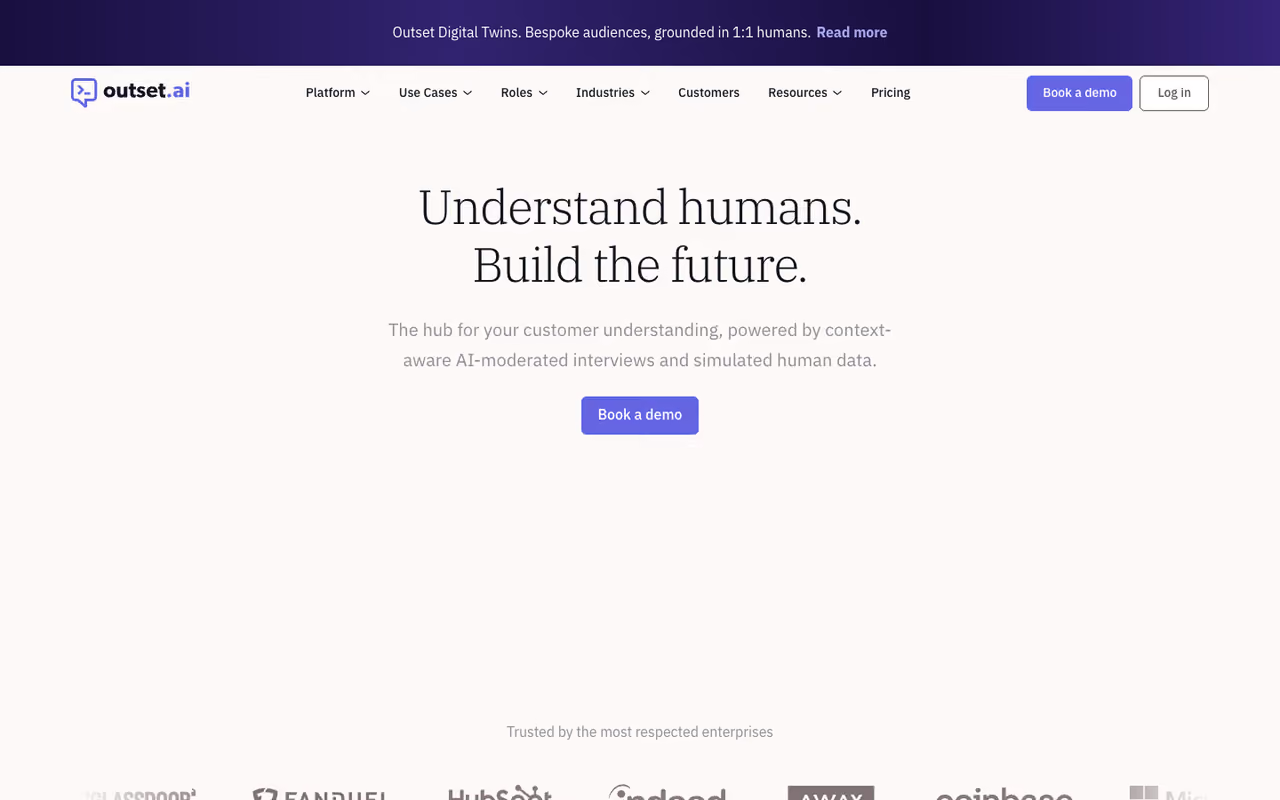
Outset runs AI-moderated interviews. You write a discussion guide (or let the AI draft one), point it at respondents, and the AI conducts text, voice, or video conversations that probe follow-ups like a decent moderator would. Then it synthesizes everything into themes while the interviews are still running, turning a concept test into readable findings within a day rather than the weeks a traditional moderated study takes.
Who it is best for: insight teams and founders who need real qualitative depth but cannot wait weeks for a moderator to run sessions one at a time. It supports 40+ languages, which matters more than it sounds if you sell outside one market.
The pick for insight teams and founders who need real qualitative depth fast. AI-moderated interviews synthesize into themes while sessions are still running, but pricing is custom and unpublished, so expect to negotiate.
Pricing: custom. Outset does not publish numbers and quotes you based on team size and support needs. The interesting bit is the billing model. According to their own breakdown, you are charged for live research questions asked during interviews, while screening questions, probes, test runs, and analysis are not billed. Cost scales with depth, not volume of throwaway questions.
The catch: no public pricing means you talk to sales before you know if you can afford it, and the AI moderator, while strong, still misses the human read on a hesitation or an eye-roll that a sharp researcher would chase. Treat it as your first 80%, then validate the rest.

Perplexity: secondary research without the tab graveyard
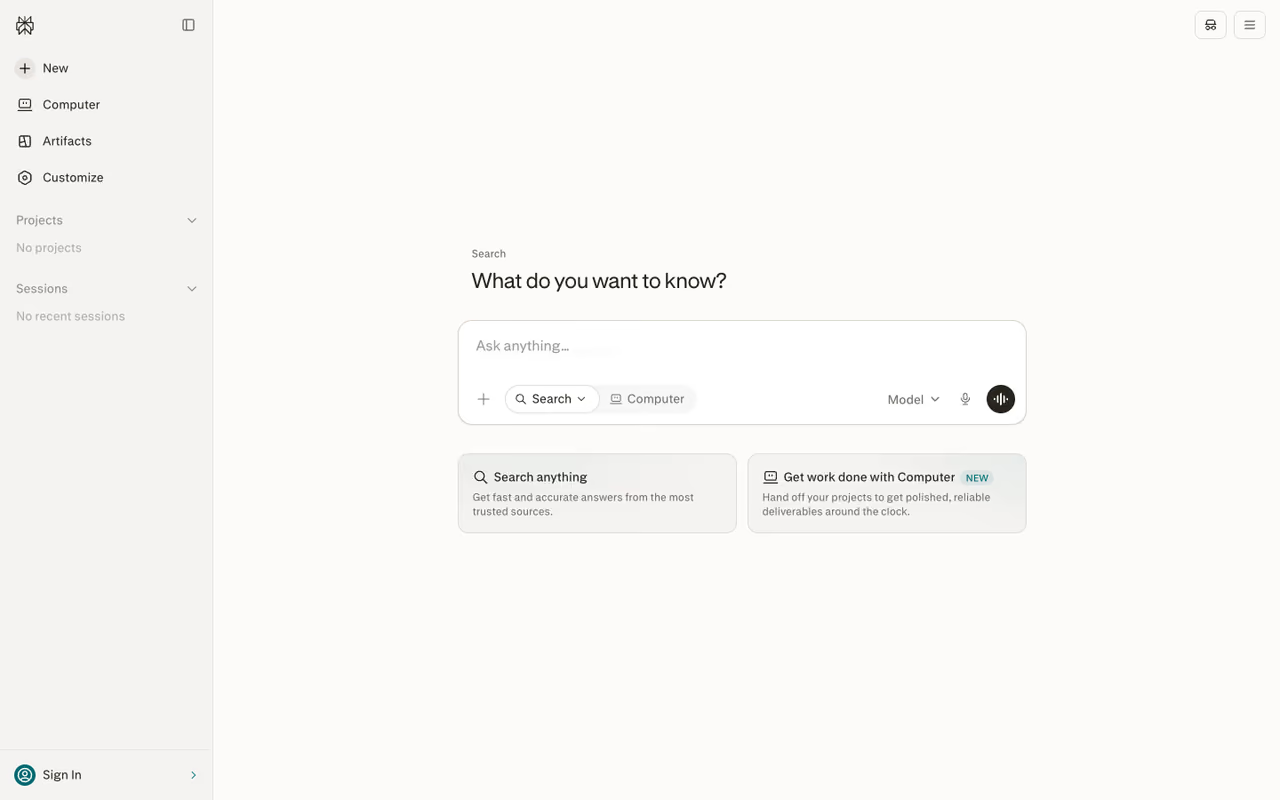
Perplexity is the tool I open before I open anything else. Ask it about a market, a competitor's funding, a category's CAGR, and it searches the live web, writes a direct answer, and footnotes every claim with a source you can click. For desk research, that citation trail is the whole point. You are not trusting a black box, you are reading the receipts.
Who it is best for: anyone doing fast secondary research, fact-checking a stat before it goes in a deck, or scoping a market they do not know yet. It is the cheapest serious entry on this list.
Start here for fast desk research and stat checks. Perplexity footnotes every claim with a clickable source, and the free tier is useful. It is a research assistant, not a replacement for primary research.
Pricing: the free tier is genuinely useful. Pro is $20/month for unlimited Pro searches, file uploads, and access to frontier models like Claude and GPT. Max runs $200/month for heavy agentic workflows. For most research jobs, Pro is plenty.
The catch: it is a research assistant, not a research method. It will not run a survey or interview a customer. And because it summarizes the open web, it inherits the web's biases. Great for "what is happening," useless for "what do my specific buyers think." Pair it with a primary tool.
SparkToro: where your audience actually hangs out
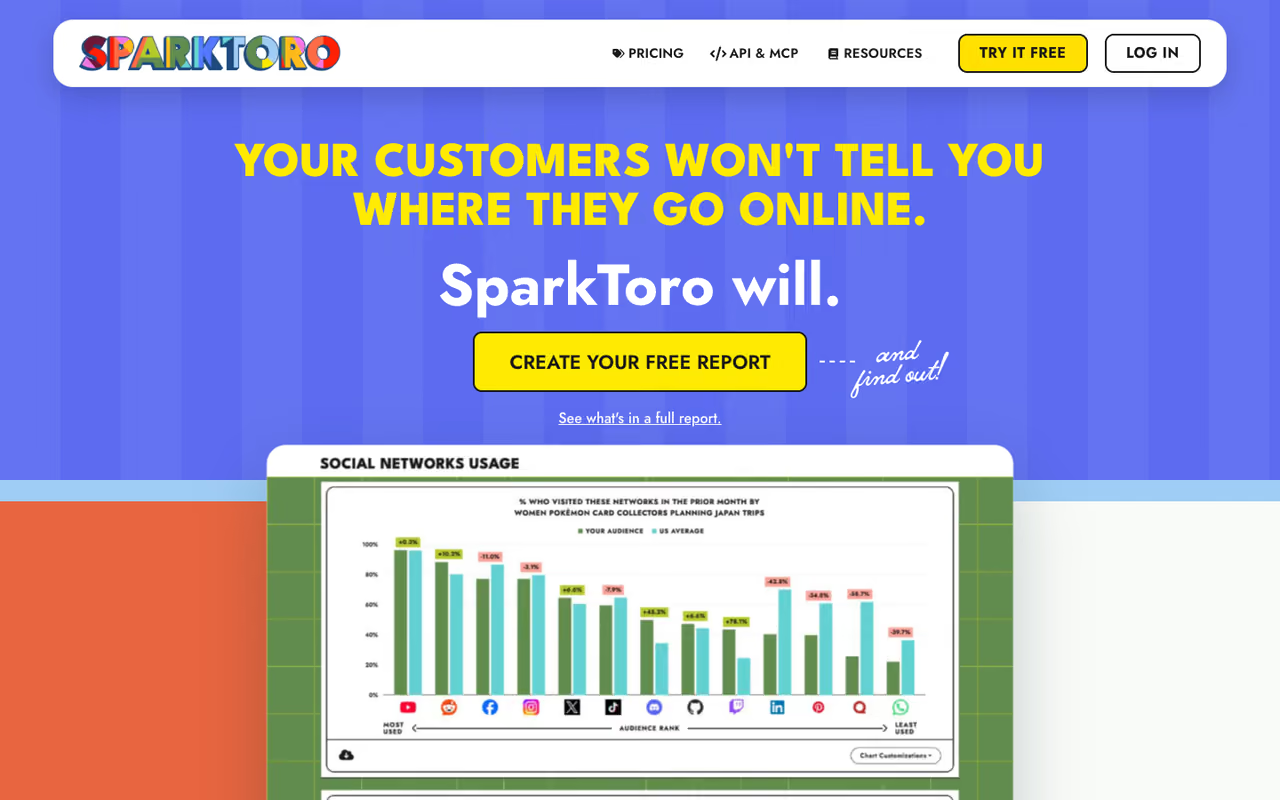
SparkToro answers a question every marketer asks and few can answer with data: where does my audience spend attention? Describe a group ("attorneys at small US law firms who want better websites") and it returns the websites they read, podcasts they hear, YouTube channels, social accounts, and search terms they use. In January 2026 they added plain-language audience descriptions, so you no longer need to start from a single seed account.
Who it is best for: content marketers, brand strategists, and anyone planning where to advertise or pitch. It is audience intelligence, not survey research, but it is the fastest way I know to stop guessing about channels.
A fast way to stop guessing where your audience spends attention, ideal for content marketers and brand strategists planning where to advertise. It is audience intelligence, not survey research, so do not expect survey-grade answers.
Pricing: a free plan gives you 5 reports a month. Personal is $50/month for 50 reports, Business $150/month for 500 reports and full demographic data, Agency $300/month for unlimited reports and up to 100 users.
The catch: it tells you where attention lives, not why people buy. The demographic data is directional, not census-grade, and for tiny niche audiences the sample thins out. It is a discovery tool that points you toward the next research step.
If you are running this kind of audience and channel research to grow your own newsletter or product, the Dupple X newsletter growth program is built around exactly this loop of finding an audience and reaching it. More on that below.
Attest: surveys with a panel attached
Attest closes the gap between "I want to ask 500 people" and "I have nobody to ask." It bundles a self-serve survey builder with access to a vetted consumer panel of 125 million-plus respondents across 59 markets, and AI helps with question design and reading the results. You can field a brand-tracking wave or a concept test and get representative answers in hours.
Who it is best for: brand and product teams running recurring quantitative research who do not want to manage a separate panel vendor. The continuous tracking workflow is where it shines.
Pick Attest if you want to ask people questions without sourcing a separate panel vendor. Brand and product teams get a survey builder plus a vetted panel, but pricing is credit-based and custom, so ask for the math first.
Pricing: custom, and credit-based. Attest does not post self-serve prices. You buy response credits, and a meaningful program tends to start in the low thousands per year once you factor platform access plus panel responses. Ask for the credit math before you commit.
The catch: the panel is the value and the cost. For a startup testing one idea, paying for ongoing panel access can feel heavy versus a cheaper one-off survey tool. And like all panel work, garbage questions produce confident garbage answers, so the AI assist does not save you from sloppy survey design.

Semrush: competitive intelligence that happens to do SEO
Semrush is filed under SEO, but for competitive research it is hard to beat. You can see a competitor's organic and paid keywords, traffic estimates, ad copy, content gaps, and backlink profile against an index of 43 trillion links. For understanding how rivals acquire customers online, that is a primary source, not a guess.
Who it is best for: marketing teams already living in search who want competitive and category intelligence in the same place they do their SEO work.
A strong choice for marketing teams already living in search who also want competitor intel. It is a lot of tool if you never touch SEO, and its traffic numbers are modeled estimates.
Pricing: Pro is $139.95/month, Guru $249.95/month, Business $499.95/month, with roughly 17% off on annual billing. There is a 7-day trial.
The catch: it is a lot of tool. If you only need competitor intel and never touch SEO, you are paying for a suite you will half-use. And traffic numbers are modeled estimates, directionally right but not the competitor's real analytics. Read them as signals, not gospel.

Brandwatch: listening at enterprise scale
Brandwatch is the heavyweight for social listening and consumer trend research. It draws on around 1.7 trillion historical conversations with AI sentiment analysis, so you can track how a brand, product, or category is discussed across social, news, forums, and reviews. When a narrative shifts about your space, this is where you see it first.
Who it is best for: larger brands doing reputation monitoring, crisis detection, and consumer trend research where breadth of historical data is the deciding factor.
The heavyweight for larger brands doing reputation monitoring, crisis detection and trend research where historical breadth decides it. Pricing is custom and climbs fast, so it is overkill for a small team.
Pricing: custom and not published. Real-world quotes for a professional team start around $800 to $1,000/month and climb past $5,000/month for enterprise scope with deep historical access and multiple seats. Annual contracts and onboarding fees are normal.
The catch: it is enterprise software with enterprise friction. Overkill and overpriced for a small team, and you will need someone who can build queries well or the firehose drowns your signal. Budget for setup time, not just license cost.
Exploding Topics: catch demand before the spike
Exploding Topics does one thing and does it unusually well: it surfaces topics, products, and startups gaining momentum before they go mainstream. It scans search and social signals to flag growth curves early, with forecasting on the higher tiers. For finding a market gap or a product wedge, getting there 6 to 12 months early is the whole edge.
Who it is best for: founders, investors, and product marketers hunting for the next category or the angle nobody is writing about yet.
Go with Exploding Topics if you are a founder, investor or product marketer hunting for the next category before it goes mainstream. It spots trends but does not validate them for your business.
Pricing: Entrepreneur is $39/month (100 tracked trends), Investor $99/month (500 trends, forecasting), Business $249/month (2,000 trends, reports). Annual billing cuts the entry price hard. There is a 7-day trial.
The catch: it spots trends, it does not validate them for your business. A topic exploding on the internet does not mean your buyers want it. Use it to generate hypotheses, then test them with a survey or interviews. On its own it is inspiration, not evidence.
Qualtrics: rigor, plus synthetic respondents
Qualtrics is the survey platform big research teams standardize on, and in 2026 it added synthetic respondents to the mix: AI-generated answers that simulate how a defined audience might respond, so you can pre-test a study before spending on real fieldwork. The survey engine itself remains the gold standard for advanced logic, conjoint, and statistical analysis.
Who it is best for: enterprise insight teams that need methodological rigor, governance, and the option to blend real and AI-simulated responses.
The rigorous option for enterprise insight teams that want governance, advanced survey logic and the choice to blend in synthetic respondents. It is expensive and built for teams, and the synthetic answers deserve skepticism.
Pricing: mostly custom. Vendr data puts the median buyer around $28,500/year, with a self-serve Strategic Research tier published at $420/month billed annually. Enterprise XM contracts typically start near $20,000/year.
The catch: it is expensive and built for teams, not solo researchers. On synthetic respondents specifically, be skeptical. Validation studies show AI responses correlate with real people at roughly 80 to 95% on directional questions but fall apart on segmentation nuance. Use them to sharpen a study, not to replace humans.
How to choose
Skip the feature checklist. Pick based on the question you are actually trying to answer.
You need to hear from real customers. Go primary. Outset for qualitative depth, Attest for representative quantitative data, Qualtrics if you need enterprise rigor and have the budget. This is the research that actually de-risks a decision.
You need to understand a market or a competitor fast. Go secondary. Perplexity for desk research with citations, Semrush for competitive acquisition intel, Exploding Topics for what is about to break. Cheap, fast, and good enough to scope before you commit to fieldwork.
You need to know your audience and where they are. SparkToro for channels and attention, Brandwatch for sentiment and conversation at scale. Different budgets, same job of mapping the people, not just the numbers.
The mistake I see most is buying a heavy enterprise platform for a question a $20 Perplexity subscription would answer. Start with the cheapest tool that can plausibly answer it, then move up only when you hit a wall. For most teams, that means one secondary tool, one audience tool, and one primary research platform when a real decision is on the line. You can build a serious research stack for under $300/month before you ever talk to a sales rep.
If your end goal is reaching the audience you research, not just studying it, that is the bet behind Dupple X: turn audience insight into actual newsletter growth. Worth a look if research is a means to an end for you.
FAQ
What is the best AI market research tool in 2026?
For primary research, Outset is my pick because AI-moderated interviews give you real qualitative depth at a speed that was impossible two years ago. For fast secondary research, Perplexity is the best value at $20/month. There is no single winner, the best tool depends on whether you need to talk to people, watch a market, or answer a question quickly.
Are AI market research tools accurate?
It depends on the type. Tools doing live web research (Perplexity) or pulling real survey data (Attest, Qualtrics) are as accurate as their sources. Synthetic respondents are more contested. Validation work shows they correlate with real people at roughly 80 to 95% on directional questions but struggle with audience segmentation, so most teams use them to pre-test a study, then validate with real respondents.
How much do AI market research tools cost?
A wide range. Trend and audience tools start at $39 to $50/month (Exploding Topics, SparkToro). Mid-tier intelligence suites run $140 to $500/month (Semrush). Enterprise platforms like Brandwatch, Attest, and Qualtrics are custom-quoted and typically start in the low thousands to tens of thousands per year. You can assemble a capable stack for under $300/month before any enterprise commitment.
Can AI replace traditional market research?
Not yet, and probably not entirely. AI replaces the slow, manual parts: moderating interviews, summarizing transcripts, scanning the web, pre-testing surveys. It does not replace human judgment about what to ask, which findings matter, or the nuance a sharp researcher reads in a pause or a contradiction. The strongest 2026 workflow uses AI for the first 80% and humans to validate the last 20%.
What is the cheapest way to start with AI market research?
Start with Perplexity's free tier for secondary research and SparkToro's free plan (5 reports a month) for audience intelligence. Together they cost nothing and cover a surprising amount of early-stage research. Upgrade to a paid survey or interview platform only when you have a real decision that needs primary data.
Which AI tool is best for competitive analysis?
Semrush for digital competitive intelligence, since it shows a rival's keywords, ads, traffic estimates, and backlinks against a 43-trillion-link index. For dedicated competitive intelligence with battlecards and win-loss tracking, purpose-built platforms like Crayon exist but run $20,000 or more per year. For most teams, Semrush plus Perplexity covers competitive research without that price tag.
Want more breakdowns like this? See our running list of the top AI tools, or dig into adjacent guides on the best AI agents and best AI for sales.
Related guides
Some offers on this page may be paid placements or contain affiliate links.
