
The 8 Best RAG Tools in 2026 (Compared)

Key facts8 tools compared: LangChain, LlamaIndex, RAGFlow, Haystack, Pinecone, Dify, Cohere Rerank…
- 8 tools compared: LangChain, LlamaIndex, RAGFlow, Haystack, Pinecone, Dify, Cohere Rerank, Ragie
- LangChain (best for: Full-control orchestration): Free (OSS); LangSmith $39/seat/mo
- LlamaIndex (best for: Complex document parsing): Free (OSS); LlamaCloud from $50/mo
- RAGFlow (best for: Working app with low code): Free (OSS, Apache-2.0)
- Haystack (best for: Production NLP pipelines): Free (OSS)
Retrieval-augmented generation went from a research curiosity to the default way to ground an LLM in your own data. If you're building anything that answers questions over documents, support tickets, or a product knowledge base, you're building RAG whether you call it that or not.
The problem is that "RAG tool" now means five different things. It's an orchestration framework. It's a document parser. It's a vector database. It's a reranker. It's a fully managed API you call and forget. Pick the wrong layer and you either reinvent infrastructure you didn't need to, or you hit a ceiling three months in.
I've compared most of these in depth and I'll tell you upfront: if you're a developer who wants control and the biggest ecosystem, start with LangChain. If your data is messy PDFs and tables, LlamaIndex parses them better than anything else. And if you want a working app without writing retrieval code, RAGFlow or a managed service like Ragie gets you there fastest. This guide is for engineers, technical founders, and AI operators deciding which layer of the stack to commit to.
Quick comparison
| Tool | Best for | Price | Standout |
|---|---|---|---|
| LangChain | Full-control orchestration | Free (OSS); LangSmith $39/seat/mo | 700+ integrations, LangGraph for agentic RAG |
| LlamaIndex | Complex document parsing | Free (OSS); LlamaCloud from $50/mo | Best-in-class PDF and table extraction |
| RAGFlow | Working app with low code | Free (OSS, Apache-2.0) | Deep document understanding, grounded citations |
| Haystack | Production NLP pipelines | Free (OSS) | Serializable, Kubernetes-ready pipelines |
| Pinecone | Managed vector storage | Free tier; Standard from $50/mo | Zero-ops serverless at billions of vectors |
| Dify | Visual RAG builder for teams | Free self-host; cloud from $59/mo | No-code interface non-engineers can use |
| Cohere Rerank | Precision boost on retrieval | $2 per 1,000 searches | Cheap accuracy lift on any pipeline |
| Ragie | RAG-as-a-service, no infra | Free dev tier; Starter $100/mo | Fully managed ingestion to retrieval |
LangChain: the default orchestration layer
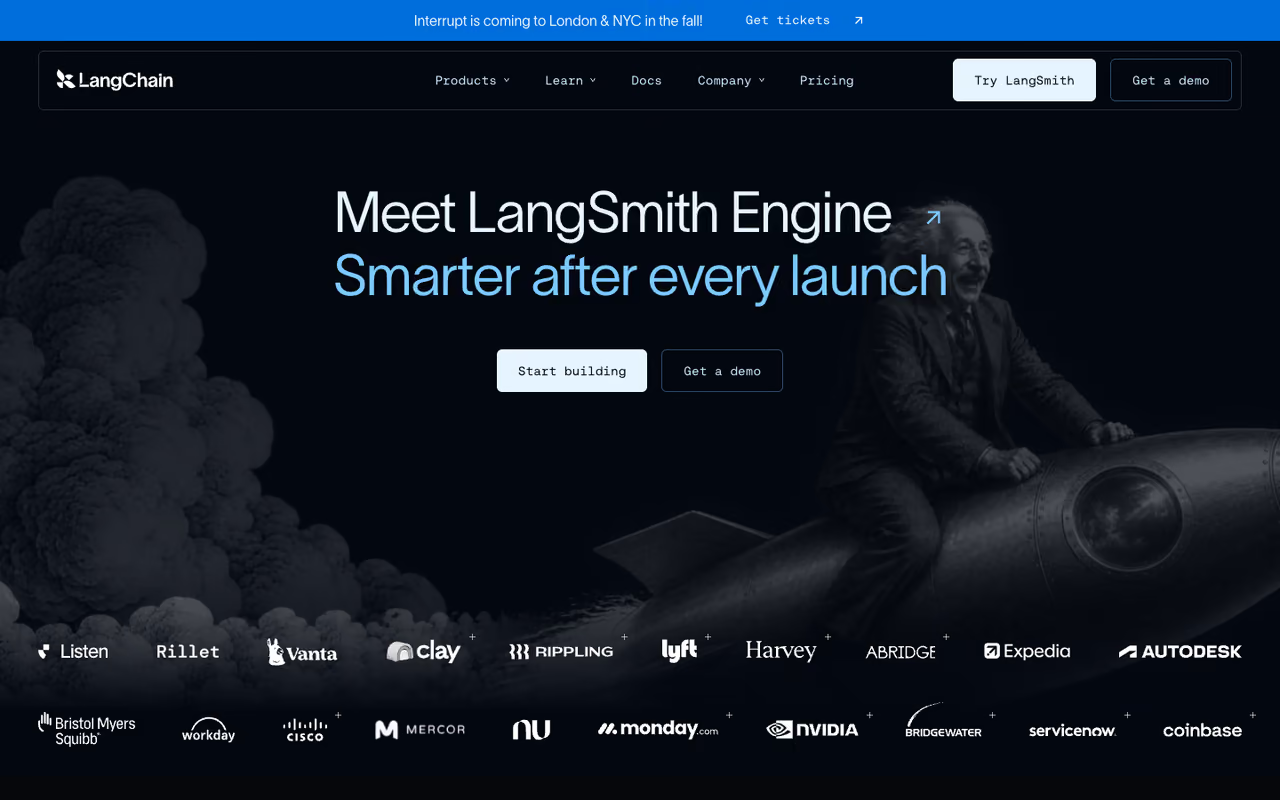
LangChain is the framework most RAG projects start with, and for good reason. It gives you composable building blocks (document loaders, text splitters, vector store connectors, retrievers) and glues them into chains you can swap piece by piece. With roughly 119K GitHub stars and 500+ integrations, almost any database, model, or loader you'd want already has a connector.
The default orchestration layer for developers who want full control and no vendor lock-in, backed by 500+ integrations. The flexibility is also the tax, with shifting abstractions, lagging docs and out-of-the-box retrieval accuracy around 85%.
The pricing is the easy part. The core framework is open source and free. You pay when you add LangSmith for tracing and evaluation, which starts at $39 per seat per month on the Plus tier. For agentic RAG, where the model decides what to retrieve and when, LangGraph adds stateful graph execution on top.
The standout is the ecosystem. When a new embedding model or vector store ships, LangChain usually supports it within days. You're rarely the first person to hit a problem.
The catch: that flexibility is also the tax. LangChain's abstractions change often, the docs lag the code, and simple tasks can require more boilerplate than you'd expect. Multiple third-party benchmarks put its out-of-the-box retrieval accuracy around 85%, behind LlamaIndex, mostly because parsing and chunking are left to you. It's powerful, but it's not the fastest path to a working demo. If your real goal is autonomous agents rather than Q&A, our guide to the best AI agent frameworks covers where LangGraph fits.

LlamaIndex: when your documents are a mess
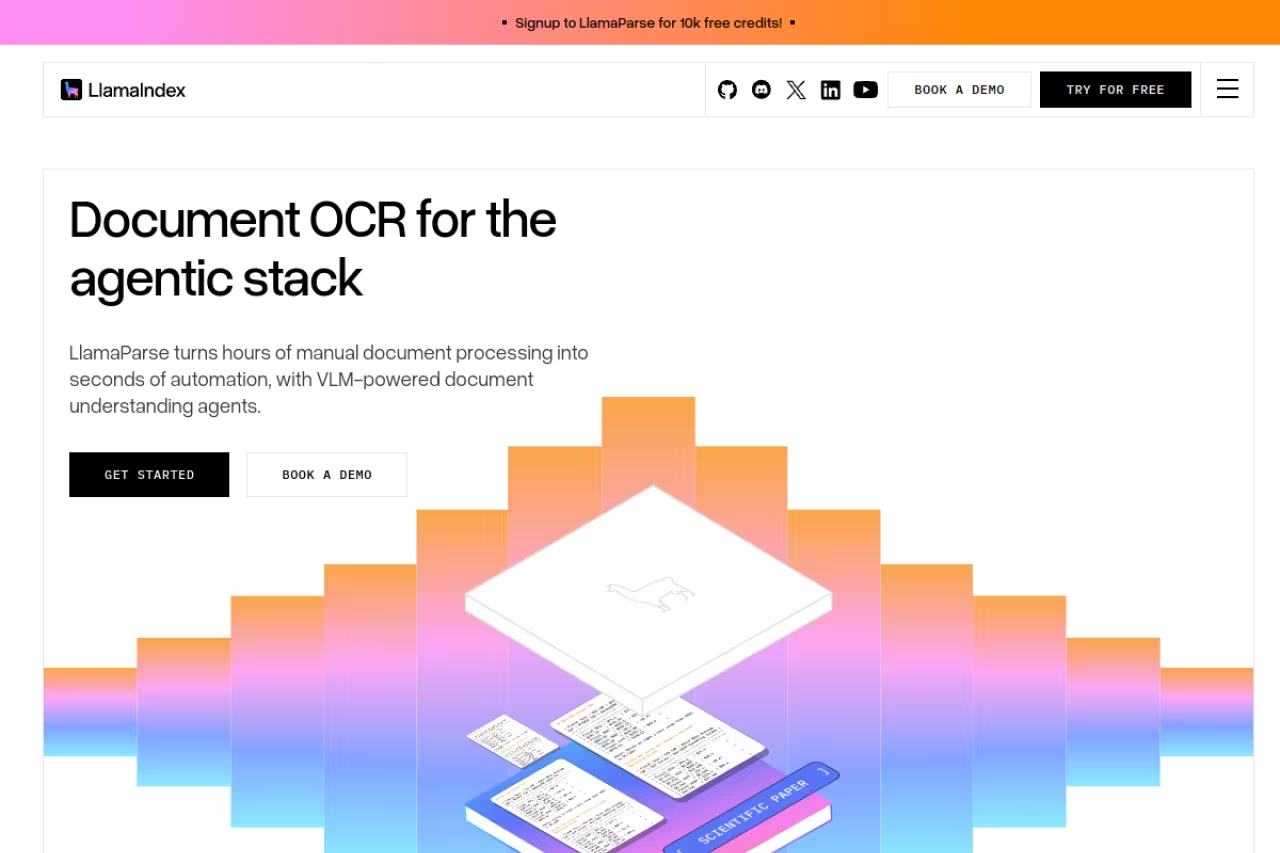
If LangChain is the generalist, LlamaIndex is the specialist in getting clean data out of ugly documents. It was built around indexing and retrieval from the start, and it shows when you throw nested PDFs, financial tables, or multi-format knowledge bases at it.
Pick LlamaIndex when retrieval quality is bottlenecked by document parsing rather than orchestration. It posts around 92% retrieval accuracy versus LangChain's 85%, and the gap widens on tables, but it is narrower and LlamaCloud credits can burn fast.
The framework is free and open source. The managed piece, LlamaCloud, handles parsing and infrastructure on a credit system: a free tier with 10K credits, then a Starter plan at $50/month with 40K credits, and a Pro plan at $500/month with 400K credits (1,000 credits is about $1.25). LlamaParse, its document parser, is the reason most people pay.
The standout is accuracy on hard documents. Multiple third-party benchmarks put LlamaIndex at around 92% retrieval accuracy versus LangChain's 85% on standard RAG test sets, and the gap widens on table-heavy or scanned content.
The catch: it's narrower than LangChain. If your app grows into complex multi-agent workflows or you need an integration LlamaIndex doesn't have, you may end up bolting LangChain on anyway. And LlamaCloud credits can burn fast in agentic parsing mode, so watch the meter on large ingestion jobs. If your bottleneck is purely extraction, also look at the dedicated AI document processing tools.
RAGFlow: a working pipeline without writing retrieval code
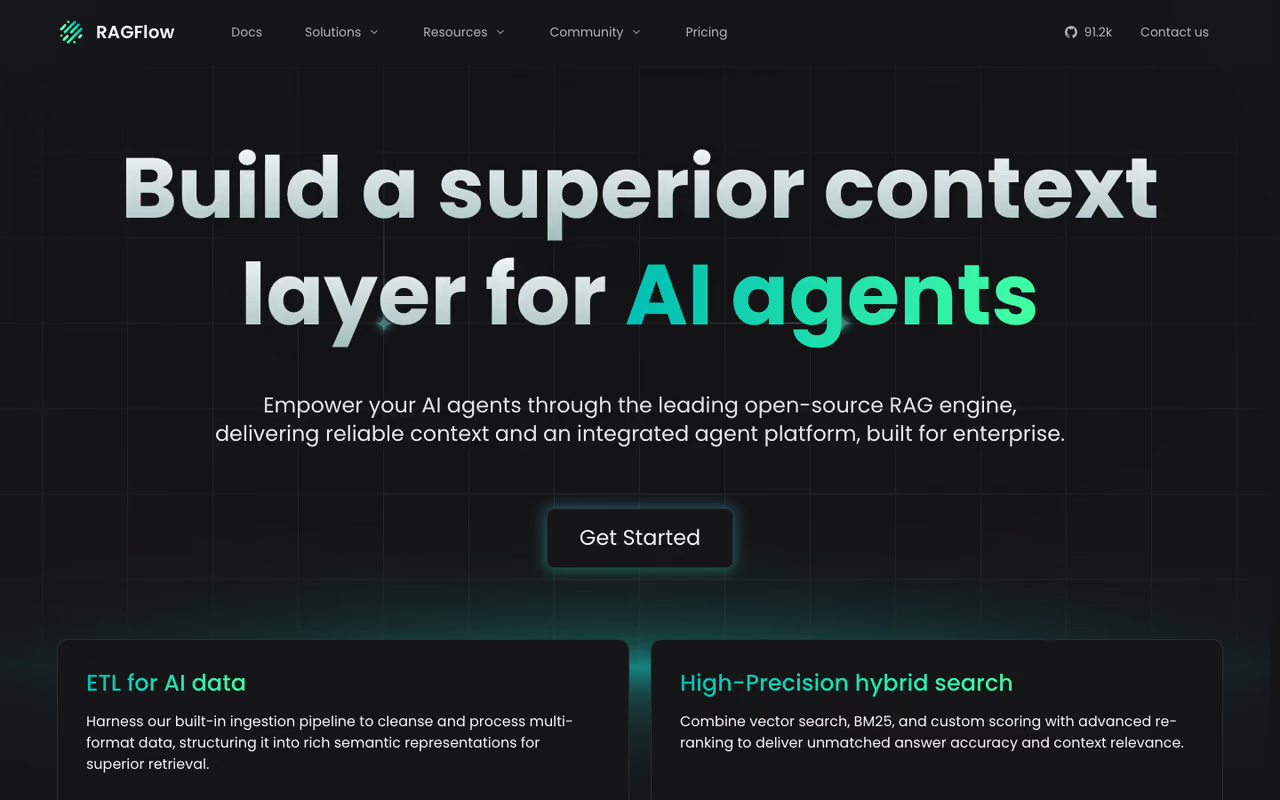
RAGFlow is the one I reach for when I want a real RAG app running by the end of the afternoon. It's an open-source engine (82.9K GitHub stars, Apache-2.0 license) with a visual, low-code interface for ingestion, chunking, and retrieval. You upload documents, pick a template, and it builds the pipeline.
Best for: people who want production-quality retrieval without assembling it from primitives.
It's free and self-hostable, with a hosted option at cloud.ragflow.io if you'd rather not run it yourself.
The standout is deep document understanding. RAGFlow does template-based intelligent chunking that respects document structure, and every answer comes with grounded citations pointing back to the source, which cuts hallucinations hard. It handles Word, slides, Excel, scanned images, web pages, and structured data out of the box.
The catch: the low-code interface is a ceiling as well as a floor. When you need custom retrieval logic or an exotic integration, you're working against the framework's opinions rather than with raw building blocks. Self-hosting also pulls in a heavier stack (it leans on its own infrastructure for document parsing), so it's not as light to deploy as a single Python library.
The one to reach for if you want production-quality retrieval without assembling it from primitives, with low-code ingestion and grounded citations. The visual interface becomes a ceiling when you need custom retrieval logic, and self-hosting pulls in a heavier stack.
If you're weighing the storage layer underneath any of these, our guide to the best vector databases breaks down where your embeddings should actually live.

Haystack: pipelines built for production
Haystack, from deepset, is the framework I trust most when something has to run reliably for a long time. It's modular and pipeline-based: you wire together retrievers, readers, routers, and generators with explicit control over each step. Version 2.x cleaned up the API considerably.
The framework to trust when a production NLP or RAG system must run reliably for a long time, with serializable, Kubernetes-ready pipelines. The community is smaller than LangChain's, and the rigid pipeline abstraction can feel heavy when you are just prototyping.
It's open source and free. deepset sells a managed enterprise platform on top if you want hosting and governance, but the framework itself costs nothing.
The standout is operational maturity. Haystack pipelines are serializable, cloud-agnostic, and Kubernetes-ready, with logging and monitoring built into the deployment story. It feels engineered rather than assembled, which matters when you're on call for the thing.
The catch: it's less trendy, so the community is smaller than LangChain's and you'll find fewer tutorials for the newest tricks. The pipeline abstraction is also more rigid. That rigidity is the point in production, but it can feel heavy when you're just prototyping an idea.

Pinecone: the storage layer you don't manage
A RAG pipeline is only as fast as its vector search, and Pinecone is the managed database most teams pick when they don't want to run that infrastructure themselves. Its serverless architecture lets you store billions of vectors without provisioning a server.
Best for: teams that want similarity search at scale with zero operational overhead.
Pinecone's pricing has four tiers: a free Starter (up to 2 GB storage, 2M write units and 1M read units per month, 5 indexes), a flat Builder plan at $20/month, a Standard plan at a $50/month minimum that grows with usage and ships with $300 in trial credits, and Enterprise at a $500/month minimum with a 99.95% uptime SLA and HIPAA compliance.
The standout is that it just works. No sharding, no index tuning, no capacity planning. You write vectors and query them, and Pinecone handles the rest with strong multi-tenant isolation.
The catch: convenience has a bill attached. Independent teardowns have shown vector database bills running well over budget at sustained load, and Pinecone's usage-based pricing can surprise you once an AI agent is hammering it. If cost is your main constraint, self-hosting Qdrant or running Milvus is meaningfully cheaper, at the price of running it yourself.
A managed vector database for teams that want similarity search at scale with zero operational overhead. It just works, but usage-based pricing can surprise you under sustained load, and self-hosting Qdrant or Milvus is meaningfully cheaper if you will run it yourself.
If you're going to put any of this in front of users, it's worth pairing your stack with a workflow that keeps you current on model and infra changes. Dupple X is the daily brief I use to track exactly that.

Dify: RAG your whole team can build with
Dify is the visual platform I recommend when the people building the app aren't all engineers. It's a no-code/low-code builder for LLM applications with solid RAG tooling built in, so a product manager or support lead can assemble a knowledge-base bot without opening a terminal.
Go with Dify when the people building the app are not all engineers, such as a product manager or support lead assembling a knowledge-base bot. Treat it as a fast on-ramp, since engineering teams needing deeply custom retrieval often outgrow it.
It's open source and free to self-host, with cloud plans starting at $59/month if you'd rather not manage it.
The standout is the visual builder. It collapses the time from idea to deployed app, and the shared interface means design, product, and engineering can all touch the same workflow.
The catch: abstraction always trades away control. For deeply custom retrieval logic or unusual data sources, Dify can feel constraining, and serious engineering teams often outgrow it and move to a code-first framework. Treat it as a fast on-ramp, not necessarily the destination.

Cohere Rerank: the cheapest accuracy win in RAG
Cohere Rerank isn't a full framework, it's a single step you bolt onto an existing pipeline, and it's one of the highest-use upgrades you can make. After your vector search returns the top candidates, the reranker reorders them by true relevance to the query, so the chunks you feed the LLM are actually the best ones.
A high-leverage upgrade for any RAG system where retrieval pulls roughly the right documents but ordering is noisy. At $0.001 per search it is cheap and predictable, but it is a component, not a solution, and adds a network call and latency to every query.
Rerank 3.5 is priced at $0.001 per search, or $2.00 per 1,000 searches, per Cohere's pricing. It bills per search rather than per token, which makes the cost trivial to predict.
The standout is the effort-to-impact ratio. Adding a reranker is a few lines of code and often lifts answer quality more than swapping your entire embedding model. Cohere's Embed v4 plus Rerank v3.5 plus Command R has become the canonical cheap-but-capable RAG stack.
The catch: it's a component, not a solution. It assumes you've already got retrieval, chunking, and generation working, and it adds a network call (and latency) to every query. If your base retrieval is fundamentally broken, reranking polishes the wrong results.
Ragie: RAG-as-a-service with no infrastructure
Ragie is the managed option for teams that want retrieval to be someone else's problem entirely. It's a fully managed RAG-as-a-service platform: you send documents through its API, and it handles ingestion, chunking, embedding, storage, and retrieval. You call one endpoint and get grounded answers back.
Pick Ragie if your product team wants RAG inside the app this week without a pipeline to maintain for years. You are renting, not owning: per-page pricing climbs with your corpus, and you get less control over retrieval internals from a younger vendor.
Ragie has a free Developer tier for testing, a Starter plan at $100/month for around 10K pages, a Pro plan at $500/month for around 60K pages, and custom Enterprise pricing. As of 2026 it's been aggressively courting customers migrating off other platforms with a free month of Pro.
The standout is how little you build. No vector database to provision, no chunking strategy to tune, no reranker to wire up. For a team without ML infrastructure experience, that's the difference between shipping and stalling.
The catch: you're renting, not owning. Per-page pricing climbs as your corpus grows, you have less control over retrieval internals, and you're betting on a younger vendor's roadmap and uptime. For a core product feature, some teams will want to own the stack instead.
How to choose
Don't pick a "RAG tool." Pick the layer of the problem you actually have.
If retrieval quality is fine and you just want control and integrations, use LangChain (or Haystack if you value production discipline over ecosystem size). If your documents are the bottleneck, start with LlamaIndex and its parser. If you want a working app fast and can live with a framework's opinions, use RAGFlow for self-hosting or Ragie if you'd rather not run anything.
Then layer in the supporting pieces. Pinecone is your storage if you don't want to manage a database. Cohere Rerank is a near-free accuracy boost you should add to almost any pipeline. Dify is the choice when non-engineers need to build alongside you.
One more rule: budget for evaluation before you scale. A RAG system that looks great on ten test questions can quietly degrade on the eleven-thousandth. Wire in measurement early. Our roundup of the best AI evaluation tools covers the options, and tools like Ragas give you reference-free metrics for faithfulness and relevance without hand-labeling data. You can also see how these slot into a wider stack in our top AI tools directory.
Want to keep up with how this stack shifts week to week? Start a Dupple X trial and get the AI tooling changes that matter, filtered for builders.
FAQ
What is the best RAG tool for beginners?
For a working app without writing retrieval code, RAGFlow's low-code interface or a managed service like Ragie gets you the furthest fastest. If you want to learn the moving parts while you build, LangChain has the most tutorials and community answers, though it asks more of you up front.
Is LangChain or LlamaIndex better for RAG?
They solve different problems. LangChain is the broader orchestration framework with more integrations and better support for agentic workflows. LlamaIndex is sharper at parsing and indexing complex documents, with third-party benchmarks showing higher out-of-the-box retrieval accuracy. Many teams use LlamaIndex for ingestion and LangChain for orchestration in the same project.
Are there free RAG tools?
Yes. LangChain, LlamaIndex, RAGFlow, Haystack, and Dify are all open source and free to self-host. Pinecone, Cohere, and Ragie offer free tiers for testing. The cost usually shows up later in managed services, vector storage at scale, and API usage rather than the frameworks themselves.
Do I need a vector database for RAG?
For anything beyond a small prototype, yes. A vector database stores your embeddings and serves fast similarity search at scale. Pinecone is the easiest managed option, while Qdrant and Milvus are strong open-source choices you run yourself. See our best vector databases guide for the full comparison.
What does a reranker actually do in a RAG pipeline?
After your initial vector search returns candidate chunks, a reranker like Cohere Rerank reorders them by true relevance to the query, so the most useful passages reach the LLM. It's one of the cheapest ways to improve answer quality, typically a few lines of code and around $2 per 1,000 searches.
How much does it cost to run a RAG system?
It depends entirely on scale and which layers you manage. Self-hosting open-source frameworks on your own infrastructure can be nearly free for low volume. Managed stacks add up: expect $50 to $500+ per month for vector storage, parsing credits, and reranking once you're in production, plus your LLM API bill, which often dominates the total.
Related guides
Some offers on this page may be paid placements or contain affiliate links.
Across our whole catalogue the median is $24 a month and 33% of tools advertise a free tier. Figures are the lowest recurring monthly price quoted in our own review of each tool, read on 2026-08-19. Full method and every category.
