
The Best AI Research Tools in 2026 (Compared and Ranked)

Key facts8 tools compared: Perplexity, ChatGPT Deep Research, Elicit, Consensus, Gemini + NotebookLM…
- 8 tools compared: Perplexity, ChatGPT Deep Research, Elicit, Consensus, Gemini + NotebookLM, Scite, ResearchRabbit, Claude
- Perplexity (best for: Fast, cited web research): Free / $20 mo
- ChatGPT Deep Research (best for: Deepest, longest reports): $20 to $200 mo
- Elicit (best for: Academic literature reviews): Free / $12 to $49 mo
- Consensus (best for: Quick scientific consensus): Free / $8.99 mo
"AI research tool" means two different things depending on who you ask. To a founder writing a market memo, it's Perplexity firing off a 30-source briefing in three minutes. To a PhD student running a systematic review, it's Elicit pulling sample sizes out of 200 papers into a clean table. Both are good. They are not interchangeable.
I spent the last few weeks comparing documentation, pricing, and public user reports for every serious option, the general deep-research agents and the academic-paper specialists, to find which ones actually save time and which just look busy while they spin. The gap is bigger than the marketing suggests.
If you want one answer: Perplexity is the tool most people should start with. It's fast, it cites everything, and the $20/month Pro plan gives you more deep-research runs than you'll use in a day. But if your work lives in peer-reviewed papers, Perplexity isn't enough, and I'll tell you exactly where it stops. Here's the full ranking.
Quick comparison
| Tool | Best for | Price | Standout |
|---|---|---|---|
| Perplexity | Fast, cited web research | Free / $20 mo | 20 deep-research runs a day |
| ChatGPT Deep Research | Deepest, longest reports | $20 to $200 mo | Browses 50 to 100 sources per query |
| Elicit | Academic literature reviews | Free / $12 to $49 mo | Structured data extraction from papers |
| Consensus | Quick scientific consensus | Free / $8.99 mo | "Consensus Meter" across studies |
| Gemini + NotebookLM | Google Workspace users | Free / $20 mo | Grounds answers in your own docs |
| Scite | Citation credibility checks | $20 mo | Supporting vs contrasting citations |
| ResearchRabbit | Visual paper discovery | Free | Citation-graph maps |
| Claude | Reasoning over messy sources | Free / $20 to $200 mo | Best at synthesis and nuance |

Perplexity, the default for most people
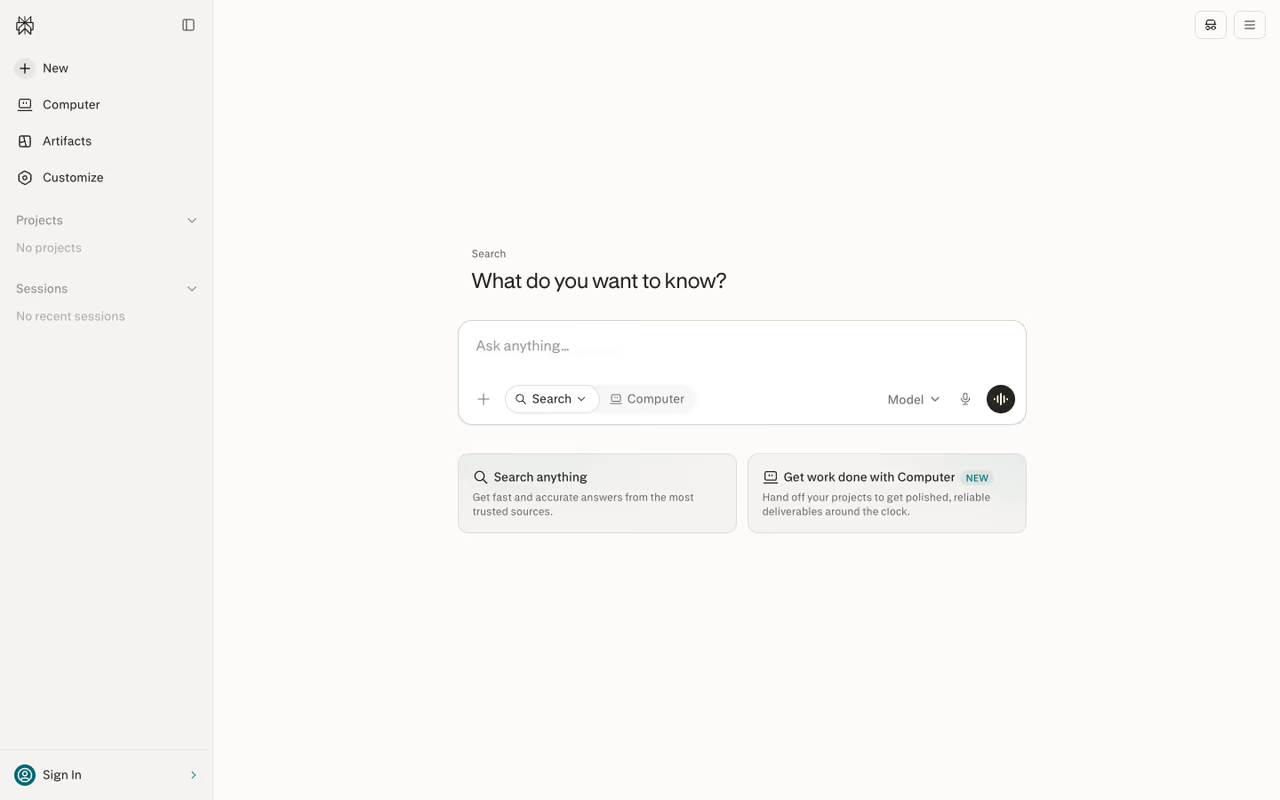
Perplexity is a search engine that answers in prose, with numbered citations next to every claim. You ask a question, it reads the web, and it hands back a sourced summary you can actually trace. That last part is why it beats a plain chatbot for research: you can click through and check whether the AI actually understood the source.
Its Deep Research mode is the headline feature. Give it something thorny ("compare the unit economics of the top three meal-kit startups") and it runs an autonomous loop, reading dozens of pages and assembling a structured report in two to three minutes. Other tools dig deeper, but Perplexity gets you a usable briefing before your coffee cools.
Pick Perplexity if you are a founder, marketer or operator who needs a credible, traceable answer fast. Its reports are sharp briefings rather than deep essays, and it skips closed academic databases, so it is the wrong tool for peer-reviewed literature.
Free includes a handful of deep-research runs a day. Pro is $20/month and bumps that to 20 deep-research queries per day, plus model choice and $5 of monthly Sonar API credits. There's also a real Sonar API if you want to build on it.
The catch: Perplexity is encyclopedic, not exhaustive. Its reports read like a sharp briefing rather than a deep essay, and it doesn't search closed academic databases the way Elicit or Consensus do. For peer-reviewed literature it's the wrong tool. It also occasionally over-trusts a low-quality source, so the citations are there for a reason. Use them.
ChatGPT Deep Research, the one that goes deepest
ChatGPT Deep Research is the slow, thorough end of the spectrum. Where Perplexity sprints, this one takes its time, often 15 to 25 minutes, browsing 50 to 100 sources and reasoning visibly as it goes. When I asked all the tools a genuinely ambiguous strategy question, ChatGPT's report was the one I'd hand to a client without rewriting half of it.
OpenAI introduced Deep Research as an agent that plans, searches, and writes a long-form report with inline citations. The output reads closer to an analyst's memo than a search summary, which is what you want for decisions that matter.
The one to use when depth beats speed and someone else will read the report. A run takes 15 to 25 minutes, so it is no good for quick fact-checks, and the usage cap on Plus will ration you if you research daily.
Plus is $20/month with expanded deep research, which heavy users burn through fast. Pro costs $100/month for 5x Plus usage or $200/month for 20x, with maximum deep research and GPT-6 Pro, powered by GPT-6 Astra; new $200 sign-ups have been paused since September 10, 2026.
The catch: that 10-run cap on Plus is brutal if you research daily. You'll feel rationed. And the long runtime means it's no good for quick fact-checks. This is a tool you batch your hard questions into, not one you ping all day.

Elicit, the literature-review workhorse
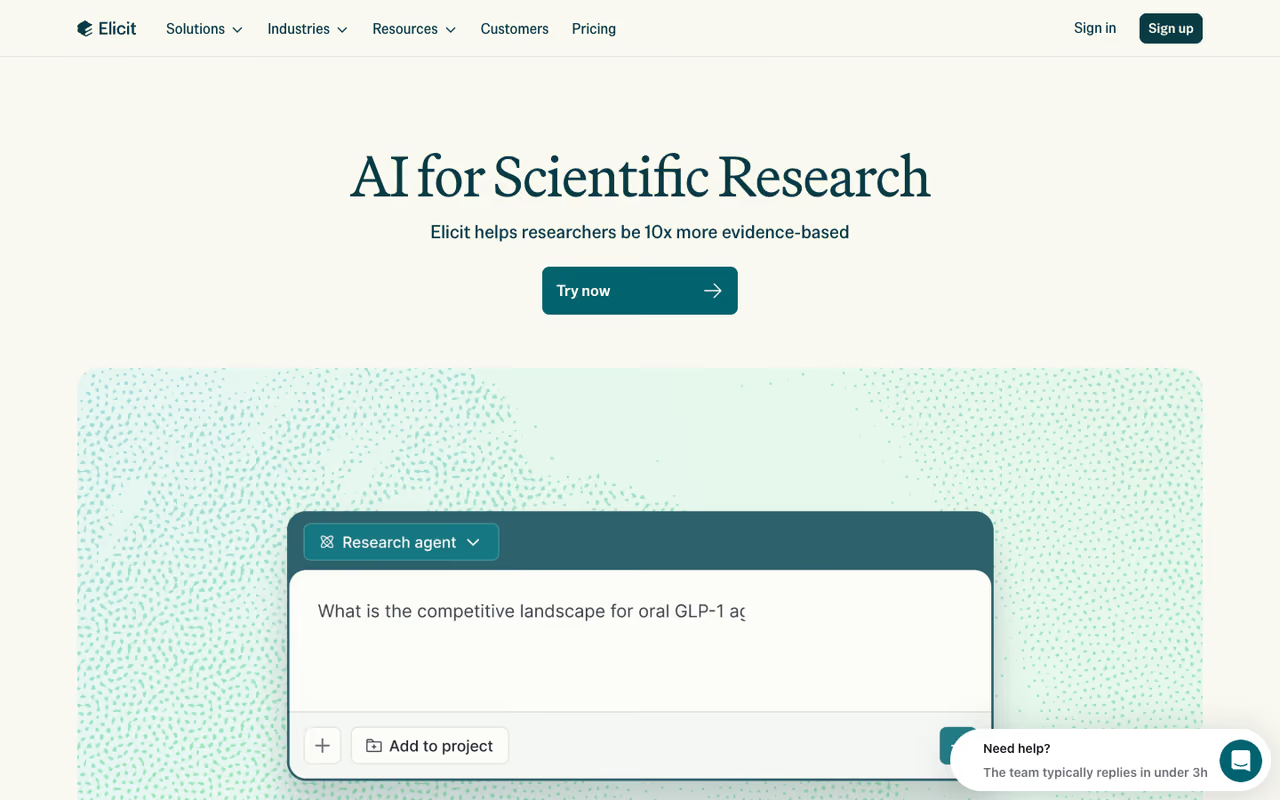
If your research means actual papers, Elicit is where the consumer tools stop and the real work begins. It searches across 138 million academic papers and extracts structured data: sample sizes, methods, outcomes, populations, dropped into a table you can sort and export. Doing that by hand across 50 studies is a week of work. Elicit does it in an afternoon.
I leaned on it for a literature review and the time saved was not subtle. It also runs automated research reports and systematic-review support, so it's not just a fancy search box. (For the academic angle, I went deeper in our best AI for literature review guide.)
The workhorse for grad students, scientists and analysts doing structured review of published papers, pulling sample sizes and outcomes into a sortable table. It is narrow by design, so market trends and breaking news are outside its reach.
Basic is free with 2 automated reports a month and unlimited search. Plus is $12/month for regular reports, and Pro is $49/month ($499/year) with 12 systematic reviews a month, unlimited high-accuracy columns, and Research Agents that reach beyond papers into clinical-trial and regulatory data.
The catch: it's narrow by design. Ask Elicit about market trends or breaking news and it has nothing, because that isn't in academic papers. The free tier's 2-report limit also runs out fast once you're serious. And extraction is excellent but not infallible: spot-check the columns before you cite them.
If you're stitching several of these into a daily workflow and want the upgraded models without juggling subscriptions, Dupple X bundles premium access to the major AI tools in one plan.
Gemini + NotebookLM
Gemini is the strongest pick for anyone already inside Google Workspace, mostly because of one feature pair. Gemini Deep Research handles the open-web reports, and NotebookLM grounds answers strictly in sources you upload, so it won't wander off and invent things. Feed NotebookLM 40 PDFs and it answers only from those, with citations back to the page. For synthesizing your own document pile, nothing else feels this trustworthy.
The natural choice for Workspace users and anyone synthesizing their own pile of PDFs or transcripts, because NotebookLM answers only from what you upload. The open-web Deep Research felt generic, so without your own sources you are paying for the weaker half.
the free tier includes basic Deep Research and NotebookLM. Google AI Pro is $19.99/month, adding 20 deep-research sessions a day, a large context window, NotebookLM Plus, and 2TB of storage. Google AI Ultra now starts at $99.99/month after a price cut.
The catch: Gemini's open-web Deep Research reports felt the most generic of the big three to me, long on length and short on insight. NotebookLM is the real reason to be here. If you don't have your own sources to load, you're paying for the weaker half.
Consensus, the fastest scientific gut-check
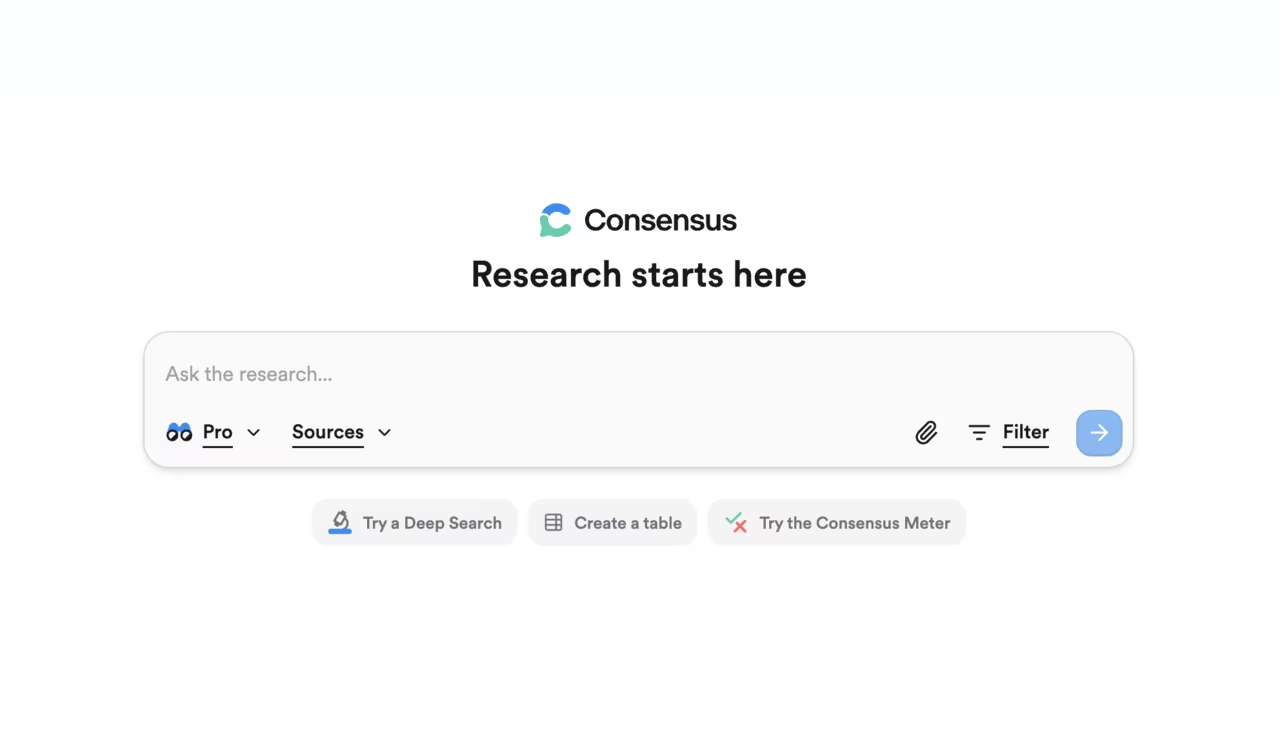
Consensus answers yes/no research questions by reading across scientific papers and showing where the evidence lands. Ask "does intermittent fasting improve insulin sensitivity?" and its Consensus Meter shows what proportion of studies say yes, no, or mixed, drawing on more than 200 million papers. It's the quickest way to sanity-check a claim before you stake an argument on it.
A quick way to gut-check a scientific claim in 30 seconds, ideal for content writers citing science. The Consensus Meter flattens nuance into one bar, so treat it as a starting point and read the actual papers.
Free covers 20 AI searches a month. Premium is $8.99/month ($108/year) for unlimited Pro analyses and study snapshots, with a Pro tier at $15/month adding deep searches. Students get 40% off.
The catch: it answers narrow empirical questions well and broad ones poorly. The Consensus Meter is a heuristic, not a meta-analysis, so it flattens nuance, study quality, and conflicting methodologies into a single bar. Treat it as a starting point, then read the actual papers.

Scite, for checking whether a citation holds up
Scite does one thing other tools don't: it tells you how a paper was cited. Its Smart Citations label every reference as supporting, contrasting, or merely mentioning the original work. That matters enormously, because a study cited 400 times might have been cited 400 times to say it was wrong. Scite is how you avoid building an argument on a paper that's been quietly refuted or retracted.
Go with Scite when you need to know whether a specific study still holds up, since it labels each citation as supporting, contrasting or merely mentioning. It is a verification layer, not a discovery engine, and it works best alongside Elicit or Consensus.
the Personal plan is $20/month, or $12/month billed annually. There's a 7-day trial but no permanent free tier.
The catch: it's a verification layer, not a discovery engine. You bring the paper, Scite tells you how it's held up. As a standalone first stop it's thin. It earns its place alongside Elicit or Consensus, not instead of them.

ResearchRabbit, the free discovery map
ResearchRabbit calls itself "Spotify for papers," and the analogy fits. You add a few seed papers and it builds a visual citation graph of related and citing work, surfacing studies you'd never find by keyword search. It's the best free tool here for the "what am I missing?" stage of a literature review.
A free way to map a field early in a literature review, building a citation graph from a few seed papers. It finds papers but does not read or summarize them, so pair it with a tool like Elicit to digest what you find.
the core product is free forever, including unlimited collections, collaboration, and up to 50 seed articles per search. RR+ is $10/month and adds extras.
The catch: it finds papers, it doesn't read or summarize them. There's no extraction, no synthesis, no answer-writing. Pair it with Elicit (ResearchRabbit to find, Elicit to digest) and the two cover the whole review. Alone, it's only the first half.

Claude, the best at making sense of a mess
Claude isn't a dedicated research agent, but for the synthesis step, reading a pile of messy, contradictory sources and writing something coherent, it's my favorite. It handles ambiguity and long context better than anything else, and its web research and document-reading have matured into a genuinely useful workflow. I draft most research summaries by handing Claude the raw material and letting it reason.
My pick for synthesis, nuanced writing and reasoning over large or contradictory inputs. It is the brain rather than the crawler, so feed it good sources, because as a source-gatherer it trails Perplexity and ChatGPT Deep Research.
Free has limited use. Pro is $20/month, and Max runs $100/month (5x usage) or $200/month (20x), the latter aimed at heavy users who also want Claude Code.
The catch: Claude's native web search is solid but not as aggressive a source-gatherer as Perplexity or ChatGPT Deep Research. It's the brain, not the crawler. Feed it good sources and it shines. Ask it to go find them and you'll get less than the purpose-built agents.
How to choose
Skip the feature charts. Pick based on where your sources live.
If you research the open web (markets, companies, trends, news), start with Perplexity for speed and reach for ChatGPT Deep Research when a report needs real depth. One $20 plan each, and most people only need the first.
If you research published papers, Elicit is the core tool, Consensus is your fast gut-check, Scite verifies that a key study holds up, and ResearchRabbit (free) maps the field. None of these overlaps much, which is why serious researchers run two or three together.
If you research your own documents, NotebookLM is unbeatable and the free tier is enough to start.
If the bottleneck is writing it up, Claude does the synthesis better than the search tools do.
The honest summary: there's no single best AI research tool, but there are obvious wrong choices. Using Perplexity for a systematic review, or Elicit for market intel, wastes both. Match the tool to the source and the 10x is real. For more options across categories, our best AI assistant and best AI search engines roundups go wider, and you can browse our full top tools directory.
Running two or three of these at once adds up fast. If you'd rather have premium access to the top AI models behind one subscription, Dupple X starts here.
FAQ
What is the best AI tool for research in 2026?
For most people, Perplexity is the best starting point: it's fast, every claim is cited, and the $20/month Pro plan gives 20 deep-research runs a day. For academic literature, Elicit is stronger because it searches 138 million papers and extracts structured data. The best choice depends on whether your sources are the open web or peer-reviewed papers.
Is ChatGPT or Perplexity better for research?
They're built for different jobs. Perplexity is faster (2 to 3 minutes per deep-research run) and produces tight, well-cited briefings. ChatGPT Deep Research is slower (15 to 25 minutes) but goes deeper, browsing 50 to 100 sources for longer, more analytical reports. Use Perplexity for quick answers and ChatGPT when depth matters. If you're weighing OpenAI's tiers, our ChatGPT Plus vs Pro guide breaks down the limits.
Are there free AI research tools that are actually good?
Yes. ResearchRabbit is free forever and excellent for mapping a field. Consensus offers 20 free searches a month, Elicit's free tier includes unlimited paper search plus 2 reports monthly, and both Perplexity and Gemini have capable free deep-research tiers. You can do real work without paying, though the limits hit fast once you're serious.
Can AI research tools be trusted for academic work?
Partly. Tools like Elicit, Consensus, and Scite are built on peer-reviewed literature and cite their sources, which makes them far safer than a general chatbot. But AI extraction and summaries still contain errors, and tools like Consensus simplify nuanced findings into a single verdict. Always verify key claims against the original papers before citing them.
What's the difference between AI search and AI deep research?
AI search (a single Perplexity or Gemini query) returns a quick cited answer in seconds. AI deep research runs an autonomous multi-step agent that plans, crawls dozens of sources, and writes a structured long-form report with citations, taking minutes instead of seconds. Deep research is for thorough briefings; standard search is for fast facts.
Related guides
Some offers on this page may be paid placements or contain affiliate links.
Across our whole catalogue the median is $24 a month and 33% of tools advertise a free tier. Figures are the lowest recurring monthly price quoted in our own review of each tool, read on 2026-08-19. Full method and every category.
