
The 8 Best Loyalty Program Software Tools in 2026

Key facts8 tools compared: Smile.io, LoyaltyLion, Yotpo, Rivo, Open Loyalty, Stamped, Square Loyalty…
- 8 tools compared: Smile.io, LoyaltyLion, Yotpo, Rivo, Open Loyalty, Stamped, Square Loyalty, Talon.One
- Smile.io (best for: Small Shopify stores): Free, then $15/mo
- LoyaltyLion (best for: Growing DTC brands): $199/mo
- Yotpo (best for: Reviews + loyalty in one stack): Free, then $199/mo
- Rivo (best for: Scaling DTC, paid memberships): $49/mo
Acquisition costs keep climbing, and the math on paid traffic gets uglier every quarter. The cheapest revenue you have is the customer who already bought once. A loyalty program is the cleanest way to turn that one-time buyer into a three-time buyer, and the software market for running one has split into two camps: dead-simple Shopify apps that go live in an afternoon, and headless platforms that need an engineer.
I spent a few weeks comparing the main contenders and checking current pricing against their own pages. Most "best loyalty software" lists rank tools by feature count. That's the wrong lens. The right question is what kind of store you run and how much you want to touch the code.
If you want the short version: Smile.io is the fastest start for a small Shopify store, LoyaltyLion is the mid-market workhorse once you can justify the spend, and Open Loyalty is what you reach for when you have developers and an enterprise budget. Everything else below fills a specific gap. Here's how they compare.
Quick comparison
| Tool | Best for | Starting price | Standout |
|---|---|---|---|
| Smile.io | Small Shopify stores | Free, then $15/mo | Live in under an hour |
| LoyaltyLion | Growing DTC brands | $199/mo | Customization + analytics depth |
| Yotpo | Reviews + loyalty in one stack | Free, then $199/mo | Bundled retention suite |
| Rivo | Scaling DTC, paid memberships | $49/mo | Checkout extensions at low cost |
| Open Loyalty | Enterprise, headless builds | Custom | True API-first engine |
| Stamped | Mid-market, reviews-led | ~$59/mo | UGC plus loyalty combo |
| Square Loyalty | Brick-and-mortar retail | $45/mo per location | Tied directly to Square POS |
| Talon.One | Large enterprise, custom logic | Custom | Real-time promotion engine |

Smile.io: the fastest way to launch
Smile.io is the default answer for a Shopify or BigCommerce store dipping a toe into loyalty for the first time. You install it, pick your earn-and-redeem rules, brand the widget, and you have a working points program before lunch. No developer, no agency, no six-week onboarding.
Who it's best for: small to mid-size stores that want points, referrals, and a VIP tier without thinking too hard about it.
The fastest way for a first-time Shopify or BigCommerce store to launch points, referrals and VIP tiers without a developer. Customization is shallow compared to LoyaltyLion, and pricing climbs with order volume.
there's a genuine free plan covering 200 monthly orders, which is enough to test whether loyalty moves the needle at all. Paid tiers go $15/mo (Essential, 500 orders), $79/mo (Standard, 1,000 orders), and $199/mo (Growth, 2,500 orders), per Smile.io's pricing page. Pricing scales with order volume, so the sticker price climbs as you grow.
The standout: time to value. Nothing else here gets a real program in front of customers as fast.
The catch: the simplicity that makes Smile.io easy also caps it. Customization is shallow compared to LoyaltyLion, the analytics are basic, and once you cross a few thousand orders a month the per-order pricing stops feeling cheap. It's a starting point, and a good one, but plenty of brands outgrow it.

LoyaltyLion: the mid-market workhorse
LoyaltyLion is where you go when loyalty stops being an experiment and becomes a real retention channel. It runs programs for brands like LEGO, Beis, and Victoria Beckham, and according to LoyaltyLion's own numbers the platform pushes over $900m in revenue per week and processes 140m transactions a year. The pitch is depth: granular earning rules, VIP tiers, on-site loyalty pages you can actually design, and tight integration with email tools like Klaviyo.
Who it's best for: growing DTC brands doing real volume that want to A/B test mechanics and tie loyalty into their email and SMS flows.
Where to go when loyalty becomes a real retention channel for growing DTC brands, with deep analytics, customization and Klaviyo integration. The price floor is high, so it is not a casual purchase.
the Classic plan starts at $199/mo for 500 orders, with Advanced and Plus tiers priced custom based on order volume (the slider on their site runs up to 1M+ monthly orders). This is not a casual purchase, and it shouldn't be one.
The standout: analytics and customization. You can see exactly which earning behaviors drive repeat purchases and tune the program around them, instead of guessing.
Where it falls short: the price floor. At $199/mo for 500 orders you're paying meaningfully more than Smile.io or Rivo for similar entry-level volume, and the real value only shows up once you're large enough to use the advanced features. A 300-order-a-month store is lighting money on fire here. Make sure your retention math justifies it before you sign.

Yotpo: loyalty bundled with reviews
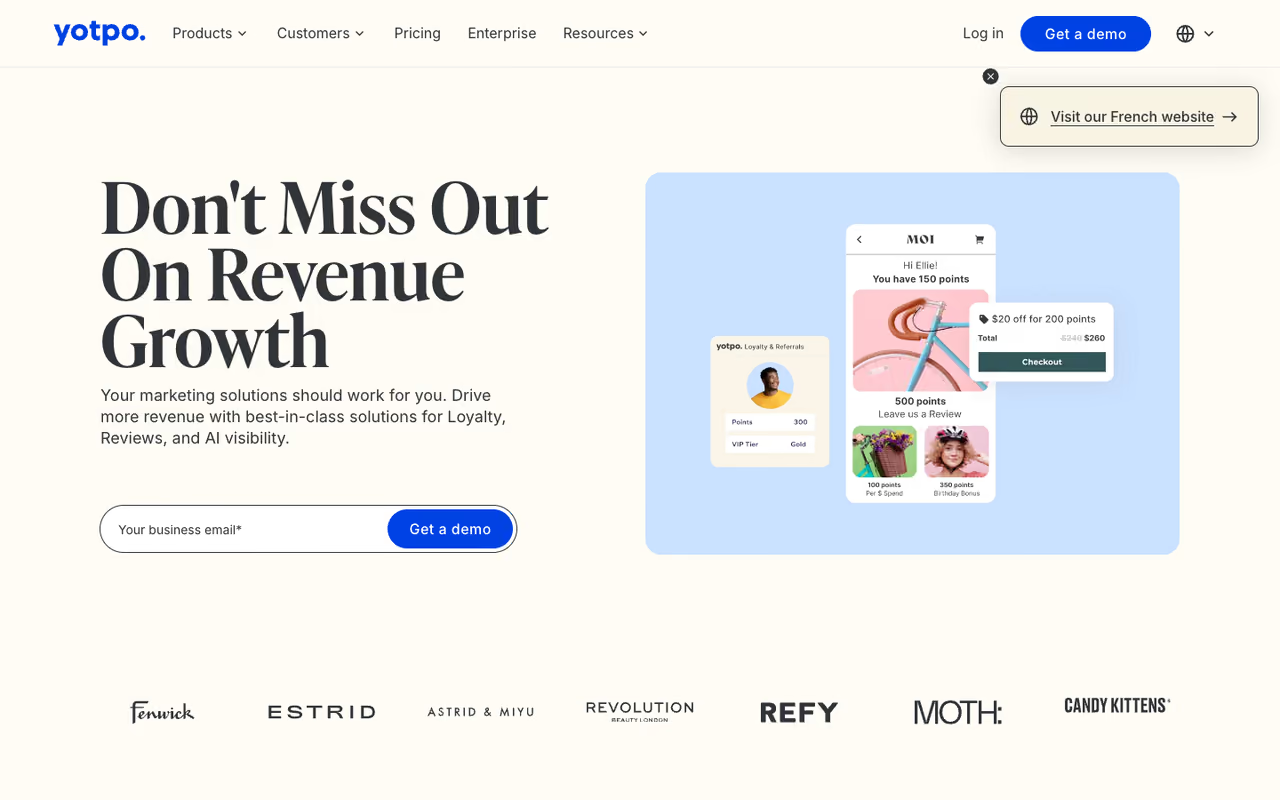
Yotpo sells loyalty as one piece of a larger retention suite that also covers reviews, user-generated content, SMS, and email. The appeal is consolidation. If you're already running Yotpo Reviews, adding loyalty inside the same dashboard, with shared customer data, beats stitching together three separate vendors.
Who it's best for: brands that want reviews, referrals, and loyalty under one roof and value a single source of customer data over best-in-class individual tools.
A good fit for brands that want reviews, referrals and loyalty under one roof with shared customer data. Pricing gets opaque once you bundle modules, so get a written quote covering everything you plan to turn on.
there's a free plan for up to 100 orders a month. Paid loyalty starts around $199/mo (Pro) and $799/mo (Premium), with enterprise/Gold pricing on quote. Yotpo's pricing has a reputation for being opaque once you start bundling modules, so get a written quote that covers every product you plan to turn on.
The standout: the bundle. Cross-product data (a reviewer who's also a VIP member) lets you build segments and flows you can't easily replicate across separate tools.
The catch: that bundle is also the trap. Buying Yotpo for loyalty alone rarely makes sense versus a focused tool, and costs creep as you switch on more modules. The loyalty product on its own is solid but not class-leading. You're paying for the ecosystem, so only commit if you'll actually use more than one piece of it.

Rivo: scaling DTC without the enterprise bill
Rivo has carved out a spot for fast-growing DTC brands that have outgrown Smile.io but can't stomach LoyaltyLion or Yotpo enterprise pricing. It leans into retention beyond points: paid memberships, checkout extensions, wishlists, and passwordless login, all with a developer API underneath.
Who it's best for: Shopify and Shopify Plus brands scaling past mid-market volume that want membership revenue and checkout-level loyalty without an enterprise contract.
A value-dense option for Shopify and Shopify Plus brands that have outgrown Smile.io but cannot stomach enterprise pricing, with paid memberships and checkout extensions. It is newer, so brand recognition and ecosystem maturity lag the bigger names.
the Scale plan starts at $49/mo and covers 200 to 2,500 orders. The Plus tier runs $499/mo with unlimited participants and 50+ integrations, and there's a custom plan for Shopify Plus brands that adds a dedicated account manager and 5x API rate limits, per Rivo's pricing page.
The standout: value density. You get paid memberships, checkout extensions, and SOC 2 compliance at price points where competitors are still selling you the basic tier.
Where it falls short: brand recognition and ecosystem maturity. Rivo is newer than the LoyaltyLion-Yotpo-Smile triangle, so the integration library, while large, has fewer battle-tested edge cases. If you need a specific niche integration, check it exists before committing.

Open Loyalty: the headless engine
Open Loyalty is a different animal. It's not a Shopify app you install, it's an API-first loyalty engine you build on top of. Brands like Heineken, Aldo, and the U.S. Soccer Federation run multi-channel programs on it, with 50+ loyalty and gamification mechanics exposed through APIs and webhooks. It carries ISO 27001 and ISO 9001 certification, a 99.99% uptime guarantee, and multi-tenancy for brands running several programs at once.
Who it's best for: enterprises and ambitious mid-market brands with a development team or agency that want to own their loyalty logic and customer data end to end.
The headless, API-first engine for enterprises and ambitious mid-market brands with developers who want to own their loyalty logic and data. The catch is that you have to build the front end yourself.
custom, priced by active members rather than your full list, which is the fairer model if you have a big database but a smaller engaged core. Expect an enterprise platform fee on top.
The standout: total control. You can build any program logic you can imagine across web, app, in-store, and beyond, because the engine doesn't impose a front end on you.
The catch: you have to build that front end. Open Loyalty gives you the engine and the API and nothing else. Without engineers or an agency, you can't realize any of its value, and the platform fee is wasted. This is a power tool, not a plug-in. If your team's reaction to "API-first" is a blank stare, look elsewhere.
Stamped: reviews-led loyalty for mid-market
Stamped is the close cousin of Yotpo's approach: a combined reviews-and-loyalty platform aimed at mid-market ecommerce, often at a lower price than Yotpo for comparable scope. If user-generated content is central to your marketing and you want loyalty layered on the same customer profiles, it's a natural fit.
Who it's best for: mid-market brands that lead with reviews and want loyalty bolted onto the same data without paying Yotpo rates.
A friendlier-priced reviews-plus-loyalty combo for mid-market brands that lead with reviews. As standalone loyalty it is middle of the pack, so if you only need loyalty, Smile.io or Rivo give you more.
loyalty plans run roughly $59/mo (Starter, ~500 orders), ~$149/mo (Growth, ~1,500 orders), and ~$249/mo (Professional, ~5,000 orders), with custom enterprise pricing above that, per Stamped's pricing page. Stamped has moved away from a free loyalty plan, so budget for a paid tier from day one.
The standout: the reviews-plus-loyalty combo at a friendlier price point than the bigger suites.
Where it falls short: as a standalone loyalty tool it's middle of the pack. The reason to pick Stamped is the bundle with reviews. If you only need loyalty, Smile.io or Rivo give you more focused value for the money.
Square Loyalty: built for the physical counter
Square Loyalty is the outlier here because it's built for brick-and-mortar, not pure ecommerce. If you run a coffee shop, salon, or retail counter on Square's POS, this turns every checkout into a points-earning moment with zero extra hardware.
Who it's best for: physical retail and hospitality already running Square POS that want a punch-card-style program tied to in-person transactions.
The right pick for brick-and-mortar and hospitality businesses already on Square POS, with native enrollment at the register. You are locked into Square, and marketing campaigns need a separate subscription.
$45/mo per location, scaling linearly (three locations is $135/mo, five is $225/mo) with no volume discount at the small-business level. Standard Square processing fees of 2.6% + 10¢ per card transaction still apply.
The standout: it's genuinely native to the POS. Customers enroll with a phone number at the register, and there's nothing to integrate.
The catch: you're locked to Square. Your entire program lives inside Square's ecosystem, so switching payment systems later means rebuilding loyalty from scratch. Marketing campaigns also sit in a separate Square Marketing subscription. Fine if you're all-in on Square, a real constraint if you're not.

Talon.One: the enterprise promotion engine
Talon.One sits at the far end of the spectrum: a real-time incentives and promotion engine that unifies loyalty, coupons, discounts, bundles, and referrals in one system. It's MACH-certified, runs 100 million campaign evaluations a day for around 300 global enterprise brands, and was acquired by Adyen in a deal valued at roughly $879m in early 2026, a signal of where enterprise loyalty is heading.
Who it's best for: large enterprises that need loyalty and promotions governed by one rules engine, with the developers to wire it in.
A real-time promotion and loyalty rules engine for large enterprises with the engineering resources to wire it in. It is overkill for almost everyone else, and pricing is enterprise-only.
custom, enterprise-only. If you're asking the price, you're probably not the target customer yet.
The standout: the rules engine. Few platforms let you express complex, conditional promotion and loyalty logic in real time at this scale.
Where it falls short: it's overkill for almost everyone reading this. Talon.One assumes deep engineering resources and a promotions strategy complex enough to justify a dedicated engine. A growing Shopify store does not need this, and the cost of getting it wrong is high.
How to choose
Skip the feature checklist. Sort by two variables instead.
First, how much engineering can you spend? If the answer is "none," you live in the Shopify-app world: Smile.io to start, Rivo or LoyaltyLion as you scale. If you have developers and want to own the logic, Open Loyalty or Talon.One open up. There's no shame in the no-code path. Most brands earn more by launching fast than by building something custom.
Second, where do your customers actually transact? Online-only points you at the ecommerce apps. A physical counter on Square points you at Square Loyalty. Omnichannel at scale is where the headless engines earn their fee.
Then sanity-check the money. Loyalty software only pays off if repeat-purchase lift covers the subscription plus the cost of the rewards themselves. Run that math at your current order volume before signing, not at the volume you hope to hit. A program that works at 3,000 orders a month can be a net loss at 300. The same discipline applies across your retention stack, from your email marketing software to your ecommerce CRM.
If you want the broader playbook on keeping customers, our guide to customer retention software covers the tools that sit alongside loyalty, and the rundown of AI tools for ecommerce is worth a look for the rest of the stack. For staying current on which retention tools are gaining traction, Dupple X tracks the moves so you don't have to read ten newsletters a week.
FAQ
What is the best loyalty program software for a small Shopify store?
Smile.io. It has a real free plan for up to 200 monthly orders, goes live in under an hour, and gives you points, referrals, and VIP tiers without needing a developer. When you outgrow the simplicity, Rivo at $49/mo or LoyaltyLion at $199/mo are the natural next steps.
How much does loyalty program software cost?
It ranges widely. Entry-level Shopify apps start free (Smile.io) or around $15 to $49/mo. Mid-market platforms like LoyaltyLion and Yotpo Pro start around $199/mo and scale with order volume. Enterprise headless platforms like Open Loyalty and Talon.One are custom-priced and typically run into thousands per month plus engineering costs.
Is a free loyalty program worth it?
For testing, yes. Smile.io and Yotpo both offer free tiers (200 and 100 monthly orders respectively) that let you prove whether loyalty lifts repeat purchases before you pay anything. Free plans cap customization and analytics, so treat them as a trial, not a permanent home if loyalty becomes a meaningful channel.
What's the difference between a loyalty app and a headless loyalty platform?
A loyalty app (Smile.io, Rivo) installs onto your store and works out of the box with a fixed front end. A headless platform (Open Loyalty, Talon.One) gives you a loyalty engine and an API, and you build the customer-facing experience yourself. Apps trade flexibility for speed. Headless platforms trade speed for total control and need engineering resources.
Do I need loyalty software if I run a physical store?
If you're on Square POS, Square Loyalty at $45/mo per location is built for exactly that, with customers enrolling by phone number at the register. Standalone POS loyalty also exists, but the value of a points program for a counter business is real: it brings people back, which is the whole point.
Which loyalty platform integrates best with email and SMS?
LoyaltyLion and Yotpo both have strong native integrations with Klaviyo and other marketing tools, so loyalty events can trigger email and SMS flows automatically. If your retention strategy is email-led, pairing loyalty with the right AI marketing automation stack is where the compounding returns come from.
Related guides
Some offers on this page may be paid placements or contain affiliate links.
Across our whole catalogue the median is $24 a month and 33% of tools advertise a free tier. Figures are the lowest recurring monthly price quoted in our own review of each tool, read on 2026-08-19. Full method and every category.
