
Best AI Marketing Automation Tools (2026)

Key facts9 tools compared: Omnisend, HubSpot, Klaviyo, Customer.io, ActiveCampaign, Brevo, Clay…
- 9 tools compared: Omnisend, HubSpot, Klaviyo, Customer.io, ActiveCampaign, Brevo, Clay, Gumloop, Jasper
- Omnisend (best for: Ecommerce email + SMS + push): Free / $16/mo
- HubSpot (best for: All-in-one B2B CRM + automation): $800/mo (Pro)
- Klaviyo (best for: Ecommerce lifecycle): $20/mo (Email)
- Customer.io (best for: Product-led SaaS messaging): $100/mo
Marketing automation used to mean "if a contact opens this email, wait two days, then send that one." You built the logic. The software just executed it. In 2026 the software writes the email, picks the send time, segments the list, and in a few cases talks to the customer on your behalf. That shift is real, and it changes which tools are actually worth paying for.
The problem is that almost every vendor slapped "AI" on their homepage, and most of it is a content generator bolted onto the same workflow builder from 2019. I spent the last few weeks comparing how campaigns, abandoned-cart flows, and outbound sequences work across the major platforms, using their docs, pricing pages, and public reviews to figure out where the AI does real work versus where it's a demo trick.
If you want the short answer: for a B2B team that needs CRM plus automation in one place, HubSpot with its AI agents is still the default. For ecommerce, Klaviyo is the one to beat. For product-led SaaS sending behavioral messages, Customer.io wins. Below is the full breakdown, who each one is for, and where it falls short.
Quick comparison
| Tool | Best for | Starting price | Standout |
|---|---|---|---|
| Omnisend | Ecommerce email + SMS + push | Free / $16/mo | AI content + native MCP connector |
| HubSpot | All-in-one B2B CRM + automation | $800/mo (Pro) | HubSpot AI agents across the stack |
| Klaviyo | Ecommerce lifecycle | $20/mo (Email) | Predictive analytics + K:AI agents |
| Customer.io | Product-led SaaS messaging | $100/mo | Event-driven journeys, dev-friendly |
| ActiveCampaign | SMBs wanting CRM + email | $15/mo | Predictive AI on Pro tier |
| Brevo | Budget teams, unlimited contacts | Free / $9/mo | 300 free emails/day, cheap SMS |
| Clay | Outbound + GTM data | $185/mo | AI research agent over enriched data |
| Gumloop | Custom AI workflows | Free / $37/mo | No-code automation with LLM steps |
| Jasper | Content production at scale | $39/mo | Brand voice + marketing copilot |

Omnisend: the ecommerce-native pick
Omnisend is the platform ecommerce teams land on when they want email, SMS, and push notifications running off the same customer profile without paying premium-platform pricing for it. The 2026 story is Omnisend's AI content generation and its native MCP connector, which let marketers draft campaigns and pull live store data from Shopify, BigCommerce, or WooCommerce straight into their existing tools, without switching tabs.
The ecommerce-native pick for stores under roughly 50,000 contacts on Shopify, BigCommerce or WooCommerce that want email, SMS and push on one profile. It costs less than Klaviyo, but SMS is priced separately and reporting and templates are thinner.
If your customer data already lives in one of those platforms, Omnisend's automations have something real to trigger on, and that matters more than a longer feature list.
On pricing, the free plan covers up to 250 contacts and 500 emails a month, no credit card required. Standard starts at $16/month for 500 contacts and scales with list size, while Pro starts at $59/month and bundles in SMS credits equal to the plan price. Since May 2026, SMS on new Pro subscriptions is metered separately at volume-based rates starting at $0.007 per message, so heavy SMS senders should model that cost rather than assume it's fully bundled. Teams migrating from another platform also get a free 5-day migration to move lists and flows over.
The standout is genuinely the cost gap: side-by-side comparisons put Omnisend up to 35% lower than Klaviyo at comparable contact volumes, with a 4.6 out of 5 rating on G2 backing up the value perception.
The catch: SMS is priced separately outside the bundled Pro allowance, template customization is thinner than design-first competitors, and reporting is more basic than teams used to deeper analytics dashboards. Overkill isn't really the risk here, it's more likely to feel underpowered for a B2B SaaS company with no ecommerce store to plug into.
HubSpot: the safest all-in-one bet
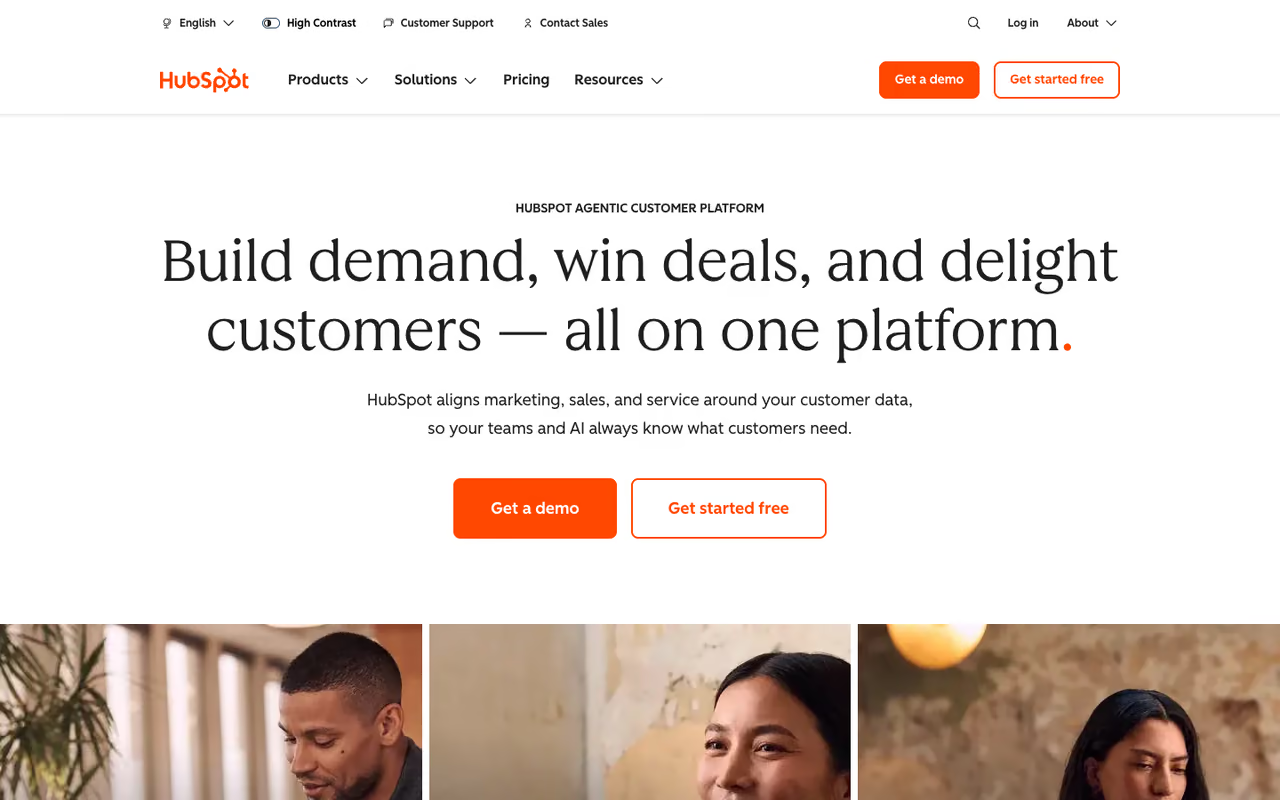
HubSpot is the platform most teams end up on when they want marketing, sales, and a CRM that all share the same contact record. The 2026 story is HubSpot AI, HubSpot's layer of AI agents that draft emails, generate blog ideas, summarize call transcripts, and build reports without you opening a workflow editor.
HubSpot is the safe all-in-one bet for B2B teams tired of stitching point solutions, since one AI agent sees deals, tickets and email engagement. It gets expensive fast, with credits and onboarding fees, and is overkill for a solo founder.
If your sales and marketing data already live in HubSpot, the AI features have something real to work with, and that matters more than the feature list.
On pricing, be honest with yourself. Full agent access starts on the Marketing Hub Professional plan at $800/month, and Enterprise runs $1,500 to $3,600/month. Many HubSpot AI actions also burn HubSpot Credits, so AI usage is metered on top of the seat cost. In April 2026, HubSpot moved two agents to outcome-based pricing: the Customer Agent now charges $0.50 per resolved conversation and the Prospecting Agent $1 per lead, which is fairer but harder to forecast.
The standout is genuinely the breadth. No other tool here lets one AI agent see your deals, your tickets, and your email engagement at once.
The catch: it gets expensive fast, the mandatory onboarding fee on higher tiers can hit several thousand dollars, and the credit system makes budgeting AI usage a guessing game. Overkill for a solo founder or a five-person ecommerce shop.
Klaviyo: the ecommerce standard
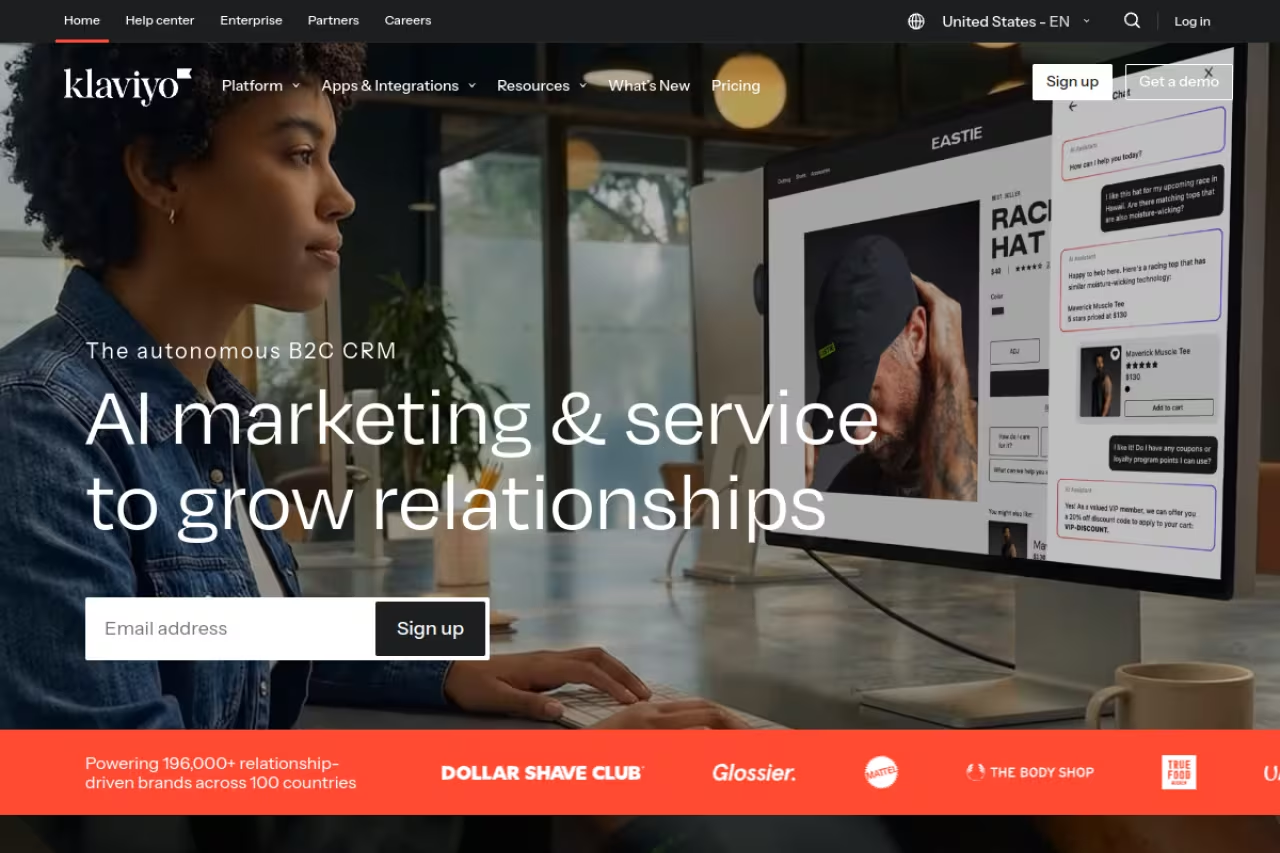
If you sell physical or digital products direct to consumers, Klaviyo is the tool I recommend first. It plugs into Shopify and the rest of your stack, builds unified customer profiles, and runs the lifecycle flows (welcome, abandoned cart, win-back) that drive most ecommerce revenue. The AI layer, branded K:AI, generates segments and content and now ships autonomous agents for campaigns and customer service.
Pick Klaviyo first if you sell products direct to consumers and live on email and SMS revenue. Its predictive analytics time sends and build segments automatically, but the bill climbs steeply with list size and the model fights B2B long sales cycles.
Pricing is usage-based on active profiles. There's a free plan for up to 250 profiles, the Email plan starts at $20/month for 500 contacts, and scales to roughly $130/month at 10,000 contacts. The Email + SMS plan starts around $35/month with 1,250 SMS credits. The newer Customer Agent is a paid add-on at $140/month introductory ($200 standard), with the first 50 conversations free each month.
The standout is the predictive analytics. Klaviyo has years of ecommerce data feeding features like predicted lifetime value and expected next-order date, and it uses them to time sends and build segments automatically.
Where it falls short: the bill climbs steeply as your list grows, and SMS credits are billed separately on top. Klaviyo is also firmly a B2C tool. If you run B2B with long sales cycles, the model fights you.

Customer.io: built for product-led messaging
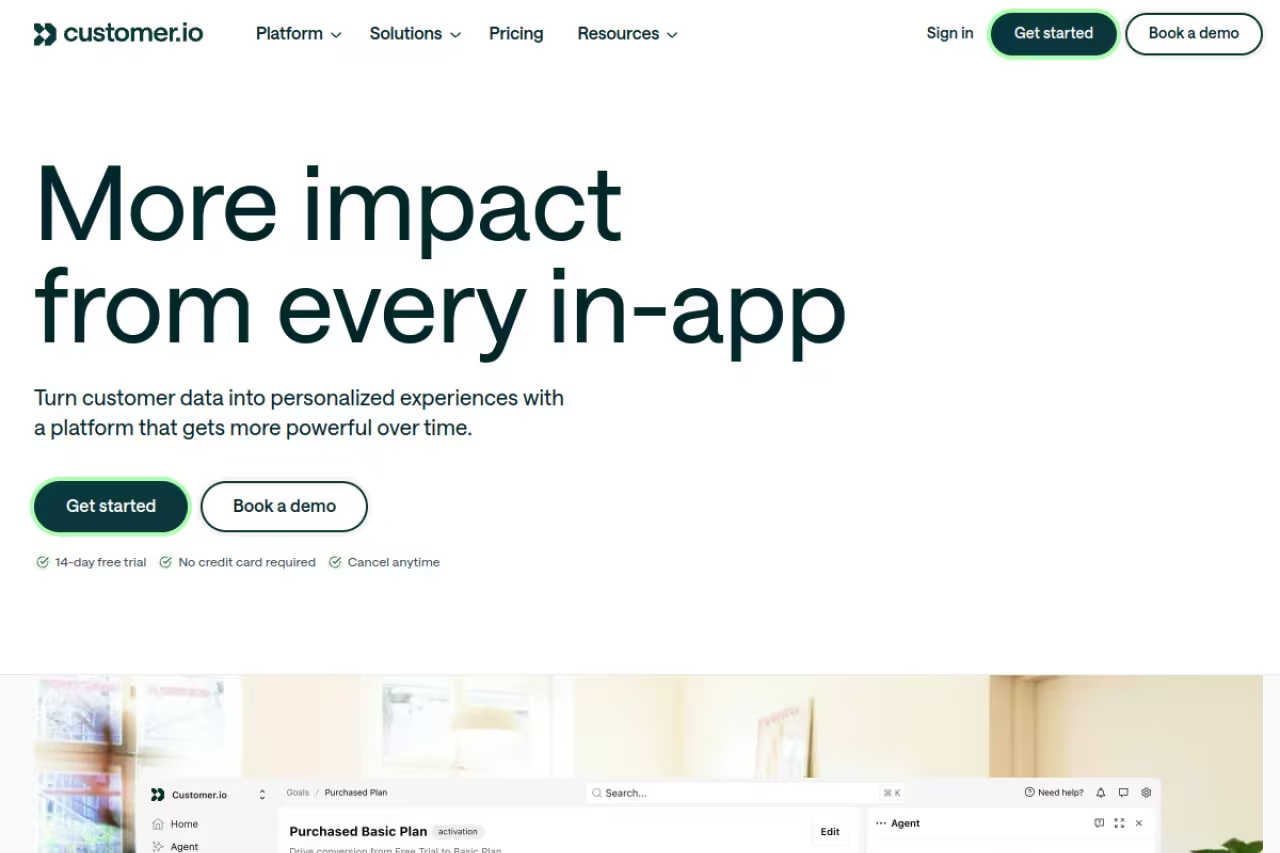
Customer.io is what you reach for when your messaging should be driven by what users actually do inside your product. It listens to behavioral events ("completed onboarding," "hit the usage limit," "invited a teammate") and triggers email, push, in-app, SMS, or webhook messages off them. It's the most developer-friendly platform here, with a flexible API and natural-language segmentation.
Best for B2B SaaS and product-led teams with a real data pipeline, plus anyone who needs HIPAA compliance for FinTech or health products.
The Essentials plan starts at $100/month and includes email, push, in-app, SMS, webhooks, segmentation, and the visual workflow builder, billed on uniquely identified profiles. The Premium plan jumps to $1,000/month for managed deliverability, dedicated IPs, HIPAA, multiple workspaces, and data-warehouse sync. Enterprise is custom.
The standout is event-driven automation you'd otherwise have to build with custom code. If your product emits clean events, Customer.io turns them into journeys faster than anything on this list.
The catch: it expects you to bring structured event data. If you're a marketer without engineering support, the setup is steeper than Klaviyo or ActiveCampaign, and the jump from $100 to $1,000 between tiers is a big cliff for mid-size teams.
Customer.io is the choice for B2B SaaS and product-led teams with a real data pipeline, or anyone needing HIPAA compliance. Event-driven journeys are its edge, but marketers without engineering support will find setup steep, and the jump from $100 to $1,000 is a cliff.
If you're still mapping which of these fits your stack, our top AI tools roundup and the Dupple X bundle are a faster way to shortlist than reading ten vendor pages.

ActiveCampaign: CRM and automation without the HubSpot bill
ActiveCampaign sits in the sweet spot between a pure email tool and a full HubSpot deployment. You get email, automation, a real CRM with pipelines and lead scoring, and an AI engine called Active Intelligence that recommends what to do when performance shifts.
Go with ActiveCampaign for CRM plus marketing automation without an $800/month bill. The predictive AI on Pro is good value, but pricing scales with contacts, the interface feels busy, and the AI is not as deep as HubSpot's or Klaviyo's.
The Starter plan is $15/month, Plus is $49/month (CRM, landing pages, lead scoring), Pro is $79/month (predictive AI, split automations, conversion attribution), and Enterprise is $145/month. Annual billing saves about 20%. Extra seats run $12/month each.
The standout is value density. The predictive AI on the Pro tier, including predictive sending and win probability, costs a fraction of what comparable features cost elsewhere.
Where it falls short: pricing scales with contacts, so the cheap headline number climbs as your list grows, and the interface has accumulated enough features over the years to feel busy. The AI isn't as deep as HubSpot AI or Klaviyo's predictive layer.

Brevo: the budget pick that scales
Brevo (formerly Sendinblue) is the one I point cost-conscious teams to. It bundles email automation, a sales CRM, a customer data platform, and live chat, and its free plan gives you unlimited contacts with a 300-emails-per-day cap.
The budget pick for startups and small businesses that want a working automation stack without a real budget line. Pricing by email volume rather than contacts suits big, infrequent lists, but AI is thinner than the leaders here and it is a starting point, not always an ending one.
Paid plans start around $9/month, and pricing is based on email volume rather than contact count, which is the opposite of how Klaviyo and ActiveCampaign work. That single difference makes Brevo dramatically cheaper for teams with large lists who send infrequently.
The standout is the pricing model. Paying by sends instead of stored contacts is the right shape for a lot of businesses, and the free tier is genuinely usable for getting started.
The catch: the AI features are thinner than the leaders here, deliverability on the lowest tiers takes work, and the all-in-one suite is shallower than HubSpot's. It's a smart starting point, not always an ending point.

Clay: AI-native outbound and GTM data
Clay isn't a classic email automation tool. It's a go-to-market engine: a spreadsheet-meets-workflow product that enriches lead lists from dozens of data sources, then runs an AI research agent over them to write personalized outreach at scale. If your automation problem is "find and reach the right people," Clay is the modern answer.
Clay is a go-to-market engine rather than an email tool, built for B2B sales, growth and RevOps teams running outbound. Claygent makes personalized outreach read like someone did homework, but there is a learning curve, credits burn fast on big lists, and it pairs with email tools.
Clay overhauled pricing in March 2026, splitting credits into Data Credits and Actions. The Launch plan is $185/month (2,500 data credits, 15,000 actions) and Growth is $495/month (6,000 data credits, 40,000 actions, plus the CRM integrations). Notably, data costs dropped 50 to 90 percent in that update, so heavy enrichment users pay less than before.
The standout is Claygent, the AI agent that researches each prospect (recent funding, job changes, tech stack) and drafts a relevant first line. Done well, it makes cold outreach read like it was written by a human who did homework.
The catch: there's a learning curve that scares off non-technical marketers, credits can burn fast on big lists, and Salesforce/HubSpot integration only unlocks on the $495 Growth plan. It pairs with email tools rather than replacing them. For more on this category, see our guide to the best AI agents.
Gumloop: build your own automations
Gumloop is a no-code canvas for building AI workflows by dragging nodes together: scrape a page, summarize it with an LLM, enrich the data, write to a sheet, send a message. Teams at Webflow, Instacart, and Shopify use it for the glue work that doesn't fit a packaged tool.
A no-code canvas for marketers and ops people who keep hitting the limits of packaged automation and want to wire up custom AI steps. It is a builder, not a solution, and the credit math on AI-heavy flows can surprise you.
There's a free plan with 5,000 credits/month, and the Pro plan is $37/month with 20,000+ credits, scaling up to 1.5M credits on higher presets. Enterprise adds hosted LLMs, SSO, and audit logs. Pricing is credit-based: a standard AI call costs around 2 credits, an advanced GPT-4-class call about 20, so heavy LLM workflows burn credits quickly.
The standout is flexibility. When you need an automation that no SaaS product ships out of the box, Gumloop lets you build it in an afternoon instead of writing code.
The catch: it's a builder, not a solution. You have to design the workflow, and the credit math on AI-heavy flows can surprise you. It complements your marketing stack rather than running campaigns on its own.

Jasper: content production at scale
Jasper repositioned from "AI writer" to "marketing AI copilot," but its core strength is still volume content: blog posts, ad variations, emails, and landing copy that match a defined brand voice.
Jasper suits content and marketing teams producing high volumes of copy that must match a defined brand voice, with output needing far less editing than a raw ChatGPT prompt. It generates only and does not send or schedule, and general-purpose models have closed much of the gap.
The Creator plan is $39/month (one seat, Jasper Chat, SEO mode, one brand voice), Pro is $59/month (up to five team members, three brand voices and audience profiles), and Business is custom. Both Creator and Pro include a 7-day trial, and annual billing saves 20%.
The standout is brand voice consistency. Once you train Jasper on how your company writes, the output needs far less editing than a raw ChatGPT prompt, which is the whole point for a busy team.
Where it falls short: it's a generation tool, not an automation platform, so it doesn't send or schedule anything. And general-purpose models have closed much of the quality gap, so you're partly paying for the marketing-specific workflows and templates rather than smarter writing.
How to choose
Match the tool to your motion, not to the longest feature list.
Start with your core channel. Selling products to consumers? Klaviyo. Sending behavioral messages from a SaaS product? Customer.io. Running B2B with sales and marketing in lockstep? HubSpot. That single decision rules out most of the list immediately.
Then check your budget against your list size. ActiveCampaign and Brevo exist precisely because HubSpot and Klaviyo get expensive at scale. Brevo's send-based pricing wins when you have big lists and send rarely; Klaviyo's profile-based pricing wins when every recipient is worth a lot.
Finally, separate "automation" from "AI labor." Most of these run your flows. A smaller group (HubSpot AI, Klaviyo's K:AI agents, Clay's research agent) actually does work a person used to do. If you're buying for the second reason, demand proof in a trial that the agent produces something usable, not just a polished demo.
If you'd rather not assemble this yourself, Dupple X bundles the tools we actually use day to day, and our top-tools directory keeps the comparisons current.
FAQ
What is the best AI marketing automation tool in 2026?
There's no single winner because the answer depends on your channel. For all-in-one B2B, HubSpot with its AI agents is the safest pick. For ecommerce, Klaviyo leads on predictive analytics and lifecycle flows. For product-led SaaS sending behavioral messages, Customer.io is the strongest. Choose by motion first, then compare pricing.
How much does AI marketing automation cost?
It ranges widely. Brevo and ActiveCampaign start under $15/month and Klaviyo has a free tier up to 250 profiles. Customer.io starts at $100/month, and HubSpot's full AI agent access begins at $800/month on Marketing Hub Professional. Watch for usage-based add-ons: HubSpot Credits, Klaviyo's Customer Agent, and Clay's data credits all stack on top of the base price.
Can AI marketing automation replace a marketer?
No, and that's not what these tools are for in 2026. They remove repetitive work: drafting first versions, segmenting lists, timing sends, researching prospects. The strategy, brand judgment, and decisions about what to test still need a human. The teams getting the most value treat AI agents as junior staff that need direction, not autopilot.
Is HubSpot or Klaviyo better for marketing automation?
They serve different businesses. HubSpot is built for B2B with a full CRM, sales pipelines, and cross-team AI agents, and it's priced accordingly from $800/month for the AI tier. Klaviyo is built for B2C ecommerce, with deeper predictive analytics and a much cheaper entry point. If you sell to consumers, Klaviyo. If you sell to companies, HubSpot.
What's the difference between marketing automation and AI agents?
Marketing automation executes rules you define: triggers, conditions, and actions in a workflow. AI agents go a step further by making decisions and producing work on their own, such as drafting an email, resolving a support conversation, or researching a lead. Most 2026 platforms now offer both, but the depth of the agent layer is where they actually differ.
Related guides
Some offers on this page may be paid placements or contain affiliate links.
Across our whole catalogue the median is $24 a month and 33% of tools advertise a free tier. Figures are the lowest recurring monthly price quoted in our own review of each tool, read on 2026-08-19. Full method and every category.
