
Best Software Composition Analysis Tools (2026)

Key facts8 tools compared: Snyk Open Source, Socket, Semgrep Supply Chain, Endor Labs, Trivy, Black…
- 8 tools compared: Snyk Open Source, Socket, Semgrep Supply Chain, Endor Labs, Trivy, Black Duck SCA, Sonatype Lifecycle, JFrog Xray
- Snyk Open Source (best for: Developer-first SCA + fix PRs): Free; Team from $25/dev/mo
- Socket (best for: Catching malicious packages): Free; Team $20/dev/mo (annual)
- Semgrep Supply Chain (best for: Reachability on a budget): Free to 10 devs; $30/dev/mo
- Endor Labs (best for: Noise reduction at scale): Free dev tier; enterprise custom
Roughly 80% of the code in a modern application isn't written by your team. It comes from npm, PyPI, Maven, Go modules, and a long tail of transitive dependencies you've never read. Software composition analysis (SCA) tells you what's actually in that pile, which pieces have known vulnerabilities, and which licenses might get your legal team on the phone.
The problem with most SCA tools is noise. A naive scanner matches every dependency version against a CVE database and dumps 400 "critical" findings on a developer who has time to fix maybe four. The good tools in 2026 do something smarter: reachability analysis, checking whether your code actually calls the vulnerable function before it pages anyone. That one feature separates a tool people use from one they mute.
This guide compares the field for teams that ship real software. One-line answer: Snyk is still the safest default for developer-first SCA, Socket is the one to watch for catching malicious packages before they land, and Trivy is the best free option if budget is zero. The rest depends on your stack, compliance load, and noise tolerance. Here's the breakdown.
Quick comparison
| Tool | Best for | Price | Standout |
|---|---|---|---|
| Snyk Open Source | Developer-first SCA + fix PRs | Free; Team from $25/dev/mo | Auto-fix pull requests |
| Socket | Catching malicious packages | Free; Team $20/dev/mo (annual) | Real-time supply chain defense |
| Semgrep Supply Chain | Reachability on a budget | Free to 10 devs; $30/dev/mo | Function-level reachability |
| Endor Labs | Noise reduction at scale | Free dev tier; enterprise custom | Up to 97% alert noise cut |
| Trivy | Free, CI-native scanning | Free, open source | One binary, scans everything |
| Black Duck SCA | License compliance + binaries | Enterprise (custom) | 2,750+ license KnowledgeBase |
| Sonatype Lifecycle | Repo-level policy enforcement | Enterprise (custom) | Blocks bad components at the gate |
| JFrog Xray | Teams already on Artifactory | Add-on to JFrog Platform | Binary scanning in the repo |

Snyk Open Source
Snyk built its name on making security something developers don't hate. Snyk Open Source is the SCA piece, and it still sets the bar for developer experience. Point it at a repo, it reads your manifest and lockfile, then opens fix pull requests that bump the vulnerable dependency to a safe version. That matters more than any dashboard. Finding a vulnerability is easy; getting someone to fix it is the hard part, and Snyk closes that loop.
Who it's best for: teams that want SCA wired into the IDE, CLI, and CI without a security engineer babysitting it.
The developer-experience benchmark, ideal for teams that want SCA in the IDE, CLI, and CI with automatic fix PRs. Products are sold separately so the bill grows fast, and the free cap of 200 tests is tight.
the Free plan gives 200 open source tests per month, fine for a side project or evaluation. Team starts at $25 per developer per month (5 to 10 seats) and lifts you to 1,000 tests with license compliance. The Ignite plan runs $1,260 per developer per year for unlimited tests up to 50 developers, and Enterprise is a sales call. A mid-size team can cross $100k a year once you add Code and Container.
The standout: the fix PRs and language breadth. Few tools make remediation this close to one click.
The catch: Snyk sells SCA, SAST, container, and IaC as separate products, so the bill grows fast, and the free test caps are tight enough that you'll feel them on an active monorepo.

Socket
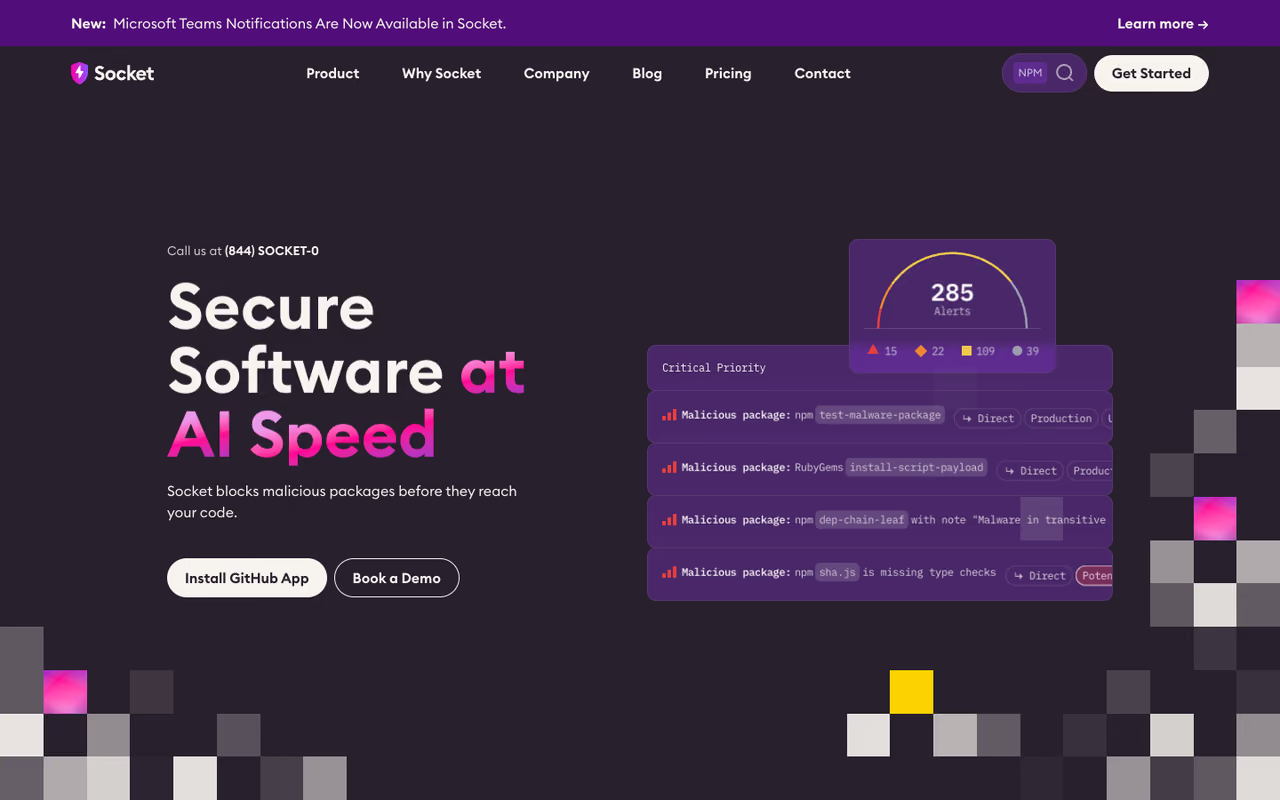
Most SCA tools only learn about a package after a CVE is published, often weeks after a malicious version ships. Socket flips that. It analyzes package behavior, install scripts, network access, obfuscated code, and sudden maintainer changes to flag supply chain attacks before anyone files a CVE. The company raised a $60M Series C in 2026 led by Thrive Capital to push this further, including a firewall that blocks malicious dependencies before they reach a build machine.
Who it's best for: teams worried about typosquatting, dependency confusion, and compromised maintainers, meaning anyone shipping JavaScript or Python at real volume.
The pick if typosquatting, dependency confusion, and compromised maintainers worry you, especially for JavaScript or Python at volume. Its behavior-based detection catches malicious packages early, but it is narrower than a full AppSec platform.
the Free tier covers unlimited developers and repos with 1,000 scans a month and detects 70+ risk types. Team is $25 per developer per month, or $20 billed annually, and adds precomputed reachability that the company says cuts about 60% of CVE false positives. Business is $50 per developer ($40 annual) with unlimited scans and SBOM import/export. Full function-level reachability sits in Enterprise.
The standout: zero-day, behavior-based detection. Nothing else here catches a malicious package this early.
The catch: Socket is narrower than a full AppSec platform. It's superb at the supply chain attack problem and lighter on license governance and binary scanning, so larger orgs often run it alongside another SCA tool rather than instead of one.

Semgrep Supply Chain
Semgrep started as a static analysis engine and grew into a full AppSec platform with SAST, secrets, and Supply Chain for SCA. Its pitch is reachability at the function level: instead of flagging every dependency with a known CVE, it checks whether your code actually reaches the vulnerable function. Import a library but never call the affected code, and it marks the finding unreachable instead of waking you up.
Who it's best for: teams that already like Semgrep's rule engine, or anyone who wants reachability without an enterprise contract.
A smart choice if you already like Semgrep's rule engine or want reachability without an enterprise contract, with a generous free tier. It caps at 10 contributors, and SCA-only buyers may be paying for a whole platform.
the Free edition covers up to 10 contributors and, unusually, includes Code and Supply Chain at no cost with reachability and malicious dependency detection. The Teams plan is $30 per contributor per month for Supply Chain, and Enterprise adds on-prem source control, unlimited repos, and dedicated infrastructure.
The standout: a genuinely useful free tier with reachability baked in. Most vendors paywall that feature hard.
The catch: the free tier caps at 10 contributors, and you grow out of it the moment you're a real team. If SCA is your only need, you may be buying a platform when you wanted a feature.

Endor Labs
Endor Labs was built around one belief: traditional SCA is too noisy to be useful at scale. Its reachability engine analyzes call graphs across 40+ languages and claims up to 97% reduction in alert noise by filtering out vulnerabilities in code paths your application never executes. For a large org drowning in findings, that number is the whole pitch. It also covers malicious package detection, SBOM and VEX generation, and AI model governance.
Who it's best for: mid-to-large orgs where the SCA backlog is unmanageable and the security team needs to prioritize by exploitability.
Built for mid-to-large orgs drowning in SCA findings, with reachability analysis claiming up to 97% less alert noise. The catch is price: nothing sits between the free local scanner and a five-figure contract.
there's a free Developer tier that runs local scans with no account required, a smart way to get engineers using it. Beyond that, Core and Pro are quote-based, and reporting from Sacra puts the average contract around $35k a year with a floor near $20k.
The standout: the noise reduction. If you've watched a dashboard show 500 criticals and seen developers stop reading it, Endor is the answer to that failure.
The catch: the price. There's no self-serve tier between the free local scanner and a five-figure contract, which prices out small teams.
Already paying for tools you barely use?
Before you add another security line item, audit the stack you already run. Dupple X bundles a library of AI and developer tools into one subscription, a cleaner way to test new categories than signing five annual contracts you'll forget to cancel.

Trivy
Trivy, from Aqua Security, is the open source scanner that punches absurdly above its weight. A single binary scans container images, filesystems, Git repos, Kubernetes clusters, and lockfiles, and generates SBOMs in CycloneDX and SPDX. One trivy fs command reads dependency manifests across Go, Java, Node, Python, Ruby, Rust, PHP, .NET, and more. No database setup, no middleware, no license fee.
Who it's best for: teams that want SCA in CI today, for free, and are fine wiring up their own dashboards and triage.
The free option for teams that want SCA in CI today and will wire up their own dashboards and triage. With no reachability, fix PRs, or policy engine, the triage burden can eat the savings.
free and open source, no feature gates. Aqua sells a commercial platform on top, but the scanner costs nothing.
The standout: the breadth-to-effort ratio. You can drop Trivy into a pipeline in an afternoon and catch CVEs in dependencies and containers the same day.
The catch: no reachability analysis, so you're back to CVE-version matching and the noise it brings. No managed dashboard, no fix PRs, no policy engine. You get raw findings and the job of acting on them. For many teams that trade is worth it; for others the triage burden eats the savings.
Black Duck SCA
Black Duck (formerly the Synopsys SCA line) is what you reach for when license compliance is a legal requirement, not a nice-to-have. Its KnowledgeBase catalogs more than 2,750 open source licenses with encoded obligations for each, depth no developer-first tool matches. It also does binary analysis, cracking open compiled artifacts to find components even without source code, which is invaluable for vendor risk and M&A due diligence.
Who it's best for: regulated industries, large enterprises with license governance mandates, and anyone who has to scan third-party binaries.
The benchmark when license compliance is a legal requirement, covering regulated industries and anyone scanning third-party binaries. Developer experience lags the modern crowd, and the value is wasted if remediation is your real driver.
enterprise, custom quoted, typically per-developer seat. Expect a sales process, not a credit card.
The standout: the license KnowledgeBase and binary scanning. For compliance-heavy work, Black Duck is still the benchmark.
The catch: the developer experience lags the modern crowd, it's heavier to deploy and tune than Snyk or Socket, and the value is mostly wasted if your driver is vulnerability remediation rather than license risk.
Sonatype Lifecycle
Sonatype Lifecycle (the old Nexus Lifecycle) takes a different angle: stop bad components at the gate. It plugs into your repository manager and enforces policy at the point a dependency enters your supply chain, blocking known-bad or non-compliant components before they hit a build. Sonatype's component intelligence is regarded as some of the most reliable data in the category, which keeps it in analyst leader quadrants.
Who it's best for: organizations that want centralized policy enforcement and proactive blocking, not after-the-fact scanning.
Choose it for centralized policy enforcement that blocks bad components at the repository gate rather than scanning afterward. It is a heavier governance platform whose cost climbs steeply with users, so small teams will find it overkill.
enterprise and quote-based. Sonatype tends to price higher than JFrog at large seat counts, so model both at scale.
The standout: prevention at the repository level, not just detection.
The catch: a heavier, governance-oriented platform that climbs steeply in cost with user count. Small teams will find it overkill.
JFrog Xray
JFrog Xray is the SCA layer of the JFrog Platform, and its value depends entirely on where you already live. If your artifacts sit in Artifactory, Xray scans them in place, analyzing binaries and containers as they're stored, with binary fingerprinting that holds up against shaded or repackaged dependencies. Deep visibility, no source access required.
Who it's best for: teams already standardized on JFrog Artifactory who want scanning without a separate vendor.
The path of least resistance for teams already standardized on JFrog Artifactory, with strong binary scanning and no source access needed. Outside a JFrog shop its value collapses, and it is not sold standalone.
an add-on to the JFrog Platform, not a standalone SKU. At large seat counts, several comparisons peg JFrog as cheaper than Sonatype, sometimes by roughly an order of magnitude.
The standout: native Artifactory integration and strong binary scanning. If JFrog is your repository, Xray is the path of least resistance.
The catch: the value collapses if you're not already a JFrog shop. Buying Artifactory just to get Xray rarely makes sense, and as a standalone tool it's less compelling than the focused players.
How to choose
Skip the feature matrix and answer three questions.
What's actually driving this? Developer remediation points to Snyk or Semgrep. Supply chain attacks and malicious packages point to Socket. License compliance for legal or M&A points to Black Duck. Centralized policy and prevention point to Sonatype. Naming the real driver eliminates half the list immediately.
How much noise can your team absorb? If developers already ignore the dashboard, reachability is non-negotiable, which means Endor Labs, Semgrep, or Socket's reachability tiers. Tools without it (Trivy, basic scanners) work only if someone owns triage.
What's your budget floor? Zero budget means Trivy, or the free tiers of Semgrep and Socket. A real budget but no enterprise appetite means Snyk Team or Semgrep Teams. Five-figure contracts only make sense once the backlog is unmanageable, which is the Endor and Black Duck zone.
Pair your SCA tool with the rest of your stack rather than treating it as an island. You still want SAST and code review for your own code, secrets scanning for leaked credentials, and broader cybersecurity tooling for runtime. Browse our top tools directory to see how these fit together.
FAQ
What is the difference between SCA and SAST?
SCA scans the third-party and open source dependencies in your project for known vulnerabilities and license risk. SAST (static application security testing) scans the first-party code your team writes for security bugs. They cover different parts of the same app, so most teams run both. Platforms like Snyk and Semgrep sell both products.
Which SCA tool is best for catching malicious packages?
Socket leads here because it analyzes package behavior in real time rather than waiting for a CVE. It flags install scripts, network access, obfuscation, and suspicious maintainer changes, catching typosquatting and compromised packages days or weeks before CVE-based scanners. For supply chain attack defense, it's the strongest pick on this list.
Are there any free software composition analysis tools that are actually good?
Yes. Trivy is fully free, open source, and scans dependencies, containers, and Kubernetes from one binary with no feature gates. Semgrep's free edition includes Supply Chain with reachability for up to 10 contributors, and Socket's free tier covers unlimited developers with 1,000 scans a month. Those three cover most small-team needs without a contract.
What is reachability analysis and why does it matter?
Reachability analysis checks whether your application actually calls the vulnerable function inside a dependency before flagging it. A library can carry a known CVE, but if your code never executes the affected path, the risk is theoretical. Endor Labs, Semgrep, and Socket use this to cut false positives, with Endor claiming up to 97% noise reduction. It's the main reason developers trust modern SCA over older scanners.
How much do software composition analysis tools cost in 2026?
Free options like Trivy cost nothing. Developer-first plans like Snyk Team and Semgrep Teams run roughly $25 to $30 per developer per month. Enterprise tools like Endor Labs start around $20k a year and average near $35k, while Black Duck and Sonatype are custom-quoted and can run into six figures for large organizations. Match the tier to your driver, not the longest feature list.
Short version: start with a free tier (Trivy, Semgrep, or Socket), add Snyk when remediation becomes the bottleneck, and only move to Endor Labs or Black Duck when noise or compliance forces it. Buy for the problem you actually have, and revisit once your dependency tree doubles, because it will.
Related guides
Some offers on this page may be paid placements or contain affiliate links.
