
Best CRM for Startups in 2026 (Compared, With Real Pricing)

Key facts7 tools compared: HubSpot, Attio, Folk, Pipedrive, Close, Zoho CRM, Salesforce Starter
- 7 tools compared: HubSpot, Attio, Folk, Pipedrive, Close, Zoho CRM, Salesforce Starter
- HubSpot (best for: The safe scalable default): Free, then $20/seat/mo
- Attio (best for: Product-led, data-minded teams): Free (3 seats), then $29/seat/mo
- Folk (best for: Founders doing BD and fundraising): Free trial, then $24/seat/mo
- Pipedrive (best for: Outbound sales-led teams): $14/seat/mo (Lite)
Most startup CRM advice is written by people who have never had to migrate one. They'll tell you to "future-proof" with an enterprise platform on day one, and six months later you're paying for seats you don't use and admin work nobody on a five-person team should be doing.
Here's the real tension. Pick something too light and you outgrow it before your Series A, then eat a painful migration mid-fundraise. Pick something too heavy and you spend your first quarter configuring fields instead of talking to customers. The right CRM for a startup sits in that narrow band: cheap enough to not think about, flexible enough to bend around your process, and capable of growing with you for at least two years.
This guide compares most of the tools below against how different startups actually operate. If you want the short version: HubSpot is still the safest default because of its free tier and aggressive startup discount, Attio is the best modern choice for product-led teams who think in data, and Folk wins for relationship-driven founders doing fundraising and BD. The rest depends on your sales motion, which I'll break down below.
Quick comparison
| Tool | Best for | Starting price (annual) | Standout |
|---|---|---|---|
| HubSpot | The safe scalable default | Free, then $20/seat/mo | 90% off year one for funded startups |
| Attio | Product-led, data-minded teams | Free (3 seats), then $29/seat/mo | Airtable-like flexibility, real CRM power |
| Folk | Founders doing BD and fundraising | Free trial, then $24/seat/mo | LinkedIn-first contact capture |
| Pipedrive | Outbound sales-led teams | $14/seat/mo (Lite) | Dead-simple visual pipeline |
| Close | Outbound teams that live on the phone | $35/seat/mo (Essentials) | Calling, SMS, sequences built in |
| Zoho CRM | Bootstrapped, budget-first | Free (3 users), then $14/seat/mo | Cheapest path to real automation |
| Salesforce Starter | Teams certain they'll go enterprise | $25/seat/mo | A real on-ramp to the full platform |

HubSpot: the default that's actually earned it
I roll my eyes at "just use HubSpot" advice as much as anyone, but for early-stage startups the consensus is right. The free CRM gives you unlimited users, contact and deal records, email tracking, meeting scheduling, live chat, and forms, with a contact cap that's far higher than most startups will hit in their first year. You can run a real sales process on $0.
The safe default for startups that expect to scale fast and don't want to migrate again at Series A. The free CRM runs a real sales process on $0, but the jump from Starter to Professional is brutal if you miss the startup discount.
Free tier, then the Starter Customer Platform at $20/seat/month covers all five hubs at Starter level. The bigger story is the HubSpot for Startups program: if you've raised pre-seed through Series A (under $20M) and you're tied to an approved accelerator or VC partner, you get 90% off year one, 50% off year two, and 25% off after that. That turns the otherwise eye-watering Professional tier ($890/month) into something a funded seed company can stomach.
The standout: Nothing else combines a genuinely usable free tier with a clear, discounted runway all the way to enterprise. You will not outgrow HubSpot.
The catch: The free and Starter tiers are deliberately limited so you feel the pull upward. The jump from Starter to Professional is brutal if you don't qualify for the discount, and a lot of startups only get the 30% partner discount, not the 90% one. Read the eligibility terms before you assume you're getting the headline deal.
Attio: the modern CRM that bends to your data
Attio is what you build when you start a CRM from scratch in 2026 instead of 2006. It feels like Airtable, but underneath it's a real relationship engine that syncs your email and calendar automatically and enriches contacts the moment they land. For product-led teams who already think in tables and pipelines, it clicks immediately.
Go with Attio if you're a technical founder or PLG startup that wants to model its own objects. The flexibility is excellent and enrichment is automatic, but you must design the pipeline yourself and call intelligence only arrives on the $69 Pro tier.
Free for up to 3 seats with automatic data enrichment and email sync. Plus is $29/seat/month (annual), which removes seat limits and raises record capacity to 250,000. Pro at $69/seat/month adds call intelligence and advanced permissions. Enterprise is custom.
The standout: The flexibility-to-power ratio. You can reshape the entire data model in an afternoon without an admin or a consultant, and the auto-enrichment means your contact records fill themselves in.
The catch: That same flexibility is a blank-canvas problem. If you want an opinionated, "here's your sales pipeline, go" experience, Attio asks you to design it first. Less technical sales teams can stall on setup, and the deepest features (call intelligence, fine-grained permissions) only show up on the $69 Pro tier.

Folk: built for founders who sell through relationships
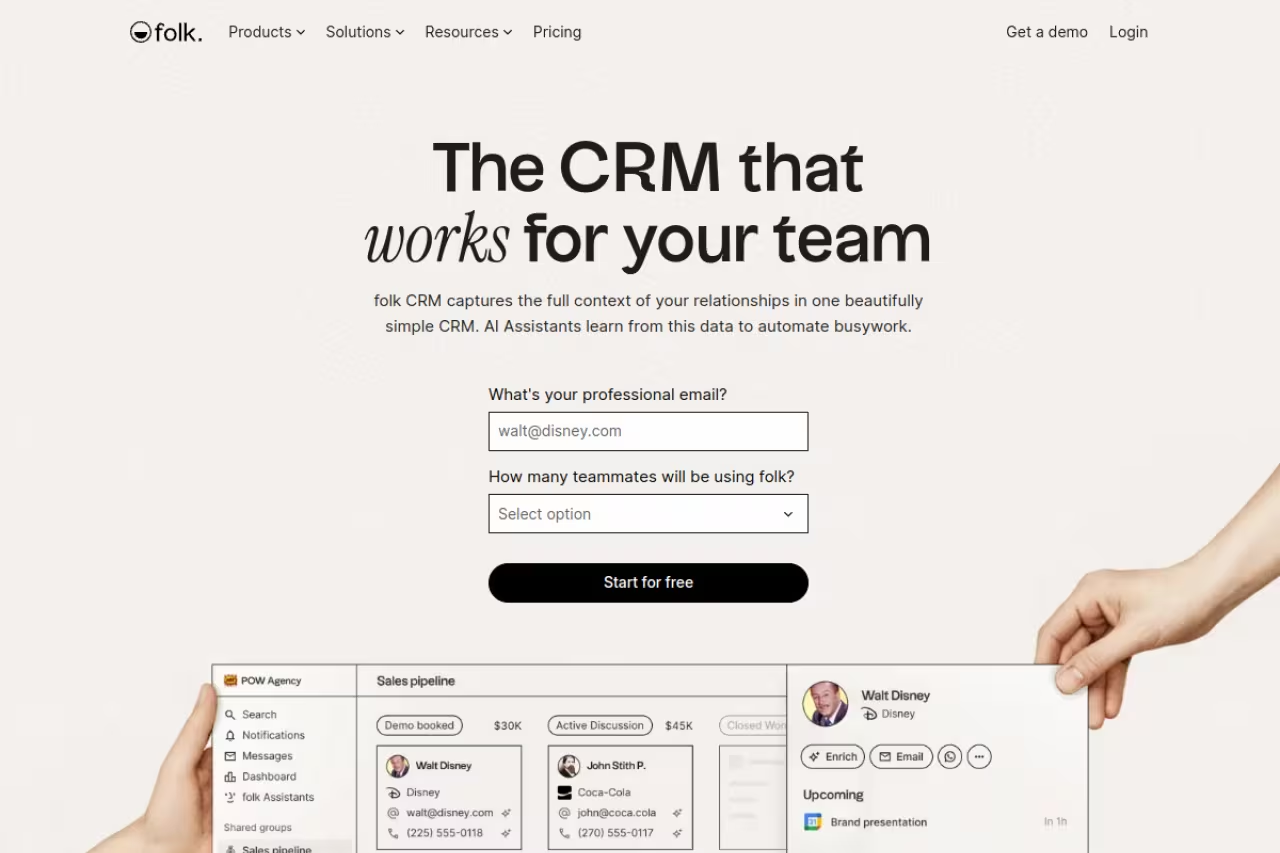
Folk is the CRM I reach for when the "sales process" is really a web of relationships: investors, design partners, advisors, BD contacts. Its LinkedIn extension lets you pull a profile into the CRM in two clicks, and the contact enrichment plus AI fields mean you're not hand-typing job titles at midnight.
The CRM for solo founders and small teams working fundraising, partnerships and high-touch BD. Folk captures contacts faster than anything else here, but it hits a ceiling for heavy outbound and its enrichment credits can run dry on Standard.
A 2-week free trial (no card), then Standard at $24/member/month annually with 500 enrichment credits, 2,000 AI field credits, and email campaigns. Premium at $48/member/month adds custom objects, deals, email sequences, and API access. Members are unlimited on every plan.
The standout: Speed of capture. Folk turns "I met someone interesting" into a clean, enriched contact faster than anything else here, which is exactly what relationship-led founders need.
The catch: It's not built for heavy outbound. If you need dialers, deep deal reporting, or complex multi-stage pipelines for a quota-carrying team, you'll feel the ceiling. Enrichment and AI credits are also metered, so power users on Standard can run dry before month's end.
If you're still mapping out which sales stack fits your motion, our guide to the best AI sales tools pairs well with whatever CRM you land on.

Pipedrive: the simplest visual pipeline that works
Pipedrive has one job and does it well: show your deals as cards moving across a board, and make it obvious what to do next. There's almost no learning curve, which matters when your "sales team" is two co-founders who'd rather be building.
Pipedrive suits sales-led startups that want a clean, affordable pipeline with almost no learning curve. Just expect the cheap $14 Lite plan to grow pricier once you add the marketing, support and reporting extras you actually want.
Lite at $14/seat/month (annual) covers pipeline tracking and basic integrations. Growth is $39, Premium $49, and Ultimate $79 per seat. There's a 14-day free trial with no card required.
The standout: Time to value. You can import contacts and run your first pipeline in under an hour, and it stays out of your way after that.
The catch: Pipedrive is a sales pipeline tool, not a full GTM platform. Marketing automation, support, and richer reporting live in paid add-ons that stack up fast, so the "cheap" Lite plan rarely stays cheap once you add the bits you actually want.

Close: for teams that close on the phone
Close was built by a sales team for sales teams, and it shows. Calling, SMS, and email sequences are native, not bolted-on integrations, so an SDR can run an entire outbound day without leaving one tab. For volume outbound, that consolidation is the whole point.
Pick Close if your reps live on the phone and you want the dialer, inbox and pipeline on one screen. Skip it for inbound or product-led motions, and note that Growth at $99/seat adds up quickly past a few reps.
Solo at $9/seat/month (capped at one user) is a genuine option for a founder selling alone. Essentials is $35/seat/month annually with unlimited users; Growth is $99 and Scale $139. The 14-day trial needs no card and includes $5 of calling credit.
The standout: Everything an outbound rep does lives in one screen. No tab-switching between a dialer, a sequencing tool, and the CRM, which compounds into real time saved across a week.
The catch: If your motion is inbound or product-led, you're paying for calling infrastructure you won't use. Workflows and email open tracking aren't on the cheapest tiers, so a real team lands on Essentials or Growth, and Growth at $99/seat adds up quickly past a few reps.
Zoho CRM: the bootstrapper's pick
Zoho CRM is the answer when budget is the first constraint and you still want real automation. The free plan covers 3 users with leads, contacts, and deals, and the paid tiers undercut almost everyone on this list while still giving you workflow automation and AI sales insights.
The bootstrapper's choice: legitimate CRM functionality, with automation and AI features, for a very low bill. The free plan covers 3 users, though the interface feels dated and the sprawling Zoho suite can be confusing.
Free for 3 users. Standard is $14/seat/month annually, Professional $23, Enterprise $40, and Ultimate $52. If you already use other Zoho apps, the bundled Zoho One pricing gets even more efficient.
The standout: Price-to-capability. Few tools give you automation and AI features this cheap, and the broader Zoho ecosystem means you can add billing, support, and email under one vendor as you grow.
The catch: The interface feels dated next to Attio or Folk, and the sprawling Zoho suite can be confusing to navigate. You trade polish and modern UX for a lower bill, which is the right trade for some teams and a dealbreaker for others.
Salesforce Starter: only if you know you're going enterprise
Salesforce is overkill for most startups, full stop. But the Starter Suite exists for a specific case: you're confident you'll be a mid-market or enterprise sales org within 18 months, and you'd rather start on Salesforce than migrate onto it later under pressure.
Choose Salesforce Starter only if a clear enterprise sales motion is ahead and you'd rather upgrade later than migrate under pressure. At $25/seat it's an on-ramp, but for most seed-stage teams the setup overhead outweighs the benefit.
Starter Suite at $25/seat/month (annual or monthly), bundling sales, service, and marketing basics with no user maximum. It's the on-ramp; the real Salesforce capability lives in much pricier editions above it.
The standout: It's a true path into the most powerful CRM platform on the market, so the migration you'd otherwise dread later is just an upgrade.
The catch: For a seed-stage team, this is buying a suit two sizes too big. The configuration overhead and ecosystem complexity are real, and unless you genuinely have enterprise deals on the horizon, you'll get more done on HubSpot, Attio, or Folk for less money and far less setup.
How to choose without overthinking it
Match the CRM to your sales motion, not to your ambition. Three questions get you most of the way:
What's your motion? Relationship-led BD and fundraising points to Folk. High-volume outbound calling points to Close. A clean visual sales pipeline points to Pipedrive. Product-led growth with custom data points to Attio.
What's your budget and funding? If you've raised from a known VC or accelerator, claim the HubSpot for Startups discount and let it carry you to Series A. If you're bootstrapped, Zoho's free tier or $14 Standard plan is the most CRM you can buy per dollar.
How fast will you scale? If you'll triple headcount in a year, weight toward tools that won't force a migration: HubSpot and Attio both scale cleanly. If you're a two-person team that'll stay small for a while, optimize for simplicity and pick the cheapest tool that fits your motion.
One rule that's saved me twice: don't buy for the team you'll have in three years. Buy for the team you have now plus one stage of growth. Migrations are cheaper than wasted years of paying for unused enterprise seats. If you want a feed of new GTM and CRM tools as they launch, the Techpresso newsletter and Dupple X are how I keep the shortlist fresh, and top-tools is a good browse when you're comparing categories.
FAQ
What is the best free CRM for startups?
HubSpot's free CRM is the strongest all-rounder: unlimited users, deal and contact tracking, email tracking, and meeting scheduling at $0. Zoho's free plan (3 users) is the better pick if you want real workflow automation without paying, and Attio's free tier (3 seats) is best if you want a modern, flexible data model from day one.
How much should a startup spend on a CRM?
Early stage, aim for $0 to $30 per seat per month. Free tiers from HubSpot, Zoho, and Attio cover most pre-revenue teams. Once you're past roughly $5,000 MRR and need automation or reporting, $14 to $35 per seat (Zoho Standard, Pipedrive Lite, or Close Essentials) is the normal range before you'd consider a Professional-tier jump.
When should a startup get a CRM instead of using a spreadsheet?
The moment more than one person touches the same deals, or you're tracking more than about 50 active conversations. Spreadsheets break on follow-up reminders, ownership, and history. A free CRM tier removes the cost objection, so the only real question is whether the manual entry is slowing you down yet.
Is HubSpot or Salesforce better for a startup?
HubSpot, in almost every case. It has a real free tier, a much gentler setup, and the 90% startup discount makes its paid tiers affordable. Salesforce only makes sense if you already know you're building an enterprise sales org and want to avoid migrating onto it later. For more on this trade-off, see our best CRM for B2B breakdown.
Which CRM is best for an outbound sales startup?
Close, because calling, SMS, and email sequences are native rather than add-ons, so reps run a full outbound day in one tool. Pipedrive is a lighter, cheaper alternative if you mostly need pipeline tracking with less call volume. Pair either with the right prospecting stack from our best AI SDR tools guide.
Whichever you pick, set it up before you need it. The worst time to choose a CRM is mid-fundraise when your pipeline is already a mess. Start free, match the tool to your motion, and upgrade only when a real limit forces your hand. If you want the new tools landing in this space delivered weekly, try Dupple X.
Related guides
Some offers on this page may be paid placements or contain affiliate links.
Across our whole catalogue the median is $24 a month and 33% of tools advertise a free tier. Figures are the lowest recurring monthly price quoted in our own review of each tool, read on 2026-08-19. Full method and every category.
