
8 Best AI Blog Writers in 2026 (Compared, With Real Pricing)

Key facts8 tools compared: Surfer SEO, Jasper, Claude, Frase, Outrank, Scalenut, Writesonic, Rytr
- 8 tools compared: Surfer SEO, Jasper, Claude, Frase, Outrank, Scalenut, Writesonic, Rytr
- Surfer SEO (best for: SEO + GEO optimization): €49/mo (Discovery)
- Jasper (best for: Brand-consistent marketing content): $59/mo (Pro, annual)
- Claude (best for: Raw writing quality): $20/mo (Pro)
- Frase (best for: Research and content briefs): $49/mo (Starter)
If you want the short version: pair a raw writing model like Claude with an SEO-aware editor like Surfer SEO, and you'll beat almost every "one-click blog generator" on the market. That combo costs about $69 a month and produces drafts that actually rank.
The harder truth is that most AI blog writers are now optimized for the wrong thing. A lot of them race to hand you a 2,000-word article in 90 seconds. Google's March 2026 core update explicitly went after exactly that: generic, robotic AI text published at scale without real editing or first-hand insight. The tools worth paying for in 2026 are the ones that help you research, structure, and optimize, then get out of the way so a human can add the part the model can't fake.
I compared how each tool handles the same brief: a 1,600-word post targeting a mid-competition keyword, judged by the same standard each time. This is for founders, marketers, and operators who publish content as a growth channel and care whether it ranks, not whether it's "done" by lunch. Below is what each tool is genuinely good at, what it costs, and where it falls short.
Quick comparison
| Tool | Best for | Price | Standout |
|---|---|---|---|
| Surfer SEO | SEO + GEO optimization | €49/mo (Discovery) | Real-time content score for Google and AI search |
| Jasper | Brand-consistent marketing content | $59/mo (Pro, annual) | Brand Voice that actually holds tone |
| Claude | Raw writing quality | $20/mo (Pro) | Best natural prose, least "AI smell" |
| Frase | Research and content briefs | $49/mo (Starter) | SERP-driven briefs with headings and stats |
| Outrank | Hands-off publishing at volume | $99/mo | 30 auto-published articles per site |
| Scalenut | GEO + SEO on a budget | $39/mo (annual) | Ready-to-rank articles plus AI visibility tracking |
| Writesonic | AI search visibility tracking | $79/mo (Starter, annual) | Tracks how AI engines cite you |
| Rytr | Cheap short-form drafting | $7.50/mo (Unlimited, annual) | Lowest price for unlimited output |

Surfer SEO: best for getting blog posts to actually rank
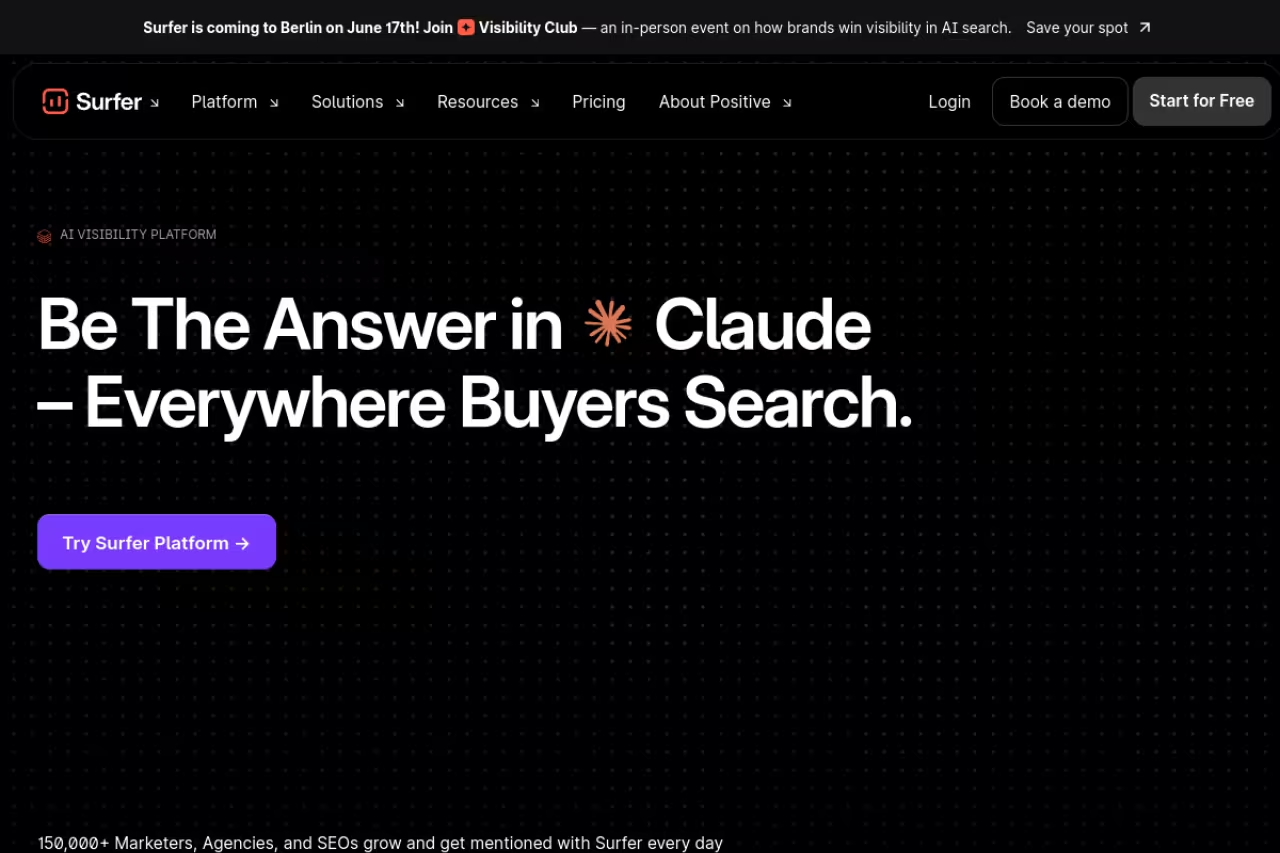
Surfer SEO is the tool I trust most when the goal is ranking, not just publishing. It analyzes the live SERP for your keyword, then scores your draft in real time against what's already winning: word count, headings, terms to include, and structure. In 2026 it also scores for GEO, so you can see how likely your content is to get cited inside AI search answers, not only ranked in blue links.
Choose Surfer if blogging is a search channel and you want a live score to optimize against, now including GEO. Its own AI drafts are mediocre, and heavy publishers outgrow the Discovery limit quickly.
It's the connective tissue between a raw draft and a post that competes.
Pricing: the Discovery plan is €49/month billed yearly for 120 documents, Standard is €99/month for 360 documents, and Pro is €182/month with five brand workspaces. There's a built-in AI writer (Surfy) on every tier.
The standout is the content editor. Watching the score climb as you edit is oddly addictive, and unlike most AI writers it pushes you to add depth rather than padding.
The catch: Surfer's own AI drafts are mediocre. Use it as the optimization layer, not the writing layer. And the per-document model means heavy publishers blow through the Discovery limit fast, forcing an upgrade to €99.

Jasper: best for teams that need brand consistency

Jasper has shifted from a generic copy generator into a marketing content platform built around agents and a Canvas workspace. For blog writing specifically, the reason to pick Jasper is Brand Voice. You feed it your existing content, and it holds your tone across long pieces better than anything else on this list. For a team where five people publish under one brand, that consistency is worth real money.
The team pick when five people publish under one brand, since Brand Voice holds tone across long pieces better than anything else here. At $59 a seat it gets pricey, and solo bloggers will not need the agent and Canvas learning curve.
Pricing: the Pro plan is $59/month per seat on annual billing ($69 monthly), with 2 Brand Voices and 5 knowledge assets. Business pricing is custom and gets you the API, unlimited brand voices, and the no-code app builder. A 7-day free trial covers Pro.
The standout is tone control. When you've taught it your voice, the drafts need far less rewriting than a blank-slate model would.
Where it falls short: it's overkill for a solo blogger, and at $59 a seat it gets expensive fast for small teams. The agent and Canvas features add a learning curve you don't need if you just want clean drafts.

Claude: best for raw writing quality
For the actual sentences, Claude is my default. Anthropic's current flagship produces the most natural long-form prose of any model on this list, with the least of that flat, hedge-everything "AI smell." When the writing is judged on tone and readability, Claude consistently edges out the alternatives, and its long context window means it holds a 2,000-word argument together without drifting.
Go with Claude when the sentences matter most: it produces natural prose that needs only light editing once it matches your samples. It is a chat model rather than a blogging tool, so pair it with something like Surfer or Frase for SEO.
Pricing: Claude Pro is $20/month, the same as ChatGPT Plus. There's a usable free tier if you only need a few pieces a month.
The standout is voice. Paste in a few examples of your writing and ask it to match them, and the output is close enough that light editing finishes the job.
The catch: Claude is a chat model, not a blogging tool. No SEO scoring, no keyword research, no publishing. You pair it with something like Surfer or Frase to handle the search side. If you want one tool that does everything, this isn't it. If you want the best prose, it is.
Most teams I talk to over-invest in the writing tool and under-invest in the editing and distribution. If you're trying to build content as a real channel, the Dupple X yearly trial covers the strategy side: which keywords to chase, how to brief, and where to distribute once the post is live.

Frase: best for research and briefs
Frase attacks the part of blogging everyone skips: the research and brief. Give it a keyword and it pulls the top-ranking results, extracts the questions people ask, and builds a structured outline with recommended headings and stats to cover. Starting from a Frase brief instead of a blank page is the single biggest quality jump I saw across these tools.
The biggest quality jump I saw came from starting with a Frase brief, which turns a keyword into a real outline grounded in what already ranks. Starter article limits are tight, and its own writing is serviceable rather than great.
Pricing: the Starter plan is $49/month for 10 AI-optimized articles, Professional is $129/month for 40 articles across 5 domains, and Scale is $299/month for 100. Annual billing saves 20%.
The standout is the brief generator. It turns "write about X" into a real plan, which is where most AI blog posts fall apart.
Where it falls short: the article limits are tight on the Starter plan, and Frase's own writing is serviceable but not in Claude's league. Treat it as a briefing and optimization tool, not your final draft.
Outrank: best for hands-off publishing at volume
Outrank is the closest thing to a true autopilot. It does keyword research, writes the article, generates images, and publishes straight to WordPress, Webflow, or Shopify with no human in the loop. For a programmatic content play across a lot of long-tail keywords, the economics are hard to beat.
A true autopilot for founders running programmatic SEO, taking you from keyword to published post at roughly $3 per article. Publishing raw output is exactly what Google's scaled-content-abuse policy targets, so add a human pass before going live.
Pricing: the Standard plan is $99/month for 30 auto-published articles per site, with volume discounts at multiple sites. That works out to roughly $3 per article, the cheapest production cost in this lineup.
The standout is the full pipeline. Few tools take you from keyword to published post with images attached, untouched by hand.
The catch: this is exactly the workflow Google's scaled-content-abuse policy targets if you publish raw output. Outrank's drafts are decent for the price, but "auto-publish and forget" is a real risk in 2026. Use it to draft at volume, then have a human pass before anything goes live. If you want to understand where this fits, our guide to AI SEO tools breaks down the trade-offs.

Scalenut: best GEO value on a budget
Scalenut repositioned in 2026 from a generic AI writer into an SEO-plus-GEO platform, and the budget pricing makes it a strong pick for solo operators. You get ready-to-rank articles, optimization for existing posts, and tracking for how your content shows up in AI answers, all in one place.
A budget SEO-plus-GEO platform for solo operators and small teams who want writing and AI-visibility tracking in one subscription. Article allowances are low and the writing sits below the dedicated drafting tools, so it is a value play, not a quality leader.
Pricing: the Starter plan runs $59/month ($30/month on a promotional annual rate) with 5 ready-to-rank GEO articles and tracking for ChatGPT and Google AI Overviews. Plus is $89/month and Professional $199/month, which adds Perplexity tracking.
The standout is bundling. SEO writing and GEO tracking in one subscription is rare at this price.
Where it falls short: the article allowances are low, the interface tries to do a lot, and the writing quality sits a notch below the dedicated drafting tools. It's a value play, not a quality leader.

Writesonic: best for AI search visibility tracking
Writesonic has pivoted hard toward GEO. It still writes articles, but the product now centers on tracking how AI engines like ChatGPT, Gemini, and Google AI Overviews cite (or ignore) your brand. If your concern in 2026 is "am I showing up in AI answers," this is built for that question.
Pick Writesonic if your main question is whether AI engines cite your brand, since the tracking layer is the product. Pricing jumps steeply and article counts are low for the cost, so for writing alone cheaper tools win.
Pricing: the Starter plan is $79/month billed annually, tracking ChatGPT only with 15 AI articles a month. Basic at $199/month adds Gemini and Google AI Overviews; Growth at $399/month adds sentiment analysis and 50 articles.
The standout is the tracking layer. Seeing which prompts surface your content (and which surface competitors) is genuinely useful for a 2026 content strategy.
The catch: pricing jumps steeply, and the article counts are low relative to the cost. You're paying for the visibility tracking, not the writing volume. For the writing alone, cheaper tools win.

Rytr: best for cheap, fast short-form
Rytr is the budget entry point. It won't write your flagship pillar piece, but for fast first drafts, intros, meta descriptions, and outlines, it's the cheapest unlimited option I found.
The cheapest unlimited option for solo bloggers who need volume over polish, handy for intros, meta descriptions and outlines. Long-form output reads generic and needs heavy editing, and there is no real SEO or research layer.
Pricing: there's a free tier capped at 10,000 characters a month, the Unlimited plan is $7.50/month on annual billing, and Premium is $24.16/month with 35-plus languages and more tone matching.
The standout is price. Unlimited generation for under $8 a month is unmatched here.
Where it falls short: quality. Rytr's long-form output reads generic and needs heavy editing, and it has no real SEO or research layer. It's a drafting assistant for people who'll do the thinking themselves.
How to choose
Skip the search for one tool that does everything. The best 2026 setup is two tools: a strong writing model and an SEO or research layer.
- If ranking is the goal and you have a small budget, start with Claude at $20 plus Surfer SEO at €49. That stack beats most all-in-one generators.
- If you're a marketing team that publishes under one brand, Jasper earns its $59 a seat through Brand Voice consistency.
- If research is your bottleneck, Frase briefs fix the blank-page problem before you write a word.
- If you need programmatic volume, Outrank is the cheapest per article, but only if a human reviews before publishing.
- If you're broke and just need drafts, Rytr does the job for under $8.
One rule cuts through all of it: in 2026, AI-drafted plus human-edited content ranks; raw AI output increasingly does not. Pick the tool that makes the editing easier, not the one that promises to skip it. For more on the writing-quality side, see our breakdowns of the best AI for content writing, the best AI for copywriting, and the best AI for blogging.
FAQ
What is the best AI blog writer in 2026?
There's no single winner, because writing and optimization are different jobs. For raw prose, Claude at $20/month is the strongest. For getting that prose to rank, Surfer SEO is the best optimization layer. Most serious bloggers run both. If you want one platform, Jasper is the best self-contained pick for brand-consistent content.
Can Google detect and penalize AI-written blog posts?
Google's position is that it judges content by quality, not how it was produced. It does not penalize AI content for being AI. What it does penalize is "scaled content abuse": publishing lots of low-value pages to manipulate rankings. AI drafts that are edited, fact-checked, and given real first-hand insight rank fine. Raw, unedited output published at volume is the thing that gets hit.
How much should I budget for an AI blog writing setup?
What's the difference between SEO and GEO for AI blog writers?
SEO optimizes for ranking in traditional search results. GEO (generative engine optimization) optimizes for getting cited inside AI answers from ChatGPT, Perplexity, and Google AI Overviews. Tools like Surfer SEO, Scalenut, and Writesonic now score for both. As more searches happen inside AI assistants, GEO is becoming as important as classic rankings. Our guide to AI search visibility covers this in depth.
Do I still need a human writer if I use AI?
Yes, and that's the whole point in 2026. The tools that work treat AI as a drafting and optimization assistant, not a replacement. The value a human adds (first-hand experience, opinions, accurate specifics, and a real point of view) is exactly what Google's recent updates reward and what AI can't fabricate. Use AI to go faster, not to skip the thinking. If you want help building content into a growth channel, the Dupple X trial covers strategy and distribution alongside the writing.
Related guides
Some offers on this page may be paid placements or contain affiliate links.
Across our whole catalogue the median is $24 a month and 33% of tools advertise a free tier. Figures are the lowest recurring monthly price quoted in our own review of each tool, read on 2026-08-19. Full method and every category.
