
Best Nonprofit CRM Software in 2026: 8 Donor Platforms Compared

Key facts8 tools compared: Bloomerang, Neon CRM, Givebutter, Little Green Light, Zeffy, Donorbox…
- 8 tools compared: Bloomerang, Neon CRM, Givebutter, Little Green Light, Zeffy, Donorbox, Virtuous, Salesforce Nonprofit Cloud
- Bloomerang (best for: Donor retention): From $125/mo
- Neon CRM (best for: Unlimited users and contacts): From $99/mo
- Givebutter (best for: Free, all-in-one fundraising): $0 (tip-based)
- Little Green Light (best for: Small budgets): From $45/mo
Most nonprofit CRMs are sold by salespeople who lead with a demo and bury the price. That makes choosing one harder than it should be, because the sticker number is rarely the real cost. Contact-based pricing balloons as your list grows. Per-user pricing punishes you for adding staff. And "free" platforms make their money on processing fees you never see until the donation lands.
I spent the past few weeks digging through pricing pages, support docs, and migration stories for the donor management tools nonprofits actually use. If you want the short version: Bloomerang is the best all-around pick for small and mid-size organizations that care about donor retention, and Givebutter is the strongest free option if your budget is genuinely zero. Everything else is a fit question, which is what the rest of this guide is about.
This is written for development directors, executive directors, and ops people at organizations with 500 to 50,000 donor records. Salesforce is on the list for the larger teams, but most of you aren't there, and I'll flag when it's overkill.
Quick comparison
| Tool | Best for | Price | Standout |
|---|---|---|---|
| Bloomerang | Donor retention | From $125/mo | Retention dashboard front and center |
| Neon CRM | Unlimited users and contacts | From $99/mo | Revenue-based pricing, not contact-based |
| Givebutter | Free, all-in-one fundraising | $0 (tip-based) | Full CRM with no platform fee |
| Little Green Light | Small budgets | From $45/mo | Cheapest serious donor database |
| Zeffy | Truly zero-fee fundraising | $0 | No processing fees at all |
| Donorbox | Online donation forms + light CRM | 1.5% platform fee | Fastest donation form setup |
| Virtuous | Mid-size teams scaling fundraising | From $199/mo | Predictive donor scoring |
| Salesforce Nonprofit Cloud | Enterprise customization | 10 free licenses, then $60/user/mo | Builds anything you can imagine |

Bloomerang
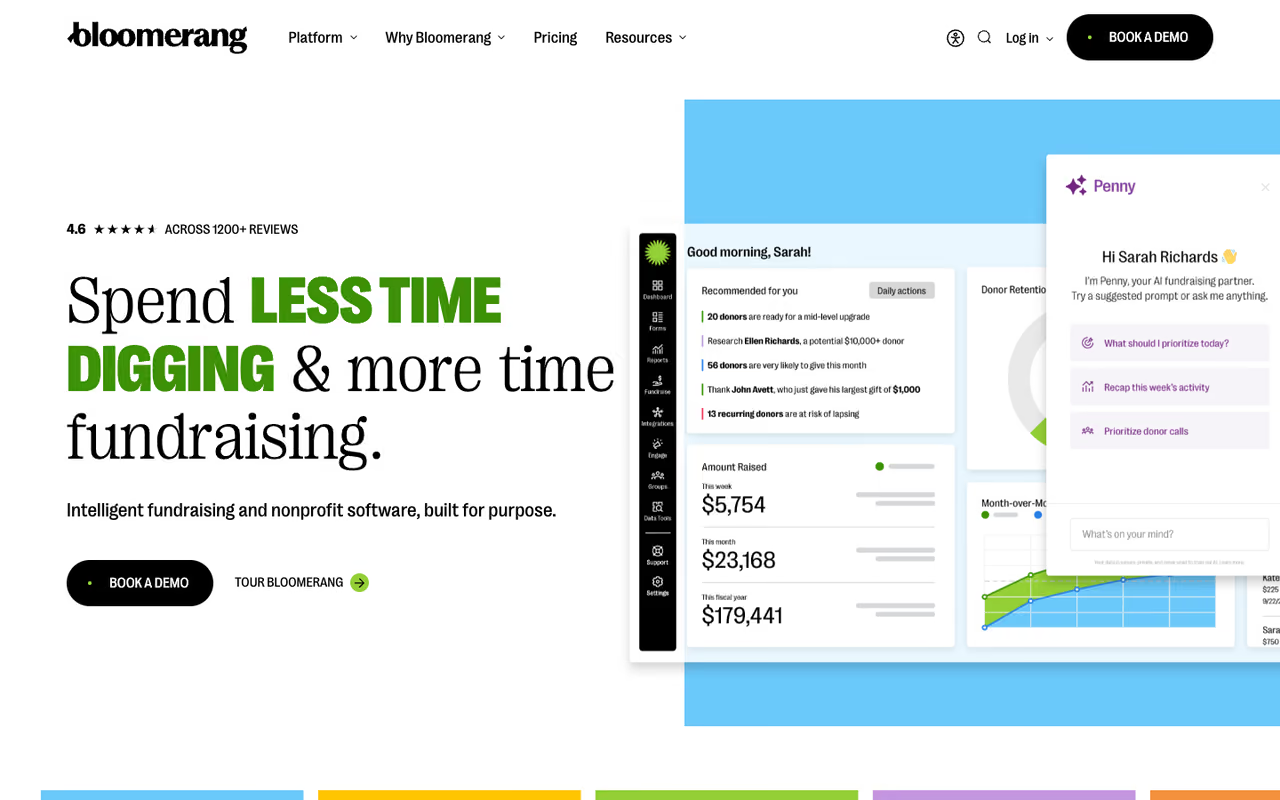
Bloomerang built its whole product around one number: donor retention. The first thing you see when you log in is your retention rate next to your year-over-year giving, and that framing changes how teams behave. Instead of obsessing over new acquisition, you start asking why donors lapse, which is where most of the money actually is.
Pick it if you are a small to mid-size nonprofit ready to leave spreadsheets and focus on donor retention, with an engagement meter that helps prioritize calls. Constituent-based pricing climbs as your database grows, so audit your list first, and there is no free trial.
The engagement meter, which scores how warm each donor is based on giving and interaction history, is genuinely useful for prioritizing who to call before year-end.
Pricing starts at $125/month for the CRM, billed annually, and scales by your number of constituents rather than users (users are unlimited). The fundraising add-on starts at $40/month and volunteer management at $119/month, per Bloomerang's pricing page. A 1,000-record org lands in the entry range. Once you cross several thousand records, expect the monthly to climb noticeably.
The catch: constituent-based pricing means your costs rise as your database grows, even if half those records are lapsed donors you'll never reactivate. Audit your list before you sign, because you may be paying to store dead weight. There's also no free trial, so you're committing based on a demo.

Neon CRM
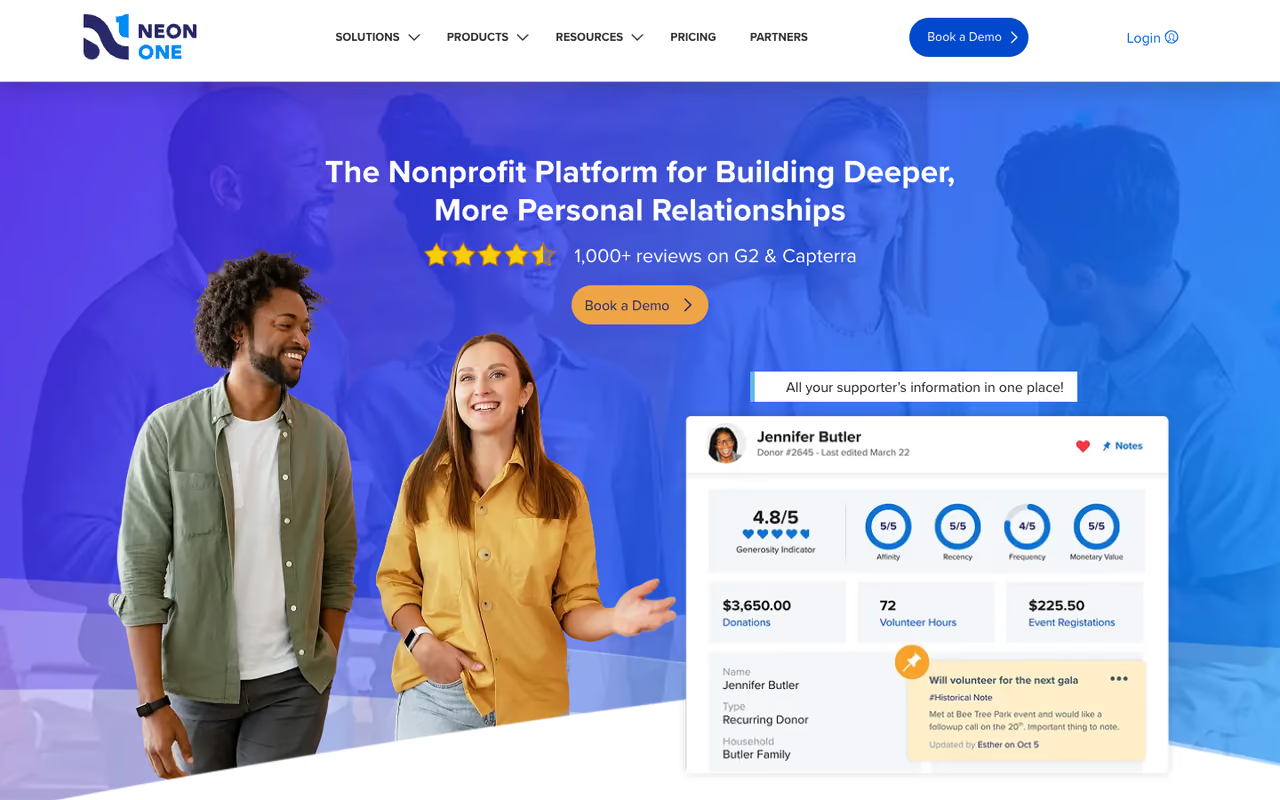
Neon CRM takes the opposite stance on pricing from almost everyone else. It charges based on your organization's annual revenue, not your contact count or staff headcount. That means you can store 5,000 records or 50,000 records on the same plan, with unlimited users included at every tier. For organizations with big lists and small budgets, that math is hard to beat.
Go with it if you want one system for fundraising, events, volunteers and memberships, with unlimited users and pricing based on annual revenue instead of contact count. The interface feels dated and the first few weeks bring a learning curve.
Associations and membership organizations specifically gravitate here because the platform handles dues and recurring memberships natively.
Plans run $99/month for Essentials, $209/month for Impact, and $409/month for Help, according to Neon One's pricing details. Essentials gives you 3 active workflows; Impact bumps that to 15 plus events and volunteer management and an open API; Help unlocks unlimited workflows and live phone support. Association pricing runs about $10/month higher per tier.
Where it falls short: the interface feels dated next to newer tools, and users consistently flag a learning curve in the first few weeks. Setup takes patience. If you want something your whole team can use on day one without training, look at Bloomerang or Little Green Light first.

Givebutter
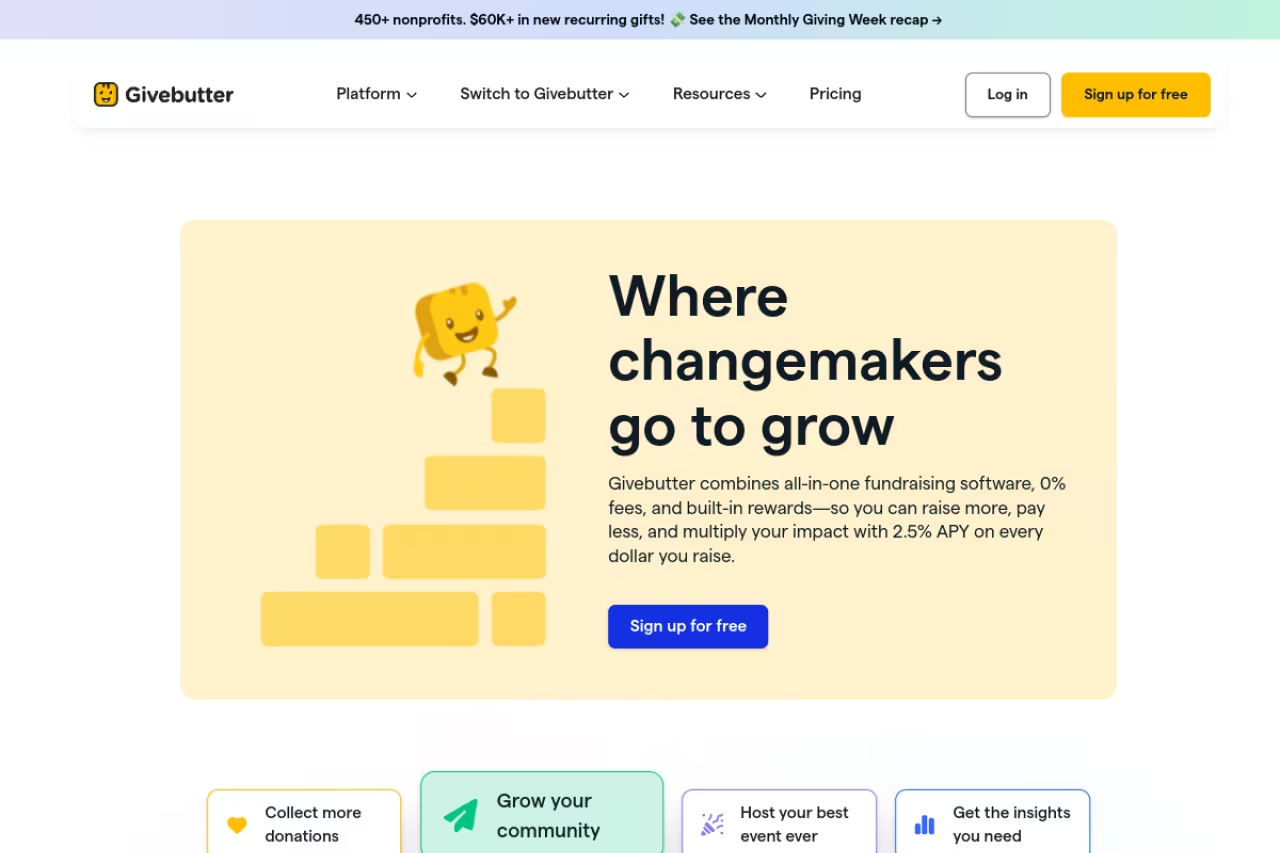
Givebutter is the best free option on this list, and "free" here means a full CRM with unlimited contacts, donation forms, event ticketing, and peer-to-peer fundraising at zero subscription cost. The company makes money through optional donor tips. When tips are on, you pay $0 in platform fees and donors get the chance to cover transaction costs.
A strong free option for small nonprofits that have outgrown a Google Sheet, bundling donation forms, events and peer-to-peer fundraising. The free promise rests on donors choosing to tip, and advanced donor management sits behind the paid Givebutter Plus.
The all-in-one nature matters here: you're not bolting a donation form onto a separate database, it's one connected system.
The pricing model has two modes, per Givebutter's pricing page. With tips enabled, your platform fee is $0 and the Givebutter Guarantee backs any processing fees donors don't cover, so you receive the full donation. With tips disabled, a flat 3% platform fee applies plus standard processing (2.9% + 30 cents for cards).
The catch: the free CRM covers the basics well, but advanced donor management lives behind Givebutter Plus, a paid add-on. And the whole "free" promise rests on donors choosing to tip. Most do, but you're effectively asking your supporters to fund your software, which some boards find awkward to explain.

Little Green Light
If you run a small shop and every dollar counts, Little Green Light is the cheapest serious donor database I'd actually recommend. It does the core job (track constituents, log gifts, manage appeals and events, generate reports) without the bloat or the enterprise price tag.
It's best for organizations under 2,500 records that want real donor management, not a fundraising widget with a contact list attached. Bookkeeping-minded development staff like it because the reporting is flexible and it integrates cleanly with QuickBooks and Mailchimp.
The cheapest serious donor database I would recommend, for organizations under 2,500 records, with flexible reporting and clean QuickBooks and Mailchimp integrations. It has no built-in donation processing, so you connect a separate payment tool, and the interface is plain.
Pricing starts at $45/month for up to 2,500 constituents and scales by record count: $60/month for 5,000, $75/month for 10,000, up to $135/month for 50,000, per Little Green Light's pricing page. Every plan includes unlimited users, no setup fees, and a 10% discount if you prepay annually.
Where it falls short: there's no built-in donation processing or native online giving forms the way Givebutter or Donorbox have. You'll connect a separate payment tool, which adds a moving part. It's also not the prettiest interface, though it's functional and fast once you learn it.
If you're a tiny team weighing a nonprofit CRM against a general-purpose one, my guide to the best free CRM software covers the cross-industry options worth a look.
Zeffy
Zeffy is the only fundraising platform and donor CRM here that's genuinely, completely free, with no platform fee and no processing fee. None. The company covers card processing costs itself and sustains the business entirely on optional donor tips. Over 100,000 nonprofits use it and they've raised more than $2B through it.
It's a common first CRM for small and volunteer-run teams, mostly because there's nothing to procure and nothing to learn before you start. But nothing about it caps out with size: no contact limit, no plan to graduate to, and the same feature set whether you're tracking 200 donors or 200,000.
A genuinely free pick for small and volunteer-run teams, with no platform fee, no contact limit and donor records created by the fundraising itself. It does not do wealth screening or predictive scoring, and it leans on optional donor tips.
Pricing is the headline: $0 for everything, including donation processing, event ticketing, membership management, auctions, raffles and peer-to-peer campaigns. The donor tip prompt appears at checkout, defaults to a suggested amount, and donors can set it to $0. The part that's unusual on a list like this one is that the cost doesn't move as your list grows, because there's no per-contact tier and no bill to grow.
On donor management specifically, contacts are created by the fundraising itself, so every donor, ticket buyer, bidder and member lands on a record without an import or a sync to maintain. You get full giving history, year-over-year comparison, tags and custom fields, stacked segmentation, lists that keep themselves current from a filter, duplicate detection and merge, consent records, and company and household records. What it doesn't do is wealth screening or predictive scoring. That's worth weighing if major-gift prospecting from external wealth data is central to your program, though it's a question of what you fundraise on rather than how big you get: there's no contact ceiling here, so growth alone won't push you off it.
Running a lean ops team and want a steady feed of new AI tools that cut software costs? Dupple X curates the ones worth your attention so you don't have to test 40 platforms yourself.

Donorbox
Donorbox earns its spot by being the fastest way to put a working donation form on your website. You can have an embeddable, recurring-donation-ready form live in under an hour, and that speed is why so many small organizations start here before they think about a full CRM.
The fastest way to put a recurring-donation-ready form on your website, best when online giving is the main need. The CRM is an add-on, so it is thinner than Bloomerang or Virtuous for stewardship and segmentation.
The forms convert well, support recurring gifts and text-to-give, and the donor-facing experience is clean.
On pricing, Donorbox uses a platform fee model: the Standard plan charges a 1.5% platform fee plus payment processing (Stripe at roughly 2.2% + 30 cents for US cards), and you can lower the platform fee by upgrading, per Donorbox's pricing page. A $150/month Pro plan and a Premium tier add analytics, priority support, an account manager, and the Donorbox CRM add-on.
Where it falls short: the CRM is an add-on, not the core product, and it shows. If donor stewardship and segmentation are central to your work, you'll find it thinner than Bloomerang or Virtuous. Donorbox is a giving tool that grew a CRM, which is fine if giving is the job to be done.
Virtuous
Virtuous is built for the moment a nonprofit decides to get serious about scaling fundraising with data. Its signature feature is predictive donor scoring: the platform analyzes giving and engagement signals and suggests the next best action for each donor, which is the kind of thing larger development teams used to pay consultants for.
Pick it when a mid-size nonprofit with a dedicated development team wants predictive donor scoring, automation and segmentation. At $199/month minimum it is overkill for a small team, so buy it after you hit a ceiling with a simpler tool.
Pricing starts at $199/month and scales by donor record count and modules, with a Platform plan for growing nonprofits and an Enterprise plan adding API access, SSO, and multi-chapter management. Virtuous doesn't publish exact tiers, so you'll need a sales conversation, but the entry point is clear.
The catch: at $199/month minimum and up, this is overkill for a small team still finding its footing. The automation and predictive features only pay off if you have the staff capacity to act on them. Buy this when you've hit a growth ceiling with a simpler tool, not before. For teams comparing across the broader market, my roundup of the best CRM software puts these donor tools in context against general-purpose CRMs.
Salesforce Nonprofit Cloud
Salesforce Nonprofit Cloud can be molded into almost anything, which is its blessing and its curse. Through the Power of Us program, eligible nonprofits get 10 free licenses, and for a small org that fits inside 10 seats, that's a legitimately powerful free CRM.
Choose it for enterprise nonprofits with complex programs and technical staff who need custom objects and workflows, with 10 free licenses through Power of Us. Implementation rarely comes in under $15,000, so most organizations should pick something purpose-built.
Beyond the 10 free licenses, additional users run $60/user/month for the Enterprise edition, billed annually, per coverage of Salesforce's nonprofit pricing. A 50-person nonprofit might pay around $17,000+/year once you account for paid seats.
Where it falls short: implementation. Real-world Salesforce setups for nonprofits rarely come in under $15,000 in consulting and configuration costs, and you'll likely need ongoing admin support. For most organizations reading this, that's a reason to choose something purpose-built. Salesforce wins when you've genuinely outgrown everything simpler, and not a day sooner.
How to choose
Skip the feature checklists and answer three questions in order.
First, what's your budget reality? If it's truly $0, go Zeffy (keep every dollar, accept a lighter CRM) or Givebutter (better CRM, tip-funded). If you have $50 to $150/month, Little Green Light or Bloomerang. Above that, Neon, Virtuous, or Salesforce.
Second, what grows faster, your list or your team? Per-contact pricing (Bloomerang, Little Green Light) hurts when your database balloons. Per-user pricing (Salesforce) hurts when you hire. Revenue-based pricing (Neon) is the safest if both are growing and you hate surprises.
Third, is fundraising or stewardship your bottleneck? If you need donations flowing tomorrow, start with Donorbox or Givebutter. If you're losing donors you already have, Bloomerang's retention focus is the right medicine. Most organizations under-invest in stewardship and over-invest in acquisition, so be honest about which problem is actually costing you money.
One last thing: whatever you pick, your CRM is only as good as the financial tools behind it. Pair it with one of the best accounting tools for nonprofits so your gift records and your books actually reconcile. And if you want a steady stream of vetted software picks for lean teams, Dupple X sends the ones worth trying. You can also browse our running list of top tools by category.
FAQ
What is the best nonprofit CRM software in 2026?
For most small and mid-size organizations, Bloomerang is the best all-around nonprofit CRM because it puts donor retention at the center of the product. If your budget is zero, Givebutter offers a full CRM with no subscription fee, and Zeffy is the only truly zero-fee option. Salesforce Nonprofit Cloud wins for large, complex organizations that need heavy customization.
Is there a truly free CRM for nonprofits?
Yes. Zeffy is completely free with no platform fee and no processing fee, funded entirely by optional donor tips. Givebutter is free when donor tips are enabled, charging a 3% platform fee only if you turn tips off. Salesforce also gives 10 free user licenses through its Power of Us program, which works for very small teams.
How much does nonprofit CRM software cost?
It ranges widely. Entry-level donor databases like Little Green Light start at $45/month, Bloomerang's CRM starts at $125/month, and Neon CRM runs $99 to $409/month based on revenue. Free platforms (Zeffy, Givebutter) charge $0 in subscription but make money on optional tips or processing fees. Salesforce is free for 10 users, then $60/user/month plus implementation that often exceeds $15,000.
What's the difference between contact-based and revenue-based pricing?
Contact-based pricing (Bloomerang, Little Green Light) scales your cost with the number of records in your database, so a growing list raises your bill even if many records are inactive. Revenue-based pricing (Neon CRM) ties cost to your organization's annual revenue and lets you store unlimited contacts. Per-user pricing (Salesforce) charges by staff seat. Pick the model whose growth metric you control best.
Do I need a nonprofit-specific CRM, or can I use a regular one?
Nonprofit-specific CRMs handle donation receipts, recurring gifts, grant tracking, soft credits, and retention metrics out of the box, which general-purpose tools don't. If donor management is your main job, use a purpose-built tool. If you mostly need pipeline and contact management, a general CRM like those in our best CRM for startups guide may be cheaper and more flexible.
Which nonprofit CRM is best for a small organization?
For a small nonprofit under 2,500 records, Little Green Light ($45/month, unlimited users) is the best paid pick, and Zeffy or Givebutter are the best free ones. Avoid Salesforce and Virtuous early on. They're powerful but require budget and staff capacity that small teams rarely have, and you'll spend more time configuring than fundraising.
Related guides
Some offers on this page may be paid placements or contain affiliate links.
