
Best AI SDR Tools in 2026: The Top Sales Agents Compared

Key facts8 tools compared: AiSDR, Agent Frank, Artisan (Ava), 11x (Alice), Amplemarket, Regie.ai, Jason…
- 8 tools compared: AiSDR, Agent Frank, Artisan (Ava), 11x (Alice), Amplemarket, Regie.ai, Jason (Reply.io), Clay
- AiSDR (best for: Transparent pricing, fast launch): $900/mo
- Agent Frank (best for: Founders running own outbound): $499/mo (annual)
- Artisan (Ava) (best for: Mid-market multichannel): $250/mo (self-serve)
- 11x (Alice) (best for: Enterprise, large TAM): ~$5,000/mo
Two years ago, "AI SDR" meant a chatbot that wrote slightly-less-terrible cold emails. In 2026 it means an agent that finds prospects, enriches them, writes the sequence, sends across email and LinkedIn, and books the meeting on your calendar while you sleep. The category grew up fast, and so did the price tags.
Here's the tension nobody selling these tools wants to say out loud: fully autonomous AI SDRs have not replaced human sales teams at any real scale. The mechanical work (sourcing, drafting, follow-up timing) is where AI shines. Judgment, brand voice, and reading a buyer's intent are where it still stumbles. So the question isn't "which tool replaces my SDR team," it's "which tool removes the grunt work without torching my domain reputation or my budget."
I compared pricing, features and public reviews across the major platforms. If you want the short answer: AiSDR is my top pick for most teams that want transparent pricing and fast setup, Agent Frank wins on price-to-control for founders running their own outbound, and 11x is the heavyweight if you have enterprise budget and a huge addressable market. This guide is for founders, sales leaders, and operators who'd rather see real numbers than another "10x your pipeline" promise.
Quick comparison
| Tool | Best for | Price (entry) | Standout |
|---|---|---|---|
| AiSDR | Transparent pricing, fast launch | $900/mo | Open pricing, message-based not per-seat |
| Agent Frank | Founders running own outbound | $499/mo (annual) | Cheapest real autonomy, unlimited mailboxes |
| Artisan (Ava) | Mid-market multichannel | $250/mo (self-serve) | Built-in deliverability + data |
| 11x (Alice) | Enterprise, large TAM | ~$5,000/mo | Deep integrations, multi-agent scale |
| Amplemarket | Human-in-the-loop teams | $600/mo (2 users) | Signal-based selling, top eval score |
| Regie.ai | Existing SDR teams (augment) | $180/user/mo | Agents + dialer + intent signals |
| Jason (Reply.io) | Reply.io users | Included / $500/mo | Bundled if you already use Reply |
| Clay | Builders who want control | $185/mo | Best-in-class enrichment + custom workflows |
AiSDR: the transparent all-rounder
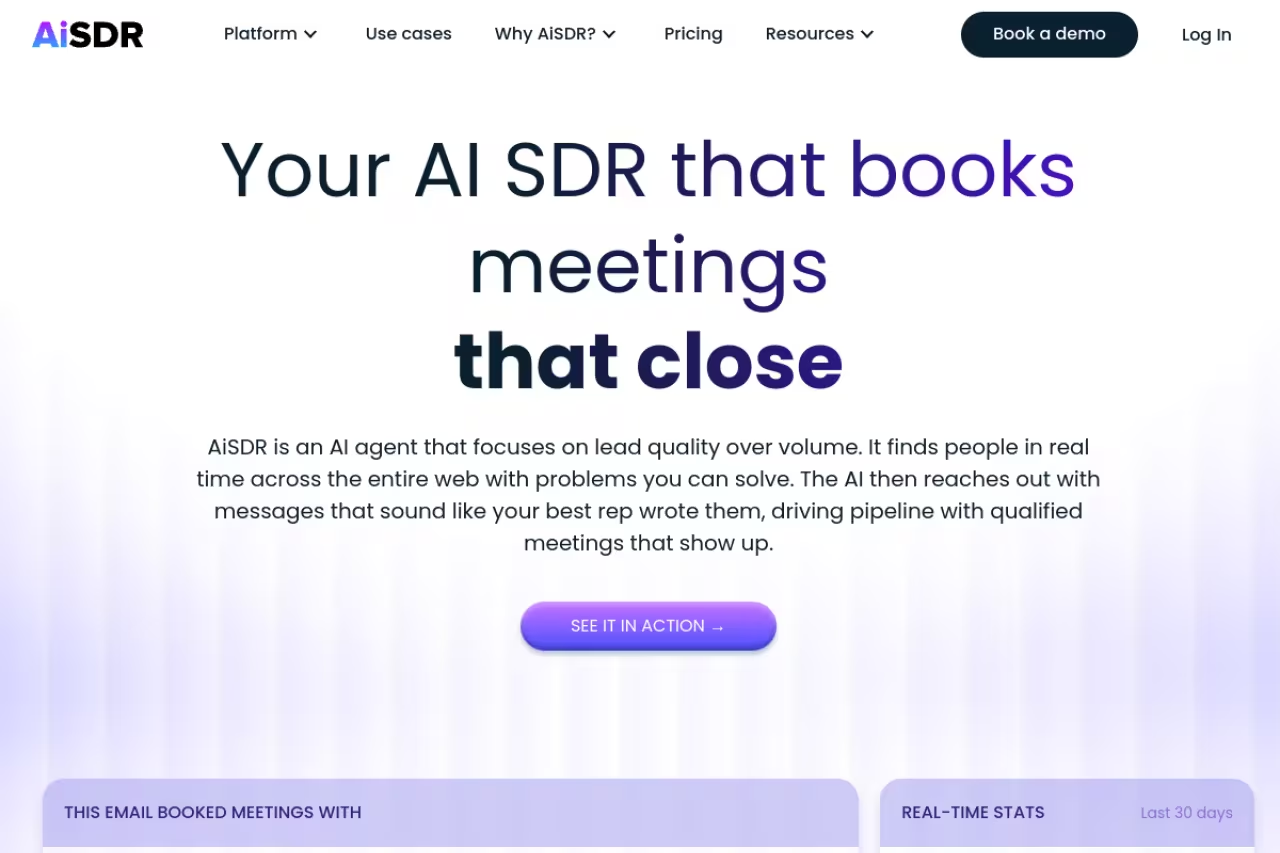
AiSDR is what most teams should try first, and the main reason is refreshingly boring: they publish their prices. In a category obsessed with "book a demo," that alone earns trust.
It coordinates outreach across email, LinkedIn, and SMS from one interface. You give it your ICP and value prop, it builds the lead list, writes personalized messages, runs the sequence, and qualifies replies. The personalization pulls from prospect activity and LinkedIn signals, so the emails read less like a template than most of its rivals.
Who it's best for: Mid-market teams and well-funded startups that want predictable cost and don't want to negotiate a contract for a week.
What most teams should try first, because it publishes its prices and charges by message volume with unlimited seats. The catch is that all plans bill quarterly in advance, so there is no cheap way to just test it.
The Explore plan is $900/month for 1,200 AI messages and 1,200 lead-search credits (roughly 3 meetings/month by their own estimate). Grow is $2,500/month for 4,500 messages. Annual billing knocks 20% off. Critically, pricing is by message volume, not per seat, so unlimited users are included.
The standout: Message-based pricing with unlimited seats. A 6-person team pays the same as a solo founder, which flips the usual per-seat math on its head.
The catch: All plans bill quarterly, paid in advance. There's no $99/month "just let me test it" tier, so the entry point is a real commitment. At 1,200 messages, the Explore plan is genuinely tight if you have aggressive targets.
Agent Frank (Salesforge): the founder's pick
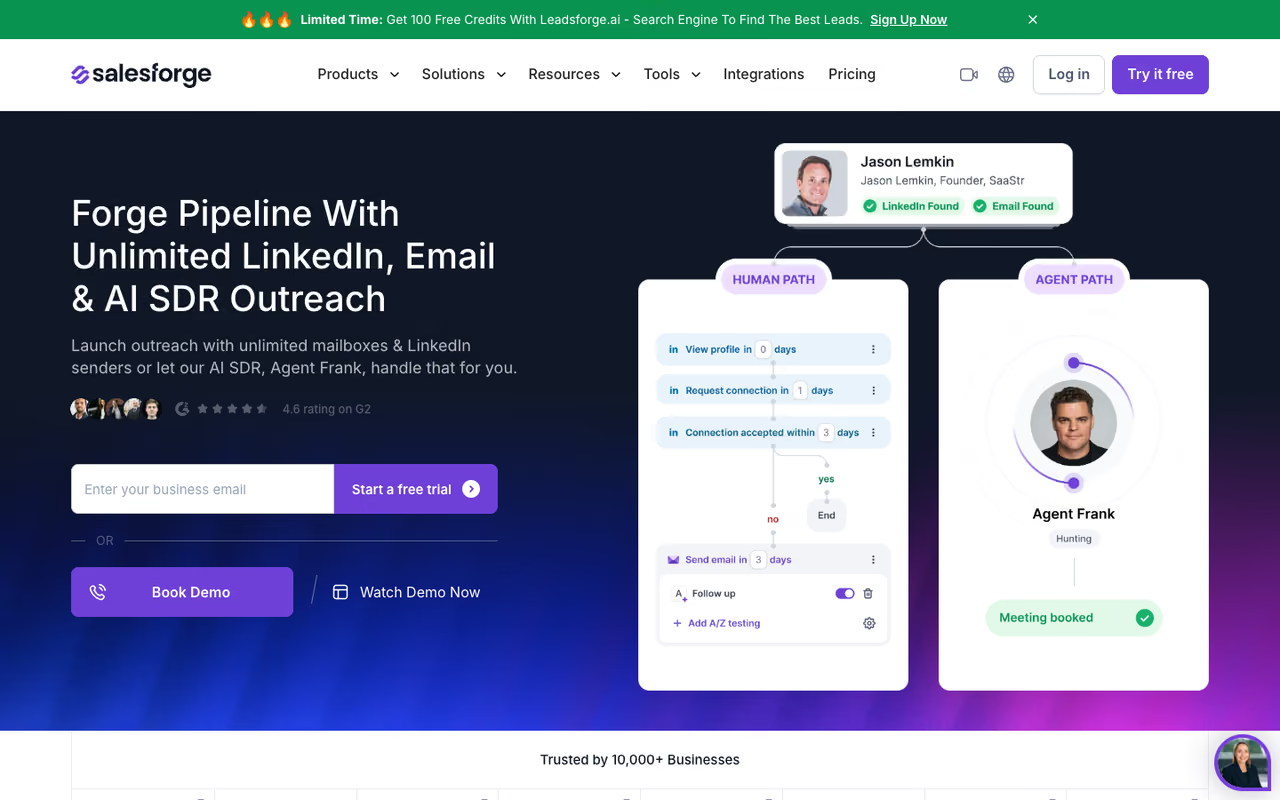
Agent Frank by Salesforge is the one I'd hand to a technical founder running outbound without a sales team. It feels less like software and more like a junior rep who actually does the boring parts. Once it learns your ICP and messaging, it handles prospecting and follow-ups without the robotic tone that plagues cheaper tools.
It runs in two modes: Auto-pilot (fully autonomous) and Co-pilot (you review before anything sends). The Co-pilot mode is the honest answer to the "I don't trust AI with my domain" objection: you can review every message before it sends until you're comfortable letting it run free.
Who it's best for: Founders and small teams who want real autonomy at a price that won't make finance flinch.
The one I'd hand a technical founder running outbound without a sales team, with a Co-pilot mode that lets you review every message before it sends. Email infrastructure is billed separately, which you will want anyway for deliverability.
$499/month billed annually (or $599/month billed quarterly), covering 1,000 active contacts and roughly 6,000 to 7,500 emails a month. No per-seat pricing, unlimited mailboxes and LinkedIn senders. Above 2,000 contacts, it's $0.25 per contact. One honest gotcha: email infrastructure is separate (Salesforge's own Infraforge starts around $33/month), which you'll want anyway for deliverability.
The standout: It's the cheapest tool here that delivers genuine end-to-end autonomy. Most things under $500/month are glorified sequencers; Frank actually sources and qualifies.
Where it falls short: You still need a demo before buying, and the deliverability setup (warming mailboxes, domains) is on you. It's powerful, but it's not a one-click product for a non-technical buyer.

Artisan (Ava): multichannel with batteries included
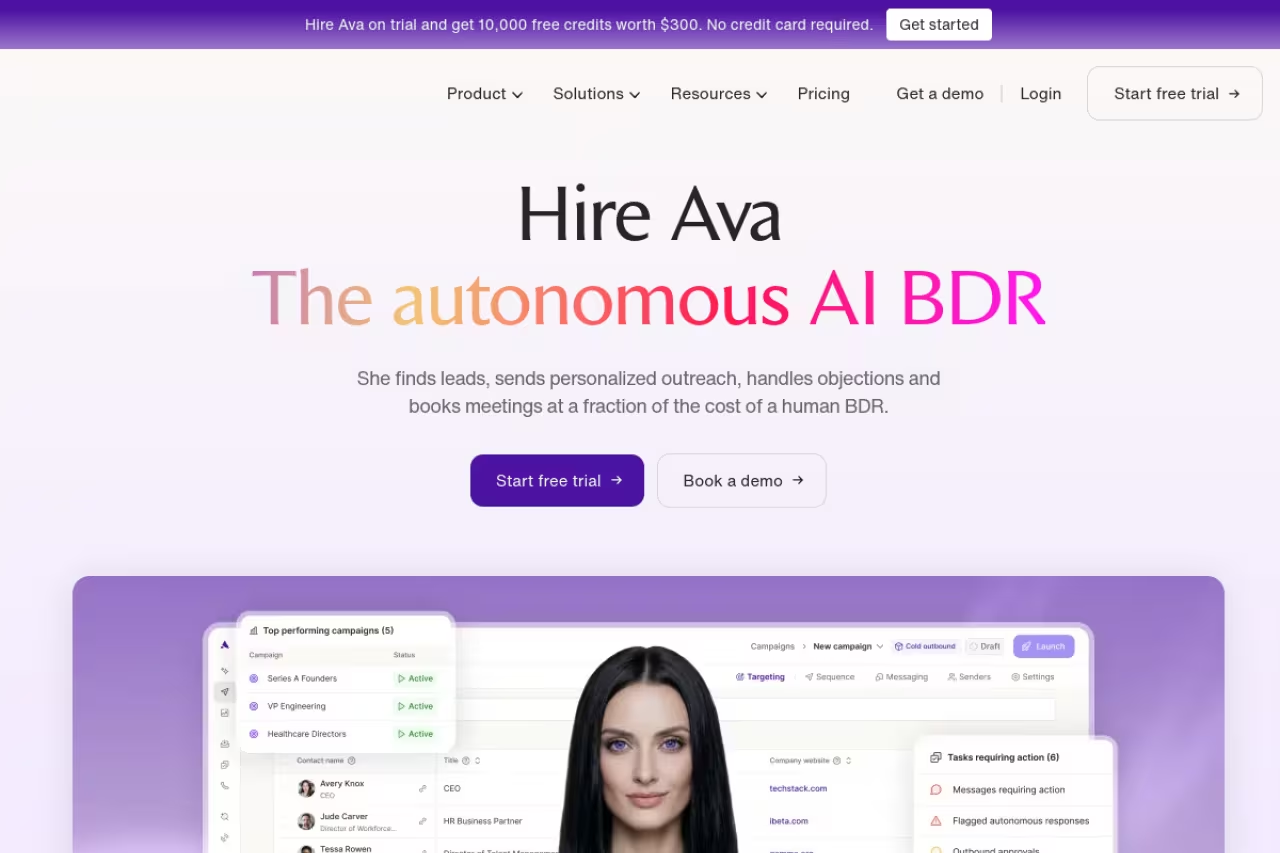
Artisan markets Ava as an "AI BDR," and in May 2026 they shipped Ava 2.0, a ground-up rebuild that finally made the product self-serve. The headline change: entry pricing dropped 10x, from $2,500/month to $250/month, with onboarding in under 10 minutes.
Ava finds leads, runs multichannel outreach, handles replies, and books meetings. What sets it apart is the bundled stack: a 300M+ contact database and built-in email deliverability tooling, so you're not stitching together three vendors to get one working sequence.
Who it's best for: Mid-market teams that want a single platform and don't already own a data tool like Clay or ZoomInfo.
A solid single-platform choice for mid-market teams that do not already own a data tool like Clay or ZoomInfo, with a 300M+ contact database and deliverability tooling bundled in. Larger deployments land well above the $250 list price once volume scales.
Free plan with 300 credits/month, Intern at $250/month (annual) for 12K credits, Employee at $600/month for 30K credits, then custom Enterprise. Worth knowing: third-party deal data (Vendr) shows a median real contract around $26,250/year, so larger deployments land well above the list price once volume scales.
The standout: Data and deliverability are baked in. For a team that doesn't want to assemble a tool stack, that's a real shortcut.
The catch: The gap between the $250 list price and the ~$2,200/month median real contract is wide. The cheap tier is genuinely capable now, but anyone running serious volume should budget for the higher end, and Artisan's reputation for aggressive sales hasn't fully faded.
If outbound is one piece of a bigger AI sales motion you're building, it's worth reading our breakdown of the best AI sales assistants and AI tools for sales prospecting alongside this list, because the right answer often combines an SDR agent with a separate enrichment layer.
11x (Alice): the enterprise heavyweight
11x sells Alice as a "digital worker" meant to replace several human SDRs. It's the most enterprise-positioned tool here: deep integrations, multiple Alice instances for different territories or segments, dedicated customer success, and contact volumes north of 10,000 a month.
Who it's best for: Enterprise teams with a large total addressable market and the budget to match.
The enterprise heavyweight, built for large teams with a big total addressable market and the budget to match. It is overkill for any team under about 30 reps, and 11x has faced public scrutiny over inflated revenue and churn claims.
Unpublished, and high. Market data puts the entry around $5,000/month billed annually, with a first-year minimum contract typically landing between $50,000 and $60,000. Median contract values sit near $40,000/year, and adding Julian (their AI phone rep) can pile on $4,000 to $6,000/month. Implementation fees often exceed $3,000.
The standout: It scales across territories and motions in a way the self-serve tools can't, with the integration depth enterprise revops teams expect.
Where it falls short: The price, obviously. It's overkill for any team under, say, 30 reps, and 11x has faced public scrutiny over inflated revenue and churn claims. For most readers of this list, the math doesn't work. If you're evaluating agent platforms at this tier, our guide to enterprise AI agents covers the broader buying criteria.

Amplemarket: the human-in-the-loop bet
Amplemarket took the contrarian position and won an independent eval doing it: its Duo Copilot scored 219 out of 231 across eight platforms, with a perfect score on AI and automation. The pitch is that AI and humans together beat full autonomy, so Duo surfaces high-intent leads, researches prospects, and prepares sequences you approve before they send.
Who it's best for: Teams that want AI use but refuse to let a bot touch the send button unsupervised.
The contrarian pick for teams that want AI but refuse to let a bot send unsupervised, with Duo surfacing high-intent leads for you to approve. It is a copilot by design, so skip it for set-it-and-forget-it, and annual-only billing makes testing harder.
Starts at $600/month for the Startup plan (a flat rate for 2 users, annual only). Growth and Elite tiers add Duo Voice and Duo Inbox for AI voice and reply handling, but those prices aren't public.
The standout: The signal-based approach. Instead of blasting a static list, it prioritizes accounts showing buying intent, which is where a human's review time actually pays off.
The catch: It's a copilot, not an autopilot, by design. If your goal is "set it and forget it," this is the wrong philosophy. The annual-only billing and unpublished higher tiers also make it harder to test cheaply.

Regie.ai: augment an existing team
Regie.ai is built less to replace your SDRs and more to multiply the ones you have. It layers AI agents, a parallel dialer, and 100+ predictive intent signals on top of a sales engagement platform.
Who it's best for: Established sales orgs with seats to fill who want AI inside their existing workflow.
Go with Regie.ai if you are an established sales org that wants to multiply the SDRs you already have, with a parallel dialer and intent data. The seat minimums make it a non-starter for solo founders and tiny teams.
AI SEP at $180/user/month with a 10-seat minimum (a $21,600/year floor), and Force Multiplier at $499/user/month with a 5-seat minimum. Vendr benchmark data shows a median buyer paying around $51,500/year, so real costs run high once you hit the seat minimums.
The standout: The parallel dialer (up to 9 lines) plus intent data makes it strong for teams that still do phone outreach, not just email.
Where it falls short: The seat minimums make it a non-starter for solo founders and tiny teams. This is a tool for orgs that already have headcount, not a replacement for hiring.

Jason by Reply.io: the bundled option
Jason AI is Reply.io's SDR agent, and its best feature is that it's effectively free if you already pay for Reply. It handles ICP research, sequence building, and reply handling inside a platform many sales teams already use.
Who it's best for: Current Reply.io customers, and budget-conscious teams that want a sales engagement platform plus an agent in one bill.
A near-free add-on if you already pay for Reply, and a sensible bundle for budget-conscious teams wanting an engagement platform plus agent on one bill. Jason is solid but less autonomous and polished than the purpose-built agents, so it is a so-so reason to switch.
Reply.io paid plans start at $49/user/month, and Jason is included on those. Dedicated AI SDR plans start around $500/month (1 LinkedIn account, 500 real-time B2B contacts), with fuller tiers from $800/month.
The standout: Bundling. If you're already in Reply's ecosystem, adding an AI SDR costs you nothing extra on the base plans.
The catch: Jason is solid but not as autonomous or as polished as the purpose-built agents above. It's a great add-on, a so-so reason to switch platforms.

Clay: for builders who want the wheel
Clay isn't a turnkey AI SDR, and that's the point. It's an enrichment and workflow engine that lets you build your own outbound machine: scrape signals, enrich contacts from 100+ data sources, write AI messages, and pipe it all wherever you want.
Who it's best for: Technical, ops-minded teams that want maximum control and don't want a black box.
For builders who want the wheel rather than a turnkey SDR, Clay is the best enrichment and data-quality layer here. It is not autonomous, the learning curve is real, and you build the workflow yourself and pair it with a sender.
After a March 2026 restructure, Launch is $185/month and Growth is $495/month (6,000 data credits, 40,000 actions). Data costs dropped 50 to 90% in that update, though most teams still spend $4,200 to $9,600/year once you add credit top-ups and a LinkedIn Sales Navigator dependency.
The standout: Nothing beats it for custom enrichment and data quality. It's the layer many of the "autonomous" tools wish they had.
Where it falls short: It's not autonomous. There's a real learning curve, and you're building the workflow, not buying a finished SDR. Pair it with a sender and you've got a powerful stack, but it's work.
How to choose
Skip the feature checklists. Three questions get you to the right tool:
1. How much control do you want over the send button? If the answer is "total," look at Amplemarket or Clay (copilot and builder). If it's "just book me meetings," go AiSDR or Agent Frank (autopilot).
2. What's your real monthly budget, all in? Under $600: Agent Frank, Artisan's entry tier, or Jason if you're on Reply. $900 to $2,500: AiSDR is the sweet spot. $50,000+/year with a big TAM: 11x or Regie make sense.
3. Do you already own a data tool? If you have Clay or ZoomInfo, you want a sender-and-sequencer and shouldn't pay twice for a bundled database. If you have nothing, Artisan's all-in-one stack saves you the integration headache.
One more piece of honesty: every tool here lives or dies on email deliverability. The best agent in the world can't help you if your domain is in spam. Sort out warming, separate sending domains, and SPF/DKIM before you scale any of these. Our guide on cold email deliverability walks through it.
If you're assembling a wider AI stack for your team and want a vetted shortlist beyond outbound, Dupple X curates the tools worth paying for, and our top AI tools directory is a good next stop.
FAQ
What is the best AI SDR tool in 2026?
For most teams, AiSDR is the best starting point thanks to transparent pricing, message-based billing, and fast setup. Founders running their own outbound get more control-for-money from Agent Frank, while enterprises with large addressable markets are the right fit for 11x. There's no single winner; the best tool depends on your budget and how much you want to supervise it.
How much do AI SDR tools cost?
Entry pricing ranges widely. Agent Frank and Artisan's self-serve tiers start around $250 to $500/month, AiSDR starts at $900/month, and enterprise tools like 11x start near $5,000/month with first-year contracts of $50,000 or more. Most mid-market deployments, once you add data tools and human oversight, land in the $20,000 to $60,000/year range.
Can an AI SDR replace a human sales rep?
Not fully, at least not in 2026. AI handles the mechanical work well: sourcing leads, drafting messages, and timing follow-ups. It struggles with judgment, brand nuance, and reading buyer intent. The teams getting results treat AI SDRs as force multipliers for human reps, not one-to-one replacements. Tools like Amplemarket lean into this with a human-in-the-loop design.
Do AI SDR tools hurt email deliverability?
They can if you let them run unchecked. Sending high volumes from a cold domain is the fastest way into spam. The better tools (Artisan, Agent Frank) include or recommend deliverability tooling like mailbox warming and separate sending domains. Always warm your domains, authenticate with SPF and DKIM, and start with low volume before scaling.
What's the difference between an AI SDR and a tool like Clay?
An AI SDR (AiSDR, Agent Frank, 11x) is closer to turnkey: it sources, writes, sends, and books with minimal setup. Clay is an enrichment and workflow engine you build outbound on top of, giving you far more control and data quality but no autonomy out of the box. Many advanced teams use Clay to feed a separate sending tool rather than buying a single all-in-one agent.
Which AI SDR tool is best for a small startup?
Agent Frank at $499/month or Artisan's $250 self-serve tier are the most realistic for a startup, since neither uses per-seat pricing with high minimums. Jason by Reply.io is also worth a look if you already use Reply, since it's bundled into existing plans. Avoid 11x and Regie.ai at this stage; their seat minimums and contract sizes are built for larger orgs.
Ready to build the rest of your stack? Start a Dupple X trial and get the curated shortlist of AI tools worth your budget.
Related guides
Some offers on this page may be paid placements or contain affiliate links.
Across our whole catalogue the median is $24 a month and 33% of tools advertise a free tier. Figures are the lowest recurring monthly price quoted in our own review of each tool, read on 2026-08-19. Full method and every category.
