
The Best Sales CRM for Startups in 2026

Key facts8 tools compared: HubSpot, Pipedrive, Attio, Close, Folk, Salesflare, Zoho / Bigin, Freshsales
- 8 tools compared: HubSpot, Pipedrive, Attio, Close, Folk, Salesflare, Zoho / Bigin, Freshsales
- HubSpot (best for: First CRM, free start): Free, then $9 to $15/seat
- Pipedrive (best for: Visual pipeline lovers): $14/user/mo
- Attio (best for: Modern, data-driven teams): Free, then $29/user/mo
- Close (best for: Outbound and calling): $9/user/mo (Solo)
Most startups pick a CRM the way they pick a bank: whatever the last company used, or whatever a friend recommended at 11pm. Then six months later the pipeline is a graveyard of half-filled deals, nobody updates anything, and the founder is back to tracking everything in a spreadsheet that only they understand.
The truth is that a CRM only works if your team actually uses it, and most startups buy something built for a 200-person sales org. You don't need forecasting dashboards and territory management when you have three salespeople and a deck. You need something fast, cheap, and impossible to ignore.
If you want the short answer: HubSpot is the safest first pick because its free tier is genuinely usable and you can grow into the paid plans without re-platforming. But it's not the best fit for everyone. If you live in outbound calling, Close wins. If you want a CRM that feels like 2026 instead of 2010, look at Attio. Below is what I found after putting eight of them through real pipelines.
Quick comparison
| Tool | Best for | Starting price | Standout |
|---|---|---|---|
| HubSpot | First CRM, free start | Free, then $9 to $15/seat | Genuinely useful free tier |
| Pipedrive | Visual pipeline lovers | $14/user/mo | Drag-and-drop deal flow |
| Attio | Modern, data-driven teams | Free, then $29/user/mo | Feels fast and flexible |
| Close | Outbound and calling | $9/user/mo (Solo) | Built-in dialer + email |
| Folk | Relationship-led sales | $24/user/mo | Lightweight, network-style CRM |
| Salesflare | B2B, hates data entry | $29/user/mo | Auto-fills your pipeline |
| Zoho / Bigin | Tight budgets at scale | $7/user/mo (Bigin) | Cheapest path that still scales |
| Freshsales | AI-native budget pick | Free, then $11/user/mo | Built-in AI scoring on cheap tiers |
HubSpot: the default that's hard to argue with
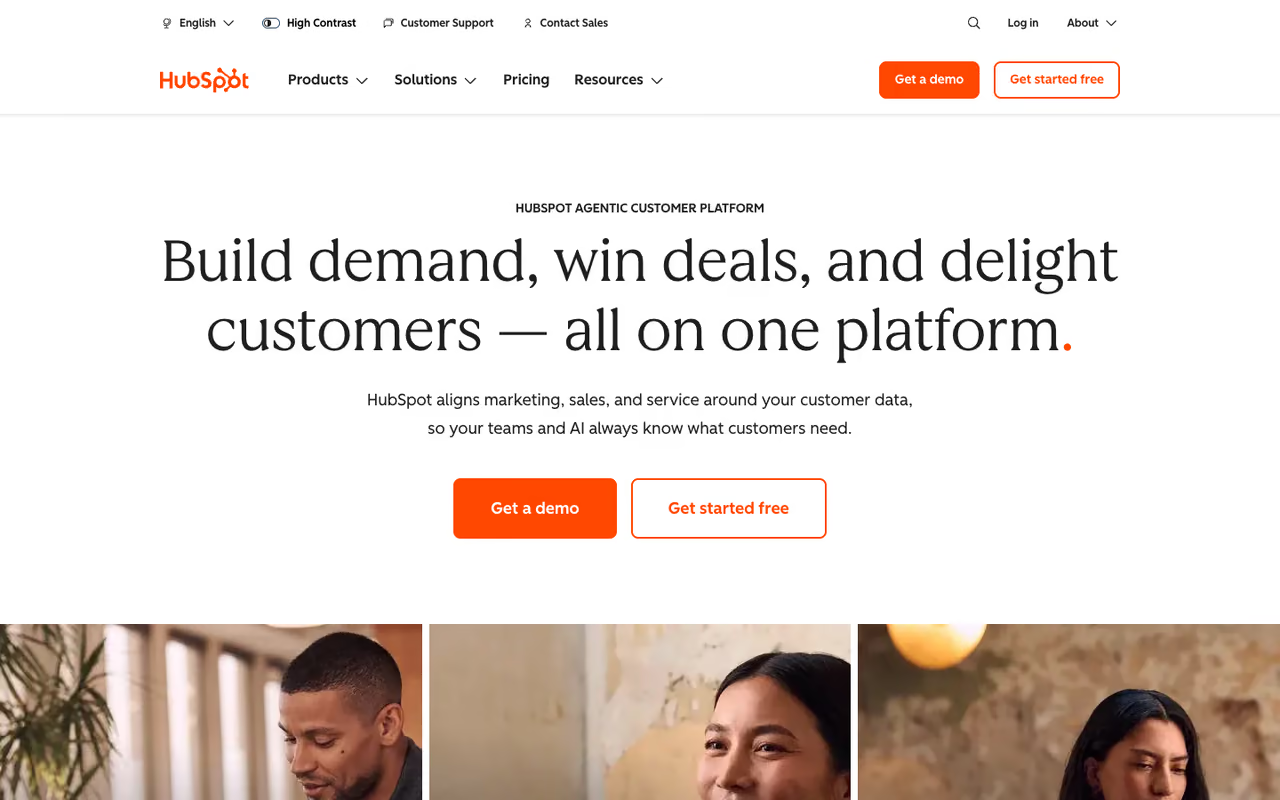
HubSpot is the CRM most startups should try first, and the reason is boring but real: the free tier is good enough to run a small pipeline on, and you never hit a wall where you're forced to rebuild everything elsewhere.
The free plan gives you unlimited users, up to a million contacts, deal pipelines, email tracking, meeting scheduling, live chat, and forms. That's more than most early teams need for their first year. When you outgrow it, the Sales Hub Starter plan runs about $15 per seat per month on annual billing, with a promo rate near $9 floating around for new accounts.
Where most startups should start, ideal for founders setting up a first real CRM who want room to grow into marketing and service tools. The free tier is genuinely usable, but the jump to Professional is brutal at roughly $890 a month without the startup discount.
The standout: if you raised pre-seed, seed, or a Series A under $20M and you're tied to an approved partner, the HubSpot for Startups program gives up to 90% off year one and 50% off year two. That turns the expensive Professional tier into something a funded startup can actually stomach.
The catch: the jump from free to Professional is brutal at roughly $890 a month if you don't qualify for the discount. Marketing automation, custom reporting, and sequences sit behind that wall. Stay on free until you genuinely feel the pain, because the middle ground is thin.

Pipedrive: the pipeline you'll actually look at
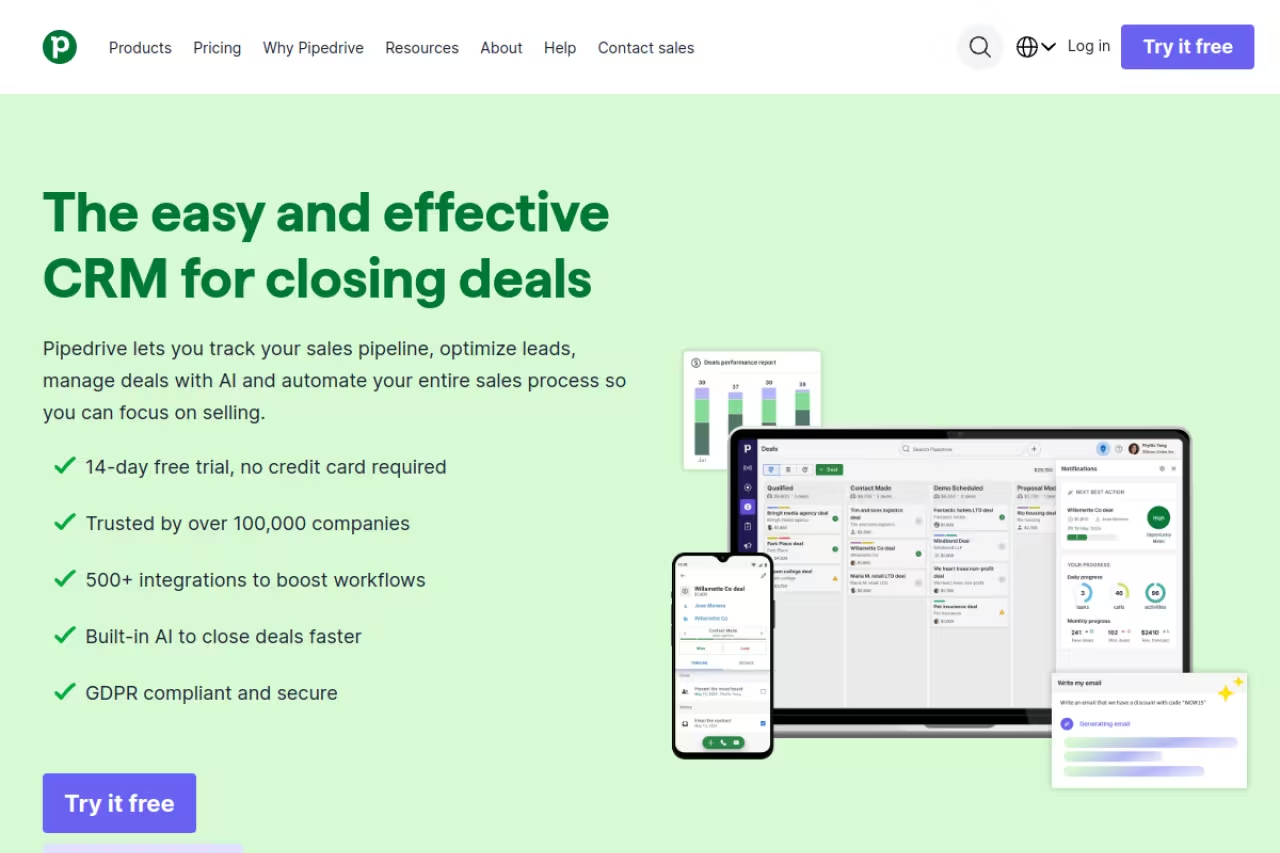
Pipedrive was built by salespeople who were tired of CRMs designed for managers. It shows. The whole product is organized around a visual pipeline where you drag deals between stages, and that single design choice makes it the CRM your reps won't avoid.
In July 2025 Pipedrive renamed its tiers. The current lineup, billed annually, is Lite at $14 per user, Growth at $39, Premium at $49, and Ultimate at $79 per user per month, per the Pipedrive pricing breakdown. Most startups land on Lite or Growth. There's a 14-day free trial with no card required.
Good for small outbound or inbound teams who think in stages and want deal movement to feel physical, so reps actually use it. Reporting and automation are thin on cheap tiers, and add-ons mean the $14 sticker price rarely holds.
The standout: the activity-based selling model. Pipedrive nudges you to always have a next action scheduled on every deal, so nothing rots in the pipeline because someone forgot to follow up.
Where it falls short: reporting and automation are thin on the cheap tiers, and the good stuff (workflow automation, real revenue forecasting) sits on Growth and above. The email and lead-gen add-ons also stack up fast, so the $14 sticker price rarely stays $14 once you're running a real team.
Attio: the CRM that finally feels modern
If HubSpot feels like enterprise software with the price hidden, Attio feels like a tool a startup founder actually designed. It's fast, the data model bends to whatever your business looks like, and it pulls in company and contact data automatically so your records aren't half-empty.
The free plan covers up to 3 seats with 50,000 records and basic enrichment, which is enough to validate it before paying. Paid plans, per the Attio pricing breakdown, run $29 per user per month for Plus and $69 for Pro on annual billing. Note there's no traditional free trial on paid tiers: you either stay free or commit.
A modern pick for technical and product-led startups that want to model their pipeline their own way and care about clean data. It is a younger product with a smaller integration ecosystem, and the free plan's cap of 3 seats pushes a fourth hire to paid.
The standout: real-time data sync and a spreadsheet-meets-database feel. You can spin up custom objects for whatever you sell without filing a support ticket, and it stays quick even with a lot of records.
The catch: it's a younger product, so the ecosystem of integrations and templates is smaller than HubSpot's or Zoho's. If you want a CRM that holds your hand with pre-built playbooks, Attio expects you to build your own. The 3-seat free cap also means a fourth hire pushes you straight to paid.

Close: the outbound machine
Close is what you reach for when your startup sells by calling and emailing a lot of people fast. The dialer, email, and SMS are built into the CRM, so your reps aren't bouncing between five tabs to run a sequence.
Pricing changed recently. The current plans, billed annually, are Solo at $9 per user, Essentials at $35, Growth at $99, and Scale at $139 per user per month according to Close's pricing page. Every tier includes the AI sales features and built-in calling. There's a 14-day free trial with no card.
The outbound machine for SDR teams and startups where the phone is still a primary channel, with a native power dialer. It gets pricey once you need the Growth tier and is overkill if your motion is purely inbound or product-led.
The standout: the built-in power dialer. For a team running cold or warm call volume, having calling native to the CRM (instead of a bolted-on integration) is the difference between 20 dials a day and 80.
Where it falls short: it gets pricey quickly once you need the Growth tier for serious automation, and it's overkill if your motion is purely inbound or product-led. You're paying for a calling engine you might never use. Inbound SaaS teams will feel the cost without the payoff.
Picking the right CRM is one of those early decisions that compounds, like choosing your first AI tools. A CRM also pairs well with the right outbound stack, so it's worth skimming the best AI sales tools and AI lead generation tools before you commit. If you're still assembling that stack, our Dupple X membership and the top tools directory are a decent shortcut to skip the trial-and-error.

Folk: the relationship-first option
Folk treats your CRM less like a sales database and more like a living network of people. If your deals come from relationships, intros, and a personal network rather than cold pipelines, Folk fits the way you actually work.
It pulls contacts in from email, LinkedIn, and other sources, and the interface stays clean instead of drowning you in fields. Pricing runs $24 per user per month for Standard and $48 for Premium on annual billing, with a 14-day trial and no permanent free tier, per the Folk pricing details.
Fits founders, agencies and partnership-led teams who sell through warm relationships rather than cold pipelines. It is deliberately simple, so you will outgrow it if you need heavy pipeline automation or forecasting, and there is no free plan.
The standout: the contact enrichment and the lightweight feel. It's the rare CRM people open because they want to, not because a manager forces a status update.
The catch: it's deliberately simple, so if you need heavy pipeline automation, deal forecasting, or a calling engine, you'll outgrow it. There's also no free plan, so you can't sit on it indefinitely the way you can with HubSpot or Attio.

Salesflare: for B2B teams who refuse to do data entry
Salesflare solves the single biggest reason CRMs fail at startups: nobody updates them. It automatically pulls data from your email, calendar, phone, and public sources to build out contact timelines and pipelines, so the CRM fills itself.
Plans are simple. Growth is $29 per user per month, Pro is $49, and Enterprise is $99 (minimum 5 users), all billed annually with a generous 30-day free trial, no card required, per Salesflare's pricing.
A good fit for small B2B sales teams that sell over email and are tired of logging every interaction by hand, since the CRM fills itself. B2C or phone-heavy sales see less benefit, as the automation depends on connected email and calendar.
If you're staffing up a larger function, our guide to the best CRM for sales teams covers heavier options.
The standout: automated data capture. It quietly logs emails and meetings and reminds you when a deal goes quiet, which is exactly the discipline most early teams lack.
Where it falls short: it's built for B2B, so B2C or transactional sales won't get the same magic. The automation also depends on you running deals through connected email and calendar, so teams that sell heavily by phone or in person see less benefit.
Zoho CRM (and Bigin): the budget path that still scales
Zoho is the answer when budget is the hard constraint but you don't want a toy. The full Zoho CRM starts at $14 per user per month (Standard) and $23 (Professional) on annual billing, with a free plan for up to 3 users.
For very early teams, Bigin (Zoho's lightweight CRM) is even cheaper: Express at $7, Premier at $12, and Bigin 360 at $18 per user per month, with a free tier too. You can start on Bigin and graduate to full Zoho when you need more, all within one ecosystem.
The budget path for cost-sensitive startups that expect to scale and want one vendor for CRM, support and email, with Bigin as a cheaper on-ramp. The interface feels dated and the suite's breadth can overwhelm a two-person team.
The standout: price-to-power ratio. At $14 a seat you get workflow automation, custom dashboards, and forecasting that competitors gate behind $40+ tiers.
The catch: the interface feels dated next to Attio or Folk, and the sheer breadth of the Zoho suite can overwhelm a two-person team. Setup takes longer, and you'll spend time configuring rather than selling on day one.
Freshsales: AI scoring without the enterprise bill
Freshsales (part of Freshworks) is the budget pick that doesn't make you wait for AI features. Lead scoring, built-in phone, and email sequences show up on cheap tiers instead of being locked behind enterprise pricing.
There's a free plan for up to 3 users with contact management, built-in phone, and Kanban deal views. Paid plans, per the Freshsales pricing breakdown, start at $11 per user (Growth), $47 (Pro), and $71 (Enterprise) per month on annual billing.
Choose Freshsales if you are a budget startup that wants AI lead scoring and a built-in phone without jumping to a premium plan. The free plan strips out automation, scoring and sequences, so you really need Growth or Pro for the value.
The standout: AI-powered contact scoring on affordable tiers, so your reps know which leads to call first without you building a model.
Where it falls short: the free plan strips out automation, AI scoring, and sequences, so you really need Growth or Pro to get the value. And like Zoho, it's part of a larger suite, which means occasional friction when features assume you're using the rest of Freshworks.
How to choose
Skip the feature checklists. Pick based on how your startup actually sells.
Start with your sales motion. If you sell by phone, Close is built for that. If you sell by email and hate data entry, Salesflare fills the gaps for you. If you sell through relationships and intros, Folk fits. If you're product-led or technical, Attio bends to your model.
Then weigh budget against runway. If you're pre-revenue, start free: HubSpot, Attio, Freshsales, and Zoho all have real free tiers, not trials. Bigin at $7 is the cheapest paid option that still grows with you.
Finally, factor in where you're headed. HubSpot and Zoho are ecosystems, so you can add marketing and service later without switching tools. The trade-off is more setup now. A focused tool like Pipedrive or Close gets you selling faster but may need replacing once you scale past it.
One rule that saves pain: the best CRM is the one your team updates without being told. A cheaper tool everyone uses beats an expensive one half your reps ignore. If a free trial ends with your salespeople still in spreadsheets, that's your answer.
FAQ
What is the best free CRM for startups?
HubSpot has the most generous free tier: unlimited users, up to a million contacts, deal pipelines, and email tracking, with no time limit. Attio (3 seats), Zoho (3 users), and Freshsales (3 users) also have real free plans. HubSpot wins if you want room to grow without re-platforming later.
How much should a startup spend on a CRM?
Early on, nothing. Start on a free tier and only pay once your pipeline outgrows it. When you do pay, expect $9 to $30 per user per month for a startup-grade plan. Bigin at $7 and Freshsales Growth at $11 are the cheapest paid options that still scale. Avoid committing to plans above $50 a seat until you have a real, repeatable sales motion.
Is HubSpot or Pipedrive better for a startup?
It depends on your motion. HubSpot wins if you want a free start and plan to add marketing or service tools later. Pipedrive wins if you have an active sales team that wants a clean, visual pipeline and doesn't need the rest of HubSpot's suite. For a pure sales team that lives in deal stages, Pipedrive is often the faster, cheaper fit.
Do startups really need a CRM, or is a spreadsheet enough?
A spreadsheet works until you have more than a handful of active deals or more than one person selling. The moment follow-ups start slipping or two reps step on each other's leads, you need a CRM. Since tools like HubSpot and Freshsales are free to start, there's little reason to stay in a spreadsheet once you're actively selling.
Which CRM is best for outbound sales teams?
Close, because it has a built-in power dialer, email, and SMS in one place. Outbound SDR teams running call volume get far more done when calling is native to the CRM instead of a separate integration. Salesflare is the better pick if your outbound is email-led rather than phone-led.
Can I switch CRMs later without losing my data?
Yes, most CRMs export contacts and deals to CSV, and many (including Close and Zoho) offer free migration help. That said, switching costs time and risks dropping custom fields and history, so it's worth picking a tool that can grow with you. Starting on an ecosystem like HubSpot or Zoho reduces the odds you'll need to migrate at all.
Want a faster way to build the rest of your stack? Dupple X curates the AI and growth tools worth paying for, so you spend less time testing and more time selling.
Related guides
Some offers on this page may be paid placements or contain affiliate links.
Across our whole catalogue the median is $24 a month and 33% of tools advertise a free tier. Figures are the lowest recurring monthly price quoted in our own review of each tool, read on 2026-08-19. Full method and every category.
