
Best CRM for Construction: 8 Tools Compared (2026)

Key facts8 tools compared: JobNimbus, BuildBook, Buildertrend, Pipedrive, Contractor Foreman, Procore…
- 8 tools compared: JobNimbus, BuildBook, Buildertrend, Pipedrive, Contractor Foreman, Procore, HubSpot, Workyard
- JobNimbus (best for: Roofing & exterior trades): $225/mo base + per-user
- BuildBook (best for: Residential builders & remodelers): $79/mo (annual)
- Buildertrend (best for: Mid-size residential GCs): Custom (~$399+/mo)
- Pipedrive (best for: Sales-led contractors): $14/user/mo
Most construction CRMs are sold as "all-in-one platforms," which is a polite way of saying they want to run your estimating, scheduling, accounting, and lead pipeline whether you asked for that or not. If you just want to stop losing bids in a spreadsheet and follow up with homeowners before your competitor does, half of these tools are overkill and the other half are priced for a 50-person GC.
I compared pricing pages, documentation, and public user reviews for the eight tools below. The honest takeaway: there is no single "best" construction CRM. A roofer chasing insurance restoration work needs something completely different from a custom home builder, who needs something different again from a service plumber. So I split this by who you actually are.
If you want the short version: JobNimbus is my pick for roofing and exterior trades, BuildBook is the best value for residential builders and remodelers, and Pipedrive is the one to grab if you mostly want a sales pipeline and don't care about project management. Now the details.
Quick comparison
| Tool | Best for | Price (starting) | Standout |
|---|---|---|---|
| JobNimbus | Roofing & exterior trades | $225/mo base + per-user | Insurance claim & EagleView workflow |
| BuildBook | Residential builders & remodelers | $79/mo (annual) | Flat pricing, client-facing polish |
| Buildertrend | Mid-size residential GCs | Custom (~$399+/mo) | Deep project management bundle |
| Pipedrive | Sales-led contractors | $14/user/mo | Cleanest pure pipeline |
| Contractor Foreman | Budget all-in-one | $49/mo | Most features per dollar |
| Procore | Large commercial GCs | ~$4,500+/yr | Enterprise-grade everything |
| HubSpot | Marketing-heavy firms | Free / $15 seat | Free CRM + real automation |
| Workyard | Field-crew-heavy contractors | $12/user/mo | GPS time tracking + CRM |
JobNimbus: best for roofing and exterior trades
If you do roofing, siding, gutters, or any trade where insurance restoration is part of the job, this is the one. JobNimbus is built around the actual workflow of a storm-chasing exterior contractor: lead capture from canvassing, a visual board that moves a job from inspection to claim to production to payment, and integrations that matter to your trade specifically.
The standout is how well it plays with the tools roofers already use. The EagleView and CompanyCam integrations share data both ways, so an aerial measurement or a job photo lands where you need it without re-keying anything. Built-in insurance claim tracking means you can run a restoration job through stages that reflect how adjusters actually work.
The one to choose if you do roofing, siding or gutters, especially with insurance restoration work. Claim tracking and EagleView and CompanyCam integrations fit exterior crews well, but pricing is murky and lower tiers cap integrations.
Pricing is the annoying part. It starts at roughly $225/month for the base plan plus per-user fees in the $25 to $75 range depending on role, and texting is a separate add-on that runs $49 to $249/month (breakdown here). A small crew lands around $350 to $620/month once you add the pieces you'll actually use.
The catch: the published pricing is hard to find for a reason. Lower tiers cap your integrations, and if you use EagleView, CompanyCam, QuickBooks, a supplier, and Zapier, you'll hit that ceiling fast and get pushed up a tier. Reviewers also flag occasional mobile app crashes. It's still the best fit for 2 to 15 person exterior crews doing insurance work.
BuildBook: best value for residential builders and remodelers
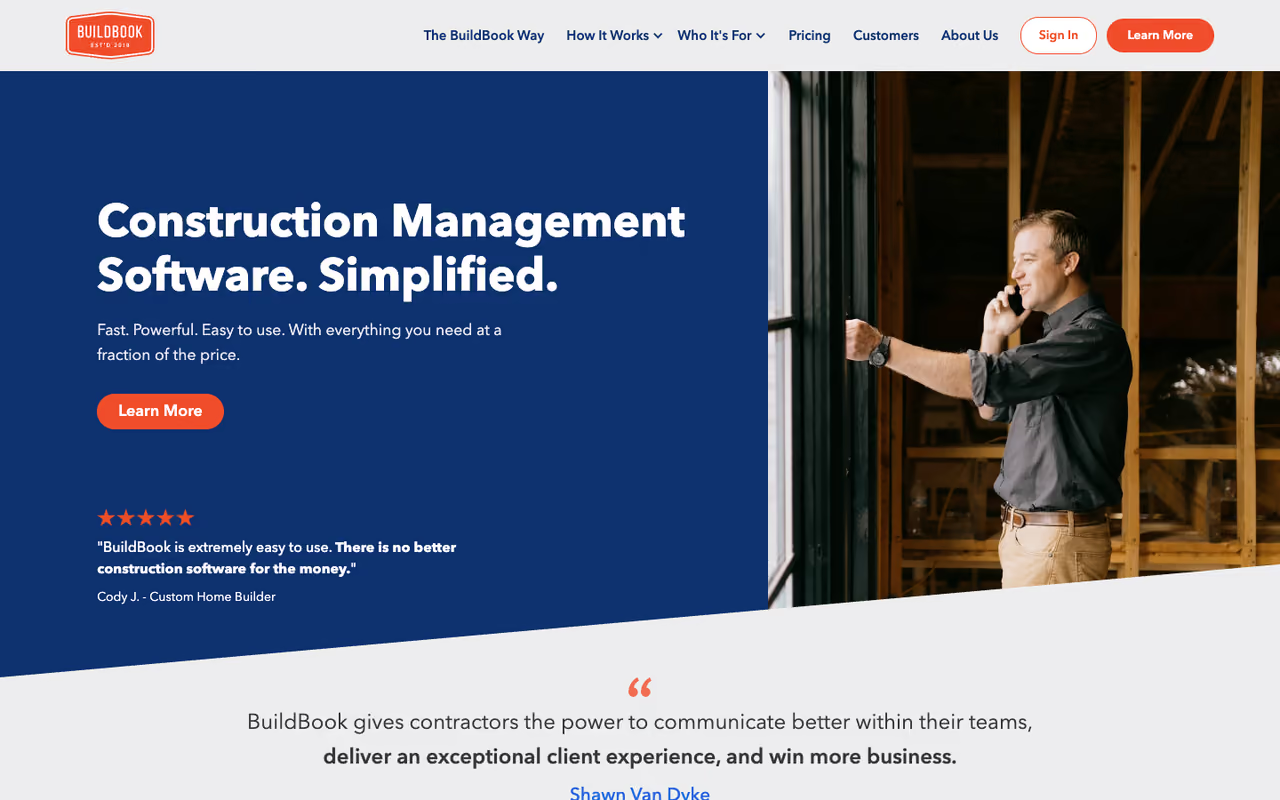
BuildBook is what I'd hand a custom home builder or remodeler who wants a CRM that doesn't feel like enterprise software. The sales pipeline, estimating, and branded proposals are genuinely clean, and the client-facing side (dashboards, selections, chat) is polished enough that homeowners actually use it instead of texting you at 9pm.
The standout here is pricing that you can read on the website without booking a demo. The Solo plan is $79/month billed annually, Team (2 to 5 users) is $149/month, and Business (6 to 8 users) starts at $249/month, with every feature included on every plan and no per-user surprises (pricing page). For a small builder that's a fraction of what the bigger platforms charge.
It connects to QuickBooks, Google Calendar, Dropbox, Slack, and Zapier, so it slots into a typical builder stack without much fuss. If you're also shopping the production side, my guide to the best construction project management software covers where BuildBook sits against the heavier options.
Where it falls short: it's deliberately simple. If you run new-construction projects with complex scheduling dependencies, multiple crews, and deep cost tracking, you'll outgrow it. There's no solid accounting module, so QuickBooks does that heavy lifting. For solo operators and small remodel shops, though, the value is hard to beat.
Great value for custom home builders and remodelers who want a CRM that does not feel like enterprise software. It is deliberately simple, so complex new-construction scheduling will outgrow it and QuickBooks handles accounting.

Buildertrend: best for mid-size residential GCs
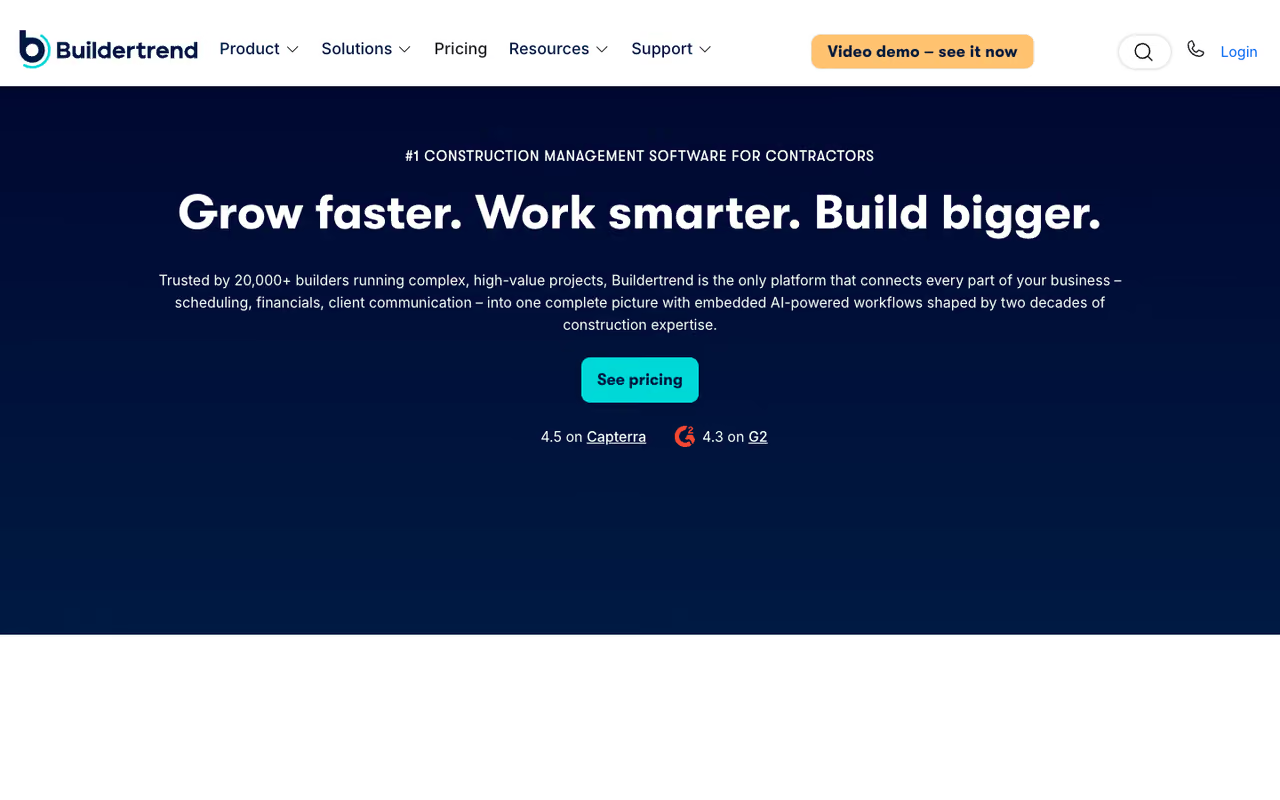
Buildertrend is the default answer when a residential builder asks "what do the bigger guys use." It bundles CRM, scheduling, budgeting, change orders, client communication, and document management into one platform with unlimited users and unlimited projects, which is the pitch that wins growing firms.
The standout is breadth. Once your team adopts it, a job lives in one place from the first lead to the final invoice, and the client portal cuts down on the "where are we at?" calls. The CRM piece handles lead tracking and follow-up well enough that you don't need a separate sales tool.
The default for growing residential builders who want CRM, scheduling, budgeting and a client portal in one place. At $400+/month minimum with a learning curve, it is overkill for a one or two-person shop.
Pricing changed in 2026. Buildertrend pulled all published numbers and now quotes based on your annual construction volume through a five-step form (their pricing page). Third-party trackers put the tiers at roughly $399 to $499 (Essential), $699 to $799 (Advanced), and $829 to $1,099 (Complete) per month, with annual contracts pulling toward the low end.
The catch: the price, and the learning curve. At $400+/month minimum it's a real commitment, useful features sit behind the higher tiers, and onboarding a crew that's allergic to software takes patience. It's overkill for a one or two-person shop. It earns its keep once you're running several jobs at once with a team that needs to coordinate.

Pipedrive: best for sales-led contractors
If your problem is "leads fall through the cracks" and not "I need to run my whole business," Pipedrive is the cleanest answer on this list. It's a pure sales CRM, not a construction platform, which is exactly why it works for contractors who already have their project tools sorted and just want a pipeline that doesn't fight them.
The standout is focus. Drag a deal across visual stages, set automated follow-up reminders, log calls, and see exactly which bids are stalling. Setup takes an afternoon, not a week. The Essential plan is $14/user/month billed annually, Advanced is $29, and Professional (with forecasting and documents) is $59, which is cheap next to the trade-specific platforms.
For the lead-gen side that feeds the pipeline, it's worth pairing with strong outreach tooling. I cover that in the best AI sales tools roundup.
Where it falls short: it knows nothing about construction. No estimating, no job scheduling, no change orders, no client portal for selections. You'll bolt it onto other software or run those processes elsewhere. If you want one tool to do everything, look at JobNimbus or Contractor Foreman instead.
The cleanest answer for contractors whose problem is leads falling through the cracks and who already have project tools. It knows nothing about construction, so estimating and scheduling must live elsewhere.
Quick aside: if your follow-up process is mostly manual copy-paste, an AI workflow assistant pays for itself fast. We bundle a few of those into Dupple X, which is worth a look before you add another point tool.

Contractor Foreman: best budget all-in-one
Contractor Foreman wins on pure dollars-per-feature. It packs estimating, invoicing, CRM, GPS time cards, daily logs, change orders, and a client portal into a platform that starts at $49/month, which undercuts almost everything else that tries to do this much.
The standout is the rate lock: when you sign up, you keep today's price and never get hit with the annual increases that platforms like Procore are known for. The Basic tier covers invoicing, estimating, and time tracking, and higher tiers up to the $332/month Unlimited plan add QuickBooks Desktop, Zapier, and the custom report builder (tier breakdown).
The catch: doing everything at this price means nothing is best-in-class. The interface is dense, the CRM is functional rather than delightful, and the mobile experience trails the trade-specific apps. There's no permanent free plan, only a trial. If budget is the deciding factor and you can tolerate a busier UI, it delivers more than its price suggests.
Dollars-per-feature champion for budget-minded contractors, covering estimating, invoicing, CRM and time cards from $49/month. Nothing is best-in-class, and the dense interface and mobile experience trail trade-specific apps.

Procore: best for large commercial GCs
Procore isn't really a CRM, it's the operating system for big commercial construction, with a CRM layer attached. If you're a general contractor above roughly $10M in revenue running complex multi-stakeholder projects, this is the standard, and the integrations and reporting are in a different league from everything else here.
The standard for large commercial GCs running complex multi-stakeholder projects, with unmatched integrations and reporting. For residential builders or small trades it is a freight train to commute in, with price and lock-in to match.
Pricing reflects that. Procore uses an Annual Construction Volume model rather than per-seat licensing, so you get unlimited users within a volume tier. Real-world costs run from about $4,500 to $10,000/year for small contractors up to $20,000 to $60,000+ for mid-size firms and beyond for enterprise deployments (cost analysis). Contracts are annual, quoted directly, with renewal increases reported between 5% and 14%.
Where it falls short: the price, the complexity, and the contract lock-in. For a residential builder or a small trade contractor, this is buying a freight train to commute to work. It only makes sense at scale, with the project volume and back-office staff to justify it. Below that threshold, you're paying for capacity you'll never touch.

HubSpot: best for marketing-heavy firms
If you generate leads through your website, content, and ads rather than door-knocking, HubSpot deserves a look. The core CRM is free for unlimited users, and it's a real CRM, not a stripped trial: contact management, deal pipelines, email tracking, and basic automation cost nothing.
The standout is the on-ramp. Start free, and when you need quotes, sequences, and heavier automation, Sales Hub Starter is $15/seat/month on annual billing ($20 month-to-month). The marketing tooling on top is genuinely good if inbound is how you grow.
The catch: it's industry-agnostic. There's no estimating, no construction-specific job tracking, and no insurance or selections workflow. You'd run HubSpot for sales and marketing and keep project management somewhere else. The free tier is a strong starting point, but the costs climb sharply once you move into Professional tiers, so map your real needs first.
Worth a look for firms that generate leads through website, content and ads, with a genuinely free CRM to start. It is industry-agnostic, so keep project management elsewhere, and costs climb sharply at Professional tiers.
Workyard: best for field-crew-heavy contractors
Workyard approaches the problem from the field instead of the office. Its core is accurate GPS time tracking and workforce management, with CRM and lead features layered into the higher tiers. For contractors whose biggest leak is labor cost and job-site hours, not lost bids, that ordering makes sense.
The standout is location accuracy. The time tracking is built to survive on real job sites and reduce the payroll guesswork that eats margin. Time tracking starts at $8/user/month and workforce management at $12/user/month, with CRM features in the broader plans.
Where it falls short: the sales pipeline is the weaker half of the product. If lead follow-up is your main pain, a dedicated CRM like Pipedrive or a trade platform like JobNimbus will serve you better. Workyard earns its place when crew management and accurate labor costing are the priority and CRM is a nice bonus.
Choose Workyard when crew management and accurate labor costing are the priority and CRM is a bonus. The sales pipeline is the weaker half, so lead-follow-up pain is better served by Pipedrive or JobNimbus.
How to choose
Skip the feature checklist and answer one question first: what's actually leaking money? If it's lost leads and slow follow-up, you want a CRM-first tool (Pipedrive, HubSpot). If it's chaos across jobs, you want a platform (Buildertrend, BuildBook, Contractor Foreman). If it's labor cost, start with Workyard.
Then filter by trade and size:
- Roofing, siding, restoration: JobNimbus, full stop. The insurance and measurement integrations save real hours.
- Custom home builders, remodelers: BuildBook for value, Buildertrend when you outgrow it.
- Service trades (plumbing, HVAC, electrical): a simple pipeline like Pipedrive plus your existing scheduling tool.
- Commercial GCs above $10M: Procore, and budget for onboarding.
- Tight budget, want everything: Contractor Foreman.
Last rule: run a real trial with real lead data and your two slowest steps. The CRM that wins is the one your crew opens on a Tuesday morning, not the one with the longest feature list. Before you commit, Dupple X is a low-risk way to test AI-assisted follow-up and proposal drafting against whichever platform you pick. Start a yearly trial here.
FAQ
What is the best CRM for a small construction company?
For most small companies it comes down to trade. Roofing and exterior contractors should start with JobNimbus. Residential builders and remodelers get the best value from BuildBook at $79/month. If you mainly need to stop losing leads and already have project tools, Pipedrive at $14/user/month is the cleanest and cheapest entry point.
How much does construction CRM software cost?
It ranges widely in 2026. A pure sales CRM like Pipedrive starts at $14/user/month and HubSpot's CRM is free. Trade platforms like BuildBook run $79 to $249/month, JobNimbus lands around $350 to $620/month for a small crew once add-ons are included, Buildertrend quotes roughly $400 to $1,100/month, and Procore runs $4,500 to $60,000+/year depending on your construction volume.
Do I need a construction-specific CRM or will a general one work?
If your only goal is managing leads and follow-up, a general CRM like Pipedrive or HubSpot works fine and costs less. You need a construction-specific tool when you want estimating, job scheduling, change orders, selections, or insurance claim tracking living in the same place as your pipeline. Most growing builders end up wanting that integration.
Is JobNimbus only for roofing?
No, but it's clearly best there. JobNimbus works for any contractor that runs jobs through a pipeline, and siding, gutter, and general restoration trades fit naturally. The insurance claim tracking and aerial measurement integrations are tuned for exterior work, so a plumber or interior remodeler wouldn't use half of what they're paying for.
What's the cheapest construction CRM with project management included?
Contractor Foreman at $49/month is the budget pick that still bundles estimating, invoicing, CRM, time tracking, and a client portal. BuildBook at $79/month annually is the next step up with a more polished client experience. Both undercut Buildertrend and Procore by a wide margin while covering the essentials a small contractor needs.
Can I run lead generation and a CRM in the same tool?
Partly. HubSpot comes closest, since its free CRM pairs with real marketing and inbound tooling. Most trade platforms focus on managing leads after they arrive, not generating them. For active outreach and prospecting you'll usually add dedicated tools, which I cover in the best AI sales tools guide, and feed those leads into whichever CRM you choose.
Related guides
Some offers on this page may be paid placements or contain affiliate links.
Across our whole catalogue the median is $24 a month and 33% of tools advertise a free tier. Figures are the lowest recurring monthly price quoted in our own review of each tool, read on 2026-08-19. Full method and every category.
