
The 8 Best AI Sales Tools in 2026 (Compared and Ranked)

Key facts8 tools compared: Clay, Apollo, Gong, Artisan (Ava), Lavender, Salesforce Agentforce, 11x…
- 8 tools compared: Clay, Apollo, Gong, Artisan (Ava), Lavender, Salesforce Agentforce, 11x (Alice), Regie.ai
- Clay (best for: Data + personalization at scale): Free; paid from $167/mo
- Apollo (best for: All-in-one prospecting + outreach): Free; Basic $49/user/mo
- Gong (best for: Conversation intelligence for teams): ~$1,400-1,600/user/yr + platform fee
- Artisan (Ava) (best for: Hands-off AI BDR): From $750/seat/mo (annual)
Most "AI sales tool" roundups read like they were written by someone who has never sent a cold email. They list 25 products, give each a paragraph of marketing copy, and never tell you what actually breaks when you turn them on. I spend a lot of time inside these platforms, so this list is the opposite: fewer tools, real prices, and the part where each one falls down.
The category has split into three jobs. There's the data layer (finding and enriching the right people), the outreach layer (writing and sending at scale), and the intelligence layer (recording calls and telling you why deals stall). A few tools try to do all three. Most do one well and the rest poorly.
If you want the short version: Clay is the best tool for building targeted, personalized lists, and it's my top pick overall for any team doing serious outbound. Apollo is the best value if you want a database and a sender in one place. Gong is the one to buy if you have a team of reps and want to know which calls are killing your deals. Here's the full breakdown.
Quick comparison
| Tool | Best for | Price | Standout |
|---|---|---|---|
| Clay | Data + personalization at scale | Free; paid from $167/mo | 150+ enrichment sources in one waterfall |
| Apollo | All-in-one prospecting + outreach | Free; Basic $49/user/mo | 200M+ contact database built in |
| Gong | Conversation intelligence for teams | ~$1,400-1,600/user/yr + platform fee | Deal-level call analysis that's actually used |
| Artisan (Ava) | Hands-off AI BDR | From $750/seat/mo (annual) | Runs the whole outbound motion for you |
| Lavender | Writing better cold emails | Free; Starter $29/mo | Real-time email scoring inside Gmail |
| Salesforce Agentforce | CRM-native AI agents | $2/conversation or Flex Credits | Lives where your data already is |
| 11x (Alice) | Enterprise outbound at volume | Custom, ~$5K-15K/mo | Full digital worker with deliverability built in |
| Regie.ai | SDR sequencing with AI | Custom (request quote) | Persona-based sequences across channels |

Clay: the data engine behind good outbound
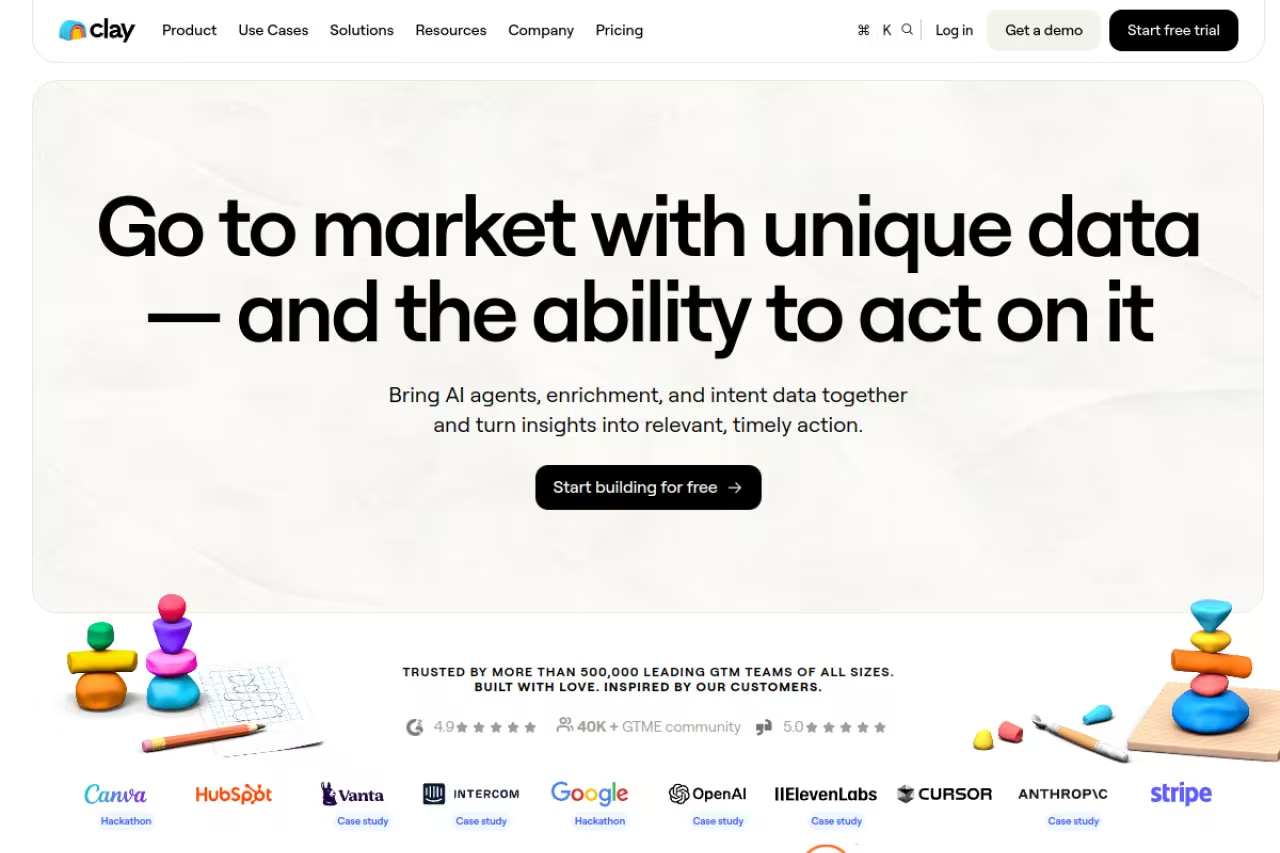
If your outreach is generic, no amount of AI copywriting will save it. Clay fixes the root cause. It's a spreadsheet-meets-automation tool that runs "waterfall" enrichment: it checks one data provider for an email or phone number, and if that comes up empty, it tries the next, and the next, across more than 150 sources. You get higher match rates than any single database can give you, plus an AI agent (Claygent) that can scrape a prospect's site to pull custom signals like recent funding or a new VP hire.
The data engine for RevOps and growth teams that want hyper-targeted lists and personalization built on real data, not first-name tokens. It waterfalls across more than 150 sources, but it has a real learning curve.
The free plan gives you 100 data credits and 500 actions a month, which is enough to test it on a few dozen contacts. Paid plans start at $167/month for the Launch tier. Note that Clay overhauled its credit pricing in early 2026 and most enrichments now cost far fewer credits than before, so the real cost per contact dropped.
The standout: Nothing else matches that many enrichment sources in a single workflow. You can build a list, find the data, write a personalized opener with AI, and push it to your sequencer without leaving the table.
The catch: Clay has a real learning curve. Credits are charged per attempt, not per success, so a three-provider waterfall that finds nothing still bills you three times. Solo founders without RevOps help often find it overkill and burn credits figuring it out.

Apollo: the best all-in-one to start with
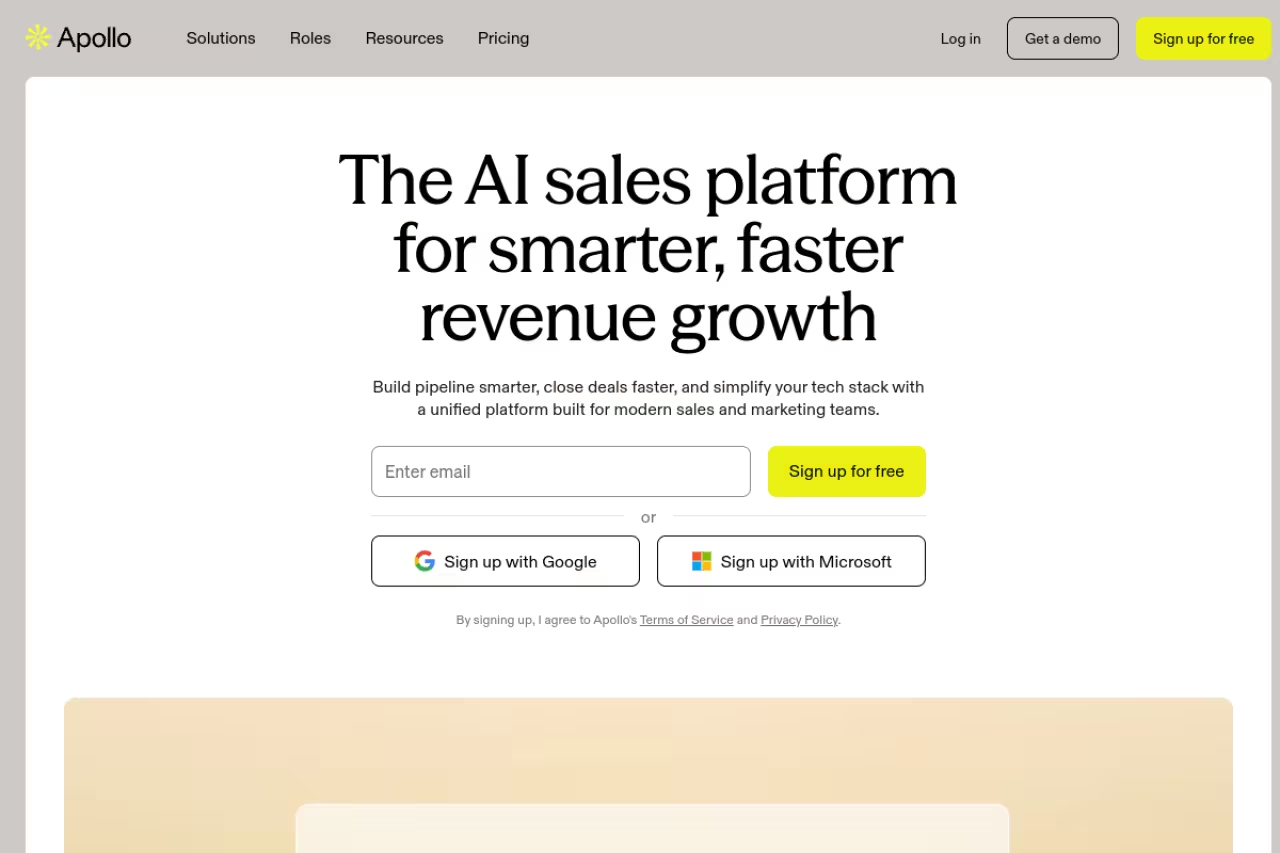
Apollo bundles a 200M+ contact database, email and call sequencing, and AI writing into one product. For most small teams and solo sellers, it's the cheapest way to go from "I have no leads" to "I'm sending sequences" without stitching five tools together.
The best all-in-one to start with for founders and small sales teams, combining a 200M+ contact database, sequencing and AI writing. Data accuracy is fine rather than elite, and phone numbers cost 8 credits, so mobile-heavy prospecting eats your allowance.
The free plan includes the contact database with 1,200 email credits a year and 5 mobile credits a month. Paid plans, per Apollo's pricing page, run Basic at $49/user/month, Professional at $79, and Organization at $119 (annual billing). Watch the credit math: an email lookup costs 1 credit but a phone number costs 8, so mobile-heavy prospecting eats your allowance fast.
The standout: You don't pay separately for data and sending. Everything lives in one login, and the free tier is genuinely usable for testing a motion before you commit a budget.
Where it falls short: Data accuracy is fine, not elite. Bounce rates climb when you scrape deep into the database, and the personalization is shallower than what you'd build in Clay. It's a great starting point that many teams eventually outgrow on the data side.

Gong: knowing why deals die
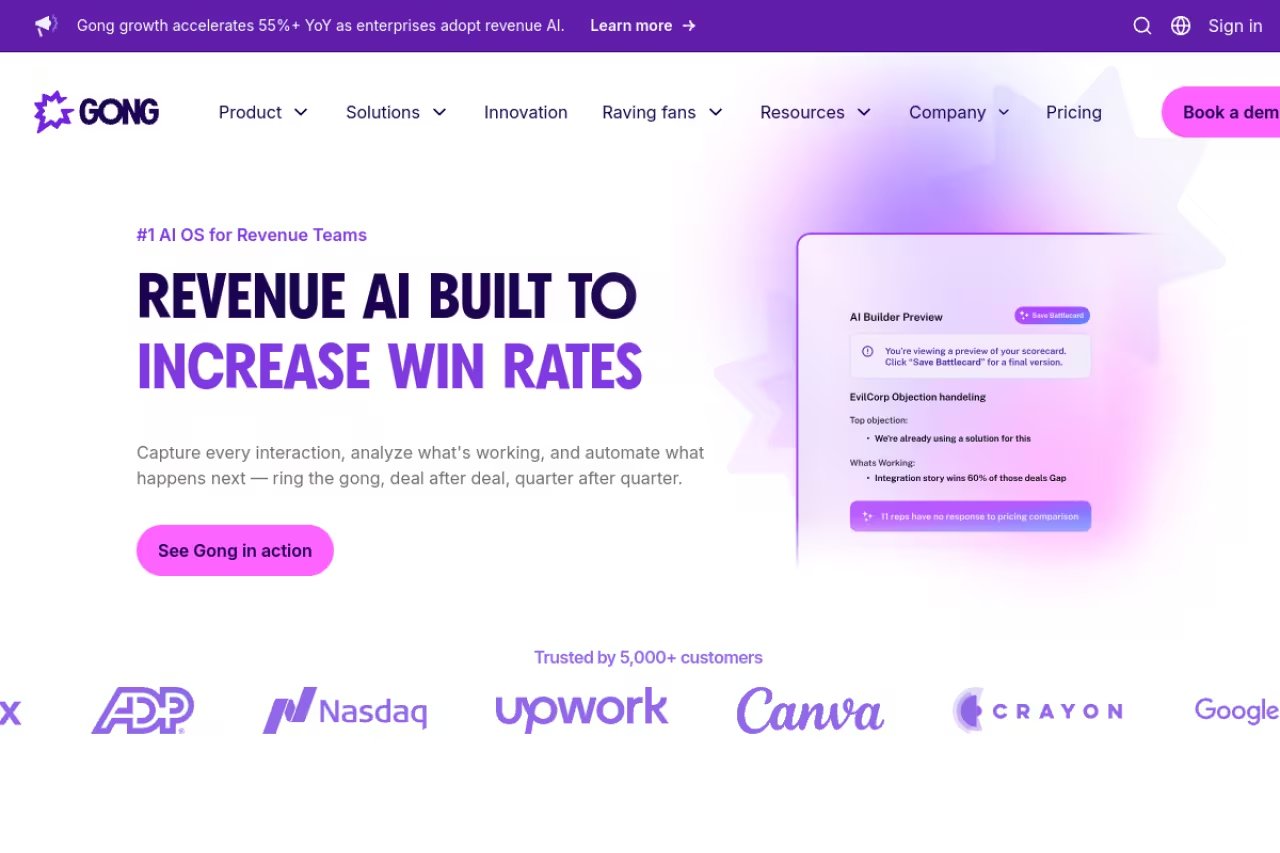
Gong records every call and meeting, transcribes it, and runs AI on top to surface talk-time ratios, competitor mentions, missing next steps, and the patterns that separate won deals from lost ones. It's the category leader in conversation intelligence, and reps actually use the coaching it produces, which is rarer than it sounds.
Go with Gong if you run roughly 10+ reps and call coaching and deal inspection move your number. It is enterprise software priced like it, with a platform fee and implementation on top of per-user costs.
This is enterprise software and priced like it. Reporting from buyers in 2026 puts the Foundation tier around $1,400-$1,600 per user per year, plus a flat platform fee that typically runs $5,000 and up, plus implementation. Year-one totals land in the tens of thousands and climb into six figures for larger teams. Forecast and Engage are sold as separate modules.
The standout: The deal-level intelligence is the real product. Gong can flag a deal that's gone quiet, show you the call where momentum stalled, and tell you which of your reps confirm next steps and which don't.
The catch: Cost and complexity. Gong's effective per-user price rose sharply between 2023 and 2026, contracts often include automatic annual increases, and the platform fee plus mandatory services make it hard to justify under about 10 seats. For a tiny team, it's expensive insurance you can't fully use yet.
If your team is drowning in tools and you'd rather invest in the skills to run them, the Dupple X yearly trial is a cheaper place to build the playbook first.

Artisan: the AI BDR that runs itself
Artisan sells "Ava," an AI BDR that handles the full outbound motion: finding accounts, enriching contacts, writing personalized sequences, and sending across email and LinkedIn. The pitch is that you replace a chunk of manual SDR work with one agent you supervise.
A hands-off outbound machine for mid-to-large teams with the deal volume to justify a premium seat. At $750 a seat you need real volume, and the personalization can feel templated without good inputs.
Entry pricing starts around $750 per seat per month on annual contracts, with custom enterprise pricing above 20 seats. It's transparent for the category, which is a low bar but worth noting.
The standout: Breadth. Most AI SDR tools do one stage well. Ava attempts the entire pipeline from list-build to reply handling, and the account-based workflows are genuinely useful when set up right.
Where it falls short: Autonomy cuts both ways. Reviewers report that the AI personalization can feel templated if you don't feed it good inputs, and deliverability still depends on your domain hygiene. At $750 a seat, you need real volume for the math to work. It's not a tool for someone sending 20 emails a week.

Lavender: a writing coach in your inbox
Lavender is the cheapest tool here and one of the most useful. It's a Chrome extension that scores your cold emails in real time inside Gmail or Outlook, flagging length, reading level, spammy phrases, and weak openers, then suggesting fixes. It won't send for you. It makes the emails you send better.
The cheapest tool here and one of the most useful for reps and SDR teams who want better reply rates without overhauling their stack. It is a coach, not an engine, and the value fades once your writing is already strong.
Free for 5 email analyses a month. Starter is $29/month for unlimited coaching, Pro is $49, and Teams is $69/user/month with shared analytics, per Lavender's plans. Annual billing knocks off around 20%.
The standout: Instant feedback. You see your email's score climb as you cut fluff, and the coaching genuinely sticks. Reps internalize the rules and write tighter emails even when the extension is off.
The catch: It's a coach, not an engine. Lavender doesn't find leads, enrich data, or run sequences, so it's an add-on rather than a platform. The value also fades once your writing is already strong, since there's only so much to fix.

Salesforce Agentforce: AI where your data lives
If you already run Salesforce, the case for Agentforce is that the AI sits directly on top of your CRM data, no syncing or exporting. Agentforce deploys agents that can qualify leads, answer prospect questions, and handle routine sales tasks, while Einstein continues to power predictive lead scoring and conversation insights.
The case for Agentforce is zero data movement, so it suits companies standardized on Salesforce that want agents acting on existing records. Consumption pricing is unpredictable, and outside the Salesforce ecosystem simpler options exist.
Salesforce lists $2 per conversation for customer-facing agents, or a Flex Credits model at roughly $500 per 100,000 credits with $0.10 per action. Big customers negotiate this down with multi-year commitments. Einstein features are bundled into higher Sales Cloud tiers.
The standout: Zero data movement. The agent reasons over your live pipeline, your contacts, and your activity history because it's the same platform. For Salesforce shops, that integration depth is hard to beat.
Where it falls short: Consumption pricing is unpredictable. Per-conversation and per-action billing makes budgeting hard, and costs can spike with usage. It also assumes you're already deep in the Salesforce ecosystem; outside it, there are simpler, cheaper paths.
11x: enterprise outbound at full scale
11x builds "Alice," a digital AI worker for outbound that bundles enrichment, multichannel sequencing, deliverability infrastructure, and dedicated support. It targets the largest sales orgs running outbound at serious volume.
Built for enterprise teams that want a fully managed AI SDR and have the budget, with data and deliverability tooling included. With no self-serve pricing and a five-figure monthly floor, it is out of reach for most teams.
Fully custom, with no self-serve tier. Public reporting puts it in the $5K-$15K per month range depending on volume and which agents you turn on.
The standout: It's an all-inclusive package. Deliverability tooling and data are built in rather than billed as separate line items, and the support model is hands-on, which matters when you're sending at high volume.
The catch: Price and opacity. With no published self-serve pricing and a five-figure monthly floor, 11x is out of reach for most teams. It's built for orgs where outbound is a major channel, not for experimentation.

Regie.ai: AI sequencing for SDR teams
Regie.ai focuses on the sequencing layer. It lets reps build persona-based outbound sequences with AI-assisted messaging across email, LinkedIn, and phone, and it can run an "Auto-Pilot" agent that handles parts of the prospecting motion while keeping humans in the loop.
A sequencing aid for outbound SDR teams that want AI to draft and orchestrate persona-based messages without going fully autonomous. Pricing is quote-based, the copy still needs a human edit, and you will pair it with Clay or Apollo for data.
Custom, quote-based. Regie positions itself between a copywriting assistant and a full AI BDR, so the cost depends on whether you use it for content help or agent-driven prospecting.
The standout: The persona engine. Regie is good at adapting tone and message to different buyer personas, which is the part most reps get wrong when they scale sequences.
Where it falls short: No public pricing makes it hard to compare, and the AI copy still needs a human edit to avoid sounding generic. It's a sequencing aid, not a data source, so you'll pair it with something like Clay or Apollo.
How to choose
Start with the gap you actually have, not the tool with the best demo.
If your problem is data and targeting, buy Clay. Generic outreach is a list problem before it's a copy problem, and Clay is the most flexible way to fix it. Pair it with a sender.
If your problem is "I have nothing," start with Apollo. The free tier and built-in database get you sending fast, and you can layer Clay on later when accuracy matters.
If your problem is closing, not prospecting, the answer is conversation intelligence: Gong if you have 10+ reps and a budget, or one of the lighter coaching tools if you don't.
If your problem is rep capacity, that's where the AI BDR tools (Artisan, 11x, Regie) come in. But be honest about volume. These only pay off if you're sending enough that a human SDR's time is the bottleneck. Below that, a $29 Lavender seat plus Apollo will outperform a $750 agent.
One rule that holds across all of them: AI amplifies your inputs. Feed it bad lists and weak offers and you'll just send bad emails faster. Get the targeting and the message right first.
FAQ
What is the best AI sales tool in 2026?
For most teams, Clay is the strongest single choice because it fixes targeting and personalization, which is where outbound usually breaks. But "best" depends on the job: Apollo wins on value for prospecting, and Gong wins for call coaching on larger teams. There's no universal winner across all three layers of the sales stack.
Can AI sales tools replace SDRs?
Not entirely, at least not in 2026. AI BDR tools like Artisan and 11x can automate list-building, enrichment, and sending, which removes a lot of manual work. But they still need a human to set strategy, write the offer, handle nuanced replies, and run discovery calls. They shift the SDR's job from manual sending to supervising and editing, rather than eliminating it.
How much do AI sales tools cost?
The range is wide. Lavender starts free and runs $29 to $69 a month. Apollo's paid plans start at $49 per user. Clay's paid tiers start at $167 a month. At the high end, Gong runs over $1,400 per user per year plus platform fees, and enterprise AI SDRs like 11x can hit $5,000 to $15,000 a month. Start cheap and scale into the expensive tools once you've proven the motion.
Do I need separate tools for data, outreach, and call analysis?
Often, yes. A few platforms bundle data and outreach (Apollo does both well enough to start with), but conversation intelligence is almost always a separate purchase. The best stacks usually pair a strong data tool (Clay) with a sequencer and add a call-analysis tool only once you have a team big enough to coach.
Are free AI sales tools worth using?
For testing, absolutely. Apollo's free tier gives you a real database to prospect with, Clay's free plan lets you trial enrichment on a few dozen contacts, and Lavender's free plan coaches 5 emails a month. They're capped, so you'll outgrow them, but they're a smart way to validate that a tool fits before you pay.
If you want to go deeper on the tools shaping modern go-to-market, browse our top AI tools directory and these related guides: the best AI agents, ChatGPT for sales, and AI tools for marketing. And if you'd rather skip the research and get a curated workflow, the Dupple X yearly trial is built for exactly that.
Related guides
Some offers on this page may be paid placements or contain affiliate links.
