
Best AI Predictive Analytics Tools (2026)

Key facts8 tools compared: DataRobot, Pecan AI, Akkio, H2O.ai, Qlik Predict, Power BI, Google Vertex…
- 8 tools compared: DataRobot, Pecan AI, Akkio, H2O.ai, Qlik Predict, Power BI, Google Vertex AI, Amazon SageMaker
- DataRobot (best for: Enterprise ML teams shipping to production): From ~$25K/yr self-service, $150K+/yr enterprise
- Pecan AI (best for: Business teams predicting churn, LTV, demand): From $760/mo (annual)
- Akkio (best for: Agencies and ops teams, no-code): From $49/user/mo
- H2O.ai (best for: Engineers who want open source + scale): Free (open source) to custom enterprise
Most "predictive analytics" demos look magic until you try to ship one. You build a churn model, it works on the slide, and then it dies in the gap between your data warehouse and the team that's supposed to act on the prediction. The hard part was never the math. It's the plumbing, the maintenance, and getting a forecast in front of someone who'll actually do something with it.
That's the lens used to compare these. Not "can it fit a random forest" (everything can now), but "how fast does a business question turn into a prediction my team trusts." The answer depends entirely on who you are. A data science team wants control and governance. A growth marketer wants a churn score in HubSpot by Friday. Those are different products.
If you have a real ML team and a budget, DataRobot is still the platform to beat for production at scale. If you're a business team without a data scientist, Pecan AI and Akkio get you to a usable prediction the fastest. Below are eight tools I'd actually recommend in 2026, who each is for, and where each one bites you.
Quick comparison
| Tool | Best for | Price | Standout |
|---|---|---|---|
| DataRobot | Enterprise ML teams shipping to production | From ~$25K/yr self-service, $150K+/yr enterprise | AutoML + MLOps + governance in one |
| Pecan AI | Business teams predicting churn, LTV, demand | From $760/mo (annual) | Predictive GenAI builds the model from a question |
| Akkio | Agencies and ops teams, no-code | From $49/user/mo | Trained model in minutes from a CSV |
| H2O.ai | Engineers who want open source + scale | Free (open source) to custom enterprise | Free H2O-3 / AutoML, no vendor lock-in |
| Qlik Predict | Existing Qlik BI users | AutoML add-on, capacity-based | Predictions live inside Qlik dashboards |
| Power BI | Microsoft shops needing light forecasting | Pro $14/user/mo, PPU $24/user/mo | Built-in forecasting at a tiny price |
| Google Vertex AI | GCP teams, serverless prediction | Pay-per-prediction / node-hour | Cheap on spiky inference, BigQuery native |
| Amazon SageMaker | AWS teams wanting full control | Per-second instance billing | Most granular control of the stack |

DataRobot
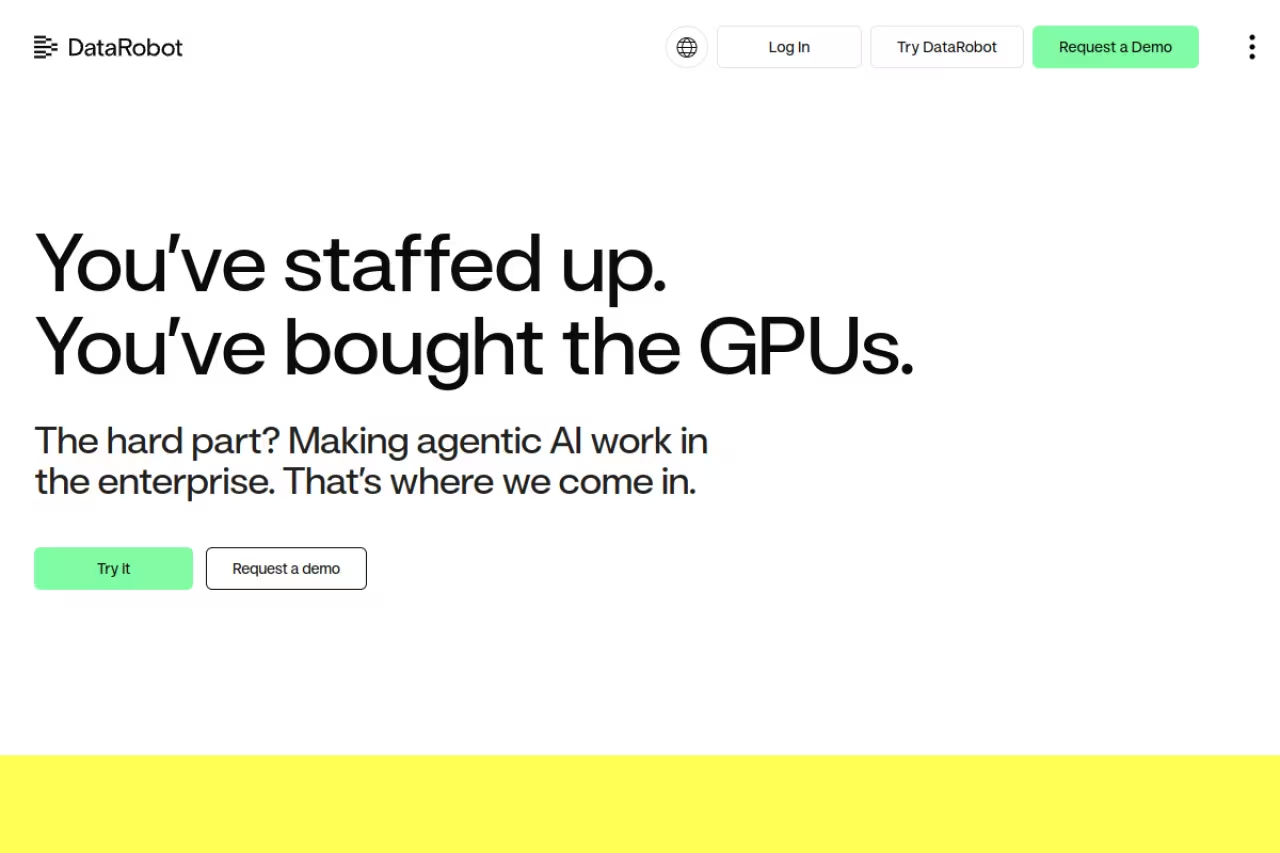
DataRobot is the platform most enterprises end up on when predictions need to run in production, not just in a notebook. You feed it data, it builds and compares dozens of models at once, ranks them, and hands you deployment, monitoring, and governance in the same place. The AutoML still does the heavy lifting, but the real value now is everything around the model: drift detection, bias checks, and an audit trail your compliance team will actually accept.
The enterprise choice for data science and ML teams that need models running live with oversight, with governance strong enough to answer a regulator. It is a six-figure commitment past the trial, and overkill for a small team that just wants a churn score.
there's a self-service tier reported from around $25K/year, and full enterprise access starts near $150K/year with consumption options. A 14-day trial exists. Licenses are per named user, and data scientist seats cost more than analyst seats.
The standout: governance. If you're in finance, insurance, or healthcare and a regulator can ask "why did the model decide this," DataRobot answers that better than almost anything else.
The catch: the price. This is a six-figure commitment once you're past the trial, and it's genuine overkill for a small team that just wants a churn score. You're paying for the MLOps and governance layer as much as the modeling.

Pecan AI
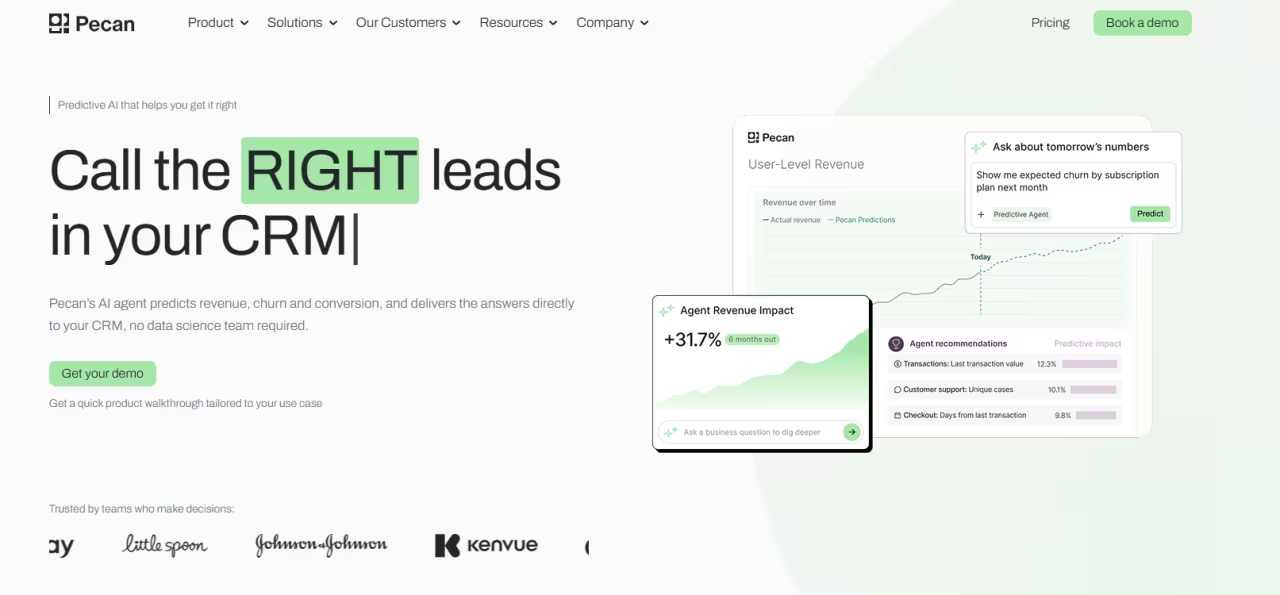
Pecan AI is built for the team that has the business question but not the data scientist. You describe what you want to predict, churn, lifetime value, demand, in something close to plain English, and its Predictive GenAI handles data prep, feature engineering, modeling, and validation. Predictions push straight into Salesforce, HubSpot, Snowflake, or your BI tool, which is the part most platforms get wrong.
Pick Pecan if you are a marketing, growth or revenue team with the business question but no data scientist, since it pushes predictions straight into your CRM. The batch pricing, with extra batches at $50 each, adds up if you need frequent scoring.
Pecan's plans start at $760/month on annual billing (Starter: 2 prediction batches/month, 500M rows), the Team plan is $1,400/month (10 batches, 2 billion rows), and Business is custom. Extra prediction batches are $50 each.
The standout: the path from question to deployed prediction is genuinely short. I've seen non-technical teams ship a churn model in days, with the score landing back in the CRM where reps live.
The catch: the batch-based pricing model. If you need frequent or real-time scoring, those $50 batches add up, and you can outgrow the row limits faster than you'd expect on a growing dataset.

Akkio
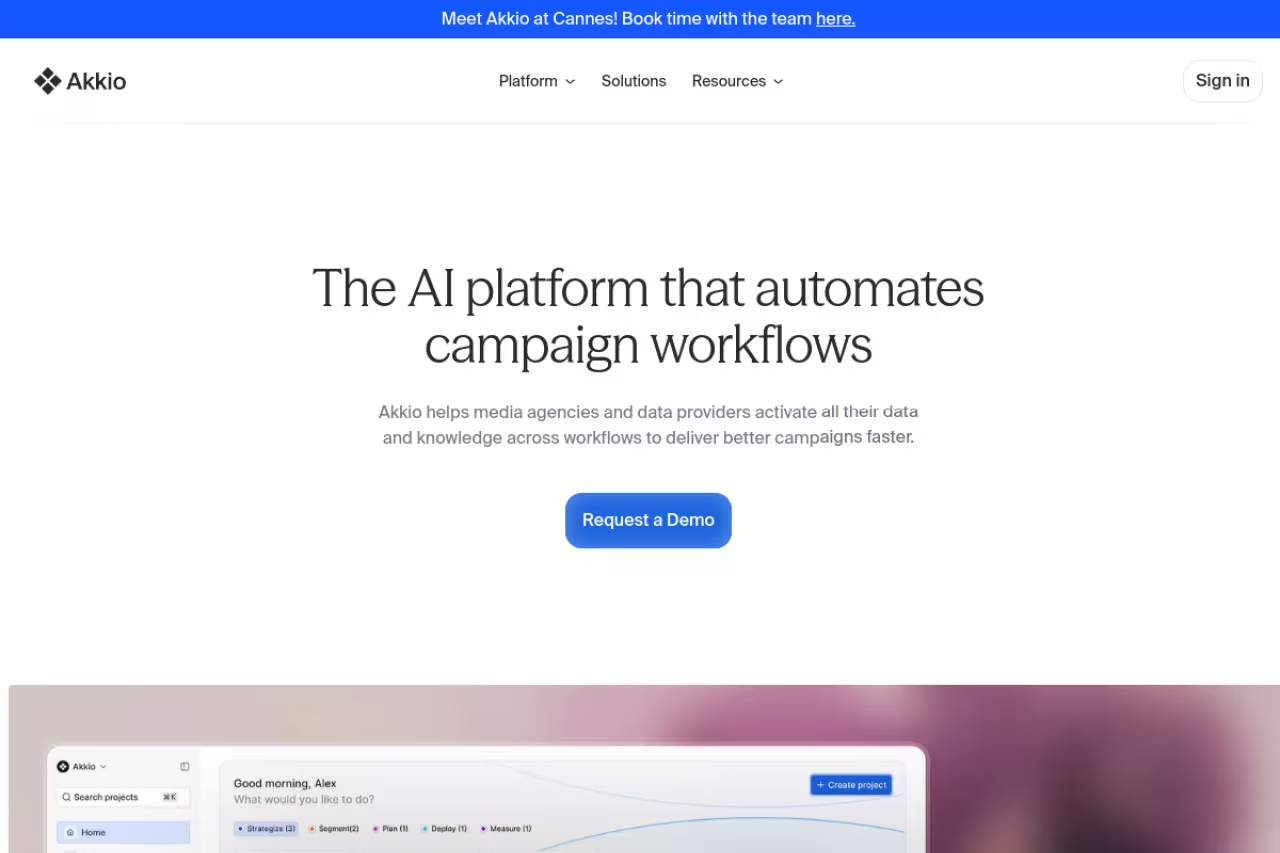
Akkio is the fastest "upload a CSV, get a prediction" tool on this list. Connect HubSpot, Salesforce, BigQuery, Snowflake, or just drop a file, pick the column you want to predict, and you have a trained model in minutes. It covers both classification (lead scoring, churn) and regression (revenue forecasting, demand), cleans the data for you, and still shows you accuracy metrics so you're not flying blind.
The fastest upload-a-CSV, get-a-prediction tool here, suited to agencies, small ops teams and analysts who want predictions without learning ML. If you need explainability and monitoring at scale, you will hit its ceiling.
Akkio's Basic plan is $49/user/month and Pro is $99/user/month, with custom enterprise pricing above that. It's by far the cheapest serious entry point on this list.
The standout: speed and price together. For a solo analyst or a lean agency, getting a usable forecast for $49/month is hard to argue with.
The catch: it's deliberately shallow. You don't get the deep tuning, governance, or MLOps of DataRobot or H2O. For high-stakes models that need explainability and monitoring at scale, you'll hit the ceiling. Akkio is also leaning hard into agency/media use cases, so generic plans get less attention.
If you're already mapping out which AI tools to standardize on across your stack, a Dupple X membership gets you our running shortlist of vetted tools and the discounts we negotiate, which usually pays for itself on the first annual plan.

H2O.ai
H2O.ai is where engineers go when they want power without a vendor's leash. The open-source H2O-3 and its AutoML are genuinely free, fit and tune models fast, and run wherever you want. Driverless AI adds automated feature engineering and a slicker enterprise wrapper. It handles tabular data, time series, NLP, and image data, with solid explainability tools baked in.
Go with H2O.ai if you have engineering talent and want open-source flexibility with the option to self-host on private data. The free path assumes you can code and operate it, and enterprise pricing is opaque until you talk to sales.
the open-source core is free; enterprise Driverless AI is custom-quoted, with deployments commonly cited in the $50K+/year range depending on scale.
The standout: no lock-in on the open-source side. You can prototype for free, keep your data in-house, and only pay when you need the enterprise support and Driverless tooling.
The catch: the free path assumes you can code and operate it. There's no hand-holding, no slick business-user UI on H2O-3, and enterprise pricing is opaque until you talk to sales. Business users without engineers will struggle here.
Qlik Predict
Qlik Predict (with Qlik AutoML) makes the most sense if your company already runs on Qlik. You get no-code predictive models, key-driver analysis, and what-if scenarios sitting right inside the dashboards your team already opens every morning. The prediction isn't a separate report you have to chase down. It's in the same view as the rest of your numbers.
Makes sense only if your organization is already standardized on Qlik, where predictions sit in the same dashboards your team opens every morning. Outside that ecosystem it is the wrong reason to buy, and standalone platforms go deeper.
AutoML, Qlik Answers, and Predict are Premium-tier and above add-ons, and Qlik moved to capacity-based pricing across its cloud products. Plan on a Qlik Cloud subscription plus the AI/ML add-on capacity.
The standout: zero context-switching. Predictions and BI live in one tool, which is a real adoption advantage. People actually look at forecasts when they're already in the dashboard.
The catch: it only pays off inside the Qlik ecosystem. If you're not already a Qlik shop, buying in just for AutoML is the wrong reason, and the capacity-based pricing can get murky to forecast. For pure prediction power, standalone platforms go deeper.
Microsoft Power BI
Power BI is the value pick for Microsoft shops that need directional forecasting, not a full ML stack. Built-in forecasting uses exponential smoothing to project time-series metrics with confidence intervals, and Copilot adds natural-language report building and anomaly explanations. For a lot of teams, "where is revenue headed next quarter" is the actual question, and Power BI answers it cheaply.
The value pick for Microsoft 365 teams that want forecasting and anomaly detection without a dedicated platform, with Pro at $14/user/month. The forecasting is time-series only, so you cannot model churn from customer attributes.
Power BI Pro is $14/user/month and Premium Per User is $24/user/month, both billed annually. The deeper AI features lean on Premium or Microsoft Fabric capacity.
The standout: the price-to-capability ratio. You get forecasting, anomaly detection, and key-driver analysis for the cost of a BI seat you may already own.
The catch: the forecasting is time-series only. It doesn't do true multivariate prediction, so you can't model churn from customer attributes the way Pecan or Akkio do. The genuinely advanced AI also pushes you toward Fabric, which gets expensive fast for small teams. For deeper dashboard work, see our roundup of the best AI business intelligence tools.

Google Vertex AI
Vertex AI is the right call when your data already lives in Google Cloud and you want prediction without running idle servers. It unifies training, deployment, and serving, ties tightly into BigQuery, and its serverless prediction bills per-prediction instead of per-instance-hour. For spiky or unpredictable inference traffic, that can land under $100/month with no idle charges.
The right call for GCP-native teams with engineering resources, especially if you already use BigQuery and have bursty traffic, thanks to serverless per-prediction billing. It is a cloud ML platform, not a business-user tool, and bills can surprise you.
consumption-based. Training is billed in node-hours, and prediction can be serverless per-prediction or provisioned per-node-hour. No flat license.
The standout: the serverless prediction economics. If your traffic is bursty, you're not paying for a model endpoint to sit idle at 3am.
The catch: this is a cloud ML platform, not a business-user tool. You need engineers, you're committing to GCP, and bills can surprise you if inference traffic spikes. It's the opposite end of the spectrum from Akkio.
Amazon SageMaker
SageMaker gives AWS teams the most granular control of any platform here. You assemble the pipeline, pick the instances, and pay per-second for exactly what you use. Real-time inference runs on dedicated endpoints, and there's a serverless option for intermittent traffic. If you want to build a heavily optimized, bespoke ML factory, this is the raw material.
For AWS-committed engineering teams that want full control over the modeling and serving stack, nothing here offers more dials. That control is the cost: billing is easy to misread, and always-on endpoints charge whether or not anyone queries them.
per-second instance billing across training and inference, with serverless inference billed per-invocation plus compute duration. Granular, but the bill can get complicated.
The standout: control. Nothing here gives you more dials to turn, which is exactly what a mature ML team wants.
The catch: that control is the cost. The a-la-carte AWS billing is the easiest on this list to misread, and always-on real-time endpoints rack up charges whether or not anyone's querying them. It's powerful and the least friendly to non-engineers.
How to choose
Forget the feature lists for a second and answer one question: do you have a data scientist who'll own this?
If yes, and you need models in production with governance, look at DataRobot (if budget allows) or H2O.ai (if you want open source and control). If you're deep in a cloud already, Vertex AI or SageMaker keep prediction next to your data.
If no, and you have a business question that needs an answer, Pecan AI or Akkio get you there without hiring. Akkio if you're cost-sensitive and want speed, Pecan if you need predictions piped back into your CRM at scale.
And if you already live in a BI tool, check whether you can avoid buying anything new. Power BI and Qlik Predict add prediction to dashboards you already pay for, which beats a new platform when your needs are modest.
One more filter: where does the prediction need to land? A churn score is useless in a notebook. The tools that win for non-technical teams are the ones that push the answer into Salesforce, HubSpot, or the dashboard people already check. If forecasting is more your goal than classification, our guide to the best AI inventory forecasting tools goes deeper on demand planning specifically.
FAQ
What is the best AI predictive analytics tool in 2026?
It depends on your team. For enterprise ML teams that need production deployment and governance, DataRobot leads. For business teams without a data scientist, Pecan AI and Akkio are the strongest picks because they turn a plain-language question into a deployed prediction. There's no single winner, only the best fit for your skills and stack.
Do I need a data scientist to use predictive analytics tools?
Not anymore. No-code tools like Akkio and Pecan AI handle data prep, feature engineering, and modeling automatically, so a marketer or analyst can build a churn or revenue model without writing code. Platforms like H2O.ai, Vertex AI, and SageMaker still expect engineering skills, which is why they sit at the other end of the spectrum.
How much do AI predictive analytics tools cost?
The range is wide. Akkio starts at $49/user/month and Power BI Pro at $14/user/month for light forecasting. Pecan AI starts at $760/month. Enterprise platforms like DataRobot run from roughly $25K/year for self-service up to $150K+/year, while H2O.ai has a free open-source core with custom enterprise pricing. Cloud platforms like Vertex AI and SageMaker bill by consumption, so cost tracks your usage.
What's the difference between predictive analytics and business intelligence?
Business intelligence tells you what happened and what's happening now. Predictive analytics estimates what will happen next, which customers will churn, how much demand to expect, which leads will convert. Many BI tools, including Power BI and Qlik, now bolt prediction onto dashboards, but dedicated platforms like Pecan and DataRobot go deeper on the modeling. See our best AI data visualization tools guide for the reporting side.
Can predictive analytics tools detect anomalies and fraud?
Yes. Most platforms here support anomaly detection alongside forecasting, and Power BI surfaces it natively. For fraud or unusual-pattern detection specifically, you often want a tool tuned for it. We cover those in our best AI anomaly detection tools roundup.
Predictive analytics is one of the few AI categories where the tooling finally matches the promise, if you pick for your team and not the feature list. Match the tool to who's actually going to run it, make sure the prediction lands where people can act on it, and start with a single high-value question rather than trying to model everything at once. If you want our continuously updated shortlist across categories, Dupple X tracks what's worth paying for and what isn't, and you can browse our full top tools directory anytime.
Related guides
Some offers on this page may be paid placements or contain affiliate links.
