
Best Marketing Analytics Tools in 2026 (Compared and Ranked)

Key facts8 tools compared: Google Analytics 4, Mixpanel, Amplitude, PostHog, Plausible, Matomo, Triple…
- 8 tools compared: Google Analytics 4, Mixpanel, Amplitude, PostHog, Plausible, Matomo, Triple Whale, HubSpot Marketing Hub
- Google Analytics 4 (best for: Free web + acquisition data): Free (360 from ~$50k/yr)
- Mixpanel (best for: Product funnels and retention): Free to 1M events, then $0.28/1K
- Amplitude (best for: Deep behavioral + experimentation): Free (10k MTUs), Plus from $49/mo
- PostHog (best for: All-in-one for product-led teams): Free to 1M events, then $0.00005/event
Most marketing teams have an analytics problem that isn't really about analytics. They have six dashboards, three of which disagree about how many signups happened last week, and nobody trusts any of them. The data exists. The truth doesn't.
I compared these tools' pricing pages, documentation, and public user reviews across a few different setups: a content site, a SaaS product, and a Shopify store. The right pick depends less on feature checklists and more on one question: what decision are you actually trying to make? Traffic attribution is a different job from product funnel analysis, which is a different job from "did that ad spend pay off."
If you want the short version: for most teams running a website and a product, the combination of Google Analytics 4 for free top-of-funnel data and PostHog or Mixpanel for behavioral analytics covers 90% of cases without a sales call. If privacy and a clean interface matter more than depth, Plausible is the one I keep recommending. Below is the full list with real pricing and the catches nobody puts on their landing page.
Quick comparison
| Tool | Best for | Price | Standout |
|---|---|---|---|
| Google Analytics 4 | Free web + acquisition data | Free (360 from ~$50k/yr) | Ubiquitous, integrates with Google Ads |
| Mixpanel | Product funnels and retention | Free to 1M events, then $0.28/1K | Fast, marketer-friendly reports |
| Amplitude | Deep behavioral + experimentation | Free (10k MTUs), Plus from $49/mo | Causal insights, cohorts |
| PostHog | All-in-one for product-led teams | Free to 1M events, then $0.00005/event | Analytics + replays + flags in one |
| Plausible | Lightweight privacy-first web stats | From $9/mo, 30-day trial | Cookieless, one-page dashboard |
| Matomo | Data ownership / GDPR control | Free self-hosted, Cloud from ~$23/mo | Self-host, you own the data |
| Triple Whale | DTC / Shopify attribution | Free tier, Foundation $219/mo | Multi-touch attribution for ads |
| HubSpot Marketing Hub | Marketing + CRM in one place | Free, Starter $15/mo, Pro ~$890/mo | Closed-loop revenue reporting |
Google Analytics 4

Nobody loves GA4. Everybody uses it. After the migration off Universal Analytics, the interface confused half the marketers I know, but it's free, it's everywhere, and it talks to Google Ads natively. That last part is why it stays installed.
GA4 is event-based, which means it tracks user actions (page views, clicks, purchases) rather than just sessions. For acquisition reporting, channel attribution, and feeding conversion data back into Google Ads, it's the default for a reason.
The free, near-universal default for any team running Google Ads, with native conversion feedback. The reporting UI is worse than what it replaced, and the free version samples data at high volumes and caps retention.
Free for standard use. The enterprise tier, GA4 360, starts around $50,000 a year and only makes sense at serious scale.
The catch: The free version starts sampling data above 10 million events per month, data retention caps at 14 months, and large datasets can lag 24 to 48 hours. The reporting UI is genuinely worse than what it replaced, and you'll spend real time building explorations to answer questions that used to be one click. It's free in dollars, not in hours.

Mixpanel
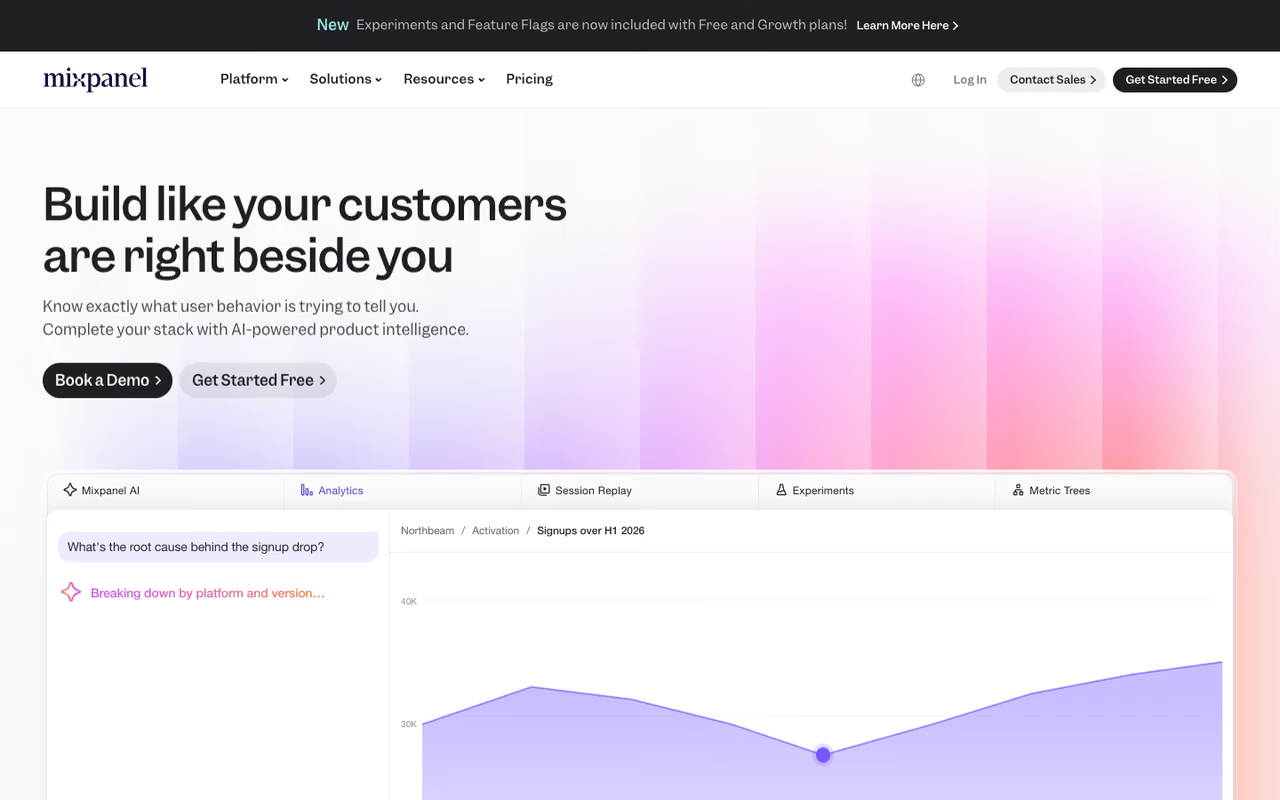
If GA4 tells you where users came from, Mixpanel tells you what they did once they arrived. This is the product analytics tool I reach for first when a marketer (not an engineer) needs to build a funnel report without filing a ticket. The reports are fast, the segmentation is intuitive, and you can answer "where do people drop off between signup and first action" in about two minutes.
The product analytics tool to reach for when a marketer needs funnels and retention without filing a ticket. Event-based pricing is unpredictable, so set billing caps early.
The free plan now caps at 1 million events per month, which covers a lot of early-stage products. The Growth plan starts free at that same 1M and charges $0.28 per 1,000 events after, with volume discounts. Enterprise is custom. Early-stage startups can get a year free through the startup program.
The catch: Event-based pricing is unpredictable. One viral week or a misconfigured tracking call can spike your event count and your bill. Set billing caps early. The free plan's drop from older, more generous limits also caught some longtime users off guard, so check your current volume before assuming you'll stay free.

Amplitude
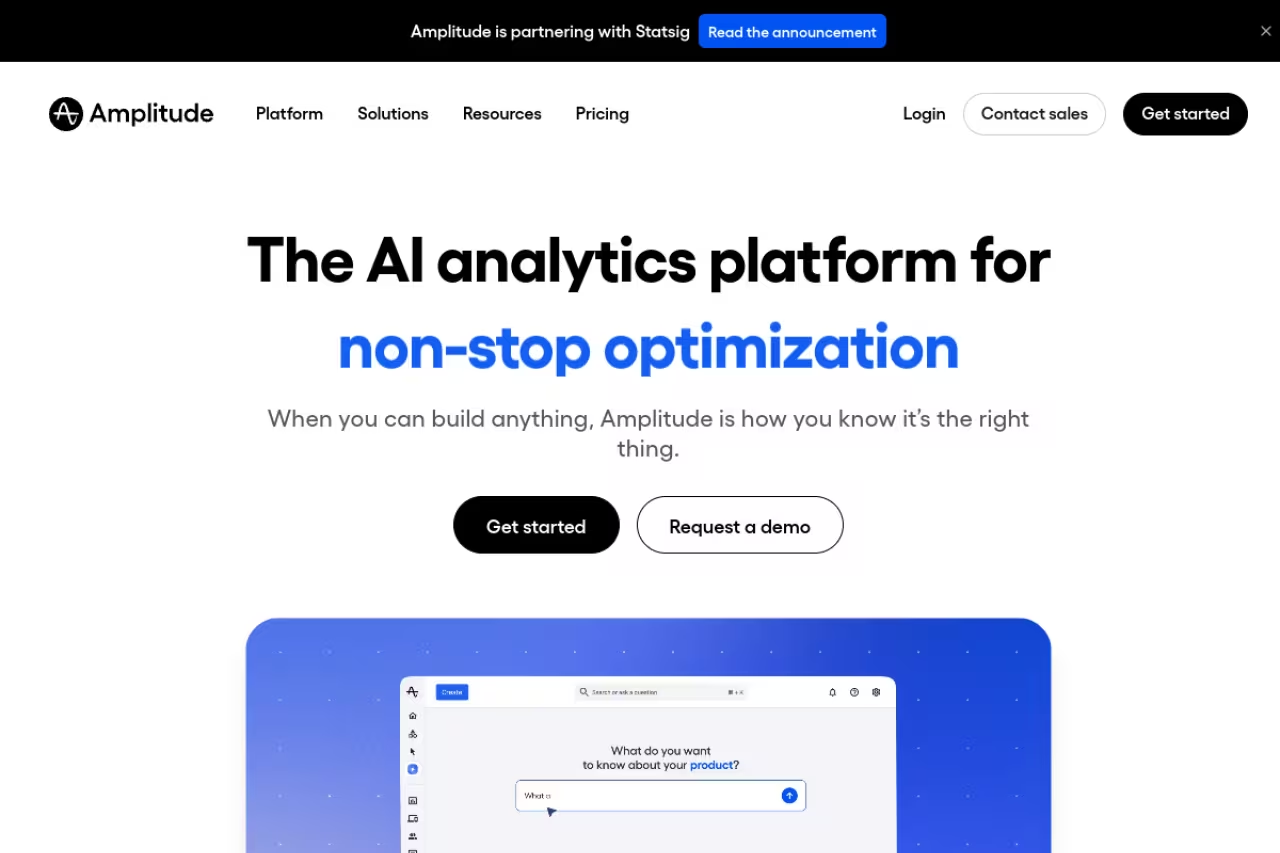
Amplitude is Mixpanel's heavier rival, and the difference shows up when you go deep. Behavioral cohorts, causal analysis, and built-in experimentation make it the pick for teams that treat analytics as a discipline rather than a dashboard. It has expanded well beyond pure analytics into feature flags, session replay, and web experimentation.
The heavier rival to Mixpanel, for product-led growth teams that run experiments and need rigorous behavioral analysis. It is overkill if you only want funnels and retention, and costs climb fast once you pass the free MTU threshold.
The free Starter plan covers 10,000 monthly tracked users and up to 2 million events. Paid Plus starts at $49 a month (billed annually) for up to 300k MTUs and 25M events. Growth and Enterprise are custom-quoted.
Where it falls short: It's more tool than most small teams need. The learning curve is steeper than Mixpanel's, and the jump from free to a meaningful paid tier can get expensive fast once you cross the MTU threshold. If you just want funnels and retention, this is overkill. If you live in experimentation, it's worth it.

PostHog
This is the one I'd hand a product-led startup today. PostHog bundles product analytics, session replays, feature flags, A/B testing, surveys, and error tracking into a single platform, so you stop paying for five separate tools that don't talk to each other. It's also open source, which means you can self-host if data residency matters.
The one to hand a product-led startup today, bundling analytics, replays, feature flags, A/B testing and surveys in one open-source platform. It is built by and for engineers, so marketers without technical support will find it less approachable.
The free tier is genuinely generous: 1 million product analytics events, 5,000 session recordings, 1M feature flag requests, and more, all resetting monthly. After that, product analytics runs $0.00005 per event and decreases at volume. You only pay for the products you actually use, and you can set per-product billing limits.
The catch: It's built by and for engineers. Marketers without technical support will find the setup and the interface less approachable than Plausible or even Mixpanel. The all-in-one breadth is a strength and a distraction; you can spend a week configuring things you didn't need. If your team is non-technical, this isn't your first pick.
If you're also weighing experimentation tooling specifically, my separate roundup of the best A/B testing tools goes deeper on that side.

Plausible
Plausible is the antidote to GA4 fatigue. One lightweight script, one clean dashboard, no cookie banner required, and you can read every number on a single page. It's privacy-first and GDPR-friendly by design, which is increasingly a legal requirement rather than a nice-to-have in Europe.
The antidote to GA4 fatigue for content sites, blogs and small teams that want honest traffic numbers with no cookie banner. It is deliberately simple, with no deep funnels or cohort analysis, so pair it with a product tool if you need both.
No free tier, but there's a 30-day free trial with no credit card. Plans start at $9 a month for up to 10,000 monthly pageviews. Growth ($14) and Business ($19) add more sites and team seats. Annual billing gives you two months free.
Where it falls short: It's deliberately simple, which means no deep funnels, no cohort analysis, no product-level event modeling out of the box. It tells you what's happening on your site, not why users behave the way they do inside your product. Pair it with a product analytics tool if you need both. For pure web stats, though, it's the most pleasant tool on this list.
If you're building out a privacy-respecting marketing stack, it also pairs well with the tools in my best AI SEO tools guide for the discovery side of the funnel.

Matomo
Matomo is for teams whose first question is "where does my data physically live?" You can self-host it for free on your own servers, which means your analytics data never touches a third party. It's the most credible privacy-and-ownership play here, with a feature set close to old-school Google Analytics: real-time dashboards, custom dimensions, heatmaps, session recordings, and funnels.
The credible choice for teams with GDPR, healthcare, finance or data-residency requirements, since you can self-host it for free. Self-hosting is not free in practice (servers, updates, patches), and the interface feels dated.
Self-hosted (on-premise) is free forever with unlimited everything on your own infrastructure. Matomo Cloud starts around $23 a month for up to 50,000 monthly actions and scales by volume from there.
The catch: "Free" self-hosting isn't free in practice. You're responsible for servers, updates, security patches, and performance tuning. For a small team without ops support, the Cloud plan ends up being the realistic option, and at higher traffic it isn't cheap. The interface also feels dated next to Plausible. You're trading polish for control.

Triple Whale
If you run a DTC or Shopify brand, your real problem isn't web analytics, it's attribution: which ad actually drove that sale. Triple Whale was built for exactly that. It pulls ad spend, Shopify revenue, and multi-touch attribution into one dashboard so you can see blended ROAS without exporting four CSVs. It has since grown into an AI-driven "intelligence platform" with media mix modeling and natural-language querying on top.
Built for Shopify and DTC brands that need attribution they can act on, with ad spend, revenue and multi-touch attribution in one dashboard. Its modeled numbers will not match Meta's in-platform reporting.
There's a free tier with basic dashboards. The Foundation plan is $219/month and adds multi-touch attribution and the Moby AI assistant. Automate runs $749/month, with custom and enterprise tiers above that for larger GMV brands. Plans are billed on a 12-month commitment.
Where it falls short: Attribution is modeling, not gospel. Triple Whale's pixel-based multi-touch numbers will not match Meta's in-platform reporting, and reconciling the two takes judgment. It's also priced and built for ecommerce; if you're a B2B SaaS company, this is the wrong tool entirely. For Shopify brands, though, it's become close to a default. My best AI tools for ecommerce roundup covers the rest of that stack.

HubSpot Marketing Hub
HubSpot earns its place because it closes the loop. Its analytics live inside a CRM, so you can trace a lead from first touch through to closed revenue without stitching tools together. For teams that already run HubSpot for email, forms, and pipeline, the marketing analytics are right there, attributing revenue to campaigns automatically.
The pick for B2B and mid-market teams that want marketing analytics tied to pipeline and revenue inside a CRM. It is only as good as your CRM hygiene, and the jump from Starter to Professional is steep.
There's a free tier with limited tools and two seats. Starter is $15 per seat/month, Professional jumps to roughly $890/month, and Enterprise is around $3,600/month. The gap between Starter and Professional is steep.
The catch: The analytics are good but only as good as your CRM hygiene. If your team doesn't keep deals and contacts clean, the revenue attribution is fiction. And the price ladder is brutal: the features most marketers actually want for attribution sit in Professional, which is a big monthly jump from Starter. You're buying a platform, not a standalone analytics tool.
How to choose
Forget the feature lists for a second and answer three questions.
What decision are you trying to make? If it's "where does my traffic come from and is my ad spend working," you want acquisition and attribution tools: GA4, Plausible, or Triple Whale for ecommerce. If it's "what do users do inside my product and where do they churn," you want product analytics: Mixpanel, Amplitude, or PostHog.
How technical is your team? Non-technical marketers should start with Plausible (web) plus Mixpanel (product) or HubSpot (if you live in the CRM). Engineering-heavy teams get more from PostHog or Amplitude, which assume you can wire up event tracking yourself.
How much does data ownership matter? If you're under GDPR, in a regulated industry, or just allergic to handing data to Google, Matomo (self-hosted) or Plausible solve that cleanly. If you don't have that constraint, free GA4 is hard to beat as a baseline.
The pattern I see working most often: one privacy-friendly web analytics tool, one product analytics tool, and one attribution layer if you spend on ads. Three tools, clearly scoped, beat one tool you've half-configured. If you're assembling that stack, our top tools directory and Dupple X curation can shortcut the evaluation.
Want the sharpest tools landing in your inbox before everyone else? Dupple X tracks the AI and marketing tool space so you don't have to.
Frequently asked questions
What is the best free marketing analytics tool?
For web acquisition data, Google Analytics 4 is the best free option because it integrates with Google Ads and tracks events natively. For product behavior, PostHog's free tier (1 million events a month plus session replays and feature flags) is the most generous all-in-one free plan. Most teams run both: GA4 for the front door, PostHog or Mixpanel for what happens inside.
Do I still need Google Analytics 4 in 2026?
If you run Google Ads, yes, because GA4 feeds conversion data back into the ad platform and nothing replaces that integration as cleanly. If you don't, you can skip it. Privacy-first alternatives like Plausible and Matomo give you cleaner reporting without GA4's sampling, retention limits, and confusing interface. Many teams keep GA4 installed purely for the Ads connection and read their actual reports elsewhere.
What's the difference between marketing analytics and product analytics?
Marketing analytics answers acquisition and attribution questions: where traffic comes from, which channels and ads drive conversions, what a campaign returned. Product analytics answers behavioral questions: what users do after they arrive, where they drop off in a funnel, whether they come back. GA4, Plausible, and Triple Whale lean marketing. Mixpanel, Amplitude, and PostHog lean product. Most growth teams need one of each.
How much should a small team budget for analytics tools?
A small team can run effectively on close to $0 using free tiers: GA4 (free), PostHog or Mixpanel free plans, and Plausible's $9/month for clean web stats. Realistically, budget $20 to $100 a month once you outgrow free event limits. The cost spikes when you cross usage thresholds on event-based tools like Amplitude or Mixpanel, so set billing caps before you scale traffic.
Is GA4 being replaced or discontinued?
No. GA4 is Google's current and only standard analytics product after Universal Analytics was retired, and there's no replacement on the horizon. It remains free and widely supported. The frustration that drives teams to alternatives is about the interface, data sampling, and privacy, not about GA4 going away. It's here to stay; people just supplement it.
Which marketing analytics tool is best for ecommerce?
For Shopify and DTC brands, Triple Whale is purpose-built for blending ad spend, revenue, and multi-touch attribution in one dashboard. For deeper attribution modeling at higher spend, brands often look at marketing-mix-modeling tools as well. Pair either with GA4 for free baseline tracking. Avoid forcing a generic product analytics tool to do ecommerce attribution; the modeling matters too much.
Related guides
Some offers on this page may be paid placements or contain affiliate links.
