
The Best Predictive Analytics Tools in 2026

Key facts9 tools compared: Pecan AI, Dataiku, Alteryx Designer Cloud, DataRobot, Qlik Predict, H2O.ai…
- 9 tools compared: Pecan AI, Dataiku, Alteryx Designer Cloud, DataRobot, Qlik Predict, H2O.ai, Azure Machine Learning, IBM SPSS Statistics, scikit-learn + XGBoost
- Pecan AI (best for: Business teams, no data scientists): From $760/mo
- Dataiku (best for: Analysts + data teams scaling up): Custom (free edition for 3 users)
- Alteryx Designer Cloud (best for: Analysts automating data prep): From ~$4,950/user/yr
- DataRobot (best for: Large enterprise AutoML + MLOps): From ~$25K/yr
Most "predictive analytics" pitches collapse the second you ask a simple question: who actually builds the model, and what happens when it drifts? The demo shows a slick churn forecast. The reality is a data scientist babysitting feature pipelines for three months before anyone trusts a single number.
That gap is the whole story in 2026. The market has split into two camps. On one side, no-code platforms that promise a business analyst can ship a working prediction in a week. On the other, enterprise AutoML and the raw open-source stack that data teams reach for when accuracy and control matter more than speed. I looked closely at both, plus the BI-embedded options that bolt prediction onto dashboards you already use.
My quick take for skimmers: if you have data but no data science team, start with Pecan AI. If you have analysts and want a real platform to grow into, Dataiku is the safer long-term bet. And if your team writes Python, the honest answer is that scikit-learn plus XGBoost will out-predict half this list for free. Here's how the nine tools I'd actually recommend stack up.
Quick comparison
| Tool | Best for | Price | Standout |
|---|---|---|---|
| Pecan AI | Business teams, no data scientists | From $760/mo | Natural-language to predictive model |
| Dataiku | Analysts + data teams scaling up | Custom (free edition for 3 users) | Visual flow plus full code |
| Alteryx Designer Cloud | Analysts automating data prep | From ~$4,950/user/yr | 260+ drag-and-drop blocks |
| DataRobot | Large enterprise AutoML + MLOps | From ~$25K/yr | Model deployment + monitoring |
| Qlik Predict | Teams already on Qlik dashboards | Premium tier add-on | Prediction inside the BI layer |
| H2O.ai | Data scientists wanting open AutoML | Free core, custom enterprise | Driverless AI feature engineering |
| Azure Machine Learning | Cloud-native ML at scale | Pay-as-you-go compute | AutoML + full MLOps on Azure |
| IBM SPSS Statistics | Researchers, classic forecasting | From $105/mo | Decades of statistical depth |
| scikit-learn + XGBoost | Python teams who want control | Free, open source | Best accuracy-per-dollar |

Pecan AI: predictions for people who don't write code
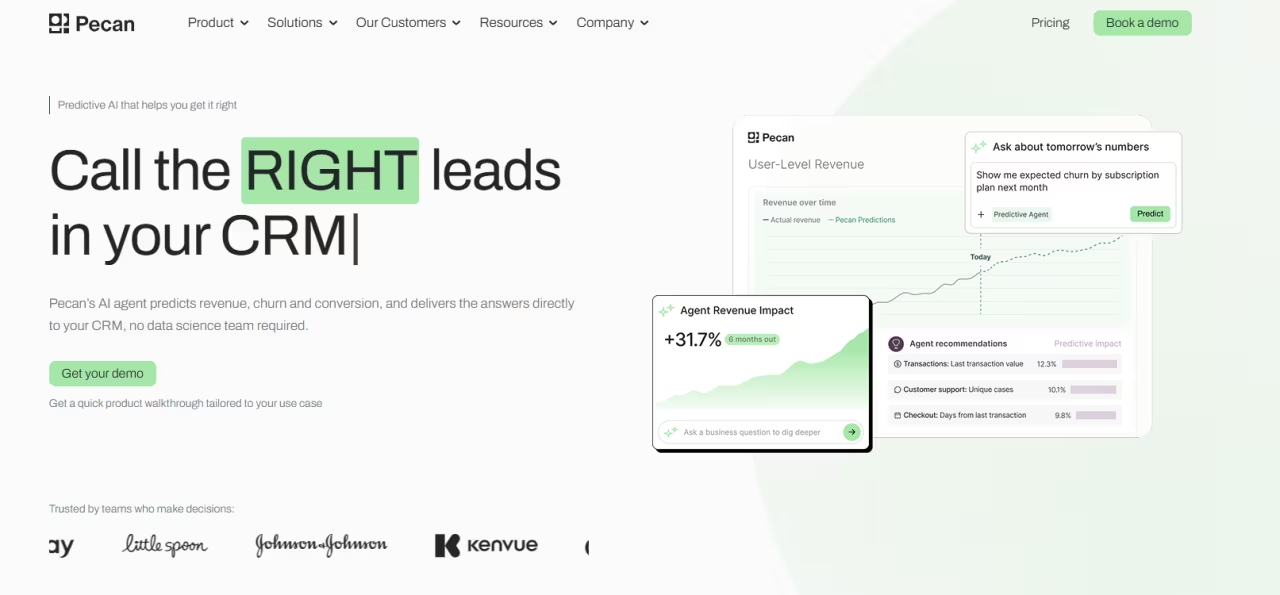
Pecan is the tool I point non-technical teams to first. You describe the business question (which customers will churn next quarter, which leads will convert), connect your data, and Pecan handles the data prep and model building behind a predictive AI agent. No notebooks, no feature engineering by hand.
The first stop for marketing, sales and ops teams that have CRM or product data but no data scientist. Starter is $760/month on an annual commitment, and it is opinionated, with per-batch pricing that makes high-frequency scoring expensive.
the Starter plan runs $760/month on an annual commitment, with 2 monthly prediction batches and 500M rows of storage. Team is $1,400/month for 10 batches and 2 billion rows. Business is custom. Extra prediction batches cost $50 each, and there are no setup fees (per Pecan's pricing page).
The standout: the predictive GenAI flow. You can describe what you want to predict in plain language and Pecan scaffolds the model, which genuinely lowers the barrier for teams that would otherwise never touch ML.
The catch: it's opinionated. You get good predictions fast, but you don't get the deep control a data scientist might want, and the per-batch pricing means high-frequency scoring gets expensive. It's a great fit for monthly or weekly forecasts, less so for real-time use cases.

Dataiku: the platform analysts grow into
Dataiku is what you buy when you expect predictive analytics to become a permanent function, not a one-off project. It pairs a visual flow (drag nodes, connect data, build pipelines) with full code support, so a business analyst and a Python data scientist can work in the same project without stepping on each other.
What you buy when predictive analytics will become a permanent function, with a visual flow plus full code support for teams that have at least one analyst today. It is overkill for a solo marketer, and the jump from the Free Edition to a paid contract is a real budget conversation.
there's a Free Edition you can run locally for up to 3 users, useful for prototyping but with no deployment, automation, or governance. Paid editions are custom-quoted and not published; third-party estimates put serious deployments well into five or six figures annually, with role-based licensing where builders cost far more than viewers. Confirm numbers with their sales team, since list pricing isn't on the Dataiku site.
The standout: the same project scales from a single analyst's experiment to a governed, monitored production model without migrating tools. That continuity is rare.
The catch: the free edition is genuinely limited, and the jump to a paid contract is a real budget conversation. This is overkill for a solo marketer who just wants a churn score. It earns its keep when multiple people collaborate on models that ship to production.
Alteryx Designer Cloud: automate the boring 80%
Most predictive projects die in data prep. Alteryx attacks that directly with more than 260 drag-and-drop building blocks for cleaning, blending, and transforming data, then layers predictive tools on top. If your problem is "my data lives in eight places and I waste days stitching it together," this is built for you.
Built for analysts who spend more time wrangling data than modeling it, with more than 260 building blocks for prep. Designer Cloud Professional starts around $4,950 per user per year, so seats add up, and modeling is less automated than AutoML.
Designer Cloud Professional starts around $4,950 per user per year, with a minimum of three named users, and Designer desktop lists near $5,195/user/year. It's annual-only, no monthly billing. Real-world contracts vary widely; transaction data shows a median around $27,000/year with heavy negotiation room (Vendr's marketplace data).
The standout: the data-prep-to-prediction workflow in one canvas. You can go from raw, messy sources to a scored output without leaving the tool or writing SQL.
The catch: the per-seat pricing adds up fast for a team, and the predictive modeling is solid but not as automated as a dedicated AutoML platform. You're paying mostly for the data engineering muscle, with prediction as a bonus.

DataRobot: enterprise AutoML with the MLOps attached
DataRobot is the heavyweight for organizations that need not just models but a full lifecycle: automated model building, deployment, monitoring, and governance. It races through dozens of algorithms, ranks them, and hands you a leaderboard, then helps you put the winner into production and watch it for drift.
The heavyweight for large enterprises with regulated or high-stakes models that need audit trails and ongoing monitoring. The self-service tier starts around $25,000/year, so it is wildly over budget for a small team.
there's a self-service tier from roughly $25,000/year, with full enterprise agreements commonly starting around $100,000/year and climbing based on prediction volume and deployment size (per Vendr). A 14-day free trial exists.
The standout: MLOps. The deploy-monitor-govern half of the platform is what justifies the price, because keeping a model accurate in production is harder than training it.
Where it falls short: the cost. For a small team this is wildly over budget, and the platform's depth means a learning curve. You buy DataRobot when model governance is a board-level concern, not when you want a quick forecast.
Qlik Predict: prediction where your dashboards already live
If your company already runs on Qlik dashboards, Qlik lets you add no-code machine learning and key-driver analysis right inside that BI layer. Analysts can build predictive models and run what-if scenarios without exporting data to a separate tool.
Makes sense only if you're already a Qlik shop, adding no-code ML and what-if analysis right where stakeholders read dashboards. AutoML is capable but not as deep as DataRobot, and pricing is quote-based on the Premium tier and above.
since March 2025 Qlik moved to capacity-based pricing, and AutoML/Qlik Predict features sit on the Premium tier and above. Exact numbers are quote-based, so you'll need to price it against your data volume (Qlik's pricing page).
The standout: zero context-switching. Predictions live next to the dashboards your stakeholders already read, which dramatically improves whether anyone acts on them.
The catch: it only makes sense if you're already a Qlik shop. Buying Qlik just for the predictive features would be backwards, and the AutoML is capable but not as deep as a specialist platform like DataRobot.

H2O.ai: open-source AutoML with an enterprise top end
H2O.ai is the pick for data scientists who want open-source foundations with an automated layer on top. The core H2O-3 engine is free and open, and Driverless AI automates feature engineering, algorithm selection, and hyperparameter tuning. It integrates with Python, R, Java, and Spark.
The pick for data science teams that want to start free with open-source H2O-3 and scale into Driverless AI later. You need real technical skill, and the gap to the paid enterprise tier is opaque until you talk to sales.
H2O-3 is free and open source. Driverless AI and the enterprise platform are custom-priced, typically starting in the several-thousand-dollars-per-year range depending on scale and support (feature overview here).
The standout: Driverless AI's automated feature engineering. It builds and tests transformations a human might never try, which often squeezes out accuracy gains on tabular data.
Where it falls short: you need real technical skill to get value. This is not a tool you hand to a marketer. The open core is excellent, but the gap to the paid enterprise tier (and its pricing) is opaque until you talk to sales.
Azure Machine Learning: cloud-native ML for teams already on Azure
Azure Machine Learning gives you AutoML, a designer canvas, and full MLOps on Microsoft's cloud. If your data and infrastructure already live in Azure, the integration story is hard to beat, and you only pay for the compute and storage you consume.
For engineering teams building production ML inside an existing Azure environment, with pay-as-you-go pricing and no fixed license. Costs can balloon on large training jobs, and outside Azure the appeal drops sharply.
pay-as-you-go. There's no surcharge on many compute types; you pay for the underlying VMs, storage, and related resources you use, with reserved capacity available for predictable workloads. A free account includes $200 of credit for 30 days (Microsoft's pricing details).
The standout: consumption pricing plus deep Azure integration. You can scale from a tiny experiment to a heavy training run and pay accordingly, without a fixed license.
The catch: the pay-as-you-go model is a double-edged sword. Costs are unpredictable and can balloon on large training jobs, and the platform assumes real engineering competence. Outside the Azure ecosystem, the appeal drops sharply.
IBM SPSS Statistics: the classic that still forecasts
IBM SPSS Statistics has been doing predictive work since long before "AI" was a marketing word, and that maturity shows. It handles regression, classification, time-series forecasting, and rigorous statistical testing, which is exactly why researchers and analysts in academia, healthcare, and government still rely on it.
Suited to researchers and analysts who need statistical rigor and defensible methodology over flashy automation. The Base subscription starts at $105/month, but it feels its age next to modern AutoML and is less suited to massive datasets.
the Base subscription starts at $105/month or $1,188/year, with Standard, Professional, and Premium editions running higher (up to a few thousand per year) as you add modules (IBM's pricing).
The standout: statistical depth and trust. When you need to explain and defend exactly how a forecast was produced, SPSS gives you the methodology to do it.
Where it falls short: it feels its age next to modern AutoML, and it's less suited to massive, messy, modern datasets. You choose SPSS for correctness and reproducibility, not for scale or automation.
scikit-learn + XGBoost: the free stack that beats half this list
I'd be lying if I left this out. For tabular prediction (churn, conversion, fraud, demand), a Python team using scikit-learn for preprocessing and XGBoost for the model will match or beat most commercial AutoML platforms, at zero software cost. XGBoost runs roughly 10x faster than scikit-learn's own gradient boosting and consistently wins on structured data (benchmark comparison).
For Python teams that want maximum accuracy and control without licensing fees, this free stack can match or beat most commercial AutoML on tabular data. There is no UI, governance or deployment out of the box, so the tool is free but the team is not.
free and open source. Your only cost is the engineers and the compute.
The standout: accuracy-per-dollar. Nothing on this list beats a well-tuned XGBoost model on tabular data for the price, which is exactly why so many Kaggle-winning solutions use it.
The catch: there's no UI, no governance layer, no deployment story out of the box. You're building everything yourself, which means you need real talent and time. The tool is free; the team is not.
If you want a broader picture of how these slot into a modern stack, our roundup of the best AI tools for business and the best AI agents cover adjacent ground worth scanning.
How to choose
Forget the feature matrices. Pick based on one variable: who builds and maintains the model.
No data scientist, business question now. Pecan or Qlik Predict (if you're already on Qlik). You trade control for a working prediction in days.
Analysts today, data team tomorrow. Dataiku or Alteryx. You want a platform that grows from visual workflows toward real code without a migration.
Large enterprise, models in production, governance matters. DataRobot or Azure Machine Learning. You're paying for deployment, monitoring, and audit trails, not just training.
You have Python engineers. scikit-learn plus XGBoost, with H2O.ai if you want automated feature engineering on top. The accuracy and the savings both favor you.
One honest warning: the most expensive mistake is buying an enterprise platform to solve a problem a $760/month tool (or a free library) would have handled. Match the tool to the team you actually have, not the team you wish you had.
If you're trying to keep up with which of these tools is worth your time as the market shifts, Dupple X tracks the AI tooling space so you don't have to read 40 vendor blogs a week.
FAQ
What is the best predictive analytics tool for a small business?
For a small business without a data scientist, Pecan AI is the strongest fit. Starting at $760/month, it builds predictive models from your existing CRM or product data through a no-code interface. If you're already running Qlik dashboards, Qlik Predict is a close second since it adds prediction without a new platform.
Do I need a data scientist to use predictive analytics software?
No, not anymore. Tools like Pecan AI, Qlik Predict, and Alteryx are built specifically so analysts and business users can build models without coding. That said, platforms like DataRobot, H2O.ai, and the open-source scikit-learn stack still deliver more control and accuracy in the hands of a real data team.
How much do predictive analytics tools cost?
It ranges enormously. Entry-level options like IBM SPSS start at $105/month, no-code platforms like Pecan run from $760/month, and per-seat tools like Alteryx start near $4,950/user/year. Full enterprise platforms such as DataRobot commonly begin around $25,000 to $100,000 per year. Open-source libraries like scikit-learn and XGBoost are free.
Is open-source predictive analytics good enough for business?
For tabular prediction problems (churn, conversion, demand, fraud), a well-tuned scikit-learn and XGBoost setup matches or beats most commercial AutoML platforms on accuracy, at no software cost. The trade-off is that you need Python engineers to build, deploy, and maintain it. The tool is free; the talent is the real expense.
What's the difference between predictive analytics and AI/machine learning tools?
Predictive analytics is the use case (forecasting a future outcome from historical data), while machine learning is the underlying method most modern tools use to do it. Every platform on this list runs on ML under the hood. The difference between them is how much of the modeling work is automated versus left to you.
Which predictive analytics tool is best for marketing teams?
Pecan AI leads here because it's purpose-built for non-technical teams predicting things like lead conversion, customer lifetime value, and churn. For marketers already living inside a BI tool, Qlik Predict keeps the predictions next to the dashboards stakeholders already read, which makes the insights far more likely to get acted on.
Related guides
Some offers on this page may be paid placements or contain affiliate links.
