
Best Real-Time Analytics Tools in 2026

Key facts8 tools compared: ClickHouse, Tinybird, PostHog, StarTree, Imply Polaris, RisingWave…
- 8 tools compared: ClickHouse, Tinybird, PostHog, StarTree, Imply Polaris, RisingWave, Materialize, Apache Druid
- ClickHouse (best for: Engineering teams serving fast analytics): $0.22/unit-hr cloud, free OSS
- Tinybird (best for: Shipping analytics APIs without ops): Free tier, $49/mo Developer
- PostHog (best for: Product/growth teams): 1M events/mo free
- StarTree (best for: User-facing apps at high QPS): $199/mo Dev, $999/mo Standard
"Real-time" is one of the most abused words in data. A dashboard that refreshes every five minutes gets called real-time. So does a system that answers a query over a billion rows in 40 milliseconds while events are still landing. Those are not the same thing, and picking the wrong tool for your actual need is how teams end up either paying for a distributed database they didn't need or watching a generic BI tool choke on live event data.
This guide compares tools against what real-time pipelines actually demand: ingesting clickstream data, wiring up user-facing dashboards, and holding latency under load. The honest takeaway is that the right tool depends entirely on whether you're an engineer serving sub-second queries to an app, or a product person who just wants to see what users are doing right now without hiring a data team.
If you want the short answer: for serving fast analytics to your own application, ClickHouse is the engine most teams are standing on in 2026. If you want that power without managing infrastructure, Tinybird is the fastest path. And if you're a product or growth team that wants real-time user analytics today, PostHog gets you there this afternoon. Here's the full breakdown.
Quick comparison
| Tool | Best for | Price | Standout |
|---|---|---|---|
| ClickHouse | Engineering teams serving fast analytics | $0.22/unit-hr cloud, free OSS | Raw query speed on huge tables |
| Tinybird | Shipping analytics APIs without ops | Free tier, $49/mo Developer | ClickHouse + instant REST endpoints |
| PostHog | Product/growth teams | 1M events/mo free | Real-time product analytics out of the box |
| StarTree | User-facing apps at high QPS | $199/mo Dev, $999/mo Standard | Managed Apache Pinot, low-latency concurrency |
| Imply Polaris | Operational dashboards on event data | $500 credits, usage-based | Managed Apache Druid |
| RisingWave | Streaming transformations in SQL | Free OSS, usage-based cloud | Postgres-compatible streaming database |
| Materialize | Incremental views on live data | Usage-based | Standard SQL on streams |
| Apache Druid | Self-hosted time-series OLAP | Free OSS | Battle-tested at huge scale |
ClickHouse
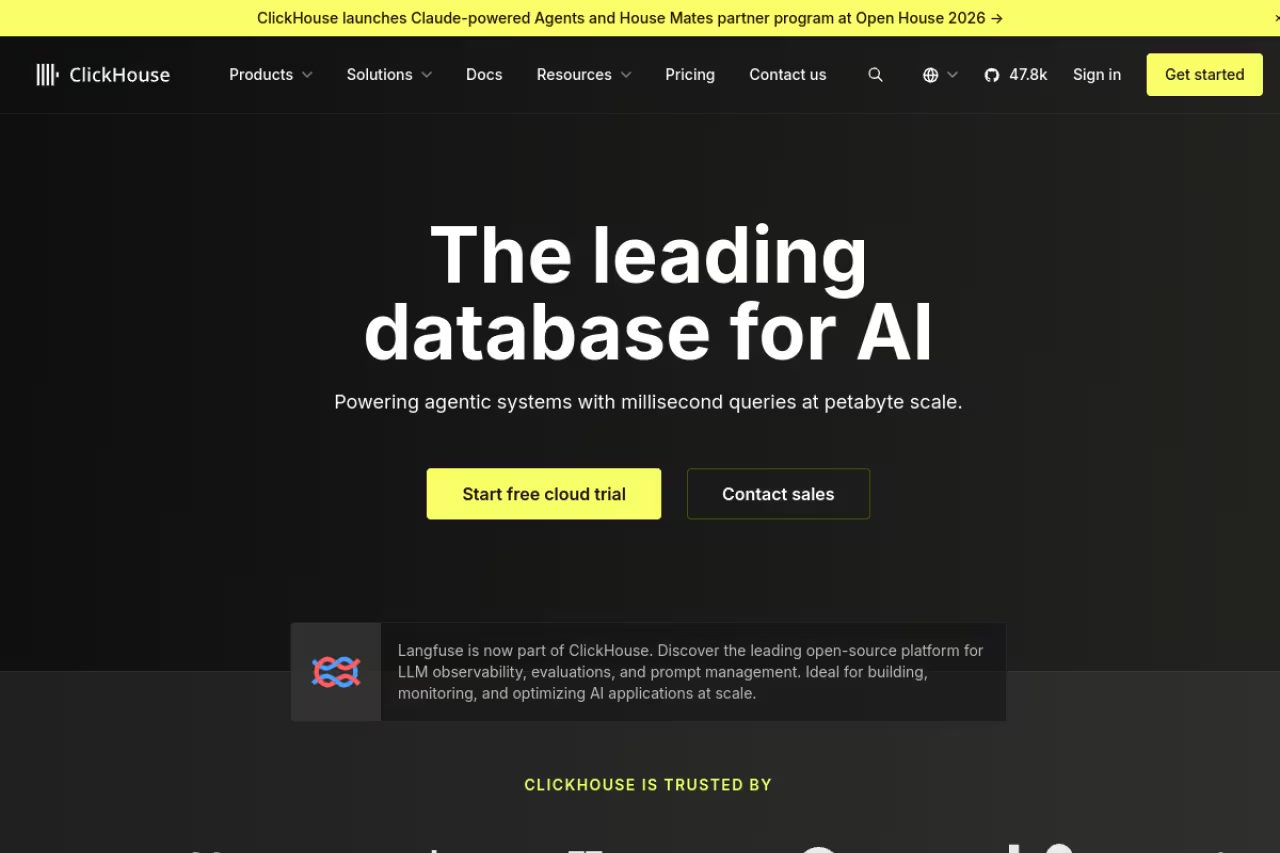
ClickHouse is the column-oriented OLAP database that quietly became the default answer for "we need analytics queries to be fast." It scans hundreds of millions of rows per second on a single node, and it's the engine underneath a surprising number of the other products on this list.
The raw-speed choice for engineering teams that want to own their stack, and usually the next stop when analytics queries time out on Postgres. It is a database, not a product, so you build ingestion, API and dashboards yourself.
If your analytics queries are timing out on Postgres, ClickHouse is usually the next stop.
On pricing, the open-source version is free and genuinely production-grade. ClickHouse Cloud runs on usage-based compute: roughly $0.22 per unit-hour on Basic, scaling to about $0.29 on Scale and $0.39 on Enterprise, with storage at around $25 per TB per month (ClickHouse pricing). A small Basic service can sit near $66/month at light usage; Scale deployments with multi-replica autoscaling start closer to $500/month. There's a 30-day trial with $300 in credits but no permanent free tier on Cloud.
The standout is benchmark performance. On ClickBench-style workloads it's commonly 3-8x faster than Druid on complex analytical queries, which is why so many teams build on it directly.
The catch: ClickHouse is a database, not a product. You get blazing queries and nothing else. No ingestion layer, no API, no dashboard. You're writing the surrounding system yourself, and operating a self-hosted cluster (sharding, replication, merges) is real work. That gap is exactly what the next two tools fill.

Tinybird
Tinybird wraps ClickHouse in everything ClickHouse leaves out. You stream events in, write SQL transformations, and publish each query as a versioned REST API endpoint. No cluster to manage, no serving layer to build.
This is the right pick if you're a developer who wants to ship a real-time analytics feature (a usage dashboard, a leaderboard, live metrics inside your product) without becoming a database administrator. You go from event to live API in an afternoon.
Pick Tinybird if you are a developer shipping a real-time analytics feature and do not want to become a database administrator. You go from event to live API in an afternoon, but you pay a premium over running ClickHouse yourself.
Pricing is refreshingly clear. The free plan gives you 0.25 vCPUs, 10GB storage, and 1,000 requests/day with no credit card and no time limit (Tinybird pricing). The Developer plan is $49/month for 0.5 vCPUs, 25GB, and unlimited requests, with vCPU overages billed per second. The SaaS and Enterprise tiers move to custom pricing with up to 32+ vCPUs and dedicated support.
The standout is the developer workflow. Defining a query, getting a documented endpoint with parameters, and versioning it like code removes the part of real-time analytics that usually eats a sprint.
Where it falls short: you're paying a premium over running ClickHouse yourself, and at very high volume that gap grows. If you have the ops muscle and the scale to justify it, self-hosting can be cheaper. Tinybird is buying you speed-to-market, which for most teams is the right trade.

PostHog
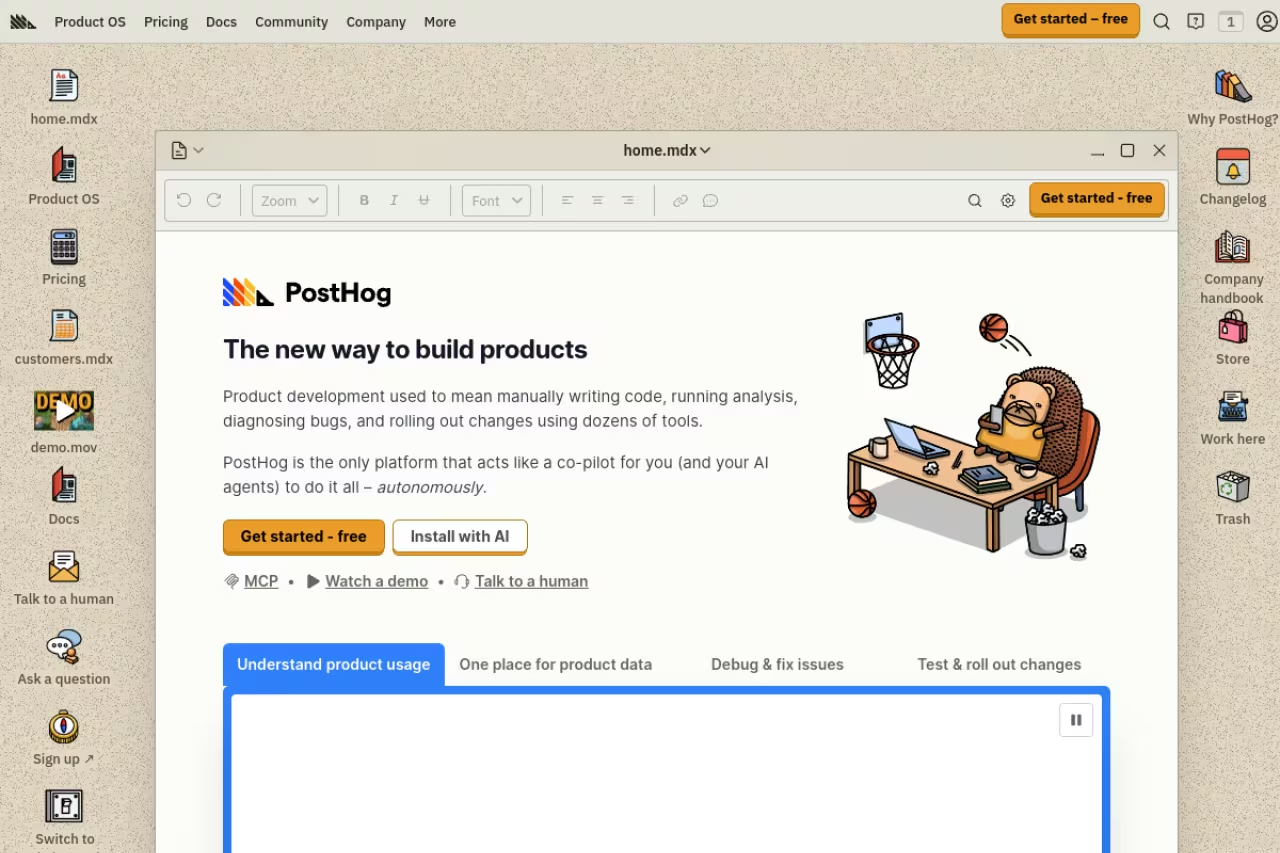
PostHog is the one tool here you can hand to a non-engineer. It's an all-in-one product analytics platform: event tracking, funnels, session replay, feature flags, web analytics, and dashboards that update in real time, all from one SDK.
It's best for product, growth, and founding teams who want to see what users are doing right now without building any infrastructure. If your question is "did the new onboarding flow change activation" rather than "can I serve 10,000 queries per second," PostHog is the answer.
The free tier is generous: 1 million events per month, 5,000 session recordings, and 1 million feature flag requests, with no credit card (PostHog pricing). After that it's pure usage: $0.00005 per event from 1-2M, dropping to $0.0000343 from 2-15M, and continuing down to $0.000009 at 250M+ events. Each product is billed separately, so you only pay for what you use.
The standout is breadth. Most teams buy four tools to get what PostHog bundles, and the open-source roots mean you can self-host if data residency matters. For a deeper category look, see my guide to the best product analytics tools.
The catch: at high event volume those per-event fractions add up, and bills can surprise you once you turn on replays, logs, and AI observability together. It's also not built to serve analytics back into your own application at sub-second latency. That's a different job, handled by the engines above.
The one tool here you can hand to a non-engineer, built for product, growth and founding teams who want to see what users do right now. The free tier is generous, but per-event bills can surprise you and it cannot serve analytics back into your app at sub-second latency.
If you're standing up a modern data and analytics stack and want a second opinion on tooling decisions, Dupple X gives our subscribers ongoing access to the playbooks and tool picks we use internally.
StarTree
StarTree is the managed cloud built on Apache Pinot, the OLAP database LinkedIn created for user-facing analytics. Where ClickHouse optimizes for raw scan speed, Pinot optimizes for serving thousands of concurrent low-latency queries, which is what you need when analytics live inside a product used by millions.
Go with StarTree for user-facing dashboards at high concurrency, where answers must arrive in tens of milliseconds under heavy load. The managed layer is nearly mandatory given Pinot's heavy architecture, and it is overkill for internal BI.
StarTree Cloud comes in three packages. The Development package is $199/month (billed annually) with burstable compute and 100GB storage. Standard is $999/month for five compute units, 1TB, multi-AZ, and a 99.9% uptime SLA. Premium is $3,999/month for fifteen units, 3TB, and BYOC options (StarTree pricing details).
The standout is concurrency. Pinot routinely returns results in tens of milliseconds even when query volume is brutal, which is exactly where simpler setups fall over.
Where it falls short: Apache Pinot's self-hosted architecture is genuinely heavy (multiple node types plus ZooKeeper), so the managed StarTree layer is almost mandatory unless you have a dedicated platform team. And for internal BI rather than user-facing apps, it's overkill.

Imply Polaris
Imply Polaris is the managed cloud for Apache Druid, another veteran real-time OLAP engine built for slicing event and time-series data with low latency and high availability. Druid has powered operational dashboards at scale for years; Polaris makes it consumable without running the cluster yourself.
A fit for teams that need real-time operational dashboards over event streams, where Druid's maturity with time-series rollups shines. ClickHouse-based options have taken mindshare and pricing is less transparent, so model your ingest volume first.
Pricing is usage-based on compute (hourly), data ingested, and storage, with Druid's heavy compression (often 90%+) keeping project size down. New signups get $500 in credits over 30 days, with Starter projects offering 25GB capacity and Standard projects split into high-performance (A-Series) and cost-optimized (D-Series) tiers (Imply Polaris pricing).
The standout is Druid's maturity for time-series rollups and high-availability ingestion. For the specific shape of work it was designed for, it's hard to beat.
The catch: Druid and Pinot occupy similar ground, and ClickHouse-based options have eaten a lot of their mindshare on raw analytical workloads. Pricing is also less transparent than Tinybird's, so you'll want to model your ingest volume before committing.

RisingWave
RisingWave approaches real-time from the other direction. It's a streaming database: instead of querying data after it lands, you define materialized views in SQL that update incrementally as events flow through. It's Postgres-wire-compatible, written in Rust, and stores state on S3 for elastic scaling.
Choose RisingWave if you want SQL transformations on streams without standing up Flink plus a separate serving database. Postgres compatibility is the draw, but streaming databases are a younger category with a thinner ecosystem and a weaker fit for ad-hoc queries.
It fills the gap between Flink (process only) and Postgres (serve only) by doing both.
RisingWave is open source under Apache 2.0, so the core is free to self-host. The managed cloud is usage-based; pricing scales with compute and isn't published as flat tiers, so plan to talk to them for production sizing. The company's benchmarks show it beating Flink on 22 of 27 Nexmark queries (RisingWave streaming database guide).
The standout is the Postgres compatibility. If your team already speaks SQL, you skip the steep Flink learning curve entirely and keep cascading materialized views fresh automatically.
Where it falls short: streaming databases are still a younger category than OLAP engines, the ecosystem is thinner, and you're committing to a newer architectural pattern. It's a strong fit when continuous transformation is the core need, less so for ad-hoc exploratory queries.

Materialize
Materialize is the other serious streaming-SQL contender. It maintains incrementally updated materialized views over live data, connecting to sources like Kafka, Postgres CDC, and S3, and lets you query, join, and transform with standard SQL plus strict serializability guarantees.
The streaming-SQL pick when correct, always-fresh views matter as much as speed, as with fraud signals, live inventory or alerting. Strict serializability is rare and valuable, but it is a newer paradigm with a smaller community and a commercial model.
Fraud signals, live inventory, and operational alerting are typical fits.
Materialize is a usage-based managed cloud and doesn't publish simple flat tiers, so you'll size it with their team. The architecture separates storage and compute and supports workload isolation, which keeps a heavy analytical query from starving your serving path.
The standout is consistency. Strict-serializability means the answer you get reflects a coherent snapshot of the data, which is rarer in streaming systems than you'd hope and matters a lot for anything financial.
The catch: like RisingWave, it's a newer paradigm with a smaller community, and it overlaps enough with RisingWave that picking between them comes down to your consistency needs and licensing preferences (RisingWave's Apache 2.0 core versus Materialize's commercial model).

Apache Druid
Apache Druid deserves a standalone mention because plenty of teams still run it self-hosted. It's the open-source real-time OLAP database designed for low-latency slice-and-dice over event data, with sub-second queries at high concurrency and a long track record at companies pushing serious scale.
For organizations with a platform team that wants full control and no per-vendor cloud bill. It has proven scale, but it is the heaviest operational lift here, so without the in-house expertise a managed option gets you most of the value.
It's free and open source. The cost is operational: Druid relies on five or six distinct node types (brokers, historicals, middle managers, coordinators) plus ZooKeeper, so running it well is a real commitment.
The standout is proven scale. Druid has handled some of the largest real-time analytics workloads in production for years, and the architecture is well understood.
Where it falls short: that same architecture is the heaviest operational lift here. Unless you have the team for it, a managed option (Imply, or a ClickHouse-based stack) gets you most of the value with a fraction of the babysitting.
How to choose
Start with one question: who consumes the analytics?
If a human looks at a dashboard occasionally, you don't need any of the OLAP engines. A product analytics tool like PostHog, or a BI layer over a normal warehouse, is plenty. Don't deploy a distributed database to answer questions you ask twice a day.
If your own application serves the analytics back to users, latency and concurrency decide it. For raw query speed where you control the stack, ClickHouse. To skip the ops, Tinybird. For very high concurrency in user-facing features, StarTree (Pinot). For time-series-heavy operational dashboards, Imply (Druid).
If the core job is continuously transforming streams (not querying them after the fact), you're in streaming-database territory: RisingWave if you want Postgres compatibility and open source, Materialize if strict consistency is non-negotiable.
And weigh the ops budget honestly. Self-hosting ClickHouse or Druid is cheaper per query at scale but costs you engineers. Managed platforms cost more in dollars and far less in headcount. For most teams under a certain size, the managed path wins on total cost. If you're also evaluating the layers around this, my guides to the best ETL tools and best observability platforms cover the rest of the stack.
FAQ
What is the best real-time analytics tool in 2026?
For engineering teams serving fast analytics to an application, ClickHouse is the most widely adopted engine, and Tinybird is the easiest managed way to use it. For product and growth teams who want real-time user analytics with no infrastructure, PostHog is the best starting point. The "best" tool depends on whether you're serving queries to software or to people.
What's the difference between real-time analytics and a streaming database?
Real-time OLAP databases (ClickHouse, Druid, Pinot) query data after it lands, very fast, often within seconds of ingestion. Streaming databases (RisingWave, Materialize) compute results continuously as events flow through, keeping materialized views fresh by the moment. Use OLAP for fast ad-hoc queries; use a streaming database for continuous transformations.
Is ClickHouse free to use?
Yes. ClickHouse is open source and free to self-host in production. ClickHouse Cloud is a paid managed service with usage-based pricing (roughly $0.22 per compute unit-hour on Basic plus storage), with a 30-day trial of $300 in credits but no permanent free tier on the hosted version.
Do I need a real-time database for product analytics?
Usually not. If you want to track user behavior, funnels, and feature adoption, a product analytics tool like PostHog handles real-time updates without any database work. You only need a dedicated real-time OLAP or streaming database when you're serving analytics back into your own product at high concurrency or low latency.
Which real-time analytics tool is cheapest to start with?
PostHog (1 million events per month free) and Tinybird (free tier with 10GB storage, no time limit) both let you start at zero cost. For self-hosting, ClickHouse, Apache Druid, and RisingWave are open source and free if you have the team to run them.
Ready to put a real-time stack to work? Start a Dupple X yearly trial and get our ongoing tool teardowns, or browse our top tools directory to compare the full field.
Related guides
Some offers on this page may be paid placements or contain affiliate links.
