
Best AI Inventory Forecasting Tools (2026)

Key facts8 tools compared: Prediko, Inventory Planner, Cogsy, Netstock, GMDH Streamline, Flowlity…
- 8 tools compared: Prediko, Inventory Planner, Cogsy, Netstock, GMDH Streamline, Flowlity, ToolsGroup, Lokad
- Prediko (best for: Shopify DTC brands): From $49/mo
- Inventory Planner (best for: Multichannel ecommerce): From ~$120/mo
- Cogsy (best for: DTC cashflow planning): $199/mo
- Netstock (best for: SMBs on an ERP): Custom quote
Stockouts and overstock are the two ways inventory quietly eats your margin. One sends customers to a competitor. The other ties up cash in a warehouse you're paying rent on. The whole job of an inventory forecast is to keep you out of both ditches, and for years most teams did it with a spreadsheet, a gut feeling, and a prayer.
AI changed the math. Modern forecasting tools read your sales history, seasonality, lead times, and promotions, then predict demand at the SKU level and tell you exactly what to reorder and when. McKinsey has found AI-driven forecasting can cut errors by 20 to 50 percent over manual methods, and Gartner expects 70 percent of large organizations to adopt AI-based forecasting by 2030.
I compared the main players across the price spectrum, from $49/month Shopify apps to enterprise platforms that need a six-week implementation, using each vendor's pricing page, documentation, and public user reviews. If you run a DTC brand on Shopify, my top pick is Prediko. It's the fastest to value and priced for brands that aren't ready to talk to an enterprise sales rep. But the right tool depends entirely on where you sell and how complex your supply chain is, so here's the full breakdown.
Quick comparison
| Tool | Best for | Price | Standout |
|---|---|---|---|
| Prediko | Shopify DTC brands | From $49/mo | AI replenishment built into Shopify |
| Inventory Planner | Multichannel ecommerce | From ~$120/mo | Open-to-buy + deep integrations |
| Cogsy | DTC cashflow planning | $199/mo | What-if scenario modeling |
| Netstock | SMBs on an ERP | Custom quote | Widest ERP integration list |
| GMDH Streamline | Manufacturers + distributors | From ~$100/mo | Forecast tied to production |
| Flowlity | Mid-market supply chains | Custom quote | Probabilistic AI forecasts |
| ToolsGroup | Enterprise multi-echelon | Custom quote | Probabilistic + agentic AI |
| Lokad | Complex, huge-SKU operations | Custom quote | Programmable optimization |
Prediko: the fastest path for Shopify brands
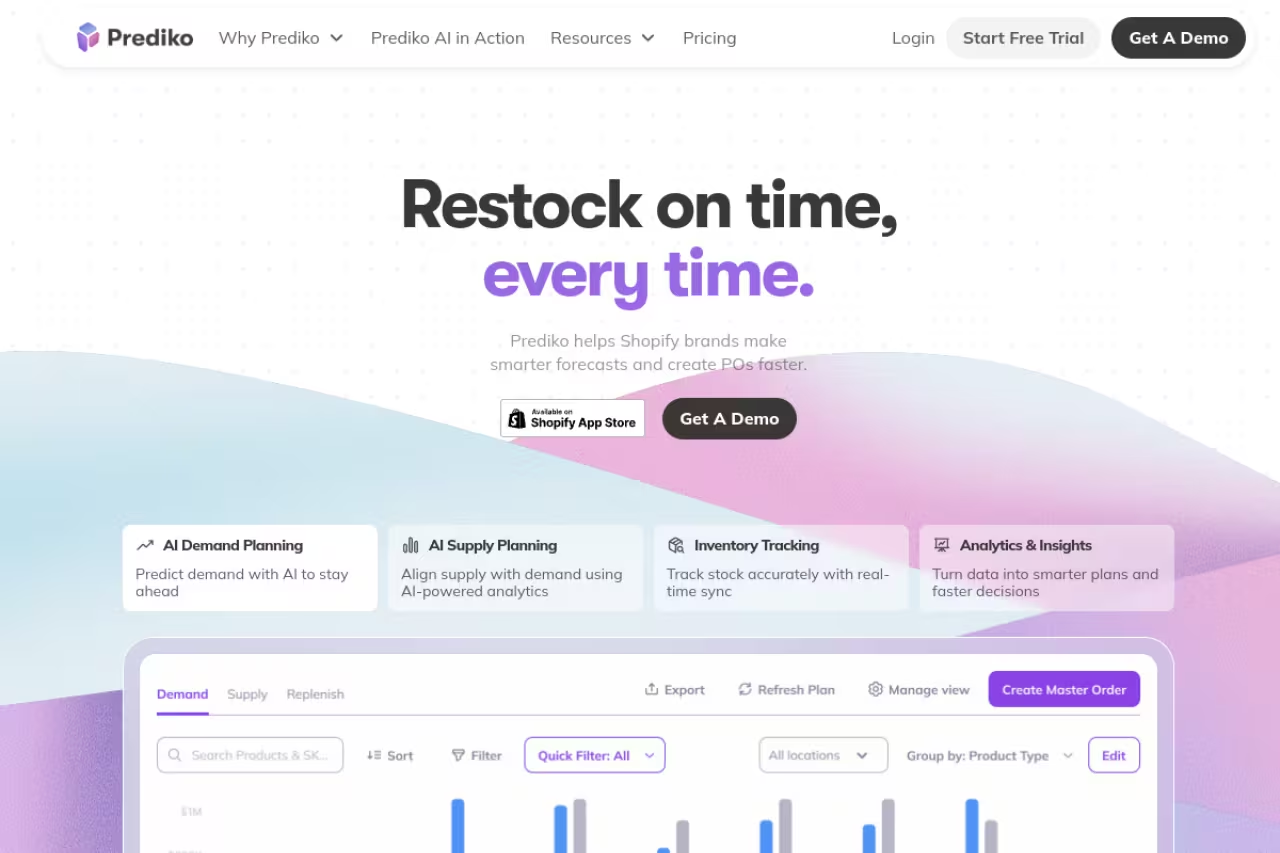
Prediko is built for one job: helping Shopify DTC brands forecast demand and reorder without drowning in spreadsheets. It syncs with your store in real time, predicts revenue and units per SKU, and turns those forecasts into purchase orders you can fire off in a few clicks. The AI replenishment recommendations are the part you actually use day to day, flagging what's about to run out and what's overstocked.
Who it's best for: ecommerce brands doing anywhere from $100k to $50m in GMV that live inside Shopify and want forecasting without hiring a planner.
The fastest route for Shopify-native brands doing $100k to $50m in GMV that want forecasting without hiring a planner. Setup is quick and pricing starts at $49/month, but accuracy suffers if meaningful revenue comes from Amazon, retail, or wholesale.
Pricing is refreshingly transparent for this category. Plans start at $49/month for stores under $100k GMV and scale with your revenue. Every tier includes unlimited users, SKUs, and purchase orders, plus a dedicated success manager and a private Slack channel. There's a 14-day full-featured trial, and a $20/month add-on covers raw materials and bills of materials if you manufacture.
The standout is how little setup it needs. You connect Shopify, it pulls your history, and you're forecasting the same day. For a category where "implementation" usually means a kickoff call and a Gantt chart, that's rare.
The catch: it's Shopify-first. If a meaningful share of your revenue comes from Amazon, retail, or wholesale channels Prediko doesn't pull in, you'll lose forecast accuracy on those streams. It's the right tool for Shopify-native brands, not omnichannel operations with heavy offline sales.
Inventory Planner by Sage: the multichannel workhorse
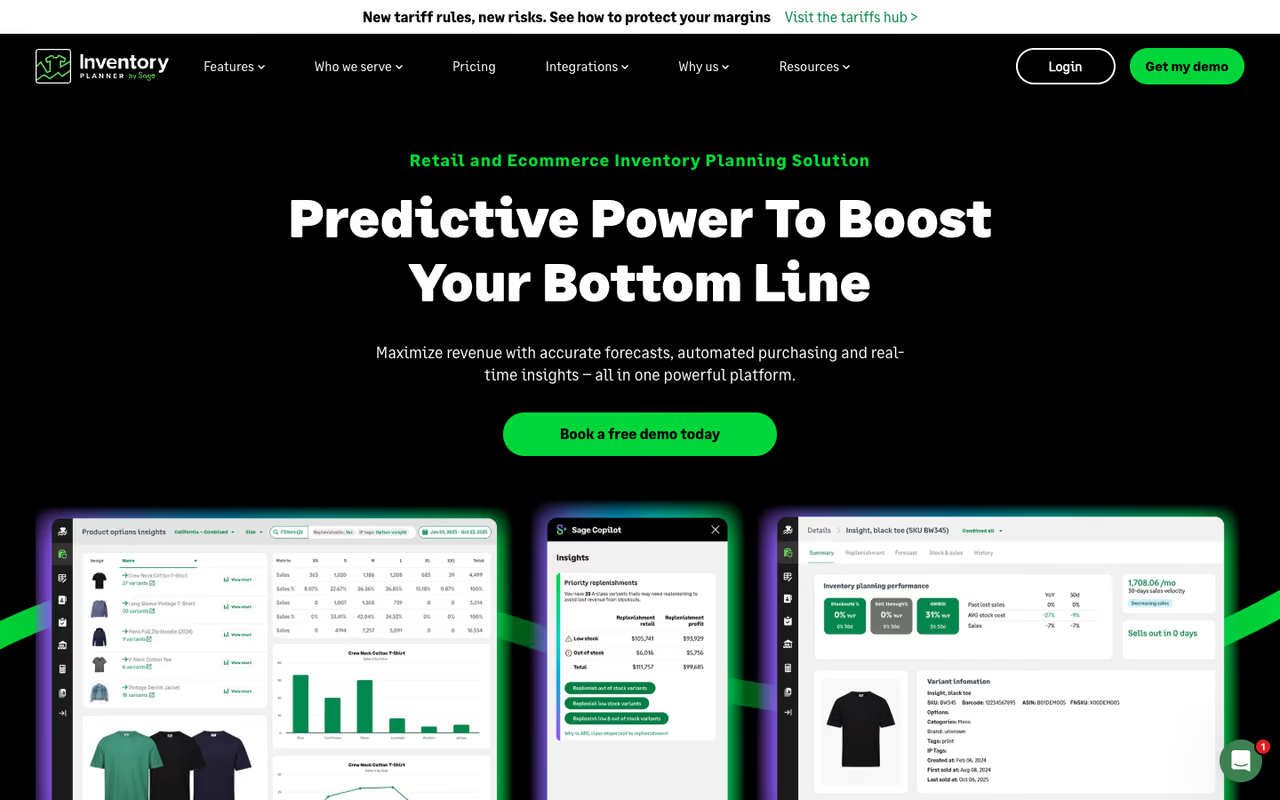
Inventory Planner by Sage is the tool I'd reach for when "ecommerce" means more than one storefront. It connects to Shopify, Amazon, WooCommerce, eBay, and BigCommerce, plus ERP and 3PL systems like NetSuite, Cin7, ShipBob, and Microsoft Dynamics 365. It serves over 2,600 brands and has been a default in the DTC world for years.
Who it's best for: established multichannel retailers selling across several platforms who need one forecast that accounts for all of them.
The multichannel workhorse for established retailers selling across several platforms that need one forecast covering all of them. Open-to-buy planning is the standout, but the dense interface and revenue-based pricing make it overkill for a small single-channel store.
Pricing isn't fully public and scales with your annual revenue, with the main product reported to start around $245/month. Sage also launched Inventory Planner Essentials, a stripped-down version for single-warehouse Shopify merchants at around $120/month. You request a quote for the full platform.
The standout is open-to-buy planning. Instead of just telling you what to reorder, it helps you plan a purchasing budget against forecasted demand, which is how real merchandising teams think. The forecasting also factors in seasonality, marketing activity, and abnormal sales spikes rather than just drawing a line through past sales.
Where it falls short: the depth comes with a learning curve. New users routinely describe the interface as dense, and the revenue-based pricing can climb fast as you grow. It's overkill for a small single-channel store, which is exactly why Sage built the Essentials tier.
Cogsy: scenario planning for cash-strapped DTC brands
Cogsy approaches forecasting from the CFO's chair. It forecasts demand up to 12 months out, but its real personality is "what-if" modeling: you can run best-case, worst-case, and most-probable inventory scenarios before you commit a dollar to a purchase order. It connects inventory decisions directly to cash flow, which is the number that actually keeps DTC founders up at night.
Who it's best for: growing Shopify and Amazon brands where capital is tight and every reorder is a real financial bet.
A smart pick for growing Shopify and Amazon brands where capital is tight and every reorder is a financial bet. Scenario planning tied to cash impact is excellent at a flat $199/month, though that stings when you're tiny and the integration list is narrower.
Pricing is a flat $199/month with a free trial. It integrates with Shopify, Amazon, ShipBob, and Fulfil, and it carries a 4.9-star rating on the Shopify App Store. The marketing event calendar is a nice touch, letting you adjust forecasts around planned promotions instead of getting blindsided by your own sale.
The standout is that scenario engine. Most tools give you a single number. Cogsy gives you a range and ties each path to the cash impact, which is far more honest about how uncertain demand actually is.
The catch: the flat price is great until you're tiny, where $199/month stings, or huge, where you'll outgrow the feature set. Its integration list is also narrower than Inventory Planner's, so unusual channels or a custom ERP can leave gaps.
Netstock: built for SMBs already on an ERP
Netstock is the answer when your inventory already lives in an ERP and you want AI forecasting bolted on top. It claims the widest range of ERP integrations on the market, connecting to NetSuite, Sage, Acumatica, Microsoft Dynamics, SAP Business One, Cin7 Core, SYSPRO, and more. It serves 2,400+ customers across 67 countries.
Who it's best for: mid-market manufacturers, wholesalers, and distributors running a real ERP who need forecasting, ordering, and S&OP in one layer.
The answer for mid-market manufacturers, wholesalers, and distributors already running an ERP that want forecasting bolted on top. Its ERP support is the broadest, but it is quote-only, slower to start, and the wrong shape for a Shopify brand without an ERP.
Pricing is quote-only. Netstock points you to an ROI calculator rather than a price list, which tells you it's sold by conversation, not credit card. Budget accordingly.
The standout is the breadth of ERP support. If your business runs on something like SYSPRO or Acumatica that the Shopify-native tools ignore entirely, Netstock probably plugs straight in. It also surfaces what it calls the "critical 10%" of inventory decisions teams miss, which is a sane way to prioritize a planner's attention.
Where it falls short: it's not an ecommerce app, so if you're a Shopify brand without an ERP, it's the wrong shape. The need to talk to sales and run a proper onboarding also makes it slower to start than the DTC tools above.
GMDH Streamline: forecasting tied to production
GMDH Streamline sits at the intersection of demand planning and manufacturing. It uses statistical models and machine learning on your sales history, then connects the forecast directly to production scheduling and automatic replenishment. That production link is what sets it apart from the pure ecommerce tools.
Who it's best for: manufacturers and distributors who need demand forecasts to drive a production schedule, not just a reorder list.
Choose it if you're a manufacturer or distributor whose demand forecast must drive a production schedule, not just a reorder list. Entry pricing in the $100 to $500 range is reachable, but the interface is functional over pretty and needs clean data first.
Pricing typically starts in the $100 to $500 range depending on users and modules, with enterprise plans quoted on request. That puts the entry point within reach of smaller manufacturers, which is uncommon for production-aware planning software.
The standout is how it ties demand to supply. For a business making goods rather than just reselling them, a forecast that doesn't account for production capacity is half a forecast. Streamline closes that loop.
The catch: it's desktop-rooted in feel and aimed at operations people, not marketers. The interface is functional over pretty, and getting full value means cleaning up your data first. This is a tool for people who already think in lead times and reorder points.
Flowlity: probabilistic forecasting for mid-market teams
Flowlity leans hard into AI. Instead of producing a single demand number, it generates probabilistic forecasts with confidence ranges and uses demand sensing to adjust in real time as signals change. The company says it automates up to 95 percent of planning tasks while keeping planners in control, and reports inventory reductions of up to 60 percent for some customers.
Who it's best for: mid-market supply chain teams in retail, distribution, or manufacturing who want serious AI without an enterprise-scale commitment.
A fit for mid-market supply chain teams in retail, distribution, or manufacturing wanting serious AI without an enterprise-scale commitment. Probabilistic forecasts help set safety stock to real risk, but the confidence-band output takes a mindset shift and clean connected data.
Pricing is quote-based. Like most tools at this level, you'll book a demo and get a number tied to your scope.
The standout is the probabilistic approach. By giving you a range of likely outcomes instead of one false-precision figure, Flowlity helps you set safety stock that matches actual risk. The newer pricing and promotions module, which simulates how a promo will hit sales and margins, is a useful bonus for teams that run frequent deals.
Where it falls short: probabilistic forecasting is a mindset shift. Teams used to a single number sometimes find the confidence-band output harder to act on at first, and the value depends on feeding it clean, connected data. It's not a plug-and-play Shopify app.

ToolsGroup: enterprise multi-echelon planning
ToolsGroup is built for the hard stuff: global, multi-echelon supply chains with SKU proliferation and intermittent demand. Its SO99+ engine combines probabilistic demand forecasting with machine learning automation, and the company has been pushing agentic AI that runs scenarios and recommends actions rather than just tuning parameters.
Who it's best for: large enterprises and complex distributors managing inventory across many locations and tiers.
The right answer for large enterprises and complex distributors managing inventory across many locations and tiers, with multi-echelon optimization done well. It is heavy machinery with quote-only pricing, and a small brand would never use a fraction of it.
Pricing is enterprise and quote-only. This is a platform you buy with a project plan and a budget line, not a free trial.
The standout is multi-echelon optimization. When inventory sits across warehouses, distribution centers, and stores that all feed each other, getting the math right at every tier is genuinely hard, and ToolsGroup is one of the few that does it well. Customers commonly report 15 to 30 percent reductions in inventory holding costs.
The catch: this is heavy machinery. The implementation, the cost, and the learning curve all assume a dedicated supply chain team. A small brand would never use a fraction of it. It's the right answer at scale and the wrong one below it.

Lokad: programmable optimization for the complex
Lokad is the most unusual tool here. Rather than a fixed-feature app, it gives you a platform and a specialized language called Envision to build forecasting and optimization logic tailored to your exact business. It produces probabilistic forecasts and optimizes for business outcomes like profit, not just forecast accuracy, and it's designed to handle hundreds of millions of SKUs.
Who it's best for: large or unusual operations whose supply chain doesn't fit a standard template, with the technical resources to build a custom model.
For large or unusual operations with the technical resources to build custom models in its Envision language, it offers flexibility and control nothing else matches. It is not self-serve, so most brands will find it overkill.
Pricing is consultative and project-based. You're effectively hiring a platform plus expertise to encode your decisions.
The standout is total flexibility. If your business has quirks that off-the-shelf tools can't express, Lokad can model almost anything, from staggered lead times to multi-sourcing rules to weird seasonality. Its joint optimization of forecasting, ordering, and pricing in one model is something the modular tools simply can't match.
Where it falls short: this is not self-serve. You need people who can think in code and probability, and the time to build. For most brands that's overkill, but for genuinely complex operations it's a level of control nothing else offers.
If your team is also evaluating broader automation, our roundup of the best AI agents covers tools that handle planning and ops workflows beyond inventory. And if you want to keep up with what's launching every week, Dupple X tracks the new AI tools worth your attention so you don't have to.
How to choose
Forget the feature checklists for a second. Three questions get you 90 percent of the way:
Where do you sell? If it's mostly Shopify, start with Prediko or Cogsy. Multichannel ecommerce points to Inventory Planner. If your data lives in an ERP, look at Netstock first.
Do you make things or just resell them? Manufacturers need a forecast tied to production, which moves GMDH Streamline, Flowlity, ToolsGroup, and Lokad up the list. Pure resellers can stay in the ecommerce lane.
How complex is your network? A single warehouse and a few hundred SKUs needs a simple app. Inventory spread across many locations that feed each other needs multi-echelon optimization, and that's enterprise territory: ToolsGroup or Lokad.
The honest advice: don't buy more than you'll use. A $49/month Shopify app that you actually run beats a six-figure enterprise platform that sits half-implemented. Match the tool to your real complexity today, not the scale you hope to hit in three years. You can browse more options in our directory of top AI tools if none of these fit cleanly.
Start with a free trial wherever one exists, load a few months of your real sales history, and check whether the forecast matches what you already know about your business. If it can't predict last quarter, it won't predict next one. Want a weekly shortlist of new tools like these landing in your inbox? Dupple X does exactly that.
FAQ
What is the best AI inventory forecasting tool in 2026?
For Shopify DTC brands, Prediko is the strongest all-around pick: it's fast to set up, transparently priced from $49/month, and built specifically for ecommerce reordering. For multichannel retailers, Inventory Planner by Sage is the deeper choice, and enterprises with complex networks should look at ToolsGroup or Lokad. The "best" tool depends on where you sell and how complex your supply chain is.
How much do AI inventory forecasting tools cost?
Prices range widely. Shopify-focused apps like Prediko start at $49/month and scale with revenue, while Cogsy is a flat $199/month. Inventory Planner by Sage starts around $120/month for its Essentials tier and climbs with annual revenue. Enterprise platforms like Netstock, ToolsGroup, Flowlity, and Lokad are quote-only and typically run into five or six figures a year.
Does AI actually improve forecast accuracy?
Yes, when fed good data. McKinsey research suggests AI-driven forecasting can reduce errors by 20 to 50 percent versus manual methods, and Gartner expects most large organizations to adopt it by 2030. The gains come from analyzing far more signals than a human can, including seasonality, promotions, and lead times, at the SKU level. But accuracy still depends on clean, connected sales history.
Do I need an AI forecasting tool if I use Shopify's built-in reports?
Shopify's native reports tell you what already sold; they don't predict future demand or generate reorder recommendations. A dedicated tool like Prediko or Cogsy forecasts at the SKU level, accounts for lead times and seasonality, and tells you what to buy and when. If you're regularly hitting stockouts or sitting on dead stock, the built-in reports aren't enough.
What's the difference between demand forecasting and inventory optimization?
Demand forecasting predicts how much you'll sell. Inventory optimization decides how much to hold and order to meet that demand at the lowest cost and risk, accounting for lead times, safety stock, and supplier reliability. The best tools do both: a forecast is only useful if it turns into a smart purchase order, which is why replenishment recommendations matter as much as the forecast itself.
Related guides
Some offers on this page may be paid placements or contain affiliate links.
