
The 8 Best AI Anomaly Detection Tools (2026)

Key facts8 tools compared: Datadog Watchdog, Dynatrace Davis, Nixtla TimeGPT, New Relic AI, Grafana ML…
- 8 tools compared: Datadog Watchdog, Dynatrace Davis, Nixtla TimeGPT, New Relic AI, Grafana ML, Coralogix, Anodot, Monte Carlo
- Datadog Watchdog (best for: Infra/APM teams already on Datadog): From ~$18/host/mo (Pro Plus)
- Dynatrace Davis (best for: Large hybrid/multi-cloud enterprises): Davis adds ~$3.60/host/mo on top of DPS
- Nixtla TimeGPT (best for: Data scientists, custom time series): Free OSS libs; API/enterprise custom
- New Relic AI (best for: Teams wanting a generous free tier): Free up to 100GB; Standard from $10/mo
Most teams find out about an anomaly the worst way possible: a customer emails, a revenue dashboard looks off on Monday morning, or an on-call engineer wakes up to a pager at 3am. By then the damage is done. The whole point of AI anomaly detection is to catch the weird thing before it becomes the incident.
The problem is that "anomaly detection" means five different products depending on who you ask. To an SRE it means a monitoring platform watching latency and error rates. To a data engineer it means catching a broken pipeline before it poisons a dashboard. To a finance or growth team it means spotting a revenue drop or a cloud bill spike on day one, not at month-end. This guide compares tools across all of those buckets, and the right pick depends entirely on what kind of "normal" you are trying to protect.
If you want the short version: for engineering teams already on an observability platform, Datadog Watchdog is the easiest win because the AI is built in and needs zero setup. If you work with raw time series and want a model you can call from code, Nixtla TimeGPT is the most flexible. The rest of this list covers the cases those two don't.
Quick comparison
| Tool | Best for | Price | Standout |
|---|---|---|---|
| Datadog Watchdog | Infra/APM teams already on Datadog | From ~$18/host/mo (Pro Plus) | Zero-config AI baked into the platform |
| Dynatrace Davis | Large hybrid/multi-cloud enterprises | Davis adds ~$3.60/host/mo on top of DPS | Causal AI that names the actual root cause |
| Nixtla TimeGPT | Data scientists, custom time series | Free OSS libs; API/enterprise custom | Foundation model, zero-shot, call from code |
| New Relic AI | Teams wanting a generous free tier | Free up to 100GB; Standard from $10/mo | AIOps plus 100GB free ingest |
| Grafana ML | Existing Grafana/Prometheus stacks | Included in Grafana Cloud Pro/Advanced | Outlier detection on metrics you already have |
| Coralogix | Log-heavy teams watching cost | ~$0.50/GB monitoring logs | ML alerts priced by pipeline, not by host |
| Anodot | Revenue and business-metric monitoring | Custom, ~$30k+/yr typical | Correlates thousands of business metrics |
| Monte Carlo | Data teams protecting pipelines | Custom, ~$25k-50k/yr typical | Data observability with full lineage |

Datadog Watchdog
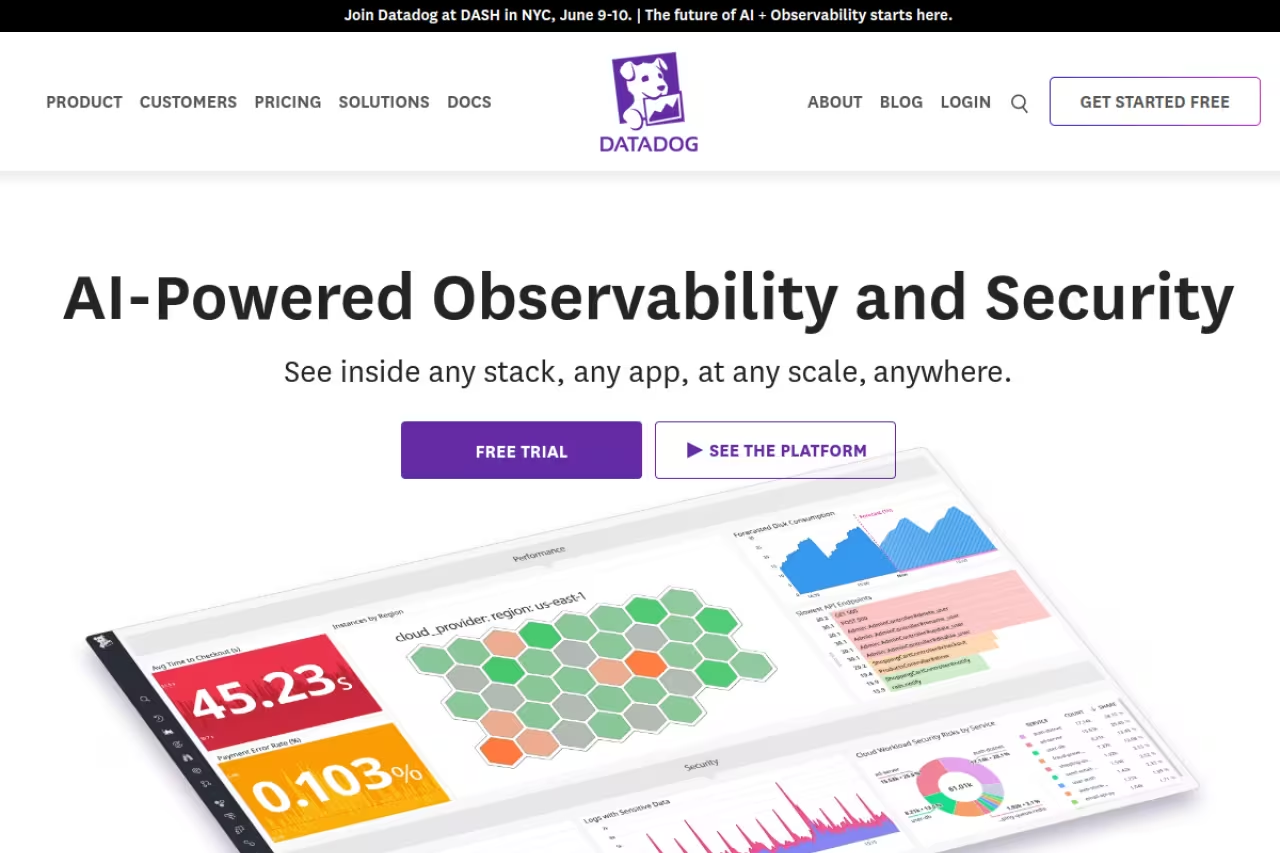
Datadog Watchdog is the AI layer that sits across the whole Datadog platform: infrastructure, APM, logs, and real user monitoring. You don't configure it. It watches your metric, trace, and log streams, learns what normal looks like for each one, and surfaces spikes and drops on its own. According to Datadog's product page, it also does root cause analysis by finding causal links between issues and flags faulty canary deployments before they spread.
Who it's best for: Engineering teams already paying for Datadog. If your infra is there, turning on AI-driven anomaly detection costs you almost no extra effort.
The obvious choice for engineering teams already paying for Datadog, since zero-config anomaly alerts cost almost no extra effort. Billing per host, per GB and per product adds up fast, so it is expensive as a standalone anomaly tool.
Watchdog anomaly monitoring shows up in the Pro Plus infrastructure tier at roughly $18/host/month and the Enterprise tier at around $23/host/month on annual billing, per Last9's pricing breakdown. On-demand usage runs 20-50% more than annual commits.
The standout: It's genuinely zero-config. You get anomaly alerts without writing a single monitor or picking an algorithm, and the context around each alert points you toward the cause.
The catch: Datadog bills per host, per GB of logs, and per product, and those lines add up fast. Teams routinely get surprised by the bill. Watchdog is also only as good as the data you send it. If you are not already a heavy Datadog user, this is an expensive way to get anomaly detection on its own.
Dynatrace Davis AI
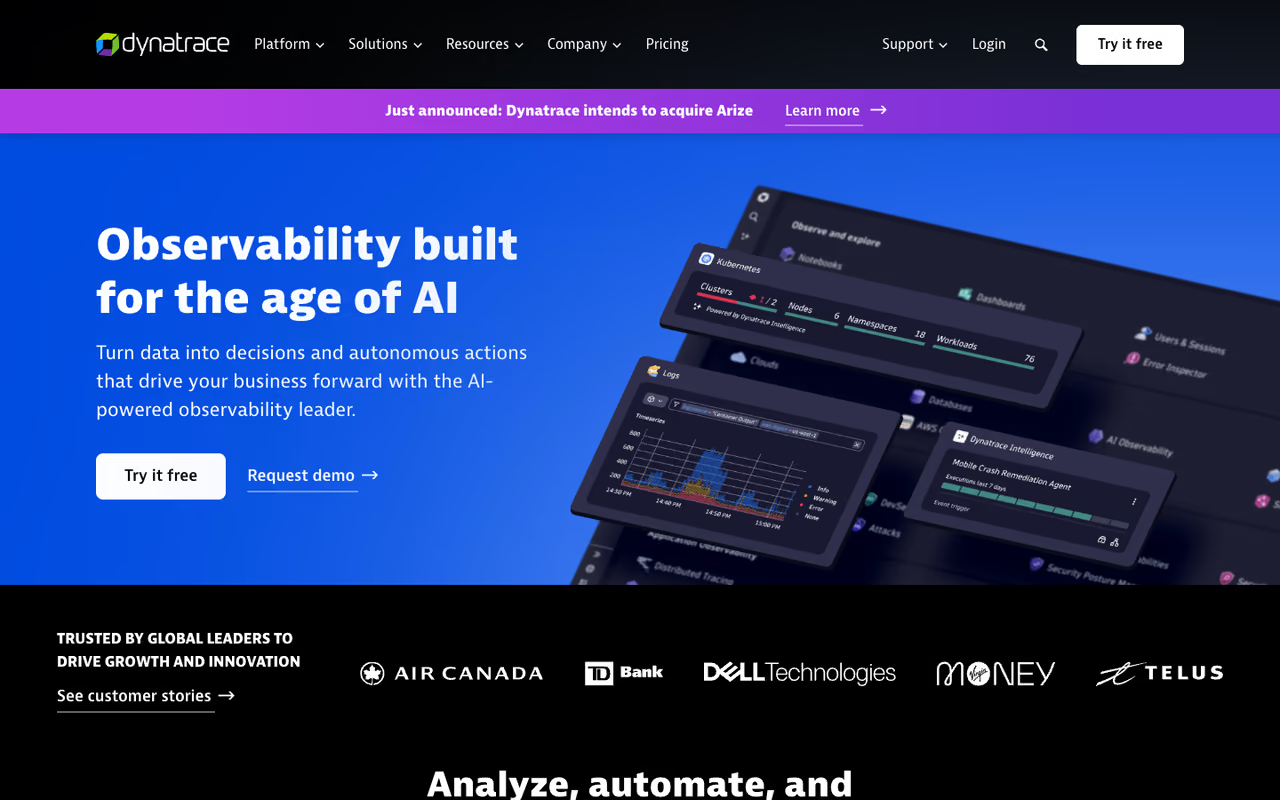
Dynatrace is the enterprise observability platform built around Davis, its causal AI engine. The difference from most anomaly detection is the word "causal." Instead of just telling you a metric looks odd, Davis maps every dependency in your environment with Smartscape and tries to tell you which component actually broke and what it affected downstream.
Who it's best for: Mid-market and enterprise teams running complex hybrid or multi-cloud environments where a single anomaly can cascade across dozens of services.
The enterprise pick for mid-market and large teams in complex hybrid or multi-cloud environments, with causal root cause analysis that usually names the real culprit. It is expensive and complex, and overkill for a small team with a handful of services.
Dynatrace uses consumption-based pricing under its Platform Subscription, billed per memory-GiB-hour and host-hour rather than per seat, with unlimited users. Davis AI adds about $3.60/host/month on top of your observability spend. Third-party data puts the median enterprise contract around $182,883/year, so this is firmly an enterprise tool.
The standout: Deterministic root cause analysis. When Davis fires, it usually points at the real culprit instead of handing you a wall of correlated alerts to sort through yourself.
Where it falls short: Price and complexity. Small businesses and startups on G2 consistently flag Dynatrace as too expensive, and the consumption model can scale in ways that are hard to predict. This is overkill for a small team monitoring a handful of services.
Nixtla TimeGPT
Nixtla takes a completely different approach. Instead of a dashboard, you get a foundation model for time series. TimeGPT is a pretrained transformer that does zero-shot forecasting and anomaly detection, meaning you can point it at a series it has never seen and get predictions without training anything. You call it from Python (or R), compare actuals against the forecast interval, and flag points that fall outside it. Nixtla raised a $16M Series A to push this further, and customers like Microsoft and Lyft are on the list.
Who it's best for: Data scientists and engineers who have their own time series (demand, sensor readings, financial data) and want anomaly detection inside their own code, not a SaaS dashboard.
A builder's tool for data scientists and engineers who want anomaly detection inside their own code on their own time series. It is the most flexible option here, but there is no alerting, incident workflow or UI, so you write the glue.
The open-source libraries (StatsForecast, NeuralForecast, and friends) are free. TimeGPT itself runs through an API with a free tier to start and custom enterprise pricing for fine-tuning, SLAs, and scale. Check Nixtla's site for current API limits, since they shift.
The standout: It's the most flexible option here. You are not locked into a vendor's idea of what to monitor. If you can get the data into a dataframe, you can detect anomalies in it.
The catch: This is a builder's tool. There is no out-of-the-box alerting, no incident workflow, no polished UI for your ops team. You write the glue. For a team without data science capacity, that gap is real.
If your team is spending hours each week stitching tools like this together, Dupple X bundles the AI assistants that handle the boilerplate so you can focus on the model, not the plumbing.
New Relic AI
New Relic folds anomaly detection into its Applied Intelligence (AIOps) layer. It watches golden signals like throughput, response time, and error rate, fires a real-time warning when one drifts, and sends an automatic all-clear when things recover. In May 2026 it added New Relic Knowledge, which pairs live telemetry with historical incident context to sharpen detection.
Who it's best for: Teams that want a real observability platform with anomaly detection but hate per-host pricing surprises.
Pick it if you want a real observability platform with anomaly detection and ingest-based pricing instead of per-host surprises. The 100GB free tier suits small teams, but Pro and Enterprise seats and verbose logging get expensive.
The free tier is the hook. Every account gets 100GB of data ingest free per month. Paid plans run Standard (from $10/month), Pro, and Enterprise, with overage at roughly $0.40-$0.60 per GB. The model is ingest-based, not host-based, which suits some architectures better.
The standout: That 100GB free tier is genuinely useful for small teams, and the recovery notifications cut down on the "is it still broken?" Slack noise.
Where it falls short: Pro and Enterprise seats get expensive once you add users, and data-ingest billing punishes verbose logging. You have to watch what you send.
Grafana Machine Learning
If your stack already runs on Grafana and Prometheus, you may not need a new vendor at all. Grafana Cloud ships an ML layer with outlier detection that flags when one member of a group behaves differently from its peers. Per Grafana's docs, it uses two algorithms (DBSCAN for trending data, MAD for stable bands) and exposes the result as a metric you can alert on like anything else.
Who it's best for: Teams already invested in Grafana Cloud who want anomaly detection on the metrics they're already collecting.
Skip a new vendor if you already run Grafana and Prometheus, because outlier detection is built into Grafana Cloud. It only covers Pro and Advanced users, and enabling ML can raise your compute usage.
Outlier and anomaly detection are part of Grafana ML, available to Grafana Cloud Pro and Advanced users. There's no separate per-detector fee, though enabling ML can raise your compute usage.
The standout: It works on data you already have. No new agent, no new pipeline. You define a baseline group, set sensitivity, and alert on the outlier metric.
The catch: It's metrics-first and lighter than the dedicated platforms. The ML compute can spike your bill unexpectedly, so watch usage and set retention policies before you turn it loose.

Coralogix
Coralogix is a log and observability platform with ML-powered anomaly alerts across logs, metrics, and traces. What sets it apart is the pricing model. Instead of charging per host, it charges per pipeline (Frequent Search, Monitoring, Compliance), so you pay for high-speed querying only on the data that needs it and route the rest to cheaper tiers.
Who it's best for: Log-heavy teams that have been burned by per-host or per-GB-search observability bills.
Built for log-heavy teams burned by per-host or per-GB-search bills, with tiered pipelines that keep premium rates to the data that needs them. There is no published list pricing, and you must route data carefully or lose the savings.
Per CubeAPM's breakdown, monitoring logs (the anomaly-detection pipeline) run about $0.50/GB, frequent search logs about $1.15/GB, compliance logs $0.17/GB, and metrics $0.05/GB. Coralogix quotes custom contracts based on your volume and pipeline mix.
The standout: Tiered pipelines mean anomaly detection on big log volumes without paying premium search rates on everything. The ML alerts adapt to system behavior over time.
Where it falls short: No published list pricing, so you're negotiating. And the pipeline model takes some upfront thought to route data correctly, or you lose the savings.

Anodot
Anodot is the one built for business metrics rather than infrastructure. Its Autonomous Business Monitoring platform watches revenue, conversion, cost, and user-experience metrics, learns each one's normal behavior with no manual thresholds, and correlates related anomalies into a single alert so you're not drowning in noise. It claims teams catch revenue leaks and cost spikes up to 80% faster.
Who it's best for: Revenue, growth, and finance teams at SaaS and ecommerce companies who need to know within hours, not weeks, when a key number moves.
The one built for business metrics like revenue and conversion, for growth and finance teams at SaaS and ecommerce companies. It correlates related anomalies into one story, but it is a real investment with a real setup process.
Custom and annual. Mid-market SaaS deployments focused on revenue monitoring typically land in the $30,000-$60,000/year range, with setup and integration services adding more in year one.
The standout: Correlation. When ten metrics drop at once, Anodot ties them into one root-cause story instead of ten separate pages, which is exactly what you want for business-impact incidents.
The catch: It's a real investment with a real setup process. This is not a tool you trial over a weekend, and the value depends on getting your data sources wired in properly.

Monte Carlo
Monte Carlo attacks anomalies one layer earlier: the data itself. It's a data observability platform that uses ML to catch freshness issues, volume drops, and schema changes in your pipelines and warehouse before they reach a dashboard or an ML model. If your "anomaly" is a silent data quality problem rather than a latency spike, this is the category you want.
Who it's best for: Data engineering and analytics teams running warehouses (Snowflake, BigQuery, Databricks) who need to trust the numbers downstream.
Pick it if your anomaly is a silent data quality problem, with lineage that turns a data fire drill into a targeted fix for warehouse teams. It covers data quality only, not app or infra, and contract values are enterprise-grade.
Custom, based on the number of tables and data sources monitored. Per Vendr's marketplace data, a Standard deployment of 30-100 tables across a few sources often runs $25,000-$50,000/year.
The standout: Lineage. When something breaks, Monte Carlo shows you the upstream cause and every downstream report affected, which turns a data fire drill into a targeted fix.
Where it falls short: It's scoped to data quality, not app or infra monitoring, and the contract value is enterprise-grade. Small data teams may get most of the value from open-source checks first.
How to choose
Start by naming the kind of normal you're protecting, then the choice gets easy.
- You run infra and apps and want AI alerts with no setup. Use the platform you're already on. Datadog Watchdog and New Relic AI both work this way. Pick on pricing model: per-host (Datadog) or per-ingest (New Relic).
- You're a large enterprise where one anomaly cascades. Dynatrace Davis earns its price tag with causal root cause analysis. Below a certain scale, it's overkill.
- You have your own time series and a data scientist. Nixtla TimeGPT gives you a model you call from code. Most flexible, but you build the alerting.
- You're already on Grafana/Prometheus. Turn on Grafana ML before buying anything new.
- You care about a business number (revenue, cost, conversion). Anodot is purpose-built for that, and infra tools are not.
- Your problem is bad data, not slow apps. Monte Carlo catches it at the pipeline before it spreads.
The honest take: most teams overbuy. If you already have an observability platform, switch on its native anomaly detection first and spend a month seeing what it catches before you add a dedicated tool. For more side-by-side picks, our top tools directory and the best AI agents guide cover adjacent categories worth a look.
FAQ
What is AI anomaly detection?
AI anomaly detection uses machine learning to learn the normal pattern of a metric, log stream, or data series, then flags points that deviate from that learned baseline. Unlike static thresholds, it adapts to seasonality, daily cycles, and long-term growth, so it catches genuine outliers without firing on every expected spike.
What is the best AI anomaly detection tool in 2026?
For engineering teams already on an observability platform, Datadog Watchdog is the easiest win because the AI is built in and needs no configuration. For raw time series you want to control from code, Nixtla TimeGPT is the most flexible. For large multi-cloud enterprises, Dynatrace Davis offers the strongest root cause analysis. The best choice depends on whether you're protecting infrastructure, data pipelines, or business metrics.
Is there a free AI anomaly detection tool?
Yes. New Relic includes 100GB of free data ingest per month with anomaly detection in its AIOps layer, and Nixtla's open-source libraries (StatsForecast, NeuralForecast) are free to use. Grafana ML outlier detection is included in Grafana Cloud Pro and Advanced plans rather than priced separately. For heavy production use, expect to pay.
How much do AI anomaly detection tools cost?
It ranges widely. Observability platforms like Datadog start around $18/host/month for the tier that includes Watchdog. Dedicated business and data observability tools like Anodot and Monte Carlo run custom annual contracts, often $25,000 to $60,000 per year. Open-source and free-tier options can get you started at no cost if you're willing to build the alerting yourself.
Can anomaly detection replace manual alert thresholds?
In most cases, yes, and that's the main reason to adopt it. Static thresholds either fire too often (false alarms) or miss real problems during seasonal swings. ML-based detection learns the expected range dynamically. That said, keep a few hard thresholds for critical, well-understood limits where you never want any ambiguity.
Ready to stop firefighting anomalies after the fact? Dupple X gives your team the AI tooling to move faster on detection and response. Start the yearly trial and see what your stack has been missing.
Related guides
Some offers on this page may be paid placements or contain affiliate links.
