
Best AI Speech Analytics Tools (2026)

Key facts7 tools compared: Observe.AI, Gong, CallMiner Eureka, AssemblyAI, Deepgram, Fireflies.ai, Avoma
- 7 tools compared: Observe.AI, Gong, CallMiner Eureka, AssemblyAI, Deepgram, Fireflies.ai, Avoma
- Observe.AI (best for: Contact center QA + coaching): Custom (est. $60K+/yr)
- Gong (best for: B2B sales/revenue teams): ~$1,600/user/yr + $5K+ platform fee
- CallMiner Eureka (best for: Enterprise, regulated industries): Custom (enterprise)
- AssemblyAI (best for: Developers building features): $0.15-$0.21/hr + add-ons
Every sales call, support ticket, and customer complaint your company handles is a recording nobody listens to. A QA team spot-checks maybe 2% of calls. The other 98% are dead weight on a server somewhere. AI speech analytics is the bet that those recordings are worth mining: transcribe everything, score it, flag the risky moments, and turn a million minutes of audio into something a manager can actually act on.
The problem is that "speech analytics" now covers wildly different products. A contact center QA platform that auto-scores 100% of agent calls is a different animal from a developer API that returns sentiment scores per sentence, which is different again from a sales tool that tells your reps which deals are slipping. Buy the wrong category and you'll either overpay for features you don't need or hit a wall the moment you try to scale.
I compared the main platforms and APIs in this space on pricing, documentation, and public user reviews. If you run a contact center and want QA plus coaching out of the box, Observe.AI is the pick. If you're a developer who wants to build speech intelligence into your own product, AssemblyAI is where I'd start. Below is the full breakdown, with real pricing and the honest trade-offs for each.
Quick comparison
| Tool | Best for | Price | Standout |
|---|---|---|---|
| Observe.AI | Contact center QA + coaching | Custom (est. $60K+/yr) | Auto-scores 100% of calls |
| Gong | B2B sales/revenue teams | ~$1,600/user/yr + $5K+ platform fee | Deal risk and forecast signals |
| CallMiner Eureka | Enterprise, regulated industries | Custom (enterprise) | True omnichannel analytics |
| AssemblyAI | Developers building features | $0.15-$0.21/hr + add-ons | Modern API with $50 free credit |
| Deepgram | Real-time/streaming transcription | $0.0043-$0.0077/min | Fastest streaming STT |
| Fireflies.ai | Small teams, meetings | Free to $19/user/mo | Cheapest conversation intelligence |
| Avoma | Mid-market sales | $19-$70/user/mo | Bundled CI + scheduling |

Observe.AI: the contact center QA workhorse
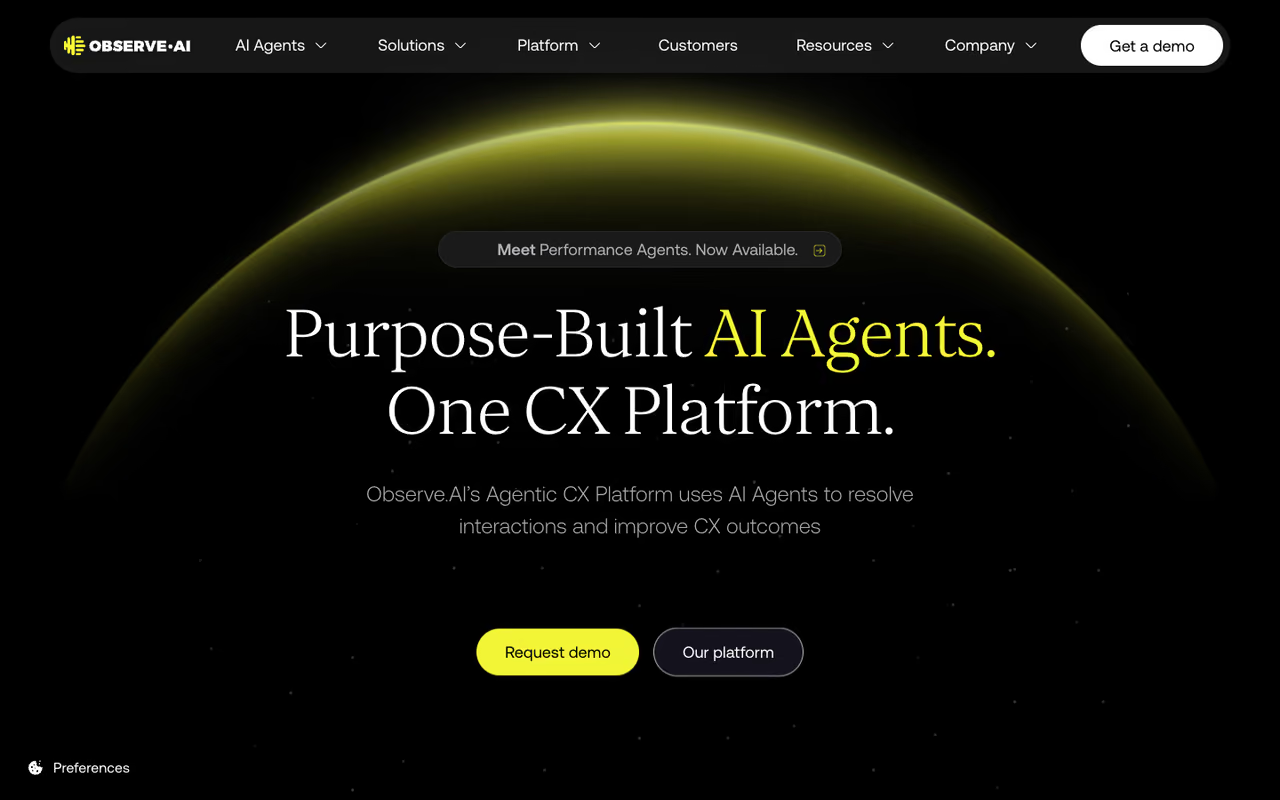
Observe.AI is built for one job: helping contact centers get value out of every call instead of a tiny audited sample. It transcribes 100% of conversations, runs sentiment and compliance checks, auto-scores agents against your QA rubric, and surfaces coaching moments managers would otherwise never see. Brands like DoorDash, SoFi, and Prudential run on it.
The product splits into five suites, from post-interaction QA to real-time agent assist to its newer VoiceAI agents that handle routine calls end to end. That last piece is priced per completed task rather than per minute, so routing a call costs less than processing an insurance claim.
Who it's best for: Enterprise contact centers running 100+ agents that care about consistent QA, compliance, and coaching at scale.
The contact center QA workhorse for enterprise teams running 100+ agents that care about consistent QA, compliance and coaching at scale. It carries enterprise overhead, so a 15-person support team will struggle with the implementation and minimums.
Observe.AI doesn't publish list prices. Public estimates put it in the $60K-$180K/year range depending on modules and seat count. Expect a real sales cycle and a custom quote.
The catch: This is enterprise software with enterprise overhead. If you're a 15-person support team, the implementation and minimum commitment are overkill. You're buying a platform, not a self-serve tool you switch on in an afternoon.

Gong: speech analytics for revenue teams
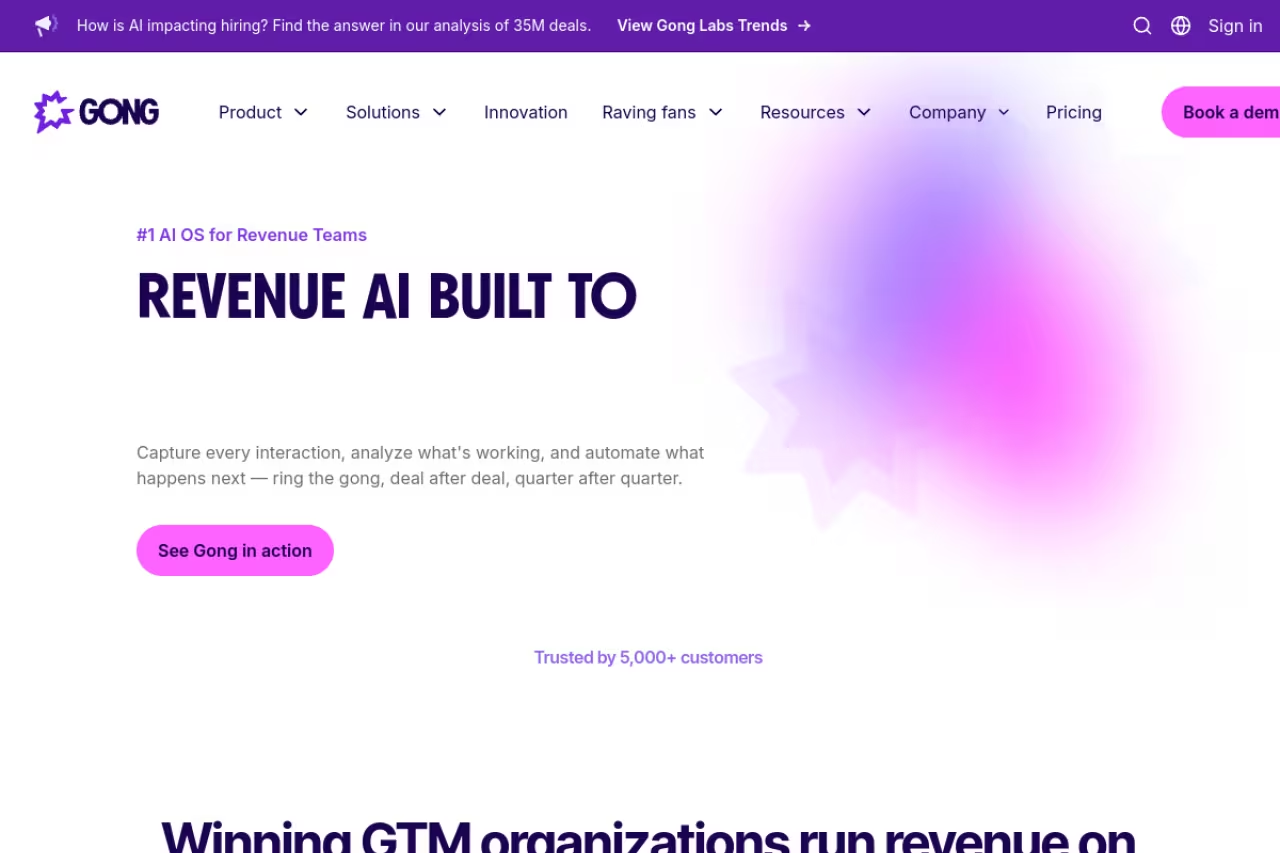
Gong isn't a contact center tool. It analyzes sales conversations across calls, video meetings, and email, then tells revenue leaders which deals are at risk, which reps need coaching, and whether the forecast holds up. If your "speech" is sales calls and the goal is closing more pipeline, Gong is the category leader, with over 5,000 companies using it.
What makes Gong stick is the volume of signal it captures and the way it ties conversation data back to deal outcomes. You can search across every call for a competitor mention or a pricing objection, then see how those conversations correlate with win rates.
Who it's best for: B2B sales organizations that want conversation intelligence wired directly into forecasting and deal management.
The category leader if your speech is sales calls and the goal is closing more pipeline, wiring conversation data into forecasting and deal management. The flat platform fee punishes small teams hardest, since it does not scale down.
Gong runs roughly $1,600/user/year for the Foundations plan, though negotiated deals land closer to $1,000-$1,349/user. There's a mandatory platform fee of $5,000-$50,000/year regardless of team size, plus a typical onboarding fee of $7,500+. A 10-person team pays around $21,000 in year one, per pricing breakdowns.
Where it falls short: That flat platform fee punishes small teams hardest because it doesn't scale down. Below 10 reps, the math gets ugly fast. Gong is also locked to sales: don't expect it to analyze support or service calls.

CallMiner Eureka: the omnichannel enterprise play
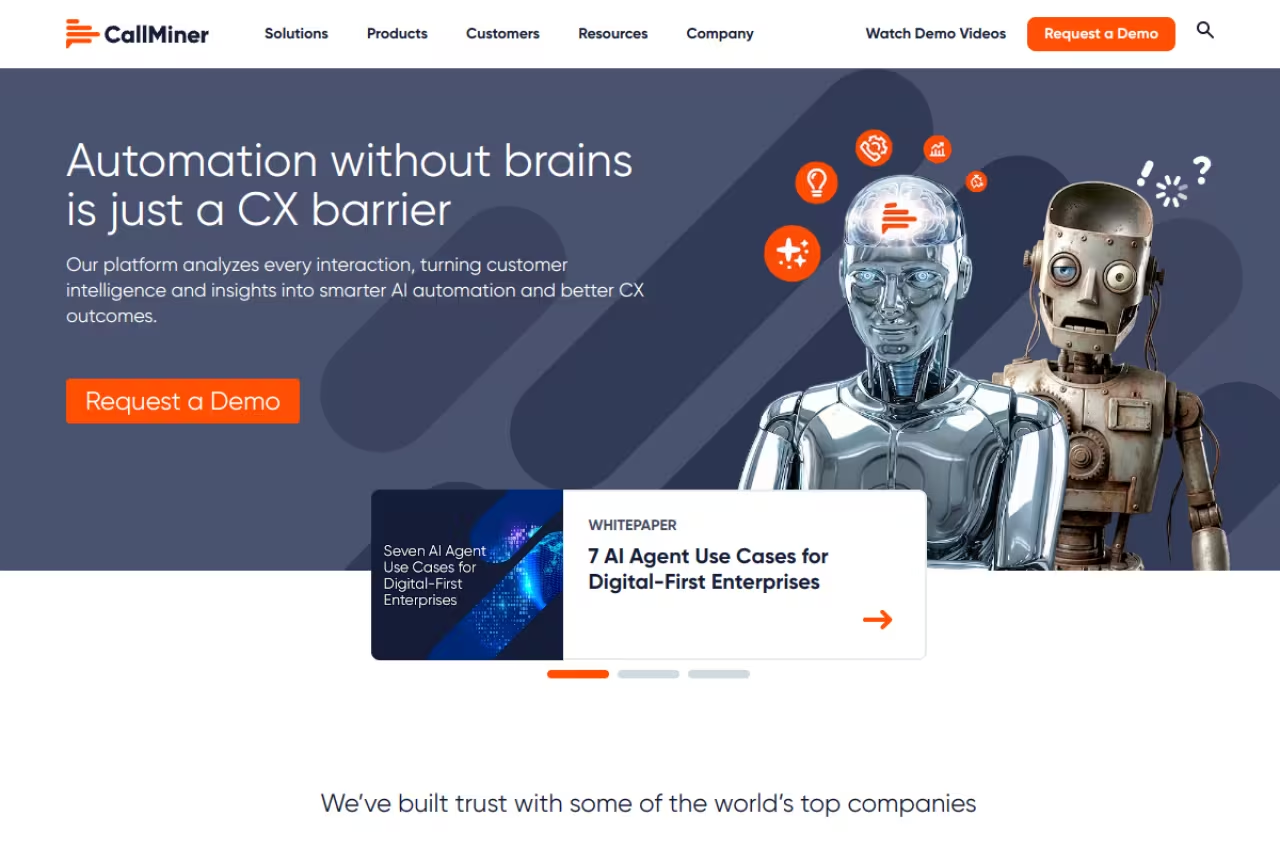
CallMiner has been doing interaction analytics since 2002, and its Eureka platform is the one I'd point regulated industries toward. It analyzes conversations across voice, chat, email, social, SMS, and surveys, then transcribes, redacts, classifies, and scores them automatically. For financial services, healthcare, and telecom teams that need compliance evidence across every channel, that breadth matters.
The pitch is a single view of the customer journey no matter where the conversation happened, with both real-time and post-interaction analytics. CallMiner has also leaned into generative and agentic AI for summarization and automated insights.
Who it's best for: Large, compliance-heavy enterprises that need analytics across many channels, not just phone calls.
The one I'd point regulated industries toward, covering voice, chat, email, social and SMS for large, compliance-heavy enterprises. It has a learning curve, and category tuning takes real effort and likely professional services.
Enterprise custom quotes only. CallMiner sits in the same tier as Observe.AI and Gong on cost, so plan for a five- or six-figure annual commitment.
The catch: Depth comes with a learning curve. CallMiner is powerful but not the tool you hand to a small team and expect instant results. The category configuration and tuning take real effort, and you'll likely lean on professional services to get there.
AssemblyAI: the developer's starting point
If you want to build speech analytics into your own product rather than buy a finished platform, AssemblyAI is where I'd begin. Its Speech Understanding API turns audio into structured data: speaker labels, sentiment per sentence, entities, topics, and summaries. The transcription accuracy is strong and the docs are genuinely good, which is rarer than it should be.
The headline rate is $0.15/hr for the Universal-2 model or $0.21/hr for Universal-3 Pro, billed per second, per the official pricing page. New accounts get $50 in free credits without a card. There's also LeMUR (now the LLM Gateway), which connects your audio to an LLM so you can build generative features without chaining tools yourself.
Who it's best for: Product and engineering teams adding transcription, sentiment, or summarization to an app.
Where I'd begin if you want to build speech analytics into your own product, with strong accuracy and good docs. It is an API, not a dashboard, and add-ons stack, so production setups land closer to $0.28/hr than the headline $0.15.
Pay as you go. The base rate is cheap, but the add-ons stack: speaker ID (+$0.02/hr), entity detection (+$0.08/hr), sentiment (+$0.02/hr), topic detection (+$0.15/hr). A realistic production setup lands closer to $0.28/hr than the $0.15 you saw first.
Where it falls short: It's an API, not a dashboard. There's no QA scorecard, no coaching workflow, no manager view. You're getting raw intelligence and building everything on top yourself. Also note: in-region pricing rises 10% on July 1, 2026 unless you set the request region to global.
If you're trying to figure out where speech APIs fit in a broader build, our guide to the best AI agents covers how teams wire these models into automated workflows.

Deepgram: built for real-time
Deepgram is the API to reach for when speed and streaming matter most. Its Nova models are among the fastest speech-to-text engines available, which makes Deepgram a common choice for live transcription, voice agents, and real-time call monitoring where latency kills the experience.
The API to reach for when speed and streaming matter most, suited to developers building real-time voice features or processing huge audio volumes cheaply. It is building blocks rather than a finished analytics product, and stereo recordings can double your cost.
Pricing is transparent and competitive: roughly $0.0043/min for batch (pre-recorded) and $0.0077/min for streaming on Nova-tier models, billed per second with no rounding up. New accounts start with $200 in free credit.
Who it's best for: Developers building real-time voice features or processing huge volumes of audio cheaply.
Pay as you go, with the lowest per-minute transcription rates in this list. Annual prepaid Growth plans start around $4K and unlock discounted rates.
The catch: Like AssemblyAI, Deepgram is transcription plus building blocks, not a finished analytics product. Add-ons like summarization, topic detection, and sentiment are billed separately per token. And if you process stereo call recordings as two channels, your cost doubles, which is easy to miss when you budget.

Fireflies.ai: speech analytics without the enterprise bill
Fireflies.ai is the one most small teams can actually afford and run themselves. It joins your Zoom, Meet, and Teams calls, transcribes them, and layers on conversation intelligence: talk-to-listen ratios, sentiment, monologue detection, and smart search across every meeting. For a sales or CS team that wants coaching signals without a procurement process, it does the job.
The free plan exists and is usable. Paid tiers run $10/user/month for Pro and $19/user/month for Business (annual billing), with the Business plan unlocking unlimited transcription, conversation intelligence, and team analytics.
Who it's best for: Startups and small teams who want meeting analytics and coaching data without a five-figure contract.
The one most small teams can actually afford, giving startups meeting analytics and coaching data without a five-figure contract. It is a meeting assistant first, so it lacks Gong's deal-risk modeling and Observe.AI's compliance scoring.
Free, then $10-$39/user/month. Genuinely affordable.
Where it falls short: It's a meeting assistant first, analytics platform second. You won't get the deal-risk modeling Gong offers or the compliance scoring Observe.AI does. The AI credit limits on lower tiers also cap how much you can run through the generative features each month.

Avoma: the mid-market bundle
Avoma sits between Fireflies and Gong. It combines meeting recording, transcription, scheduling, and conversation intelligence in one tool, then adds call coaching, scorecards, and deal intelligence on higher tiers. For a mid-market sales team that wants more than a transcription bot but can't stomach Gong's bill, it's a reasonable middle path.
A reasonable middle path for mid-market sales teams that want conversation intelligence, coaching and scheduling in one subscription without Gong's bill. The $19 headline is misleading, since add-ons can land a rep near $77 a seat.
Pricing starts free (around 10 meetings/month), then $19/user/month for the entry tier, with coaching and deal intelligence on the $35 and $70 seats. Watch the bundling: the listed base price climbs once you add conversation intelligence and revenue intelligence as separate line items.
Who it's best for: Mid-market sales teams who want CI, coaching, and scheduling in a single subscription.
$19-$70/user/month depending on which intelligence modules you turn on.
The catch: The "starts at $19" headline is misleading. A rep who actually needs conversation and revenue intelligence can land near $77/seat once the add-ons stack. Still cheaper than Gong, but read the line items before you sign.
A quick note for teams comparing these: the right tool depends as much on your existing stack as the features. If you want a faster way to scan the market, our top AI tools directory tracks what's current across categories, and Dupple X curates the ones worth your time.
How to choose
Start with what kind of "speech" you're analyzing, because that decides your category before price ever enters the picture.
Run a contact center? Look at Observe.AI or CallMiner. You want 100% call coverage, auto QA scoring, and compliance checks. CallMiner if you need omnichannel and live in a regulated industry; Observe.AI if voice QA and coaching are the priority.
Selling B2B and want to close more deals? Gong if you have budget and a real sales org. Avoma if you're mid-market and want most of the value at a third of the cost. Fireflies if you're small and just want coaching signals.
Building speech intelligence into your own product? AssemblyAI for the best mix of features and documentation, Deepgram if real-time streaming and per-minute cost are what keep you up at night.
The single biggest budgeting mistake I see is reading the headline rate and stopping there. On the APIs, every add-on stacks. On the platforms, the platform fee and onboarding can dwarf the per-seat cost. Always model the real total for your actual volume before you commit. For more on building an AI stack that doesn't bleed money, see our take on AI tools for business.
If you want a steady read on which tools in this space are actually worth testing, Dupple X members get vetted picks before they hit every roundup.
FAQ
What is the difference between speech analytics and conversation intelligence?
Speech analytics focuses on what was said: it transcribes audio and flags specific words, phrases, and compliance terms. Conversation intelligence goes deeper into how and why, analyzing sentiment shifts, talk-to-listen ratios, and the flow of the whole interaction. In practice the terms overlap, and most 2026 platforms do both. The distinction matters most when a vendor only does basic keyword spotting versus full interaction analysis.
How much do AI speech analytics tools cost?
It splits into two worlds. Enterprise platforms like Observe.AI, Gong, and CallMiner use custom pricing that typically starts around $1,000-$5,000/month for small teams and climbs into six figures annually for large deployments, often with platform fees and onboarding costs on top. Developer APIs like AssemblyAI and Deepgram are pay as you go, from roughly $0.15/hr down to $0.0043/min, plus add-ons. Small-team tools like Fireflies start free.
Can AI speech analytics work in real time?
Yes. Real-time analytics is one of the fastest-growing parts of the market. Deepgram's Nova streaming models are built for low-latency live transcription, and platforms like Observe.AI and CallMiner offer real-time agent assist that surfaces compliance warnings and next-best actions mid-call. Real-time generally costs more than batch processing, often 40-50% more per minute on the API side.
Which AI speech analytics tool is best for a small team?
Fireflies.ai is the most realistic option for small teams. It has a usable free tier, paid plans from $10/user/month, and gives you transcription plus conversation intelligence without a sales cycle or enterprise contract. Avoma is the next step up if you want scheduling and deal coaching bundled in. The enterprise platforms aren't worth it until you're past roughly 50 agents or reps.
Do these tools transcribe accurately enough to trust?
Modern speech-to-text from AssemblyAI, Deepgram, and the major platforms is accurate enough for analytics on clean audio, often above 90% word accuracy. Accuracy drops with heavy accents, crosstalk, background noise, and industry jargon. For compliance-critical use, keep a human QA layer and use the AI to prioritize which calls a person reviews rather than replacing review entirely.
Related guides
Some offers on this page may be paid placements or contain affiliate links.
