
Best AI Customer Insights Tools (2026)

Key facts10 tools compared: Unwrap, Zonka Feedback, Dovetail, Enterpret, Chattermill, Thematic, Sprig…
- 10 tools compared: Unwrap, Zonka Feedback, Dovetail, Enterpret, Chattermill, Thematic, Sprig, Gong, Qualtrics XM, Contentsquare
- Unwrap (best for: Enterprise customer intelligence at scale): ~$24k/yr, volume-based
- Zonka Feedback (best for: Unified feedback analysis with sentiment and impact scoring): Custom/quote
- Dovetail (best for: Qualitative research repos): Free; Enterprise custom
- Enterpret (best for: Unifying every feedback source): Usage-based, custom
Customer feedback used to mean a spreadsheet of survey verbatims that nobody read past row 200. Now it arrives from everywhere at once: support tickets, app store reviews, sales calls, Slack communities, NPS comments, churn surveys. The volume is the problem. By the time a human tags it all, the insight is stale.
AI changed the math. The good tools now read thousands of pieces of unstructured feedback, group them into themes, attach sentiment, and tie those themes back to revenue or retention numbers. According to one industry survey, 73% of B2B SaaS product teams now use at least one AI tool for feedback analysis, up from 31% in 2023. That jump tells you the manual approach is dying.
I compared the current crop of tools based on their pricing pages, documentation, and public user reviews. This guide is for founders, PMs, and CX leads who want to turn scattered signals into decisions without hiring a research ops team. My top pick for enterprise teams with real feedback volume is Unwrap, because it proactively surfaces the trends and pain points that matter instead of handing you another dashboard to watch. Zonka Feedback is my pick for teams that want unified sentiment and impact scoring mapped to locations, agents, or product areas without the enterprise price. For smaller product and research teams, Dovetail is the better starting point, because it nails the qualitative work without an enterprise contract. But the right answer depends heavily on whether your feedback is mostly qualitative interviews, support-ticket noise, or sales conversations. Let me walk you through it.
Quick comparison
| Tool | Best for | Price | Standout |
|---|---|---|---|
| Unwrap | Enterprise customer intelligence at scale | ~$24k/yr, volume-based | Proactive alerts, 90%+ tagging precision |
| Zonka Feedback | Unified feedback analysis with sentiment and impact scoring | Custom/quote | Theme-level sentiment, anomaly detection, entity-mapped trends |
| Dovetail | Qualitative research repos | Free; Enterprise custom | AI tagging across interviews and calls |
| Enterpret | Unifying every feedback source | Usage-based, custom | Adaptive 5-level taxonomy |
| Chattermill | Tying themes to NPS/revenue | Custom (enterprise) | 50+ integrations, deep-learning NLP |
| Thematic | Open-text survey analysis | ~$2k/mo, custom | Theme tracking over time |
| Sprig | In-product surveys + replays | Free; Starter $199/mo | Natural-language data queries |
| Gong | Sales-call intelligence | ~$5k base + $1,600/user/yr | Models trained on billions of calls |
| Qualtrics XM | Enterprise survey programs | Custom (median ~$28k/yr) | Predictive XM at scale |
| Contentsquare | Behavioral + experience data | Custom (enterprise) | Heatmaps plus AI insights |
Unwrap: best for enterprise customer intelligence at scale
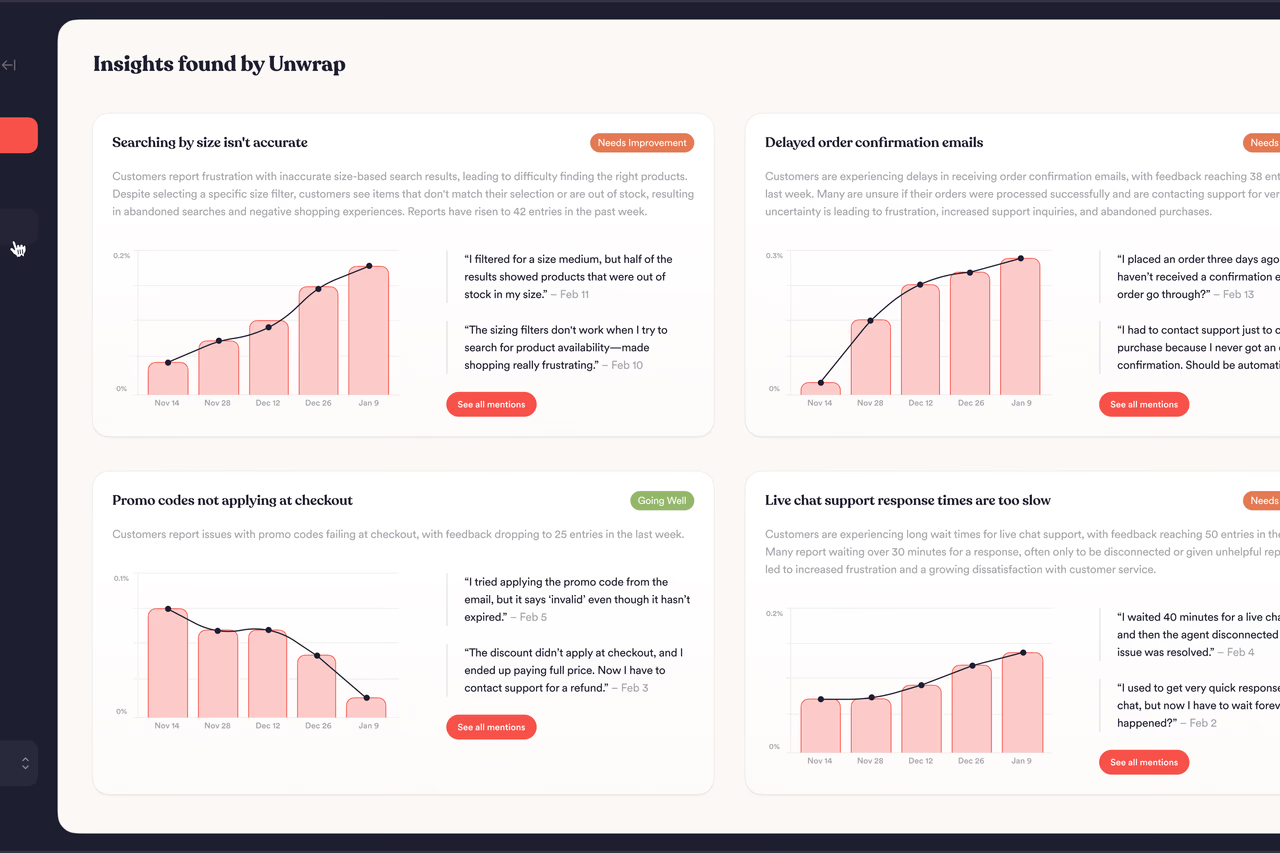
Unwrap is an AI-native customer intelligence platform that uses NLP to aggregate and analyze feedback at scale, then proactively surfaces the trends, pain points, and opportunities that matter, so teams get answers instead of another dashboard to monitor. Custom models fine-tuned on customer feedback auto-categorize everything into a structured taxonomy with no manual tagging.
Who it's best for: enterprise product, CX, support, and voice-of-customer teams handling high feedback volume across many channels. Named customers in its materials include Microsoft, DoorDash, Southwest, Lyft, JetBlue, GitHub, and Perplexity.
The pick for enterprise teams with real feedback volume across many channels. Unwrap auto-categorizes everything with no manual tagging and traces every insight back to verbatim feedback, but plans start around $24,000 a year and light-volume teams will get less out of it.
Pricing is volume-based rather than per-seat, with plans starting around $24,000 a year, so the whole organization can access insights instead of a single analyst. Setup needs only an API key or OAuth (no developer), and you can run a 30-day proof of concept on your own data.
The standout is proactive discovery paired with trust. The Assistant answers plain-language questions with charts and customer quotes, real-time Slack and email alerts flag anomalies before they grow, and every insight traces back to the original verbatim feedback. Unwrap reports 90%+ tagging precision, third-party verified.
The catch: it is built for real feedback volume, so a small team with light volume will get less out of it. It is also focused on feedback intelligence rather than predictive or revenue-attribution modeling, and for pixel-level chart customization you will still export to a BI tool.

Zonka Feedback: best for unified feedback analysis with impact scoring
Zonka Feedback unifies feedback from surveys, support tickets, reviews, and calls into one layer; AI clusters it into themes and surfaces root causes, not just a dashboard of scores. The differentiator is entity-mapped sentiment and impact scoring: you see not only what's driving sentiment down, but which locations, agents, or product areas are most affected.
Who it's best for: CX, product, and support teams collecting feedback across many channels (surveys, email, SMS, WhatsApp, web, in-app, kiosks) who want one searchable home for it, plus close-the-loop workflows to act on insights.
Go with Zonka if you want feedback collection and analysis in one place. Entity-mapped sentiment shows which locations or agents are hurting, and close-the-loop workflows are built in, but pricing is quote-only and there is no self-serve trial.
Pricing is custom and quote-only, so you'll need a conversation with sales. The platform is less expensive than pure enterprise suites like Unwrap, but more comprehensive than lightweight tools. Unlike Chattermill or Enterpret, Zonka also collects the feedback itself (NPS, CSAT, CES, custom surveys across email, SMS, WhatsApp, web, in-app, kiosks), no external data pipeline required to get started.
The standout is theme-level sentiment with built-in close-the-loop workflows. You learn not just that sentiment dropped, but that it's specific to onboarding in the EMEA region, and then centralized inbox, case assignment, and automated follow-up let your team act. Anomaly detection with adjustable sensitivity flags unexpected shifts automatically, and real-time alerts on negative/critical feedback route with full context.
The catch: like Unwrap, there's no self-serve trial or free tier, so adoption starts with a sales demo. It's built for real feedback volume, not for teams with a few dozen responses a quarter.

Dovetail: best all-around for research teams
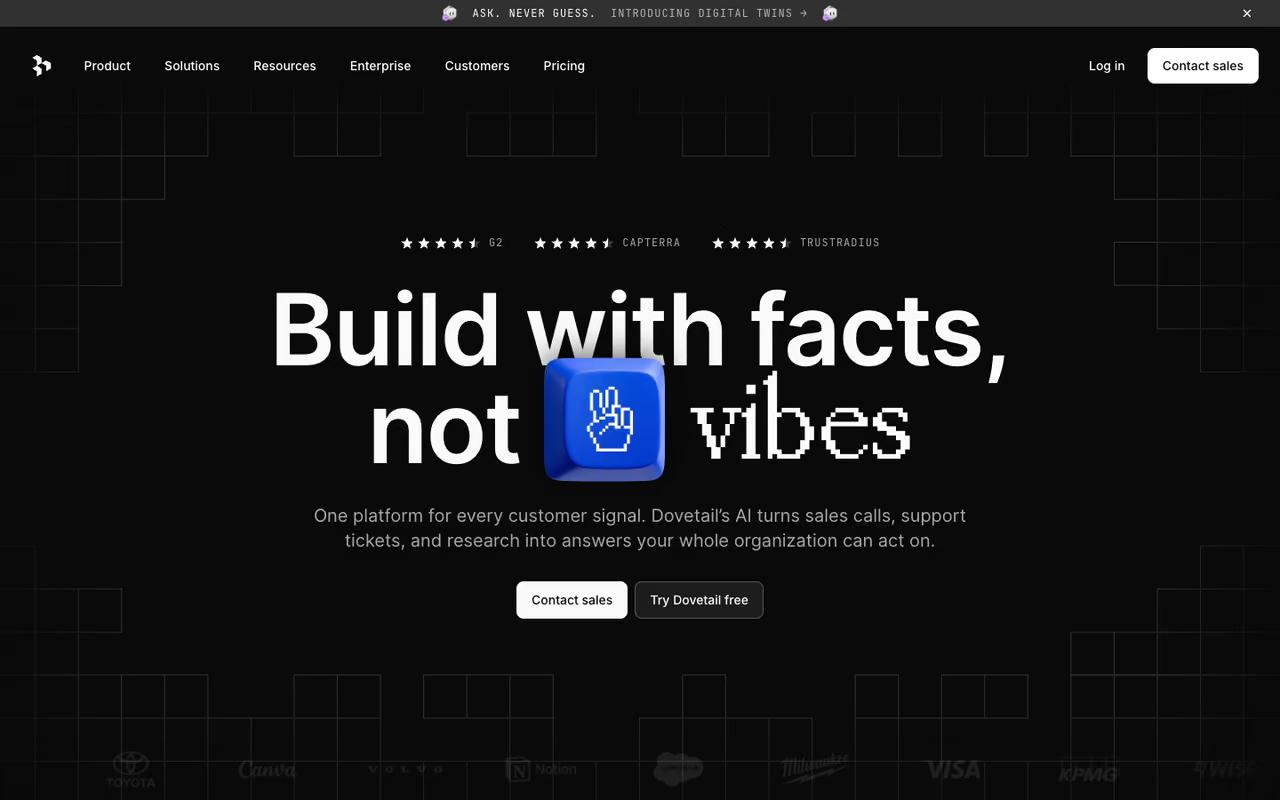
Dovetail is the category leader for qualitative research repositories, and it earns the spot. You drop in interview transcripts, call recordings, survey responses, and notes, and the AI tags themes, writes summaries, and lets you ask questions of the whole corpus in plain English. For a product team that runs real user interviews, it removes the worst part of the job: manual coding.
Who it's best for: PMs, UX researchers, and small research teams who work with messy qualitative data and want one searchable home for it.
The free plan is genuinely usable for solo work. It gives you one project, one feedback channel, AI chat, and basic summaries with no card required, per Dovetail's pricing page. The Enterprise tier unlocks unlimited projects, semantic search, global tags, redaction, and dedicated support.
The standout is how the AI handles calls and interviews. It does not just transcribe. It clusters recurring pain points across dozens of sessions, so you can see a pattern you would have missed reading them one by one.
The catch: there is a big gap between the free tier and Enterprise. The mid-tier pricing isn't published anymore, and several teams report per-seat costs climb fast once you add contributors. If your feedback is mostly support tickets rather than interviews, a dedicated VoC tool will serve you better.
The default for PMs and UX researchers who live in interviews and call recordings. Dovetail's AI removes manual coding and its free plan works for solo use, but there is a big jump to Enterprise and per-seat costs climb as you add contributors.

Enterpret: best for unifying every signal
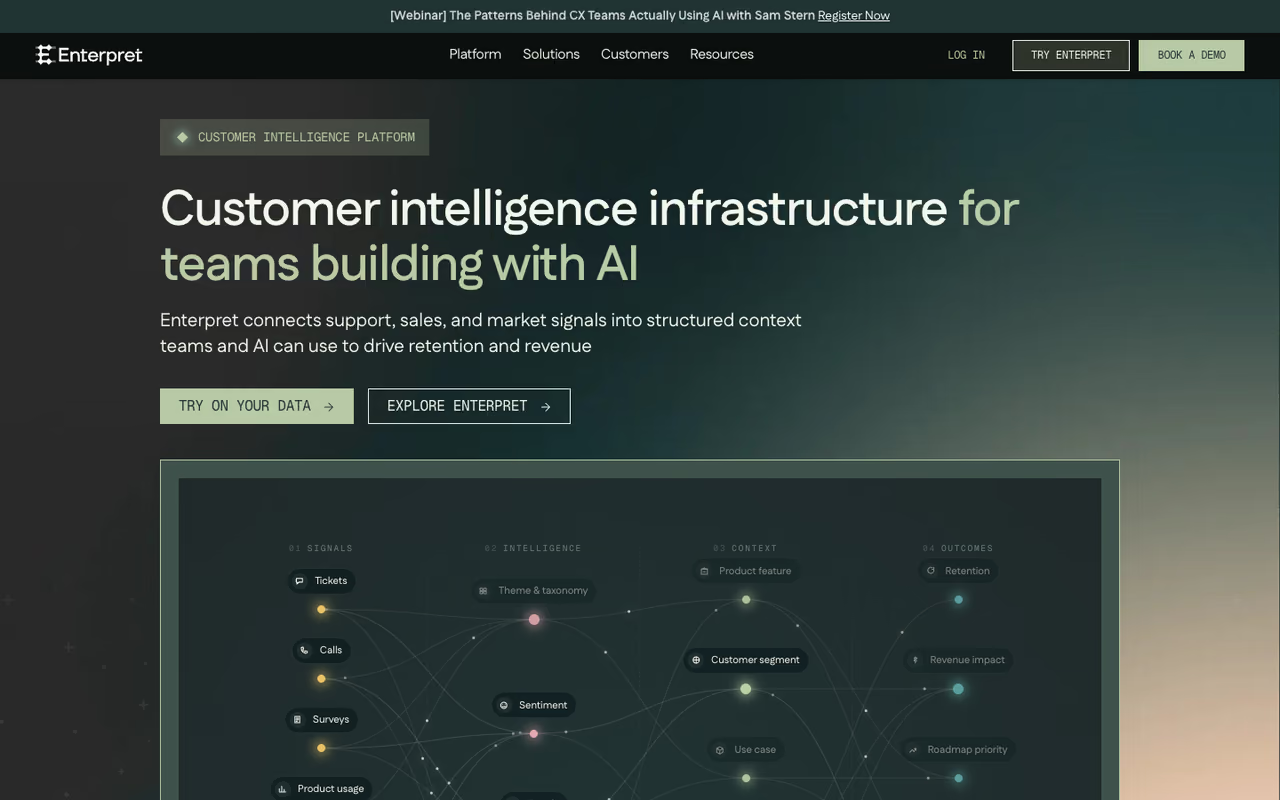
Enterpret treats customer feedback as infrastructure. It connects support tickets, sales calls, surveys, app reviews, community posts, and product usage into one structured layer, then runs what it calls an adaptive taxonomy across all of it. The taxonomy is the differentiator: instead of a fixed tag list, it evolves as new feedback comes in, so your categories stay current with how customers actually talk.
Who it's best for: growth-stage and enterprise product teams drowning in feedback across more than a handful of channels, who want a single source of truth.
A strong fit for growth-stage and enterprise product teams drowning in signals from many channels. Enterpret's adaptive five-level taxonomy keeps categories current, but there is no public price or self-serve entry, so small startups should start lighter.
Pricing is usage-based and quote-only. The company raised a $20.8M Series A in late 2024 (Business Wire) and in 2025 launched an agentic version that acts on signals, not just reports them. That tells you the roadmap is moving toward automation, not dashboards.
The standout is the five-level taxonomy. It gives you granularity most tools flatten away, so "billing" can split into the specific friction points underneath it.
Where it falls short: there is no self-serve entry point and no public price, so you cannot kick the tires before a sales call. It is built for teams with real feedback volume, which means small startups will find it heavy. If you're earlier, start with something self-serve and graduate to this.
Chattermill: best for connecting feedback to revenue
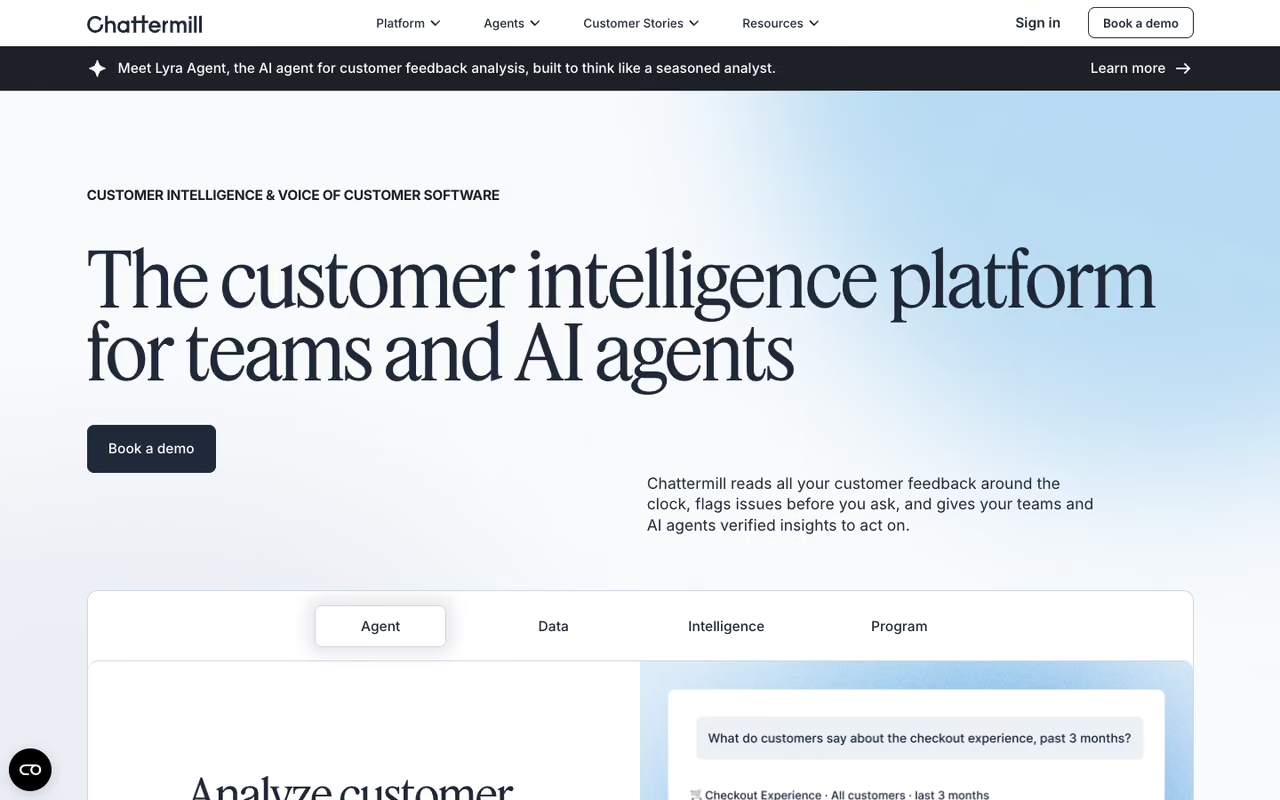
Chattermill is the AI-native platform that unifies surveys, support tickets, reviews, and social data into one intelligence layer, then ties theme-level insights directly to NPS, CSAT, and revenue impact. That last part is the reason finance and exec teams take it seriously. It does not just tell you customers are annoyed about onboarding. It estimates what that friction costs you.
Who it's best for: mid-market and enterprise CX and product teams that need to prove the dollar impact of fixing an issue.
It runs on deep-learning NLP across 50+ integrations, and the customer list (Amazon, Uber, Zendesk, H&M) signals it handles serious scale. Pricing is custom and depends on data sources and feedback volume, so expect an enterprise contract.
The standout is the revenue tie-in. Linking a theme to churn or expansion turns a research finding into a business case, which is what gets engineering time allocated.
The catch: no public pricing and an enterprise sales motion. This is not a tool you adopt on a Tuesday afternoon. For smaller teams, the setup overhead outweighs the payoff until your feedback volume justifies it.
Choose Chattermill when you need to prove the dollar impact of fixing an issue. It ties themes to NPS, CSAT and revenue, which makes the business case, but expect an enterprise contract and real setup overhead for smaller teams.
Thematic: best for open-text survey analysis
Thematic is purpose-built for one job: take large volumes of open-ended survey responses, reviews, and support comments and turn them into structured, analyzable themes without manual coding. If your primary pain is a mountain of free-text NPS verbatims, it does exactly that and tracks how themes shift over time.
Who it's best for: insights and CX teams running high-volume survey programs who care about trends, not one-off reads.
Pick Thematic if your main pain is a mountain of free-text NPS verbatims and you care about how themes shift over time. It is text-only, with no behavioral data, and the annual contract is overkill for a few hundred responses a quarter.
Pricing is custom. Third-party sources put it around $2,000 per month with a reported $25,000 annual minimum, though Thematic does not publish numbers. Treat that as a rough floor, not a quote.
The standout is theme tracking over time. Watching a sentiment line move after a release tells you whether your fix worked, which static analysis cannot.
Where it falls short: it is focused on text analytics, so it is not the place for session replay or behavioral data. And like most VoC tools at this tier, the annual contract means it is overkill for a team analyzing a few hundred responses a quarter.
If your needs lean more toward digging through raw datasets and spreadsheets, our roundup of the best AI tools for data analysis covers options that fit that workflow better.

Sprig: best for in-product insight without leaving the app
Sprig combines in-product surveys, session replays, and AI analysis so product teams can ask users questions at the exact moment behavior happens. The natural-language querying is the part that saves real time: you type a question about your user data and get an answer instead of building a report.
Who it's best for: product teams that want continuous, in-context feedback tied to what users are actually doing in the app.
There is a free plan for individuals with one in-product survey or replay per month and AI analysis for up to 5,000 monthly tracked users. The Starter plan runs $199/month with two surveys or replays and 25,000 MTUs, per coverage of Sprig's pricing. Enterprise scales with response volume and activated agents.
The standout is pairing surveys with replays. Seeing the clip of a user struggling, next to their survey answer, is far more convincing than either alone.
The catch: pricing is tied to monthly tracked users, which climbs quickly for high-traffic products. A consumer app with millions of users could find the MTU model expensive fast. Watch that meter.
For teams thinking about the wider stack, this pairs well with what we cover in the best AI business intelligence tools guide.
Pick Sprig if you want answers tied to what users do inside the app. Pairing surveys with session replays is its edge, and there is a free plan, but pricing follows monthly tracked users and can get expensive for high-traffic products.

Gong: best for mining sales conversations
Gong is a revenue intelligence platform built around conversation analytics. Its models are trained on billions of real sales interactions, which is a moat general transcription tools cannot match. It surfaces transcripts with speaker separation, talk-time ratios, detected objections, competitor mentions, and buying signals across every recorded call.
Who it's best for: B2B sales and revenue teams who want to understand customer objections and competitive threats straight from the source, plus product teams who want to hear the voice of the customer from sales calls.
The right tool when your customer voice lives in sales calls. Gong surfaces objections, competitor mentions and buying signals across recorded conversations, but it is squarely a sales tool and wrong in shape and price if your feedback sits in tickets or surveys.
Pricing is enterprise-grade: roughly a $5,000 annual platform fee plus about $1,600 per user per year, so a 10-person team lands near $21,000/year, according to pricing breakdowns from Oliv. In 2026 Gong shipped faster processing, with call insights available up to 70% quicker than before.
The standout is the depth of the conversation data. Knowing which competitor gets named in lost deals, and at what stage, is the kind of insight that changes your messaging.
Where it falls short: it is squarely a sales tool. If your feedback lives in support tickets or surveys rather than calls, Gong is the wrong shape and the wrong price. Read more in our look at generative AI for sales.
Qualtrics XM: best for large, structured survey programs
Qualtrics is the dominant enterprise experience management platform, built around survey programs with predictive XM capabilities. Its AI analyzes structured survey responses, NPS verbatims, and CSAT at massive scale, and the XM Discover module pulls in contact-center and unstructured data on top.
Who it's best for: Fortune 1000 organizations with dedicated CX functions and survey-heavy programs that need governance, compliance, and breadth across customer, employee, and brand experience.
There is no public pricing. Vendr data puts the median buyer around $28,533 per year, ranging from roughly $6,500 to $126,000 depending on modules, per Vendr's marketplace listing. Implementations commonly run 6 to 12 months.
The standout is breadth and predictive analytics. Few platforms cover this much surface with this much statistical horsepower.
The catch: the cost, the implementation timeline, and the negotiation in the dark on package design. For most startups this is overkill. It earns its keep at large organizations with the headcount to run it.
Built for Fortune 1000 organizations running survey-heavy CX programs that need governance and breadth. Qualtrics brings predictive analytics few rivals match, but the cost and implementation timeline make it overkill for most startups.

Contentsquare: best for behavioral experience data
Contentsquare sits in a different lane: it tells you what customers do, not just what they say. Heatmaps, journey mapping, and zone-based analytics show where users hesitate, rage-click, or drop off, and AI-powered insights flag anomalies in that behavior. It absorbed session-replay capabilities and is strong for ecommerce and conversion teams.
Who it's best for: marketing, ecommerce, and product teams optimizing digital journeys who want behavioral evidence alongside attitudinal feedback.
Reach for Contentsquare when you want to see what customers do rather than what they say. Heatmaps and journey analysis are strong for ecommerce and conversion teams, but it is not voice-of-customer and add-on pricing can balloon the quote.
Pricing is custom and reportedly starts in the several-thousand-per-month range, targeting mid-market and enterprise. The AI insights and product analytics modules are often add-ons rather than included, which inflates the real number.
The standout is the visual journey analysis. Watching exactly where a checkout flow loses people is a different kind of insight than reading a complaint about it.
Where it falls short: this is behavioral analytics, not voice-of-customer. You will still want a feedback tool to capture the why behind the what. And the add-on pricing means quotes can balloon past the headline figure.
How to choose
Match the tool to where your feedback actually lives. That single question narrows the field fast.
- Mostly interviews and qualitative notes? Start with Dovetail. It is the cheapest way to make qualitative research searchable, and the free tier lets you test it today.
- Feedback scattered across 5+ channels and you have volume? Unwrap, Enterpret, or Chattermill. Pick Unwrap if you want proactive discovery with insights the whole org can access; pick Chattermill if proving revenue impact to leadership is the goal; pick Enterpret if taxonomy precision and AI-native infrastructure matter more.
- Drowning in open-text survey responses? Thematic for trend tracking, or Qualtrics if you are already a survey-heavy enterprise.
- Want feedback tied to in-app behavior? Sprig for surveys plus replays, or Contentsquare for pure behavioral analytics.
- Your customers' truth is in sales calls? Gong, full stop.
Second filter: budget and motion. Dovetail and Sprig have real free or self-serve tiers you can adopt without a sales call. Everything else here is an enterprise contract with a demo gate, so factor in implementation time before you commit.
A practical move: pair one qualitative tool with one quantitative one. A Dovetail-plus-Sprig stack covers the why and the what for a fraction of an enterprise suite, and you can always graduate to Enterpret or Chattermill when volume demands it.
If you want a faster way to keep up with which of these tools is shipping what, Dupple X tracks the AI tooling space so you don't have to read eight changelogs a week. You can also browse our wider top AI tools directory for adjacent picks.
FAQ
What are AI customer insights tools?
They are platforms that use natural language processing and machine learning to read unstructured customer feedback, from surveys, support tickets, reviews, chats, and call transcripts, and turn it into structured intelligence: themes, sentiment, root causes, and emerging trends. The point is to surface what customers are telling you at a scale no human team could code by hand.
Which is the best AI customer insights tool for a small team?
For most small teams, Dovetail is the best starting point because its free tier handles qualitative research without a contract. If your feedback is more product-behavior than interviews, Sprig's free plan and $199/month Starter tier are the more affordable self-serve option. Enterprise platforms like Chattermill and Qualtrics are usually overkill until your feedback volume grows.
How much do AI customer insights tools cost?
It splits in two. Self-serve tools start free and run a few hundred dollars a month (Sprig Starter is $199/month). Enterprise voice-of-customer and experience platforms are quote-only and land in the five to six figures annually. Gong runs roughly $5,000 base plus about $1,600 per user per year, and Qualtrics buyers pay a median near $28,500 a year.
Can these tools analyze support tickets and reviews, not just surveys?
Yes. That is the core strength of unified platforms like Enterpret and Chattermill, which pull from 50+ sources including tickets, app store reviews, social posts, and community discussions. Dovetail handles call and interview transcripts well, while Gong is specialized for sales-call data specifically.
Do I need a separate tool for behavioral data?
Often, yes. Voice-of-customer tools tell you what customers say; behavioral tools like Contentsquare and session-replay platforms tell you what they do. The strongest setups pair both, so you can see a user struggle in a replay and read their explanation in a survey. For broader analytics options, see our guide to the best AI competitive intelligence tools.
Are AI-generated insights accurate enough to trust?
They are good at surfacing patterns and clustering themes, but treat them as a first pass, not gospel. Sentiment models still miss sarcasm and context, and transcript accuracy on calls sits around 85 to 90%. Use the AI to find the signal fast, then have a human verify the high-stakes conclusions before you act on them.
Ready to stop reading changelogs and start tracking the tools that matter? Try Dupple X and get the AI tooling signal in one place.
Related guides
Some offers on this page may be paid placements or contain affiliate links.
