
Best Revenue Intelligence Platforms in 2026

Key facts8 tools compared: Gong, Clari, Aviso, Avoma, Terret (ex-BoostUp), ZoomInfo + Chorus…
- 8 tools compared: Gong, Clari, Aviso, Avoma, Terret (ex-BoostUp), ZoomInfo + Chorus, Salesloft, Sybill
- Gong (best for: Conversation intelligence + coaching): ~$1,200-1,600/user/yr
- Clari (best for: Enterprise forecasting + pipeline): Custom (~$200-400/user/mo bundled)
- Aviso (best for: Agentic RevOps in one platform): $40K-100K/yr
- Avoma (best for: Small teams + budget buyers): $19-39/user/mo + RI add-on
Here's an uncomfortable number to start with: 87% of enterprises missed their 2025 revenue targets despite record AI spending, according to Clari Labs research published in January 2026. Buying more software clearly isn't the fix on its own. But the right revenue intelligence platform, the kind that pulls every call, email, and CRM signal into one view, is one of the few things that actually moves forecast accuracy.
The problem is the category got noisy fast. Clari merged with Salesloft. BoostUp rebranded itself as Terret. Gong shipped a multi-agent overhaul called Mission Andromeda. Half the "revenue intelligence" tools you'll find are really conversation recorders wearing a fancier label, and the enterprise platforms quote you $40K before they'll show you a dashboard.
I compared these tools' documentation, pricing, and public reviews, and here's my short answer for skimmers: Gong is still the platform most teams should look at first if conversation intelligence and coaching are your gap. Clari wins for forecasting and pipeline governance at the enterprise level. And if you're a smaller team that balked at the enterprise quotes, Avoma gets you 80% of the value for a fraction of the price. The rest depends on your stack and your team size, so let's get into it.
Quick comparison
| Tool | Best for | Price | Standout |
|---|---|---|---|
| Gong | Conversation intelligence + coaching | ~$1,200-1,600/user/yr | Deepest call analysis, now agent-driven |
| Clari | Enterprise forecasting + pipeline | Custom (~$200-400/user/mo bundled) | Forecast accuracy at scale |
| Aviso | Agentic RevOps in one platform | $40K-100K/yr | 50+ task agents out of the box |
| Avoma | Small teams + budget buyers | $19-39/user/mo + RI add-on | Cheapest real revenue intelligence |
| Terret (ex-BoostUp) | Multi-model forecasting | $40K-100K/yr | Flexible forecast for PLG/consumption |
| ZoomInfo + Chorus | Teams already on ZoomInfo | ~$35K-50K/yr (10 users) | Data + conversation in one buy |
| Salesloft | Engagement-first revenue teams | Custom (Clari-owned) | Cadences plus Clari forecasting |
| Sybill | Lean sales teams wanting automation | $49-99/user/mo | Sentiment + auto CRM updates |

Gong: still the one to beat
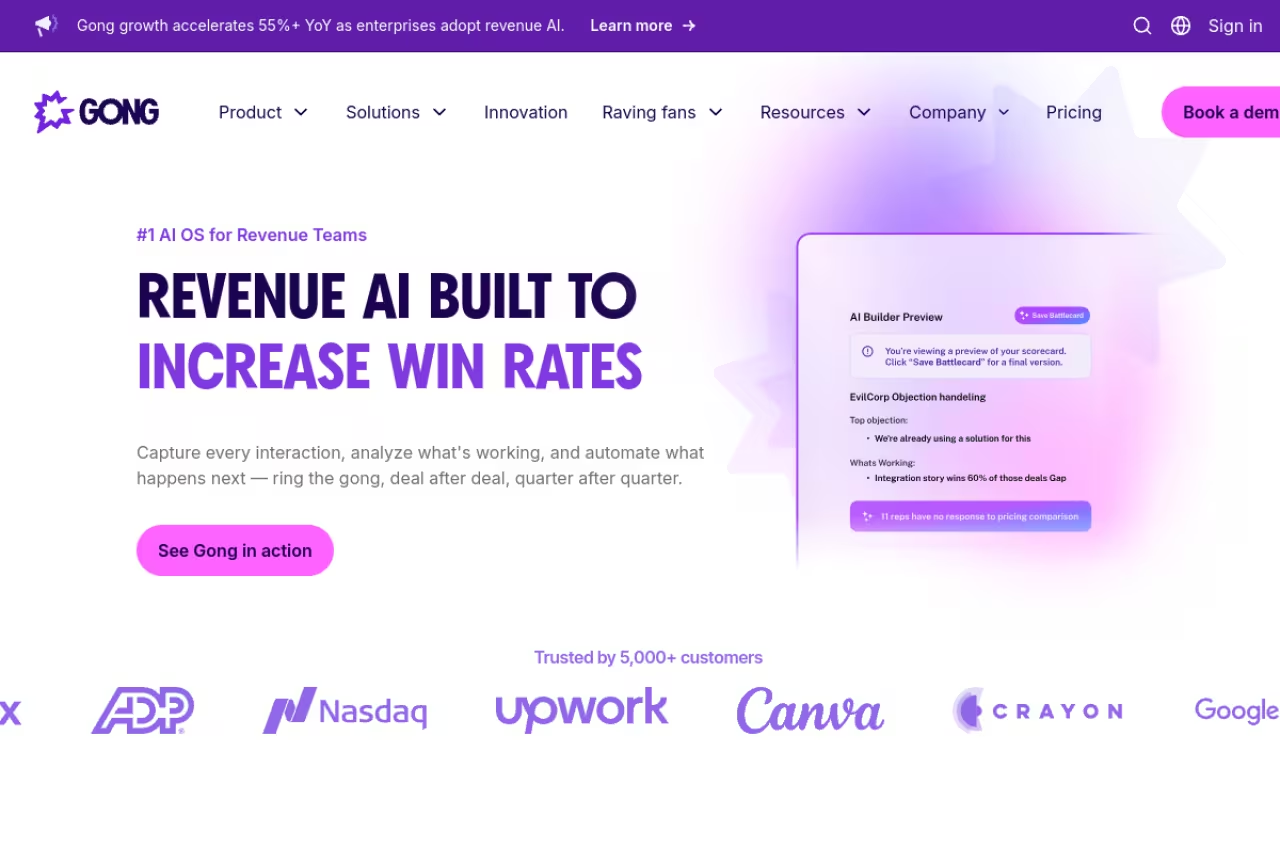
Gong built its reputation on conversation intelligence: recording, transcribing, and analyzing every sales call to surface what actually moves deals. In 2026 it calls itself the "AI OS for Revenue Teams," and it backs that up. The platform now spans Gong Engage (sales engagement), Gong Forecast (pipeline and forecasting), and the new Gong Enable for enablement, all sitting on top of what Gong calls its Revenue Graph.
The big shift this year is Mission Andromeda, shipped in February 2026. It adds an Agent Studio, an AI Trainer, and open MCP support so Gong's agents can talk to your other tools. If you've used Gong before and found it a passive recorder, the new version pushes follow-ups, pipeline edits, and forecast updates on its own.
Who it's best for: Sales orgs where coaching and call analysis are the weak spot. Managers who want to know which reps mishandle objections, where deals stall, and which competitor keeps coming up.
Still the one to beat for sales orgs where coaching and call analysis are the weak spot, now pushing follow-ups and forecast updates on its own. It is expensive, modules cost extra, and teams under 15 reps pay enterprise prices for capabilities they may not use.
No public list price. Mid-market teams typically land around $1,200 to $1,600 per user per year, with Engage and Forecast priced as separate modules. Expect a platform fee on top.
The catch: Gong is expensive and it knows it. Forecast and Engage cost extra, so the all-in number climbs quickly. For a team under 15 reps, you're paying enterprise prices for capabilities you may not fully use. And the contract is annual, so there's no easy month-to-month trial.
Clari: the forecasting heavyweight
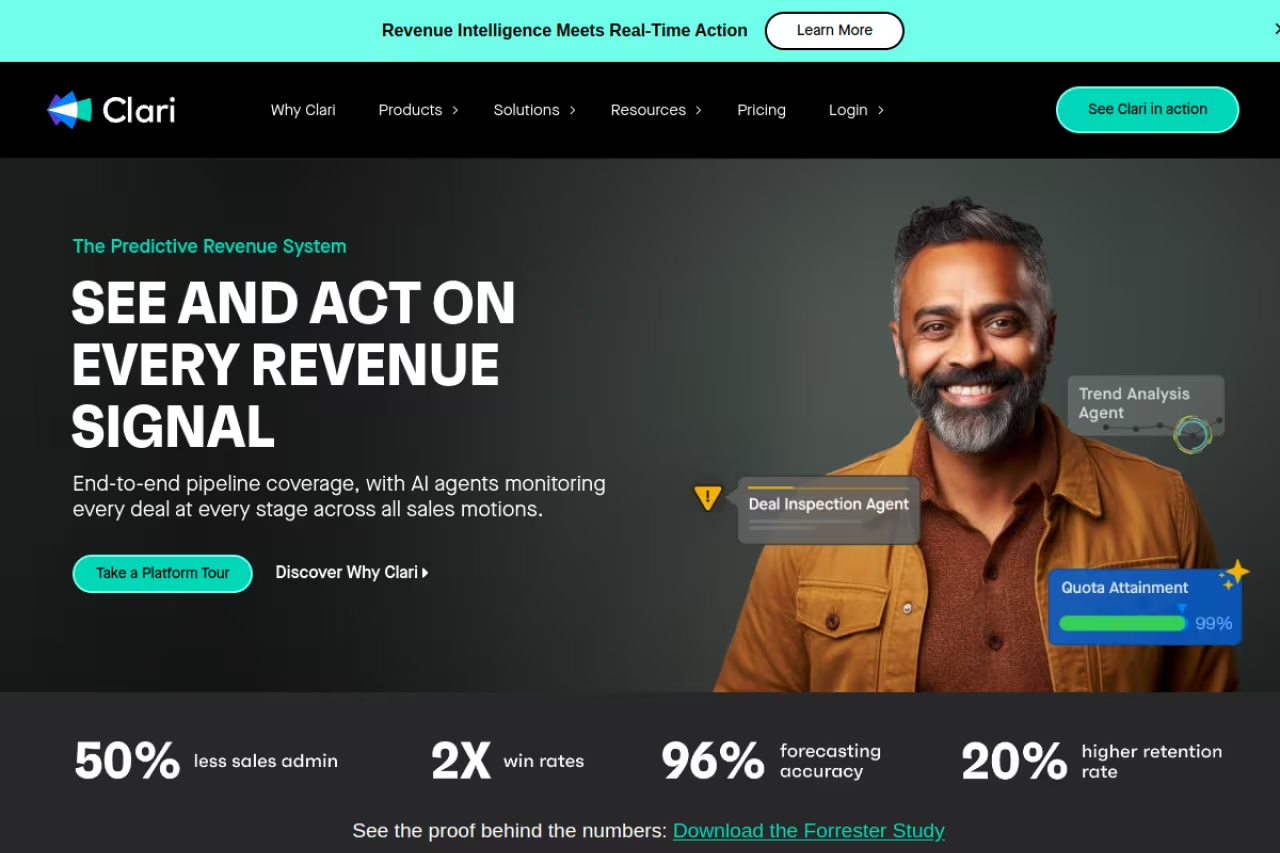
Clari came at this from the opposite direction. It started as a forecasting and pipeline platform, and that's still where it's strongest. It describes itself as "The Predictive Revenue System" and says it manages over $5 trillion in revenue for 1,500+ customers. If your CRO needs to walk into a board meeting and defend a number, Clari is built for that conversation.
The 2026 wrinkle is the Salesloft merger, announced in August 2025. Clari now folds in Groove for engagement, Copilot for conversation intelligence, and RevAI agents that automate deal inspection and forecasting. On paper it's an end-to-end revenue stack. In practice, several reviewers point out the merged platform still feels fragmented, with two conversation intelligence systems and two engagement tools bolted onto one forecasting engine.
Who it's best for: Enterprise RevOps and finance teams that live and die by forecast accuracy and pipeline governance. Companies with messy multi-source data that need one source of truth.
The forecasting heavyweight for enterprise RevOps and finance teams that must defend a number and need one source of truth. It is overkill for small teams, the post-merger platform still feels fragmented, and coaching-first teams usually prefer Gong.
Quote-only. Bundled estimates put the combined Forecast plus Copilot stack at roughly $200 to $400 per user per month, with implementation running $15K to $75K over an 8 to 16 week rollout.
Where it falls short: Clari is overkill for small teams, and the post-merger product sprawl means you're betting on a roadmap that's still settling. Conversation intelligence is real but not its native strength, so coaching-first teams usually prefer Gong.

Aviso: the agentic all-in-one
Aviso positions itself as an end-to-end AI revenue platform, and it leans hard into agents. The pitch is 50+ task-based agents and 30+ pre-built workflows covering everyone from BDRs to CROs, with forecasting, conversation intelligence, pipeline inspection, and coaching under one roof. The appeal is consolidation: instead of stitching Gong plus Clari plus an engagement tool, you buy one platform.
I like Aviso for teams tired of integration tax. The forecasting is genuinely strong, and the agentic layer does real work rather than just summarizing calls. It positions itself directly against the Clari-Salesloft merger by arguing one native platform beats two stapled-together ones.
Who it's best for: Mid-market to enterprise RevOps teams that want forecasting, conversation intelligence, and agents in a single contract without managing multiple vendors.
A consolidation play for mid-market to enterprise RevOps teams tired of integration tax, with strong forecasting and agents that do real work. It is less of a household name, pricing is not transparent and there is no self-serve trial.
Custom, typically $40,000 to $100,000 annually depending on modules and seat count.
The catch: It's less of a household name than Gong or Clari, so internal buy-in can take longer. And like every enterprise platform here, there's no transparent pricing and no self-serve trial. You're committing to a sales cycle and an onboarding before you see results.

Avoma: revenue intelligence without the enterprise tax
This is the one I recommend to smaller teams who read the prices above and winced. Avoma started as an AI meeting assistant and grew into a real revenue intelligence platform, with the key difference being price transparency. Plans run $19/user/month (Startup), $29 (Organization), and $39 (Enterprise) on annual billing, and the Revenue Intelligence add-on is $29/user/month.
That add-on is the part that matters here: AI deal risk alerts, deal health scoring, sales methodology tracking tied to frameworks like MEDDIC and SPICED, win-loss analysis, and pipeline forecasting that writes back to your CRM. For a 10-person sales team, you're looking at a few thousand dollars a year instead of tens of thousands.
Who it's best for: Startups and small-to-mid sales teams that want deal intelligence and forecasting without a six-figure commitment. Teams already using Avoma for meeting notes who want to expand.
The pick for startups and small-to-mid sales teams that want deal intelligence and forecasting without a six-figure commitment. It will not match Gong's conversation depth or Clari's forecasting at enterprise scale, but for everyone else the value is hard to beat.
$19-39/user/month base, plus $29/user/month for Revenue Intelligence. There's a 14-day full-feature trial, no card required.
Where it falls short: It won't match Gong's depth of conversation analysis or Clari's forecasting muscle at true enterprise scale. If you have hundreds of reps and complex multi-product pipelines, you'll outgrow it. For everyone else, the value is hard to beat.
Choosing the right stack is a margin decision as much as a tooling one, and the same logic applies to the AI subscriptions your whole team runs on. If you're trying to keep that spend sane, Dupple X bundles the major AI tools into one plan.
Terret (formerly BoostUp): forecasting for modern revenue models
BoostUp rebranded as Terret in September 2025, repositioning from a forecasting tool into an "answer-to-action" engine with a fleet of AI revenue agents. The forecasting roots still show, and that's the strength. Terret handles multi-dimensional forecasting well: SaaS, consumption, PLG, and renewals, which is exactly where Clari's older models tend to creak.
Customers like MongoDB, Cloudflare, and Carta use it, which tells you it holds up at scale. The product splits into Nexus (the core engine), Forecast (pipeline prediction), and Conversation Intelligence.
Who it's best for: Companies with non-traditional revenue models. If you sell usage-based or PLG and standard opportunity-stage forecasting misses your reality, Terret's flexibility pays off.
Choose Terret if you sell usage-based or PLG and standard opportunity-stage forecasting misses your reality. The rebrand still confuses buyers, and the agent roadmap is newer than the proven forecasting core.
Custom, generally in the $40,000 to $100,000 per year range like its enterprise peers.
The catch: The rebrand is recent enough that the name still confuses buyers, and documentation across the web is a mix of "BoostUp" and "Terret." You're also early on the agent roadmap, so some of the "fleet" is newer than the proven forecasting core.
ZoomInfo (with Chorus): data and conversation in one buy
If your team already runs on ZoomInfo, its Chorus conversation intelligence and Copilot AI layer are the path of least resistance. You get prospecting data, buying signals, and call analysis in a single platform, which removes a lot of integration headaches.
The honest framing: you can't really buy Chorus standalone anymore. It's consolidated into ZoomInfo's bundles. Chorus on its own runs around $8,000/year for 3 seats with additional seats near $1,200 each, but bundled with ZoomInfo you're typically looking at $35K to $50K per year for a 10-user deal once Copilot and intent data are included.
Who it's best for: Teams already committed to ZoomInfo for data, who want conversation intelligence without adding another vendor.
Where it falls short: If you're not already a ZoomInfo customer, this is an expensive on-ramp. The conversation intelligence is solid but not as coaching-focused as Gong, and you're buying into ZoomInfo's whole ecosystem and credit-based pricing to get it.
The path of least resistance for teams already committed to ZoomInfo for data who want conversation intelligence without another vendor. For everyone else it is an expensive on-ramp, and it is less coaching-focused than Gong.
Salesloft: engagement-first, now Clari-powered
Salesloft is the engagement half of the Clari merger. Its core has always been cadences, sequences, and rep workflow, the day-to-day execution layer. With Clari's forecasting now attached, it pitches a loop from outreach through to predictable revenue.
For teams under 15 reps, Salesloft often delivers a better ROI than Gong: similar call intelligence and engagement at a lower cost. The trade-off is the same merger uncertainty that hangs over Clari. You're buying into a combined roadmap that's still being unified.
Who it's best for: Sales teams where execution and cadence discipline matter more than deep forecasting. Mid-market orgs that want engagement plus a forecasting upgrade path.
The catch: Standalone pricing is now custom and routed through Clari's sales motion. And the two-product integration is a work in progress, so expect some rough edges between the engagement and forecasting sides.
A fit for mid-market sales teams where execution and cadence discipline matter more than deep forecasting. For teams under 15 reps it often beats Gong on ROI, but merger uncertainty and rough edges between engagement and forecasting remain.
Sybill: lightweight automation for lean teams
Sybill is the scrappy pick. It focuses narrowly on sales conversation analysis, buyer sentiment mapping, and automatic CRM updates. It's not trying to be an enterprise revenue OS. It's trying to save individual reps the busywork of writing notes and updating Salesforce after every call.
At $49/user/month (Starter) and $99 (Professional), it sits between Avoma and the enterprise platforms. The sentiment tracking is genuinely useful for reading how a buyer felt during a call, and the auto-CRM updates remove a real chore.
Who it's best for: Lean sales teams and individual reps who want sentiment analysis and CRM automation without a platform-sized commitment.
Where it falls short: It's not a forecasting platform, and it won't give RevOps the pipeline governance the bigger tools do. Think of it as a focused assistant, not a system of record.
A focused assistant for lean sales teams and individual reps who want sentiment analysis and automatic CRM updates without a platform-sized commitment. It is not a forecasting platform and gives RevOps little pipeline governance.
How to choose
Skip the feature checklists and answer one question: what's your biggest gap right now?
- Forecast accuracy is the problem? Start with Clari (enterprise) or Terret (non-standard revenue models). Both are forecasting-native.
- Reps need coaching and you can't see inside calls? Gong, full stop. It's still the conversation intelligence leader.
- You want one platform instead of a stack? Aviso for the agentic all-in-one, or ZoomInfo if you're already on it for data.
- Budget is tight and you're under ~30 reps? Avoma with the Revenue Intelligence add-on, or Sybill for pure automation.
Then weigh two things the demos won't tell you: implementation time and data readiness. The Clari Labs research found 48% of enterprises say their revenue data isn't AI-ready. The best platform on a messy CRM still produces a messy forecast. If your data is a swamp, fix that before you sign a six-figure contract.
For the wider sales stack around these tools, our guides on the best AI sales tools and best AI sales assistants cover the prospecting and outreach side, and the best AI meeting assistants roundup goes deeper on the conversation-recording layer. If agents are where you're headed, the best AI agents overview is a useful companion. You can also browse our full top tools directory.
One more practical note: most of these platforms run on the same underlying AI models you're already paying for elsewhere. If you want to consolidate the AI subscriptions your sales and RevOps teams use day to day, Dupple X puts the major tools under one plan.
FAQ
What is a revenue intelligence platform?
A revenue intelligence platform pulls data from your calls, emails, meetings, and CRM into one system, then uses AI to surface deal risk, forecast revenue, and coach reps. The goal is replacing gut-feel pipeline reviews with signals from what's actually happening in deals. Gong, Clari, and Aviso are the leading examples in 2026.
Is Gong or Clari better in 2026?
It depends on your gap. Gong is the better choice if conversation intelligence and rep coaching are your weak spots, since it analyzes calls in more depth than anything else. Clari wins if forecasting accuracy and pipeline governance are the priority, especially at enterprise scale. Many large orgs run both, but most teams should pick based on their single biggest pain.
How much does revenue intelligence software cost?
Enterprise platforms like Gong, Clari, Aviso, and Terret run roughly $1,200 to $400 per user per month, or $40,000 to $100,000+ per year for full deployments, almost always quote-only. Budget options change the math entirely: Avoma starts at $19/user/month with a $29 Revenue Intelligence add-on, and Sybill runs $49 to $99 per user per month.
Can small teams afford revenue intelligence tools?
Yes. The enterprise platforms price out most small teams, but Avoma and Sybill are built for budget-conscious buyers. Avoma's Revenue Intelligence add-on gives you deal risk scoring, forecasting, and win-loss analysis for a fraction of what Gong or Clari cost. For teams under about 30 reps, these are usually the smarter starting point.
Did Clari and Salesloft merge?
Yes. The merger was announced in August 2025, bringing Salesloft's sales engagement together with Clari's forecasting platform. Clari now includes Groove for engagement, Copilot for conversation intelligence, and RevAI agents. The combined product is still being unified, so some reviewers note it feels fragmented across two engagement and two conversation intelligence systems.
What's the difference between revenue intelligence and conversation intelligence?
Conversation intelligence is narrower: it records and analyzes calls and meetings (think Chorus or Sybill). Revenue intelligence is the broader category that includes conversation data plus forecasting, pipeline inspection, deal scoring, and CRM signals. Most modern platforms like Gong and Clari now do both, but a tool that only analyzes calls is conversation intelligence, not full revenue intelligence.
Related guides
Some offers on this page may be paid placements or contain affiliate links.
