
Best Marketplace Transactability Platforms in 2026

Key facts8 platforms compared: Stripe Connect, Mangopay, Adyen for Platforms, Ryft, Finix, Airwallex…
- 8 platforms compared: Stripe Connect, Mangopay, Adyen for Platforms, Ryft, Finix, Airwallex, Sharetribe, Marketplacer
- Stripe Connect (best for: Most platforms wanting fast launch): $2/active account/mo + 0.25% payout (Express)
- Mangopay (best for: EU marketplaces needing escrow/e-wallets): Sales-led, custom
- Adyen for Platforms (best for: High-volume enterprise marketplaces): Interchange++, monthly minimums
- Ryft (best for: UK/EU split-payment marketplaces): Volume-based, monthly minimum
"Transactability" is one of those words that sounds like jargon until you try to ship a marketplace and realize it is the entire problem. The moment you have buyers paying sellers through your platform, you inherit a stack of work that has nothing to do with your product: seller onboarding, KYC and KYB checks, splitting a single payment across multiple parties, holding funds in escrow, paying everyone out, and staying compliant in every country you touch. Get it wrong and your accounts get frozen, your sellers don't get paid, and your growth stalls.
I've compared the docs and pricing pages of all of these platforms, and dug deeper into the implementation guides for the ones founders ask about most. The short version: if you're a software platform or marketplace and you want the fastest path to taking money and paying sellers, Stripe Connect is still the default that fits the most situations. But "default" is not "best for you." A high-volume enterprise marketplace, a UK platform splitting payments across hundreds of sellers, or a team that wants to become its own payment facilitator will each land somewhere else.
This guide is for founders, operators, and engineers deciding what to build on. I'll give you real pricing, the standout feature for each, and where each one falls short. Skim the table, then read the two or three that match your stage.
Quick comparison
| Platform | Best for | Price | Standout |
|---|---|---|---|
| Stripe Connect | Most platforms wanting fast launch | $2/active account/mo + 0.25% payout (Express) | Ecosystem + onboarding |
| Mangopay | EU marketplaces needing escrow/e-wallets | Sales-led, custom | Flexible e-wallet ledger |
| Adyen for Platforms | High-volume enterprise marketplaces | Interchange++, monthly minimums | Unified global acquiring |
| Ryft | UK/EU split-payment marketplaces | Volume-based, monthly minimum | Unlimited splits per txn |
| Finix | Platforms going PayFac in 24-36 months | Custom, interchange-plus | Path to own underwriting |
| Airwallex | Cross-border multi-currency payouts | 0.5%-1% FX, ~1.65% + $0.30 cards | Global payout rails |
| Sharetribe | No-code marketplace founders | $39-$299/mo | Full marketplace + payments bundled |
| Marketplacer | B2B/enterprise multi-vendor commerce | Enterprise, custom | Headless marketplace engine |
Stripe Connect
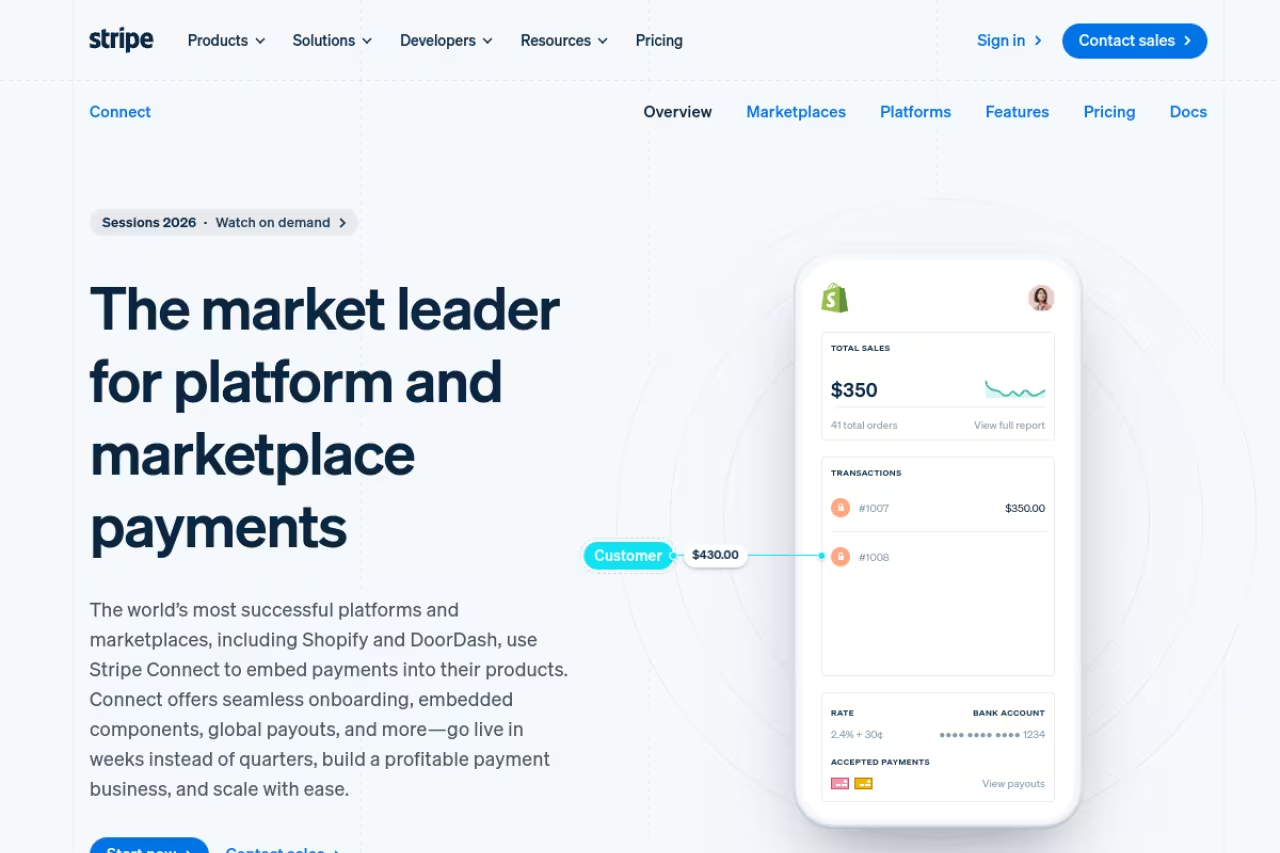
Stripe Connect is the payments layer for platforms and marketplaces inside the broader Stripe ecosystem. You create "connected accounts" for your sellers, onboard them through Stripe's hosted flow, charge buyers, split the money, and pay sellers out. It supports onboarding across 46+ countries and handles the KYC and compliance work most teams dread building.
Who it's best for: almost any early-to-mid-stage software platform that already values shipping speed over squeezing the last basis point out of fees. If your team is small and you want to launch this quarter, this is the safe pick.
The safe pick for early-to-mid-stage software platforms that value shipping speed over squeezing out the last basis point of fees. Pricing is the most transparent of the bunch, though per-account, payout and currency conversion fees stack up.
Pricing is the most transparent of the bunch. Standard transaction fees apply (2.9% + 30¢ for online card charges), then Express and Custom connected accounts cost $2 per monthly active account plus 0.25% with a 25¢ minimum per payout, per Stripe's published Connect rates. Currency conversion adds another 1%.
The standout is the ecosystem. Billing, Radar fraud tools, Tax, Issuing, and Capital all plug into the same connected accounts, so you can add features without re-integrating. Onboarding components drop into your UI and shoulder the compliance burden.
The catch: the pricing is flat and non-negotiable until you're very large, so processing costs don't fall as you scale. Marketplaces splitting one payment across many sellers feel that flat rate compound. Support is slow, branding is limited on the cheaper account types, and account freezes (sudden, with little warning) are the most common complaint that pushes founders to look elsewhere.
Mangopay
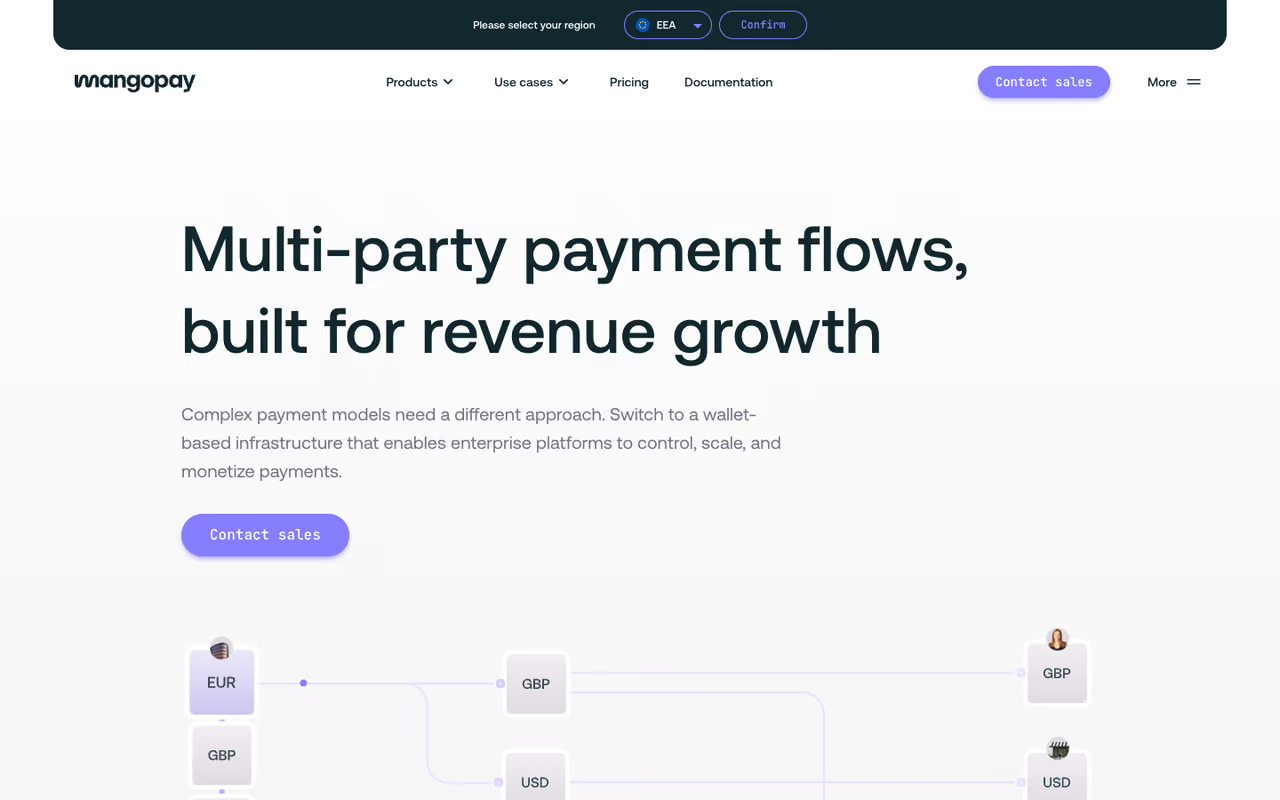
Mangopay is European payment infrastructure built specifically for marketplaces, crowdfunding platforms, and the sharing economy. Its defining idea is the e-wallet: instead of money flowing straight through, funds sit in programmable wallets you control, so you can collect, hold, split, reuse, and reconcile money on your own ledger.
Who it's best for: EU marketplaces that need real escrow logic. If you hold funds until a job is done, release on delivery, or run complex multi-party splits, the wallet model is cleaner than bolting escrow onto a pure pass-through processor.
The cleaner choice for EU marketplaces that need real escrow logic, thanks to programmable wallets that hold, split and release funds. Pricing is sales-led with no published plans, so you cannot model costs before talking to sales.
Pricing is sales-led. Mangopay does not publish self-serve plans or a free tier on its pricing page; you talk to sales and get a custom quote. That opacity is the trade-off for the flexibility.
The standout is that wallet ledger plus KYC and KYB coverage for freelancers, individuals, and businesses across 170+ countries, with an AI fraud system watching behavior and device signals.
Where it falls short: no transparent pricing means you can't model costs before a sales call, and the e-wallet model adds conceptual overhead. If all you need is "charge buyer, pay seller," it's more machinery than the job requires. It's also Europe-first, so US-centric platforms should weigh that.
Ryft
Ryft is an FCA-regulated payments provider purpose-built for UK and European marketplaces. It is the one most often pitched as the direct Stripe Connect alternative for split-payment-heavy platforms, and the pitch holds up where geography matches.
Who it's best for: UK and EU marketplaces where a single transaction splits across many sellers and the flat-rate math on Stripe starts to hurt. Ryft handles splits to effectively unlimited sellers per transaction in real time, with commission rates configurable per seller, item, or transaction type, and no manual reconciliation.
A credible Stripe Connect alternative for UK and EU marketplaces where one transaction splits across many sellers, with FCA regulation and real-time splits. Pricing is volume-based and quote-only, and a monthly minimum fee matters at small scale.
Pricing is volume-based, meaning the per-transaction cost falls as you grow rather than staying fixed. Ryft doesn't publish tiered numbers on the homepage, so you request a quote, and one published case study claims a 62% reduction in payment costs versus the prior setup. There is a monthly minimum fee, which matters below.
The standout is that split engine paired with PSD2 compliance, PCI DSS Level 1, white-label checkout, and 24/7 support, which is rare in this category.
The catch: Ryft only covers the UK and Europe, so this is a non-starter if you operate in the US or globally. And the monthly minimum makes it a poor fit for pre-revenue or very early marketplaces still validating demand.

Adyen for Platforms
Adyen for Platforms is the enterprise option. It gives marketplaces a single global acquiring connection with split payments, delayed payouts, and the compliance machinery that very large platforms need. When you authorize a payment, you split the amount across balance accounts in the same request, booking the sale, your commission, fees, and the remainder separately, as many splits as you need.
Who it's best for: high-volume marketplaces with a dedicated payments or engineering team, typically processing eight figures a year and up. If you're operating across many countries and want one acquirer instead of stitching regional processors together, Adyen earns its keep.
The enterprise option for high-volume marketplaces with a dedicated payments team that want one global acquirer with flexible split payments. Interchange++ pricing is cheapest at scale but opaque, and it only pays off at volume.
Pricing uses Interchange++ with monthly minimum invoice requirements that vary by industry and business model, per Adyen's transaction-fee docs. Interchange-plus is genuinely the cheapest structure at scale because you see the true cost plus a fixed markup, but it's opaque and only pays off at volume.
The standout is global reach with deep optimization: better authorization rates, local payment methods everywhere, and split flexibility built into the core.
Where it falls short: it's overkill for small teams. The monthly minimums, longer implementation cycles, and enterprise sales process make it a bad fit for a marketplace doing five or six figures. Pricing details like FX and dispute fees aren't public, so budgeting needs a sales conversation.
Finix
Finix is payments infrastructure as a service with one developer-friendly API to accept payments, manage payouts, and onboard merchants. Its distinct angle: it's built for platforms that want to eventually become their own payment facilitator and capture more of the payment margin.
Who it's best for: platforms planning to take the underwriting decision in-house and register as a PayFac within roughly 24 to 36 months. Finix is designed for that transition, where competitors assume they stay a permanent intermediary. Regulated verticals (healthcare, insurance, lending) benefit from its tunable risk thresholds and custom underwriting prompts.
The pick for platforms that plan to become their own payment facilitator, with a deliberate PayFac path and tunable risk thresholds for regulated verticals. Pricing is custom and quote-based, so expect a sales call, and the ambition is wasted if you never plan to own payments.
Pricing is custom and quote-based, typically interchange-plus, with reviewers citing transparent pricing as a deciding factor. No public numbers, so expect a sales call.
The standout is the PayFac path. If owning payments economics is a strategic goal rather than a side feature, Finix is one of the few that maps a deliberate route there instead of locking you into being a reseller forever.
The catch: that ambition is wasted on a simple marketplace. If you have no intention of becoming a PayFac, the added control is complexity you'll pay for and never use. It also leans US-centric.
If you're evaluating payment infrastructure this carefully, you're past the "scrappy MVP" stage, and the tooling around your platform matters as much as the rails underneath it. Keeping a tight feedback loop on the AI tools your team uses is exactly what Dupple X is built for.

Airwallex
Airwallex is a global financial platform that's strong specifically on the cross-border and multi-currency side of transactability. It serves over 100,000 businesses with payment acceptance, global accounts, and a payouts API that pays suppliers and sellers in their local currencies.
Who it's best for: marketplaces with international sellers where FX and same-day payouts are the real pain. If you're losing margin to bank wire fees and slow conversions, Airwallex's rails are built for exactly that.
The strongest fit for marketplaces with international sellers where FX and fast local-currency payouts are the real pain, with fairly transparent pricing. It is a financial platform first, not a marketplace-native split-payments engine.
Pricing is among the more transparent: roughly 0.5% FX on major currencies and 1% on others, with card processing around 1.65% + $0.30 domestic and 3.40% + $0.30 international, per Airwallex's published pricing. It claims 93% same-day payouts.
The standout is the global payout network. Paying out to many countries cheaply and fast is its own hard problem, and Airwallex solves it better than most general processors.
Where it falls short: it's a financial platform first, not a marketplace-native split-payments engine. The seller onboarding and per-transaction split tooling aren't as turnkey as Mangopay or Ryft, so you do more assembly to get true marketplace flows.

Sharetribe
Sharetribe is the odd one out: not just payment rails but a near-complete marketplace you can launch without code, with transactions built in via Stripe under the hood. You get listings, search, user profiles, reviews, and the payment flow in one package.
Who it's best for: non-technical founders validating a marketplace idea fast, or teams that want a working product live before investing in custom engineering. It claims to cut roughly 90% of the time and cost to build a marketplace.
The odd one out: a near-complete no-code marketplace you can have live in days, with transactions built in via Stripe. You inherit Stripe's flat fees on top of the subscription, which stings for high-volume or low-margin marketplaces.
Pricing is the most predictable here: plans run from $39 to $299 per month with a 14-day free trial, per Sharetribe's pricing page. A fully white-labeled marketplace starts around $119/month.
The standout is speed. You can have a transactable marketplace live in days, then extend with code when you outgrow the no-code surface.
The catch: transactability rides on Stripe Connect, so you inherit Stripe's flat fees on top of Sharetribe's subscription. And high-volume or low-margin marketplaces feel the subscription cost more as they scale, since you're paying for the whole platform, not just payments. For pure payment flexibility, a direct integration wins.
Marketplacer
Marketplacer is an enterprise, headless marketplace engine, recognized as a New Wave Leader by Forrester for marketplace development platforms. It handles the third-party product engine underneath your existing storefront, whether that's Shopify, Salesforce, or Adobe Commerce.
Who it's best for: established B2B and retail brands adding a multi-vendor marketplace to an existing commerce stack. It gives you governance over supplier access, listings, pricing, and product vetting, with order orchestration and payments handled in the layer below.
An enterprise, headless marketplace engine for established B2B and retail brands adding multi-vendor selling to an existing commerce stack. It is heavy and sales-led, far more platform than an early-stage two-sided marketplace needs.
Pricing is enterprise and custom, so this is a sales-led, board-level decision, not a self-serve sign-up.
The standout is the operating-system view of a marketplace: it treats vendor management, product approval, and order routing as first-class problems, which is exactly what enterprise B2B marketplaces hit at scale.
Where it falls short: it's heavy. For an early-stage two-sided marketplace, this is far more platform than you need, and the enterprise pricing and integration timeline reflect that. It's a fit when marketplace is a strategic line of business, not an experiment.
How to choose
Match the tool to your stage and geography, not the other way around.
Start with launch speed. No code and need it live this month? Sharetribe. Have engineers and want a fast, flexible integration? Stripe Connect.
Then weigh geography. UK or EU only, with heavy splits? Ryft. Lots of international sellers and FX pain? Airwallex. Europe-first with escrow needs? Mangopay.
Then weigh scale and ambition. Eight figures plus with a payments team? Adyen. Planning to become your own PayFac? Finix. Enterprise B2B bolting a marketplace onto an existing store? Marketplacer.
The honest default for most readers is Stripe Connect: start there, and only migrate when a specific pain (flat fees at scale, account freezes, missing local methods) forces a move. Picking the "perfect" infrastructure before you have transaction volume is a way to burn months you don't have.
FAQ
What is marketplace transactability?
Transactability is a marketplace's ability to actually process money between buyers and sellers: accepting payments, verifying sellers with KYC/KYB, splitting a single payment across multiple parties, holding funds in escrow, and paying everyone out compliantly. It's the financial plumbing that turns a directory of listings into a working marketplace.
Is Stripe Connect the best option for a new marketplace?
For most new marketplaces, yes, because it's transparent, fast to integrate, and handles onboarding and compliance out of the box. The main reasons to look elsewhere are flat fees that don't shrink as you scale, occasional account freezes, and limited branding on cheaper account types. If those don't apply to you yet, start with Stripe and migrate later.
Which platform is cheapest for high-volume marketplaces?
At real scale, Interchange++ structures like Adyen's and volume-based pricing like Ryft's beat flat rates because your per-transaction cost falls as you grow. The trade-off is opaque, quote-based pricing and monthly minimums, so they only pay off once you're processing serious volume, typically seven or eight figures a year.
What's the difference between a payment processor and a marketplace builder?
A payment processor (Stripe Connect, Mangopay, Adyen, Ryft, Finix, Airwallex) gives you only the rails: you build the marketplace around them. A marketplace builder (Sharetribe, Marketplacer) gives you the whole product (listings, search, vendor management) with transactability bundled in. Builders get you live faster; processors give you more control over the money flow.
Do I need to become a payment facilitator (PayFac)?
Most marketplaces don't. Becoming a PayFac lets you own more payment margin and control underwriting, but it adds real compliance and risk responsibility. It's worth it only if payments are a strategic revenue line and you'll process enough volume to justify the overhead. If that's the plan, Finix is built for the transition over a 24-36 month horizon. If it isn't, stay an intermediary.
Whichever rails you land on, the platform underneath is only half the battle. The team running it has to stay sharp on the tools and AI workflows that move the needle, which is what Dupple X helps with. For a wider view of the software in this space, browse our top tools, and if you're building with AI in the loop, our guides on the best AI agents and the best no-code app builders are worth a read.
Related guides
Some offers on this page may be paid placements or contain affiliate links.
