
Best AI Competitive Intelligence Tools (2026)

Key facts8 tools compared: Crayon, Klue, Visualping, AlphaSense, Kompyte, Similarweb, Contify, Hexowatch
- 8 tools compared: Crayon, Klue, Visualping, AlphaSense, Kompyte, Similarweb, Contify, Hexowatch
- Crayon (best for: All-around B2B CI programs): ~$20K-$40K/yr
- Klue (best for: Sales battlecards + deal intel): ~$20K-$40K/yr
- Visualping (best for: Watching competitor pages): Free; paid from ~$14/mo
- AlphaSense (best for: Market + financial research): ~$12K-$50K/yr
Tracking competitors used to mean a poor analyst with 40 browser tabs, a Google Sheet, and a Slack channel nobody read. That job is being eaten by software. In 2025, 60% of competitive intelligence teams reported using AI tools daily, up 25 points from the year before, according to Crayon's State of Competitive Intelligence report. The tools went from "summarize this article" to agents that push battlecards to a rep mid-call.
The problem: most of these platforms hide their pricing behind a sales call, and the category splits into two very different worlds. One world is sales-led CI for B2B SaaS (think battlecards and win/loss). The other is enterprise market intelligence for analysts reading SEC filings. Buying the wrong one wastes five figures.
If you want one answer: Crayon is the best all-around AI competitive intelligence platform for most B2B teams in 2026. But the right pick depends heavily on whether you sell software, monitor pricing pages, or research markets. Below are the eight I'd actually recommend, who each is for, and where each one falls down. This is written for founders, marketers, and operators who need real intel, not a dashboard they'll abandon in a month.
Quick comparison
| Tool | Best for | Price | Standout |
|---|---|---|---|
| Crayon | All-around B2B CI programs | ~$20K-$40K/yr | Auto-summarized intel + battlecards |
| Klue | Sales battlecards + deal intel | ~$20K-$40K/yr | Compete Agent pushes intel to reps |
| Visualping | Watching competitor pages | Free; paid from ~$14/mo | AI "important change" flag |
| AlphaSense | Market + financial research | ~$12K-$50K/yr | Generative Grid over filings |
| Kompyte | Mid-market on a budget | From ~$300/yr | Daily site crawls, Semrush data |
| Similarweb | Traffic + market share | From $125/mo (annual) | Estimated competitor traffic |
| Contify | Market intelligence at scale | ~$15K-$30K/yr | Athena agentic insights engine |
| Hexowatch | Cheap multi-page monitoring | Free; paid from $29/mo | 13 monitor types, archived proof |

Crayon: the best all-around AI competitive intelligence platform
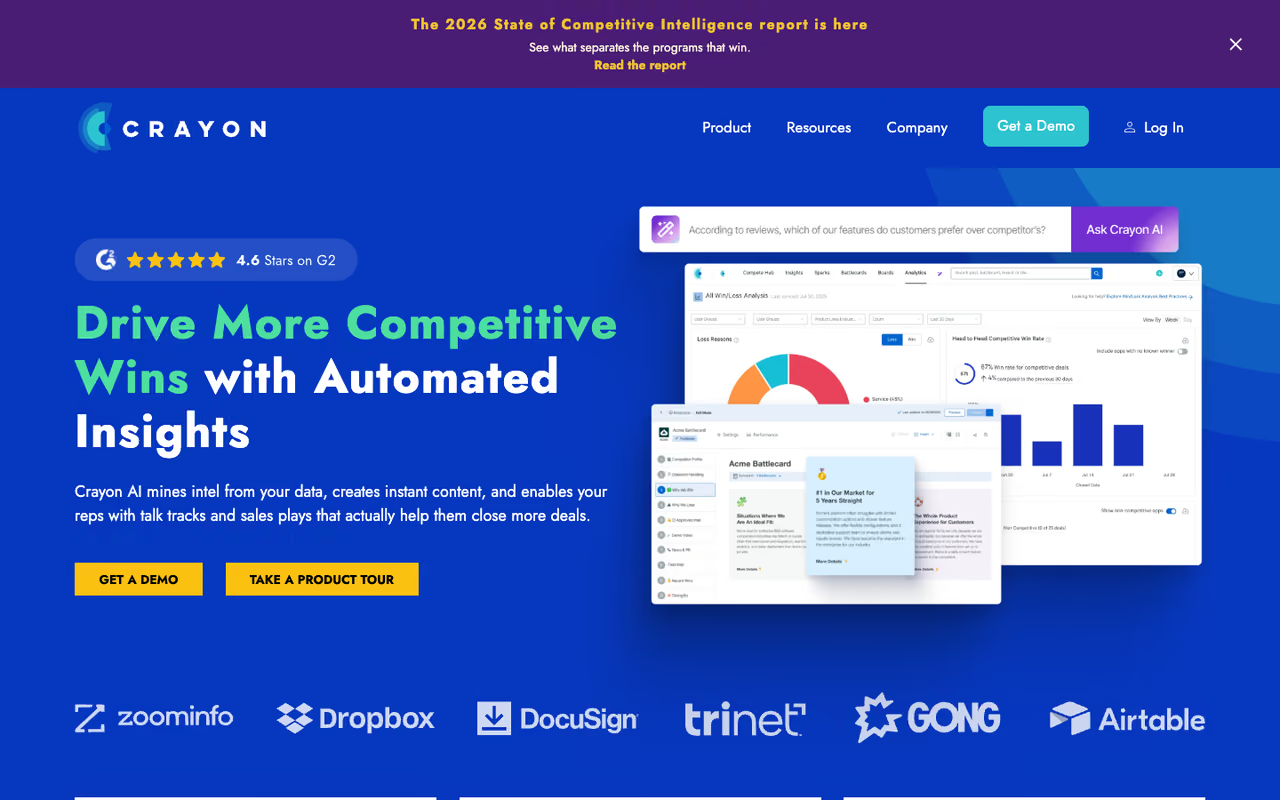
Crayon is the platform I'd hand to a competitive intelligence team that has to serve both marketing and sales. It crawls millions of sources daily (competitor sites, pricing pages, reviews, news, social, job posts) and uses AI to distill articles into takeaways, score them by importance, and surface what actually matters.
Who it's best for: B2B companies with a dedicated CI or product marketing function, tracking a defined set of competitors and arming a sales org.
The AI piece is the reason to buy now. Crayon AI summarizes raw intel into plain-English takeaways and drafts battlecards and sales plays from your data, which cuts the manual writing that kills most CI programs. The importance scoring means you're not drowning in noise.
Real pricing: Crayon doesn't publish rates. Third-party data from Vendr puts typical deployments in the $20K-$40K/year range, scaling up to $100K+ for large enterprise contracts. Cost is driven mostly by how many competitors you track, not seats, so you can roll it out to a big sales team without per-rep fees.
The catch: it's overkill (and over budget) for small teams or solo founders. There's no self-serve tier, and you'll sit through a sales process before you see a number. If you track three competitors, this is too much machinery.
The platform to hand a CI team serving both marketing and sales, with AI summaries and importance scoring that cut the noise. It is overkill for small teams, with no self-serve tier and typical deployments of $20K-$40K/year.

Klue: best for sales battlecards and live deal intelligence
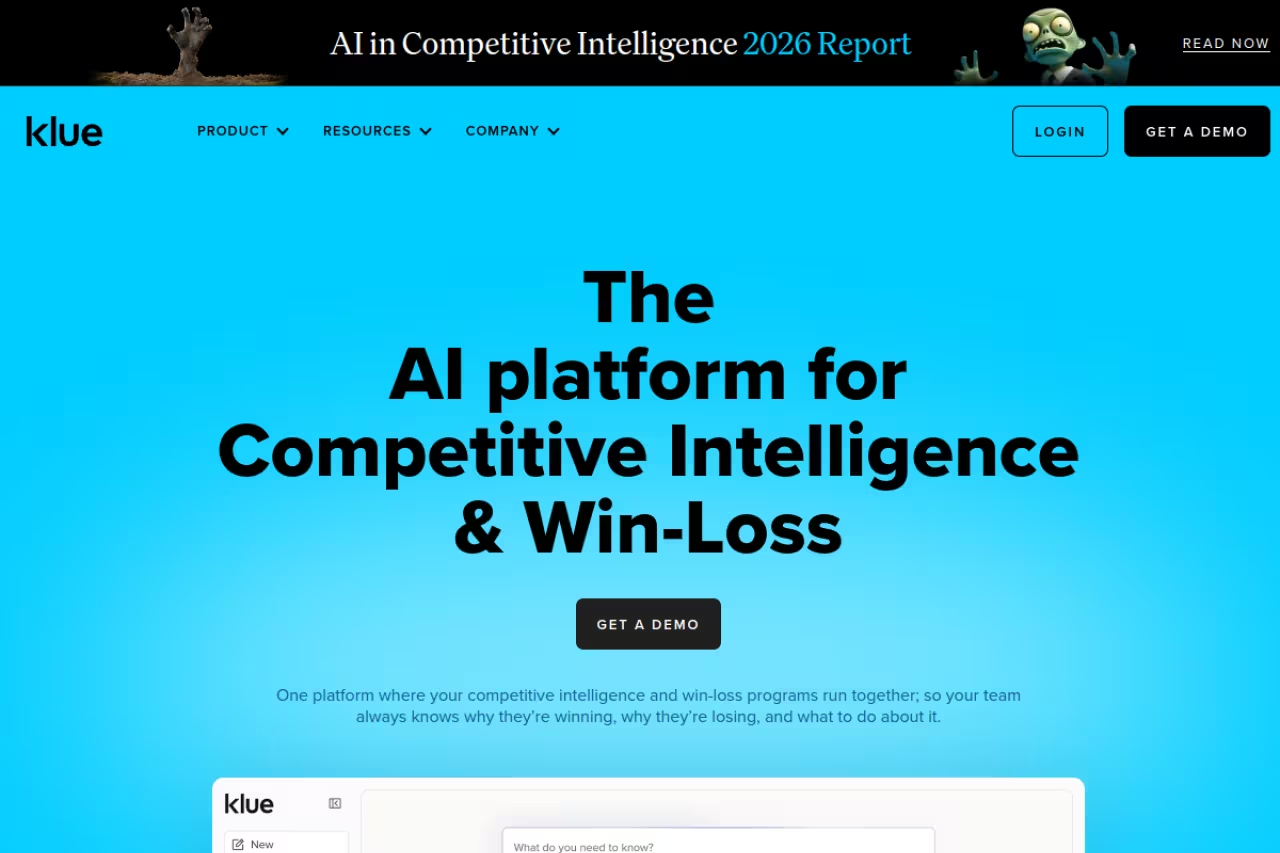
Klue is the platform most obsessed with one outcome: helping reps win competitive deals. It collects intel from thousands of sources, then turns it into dynamic battlecards that update themselves, plus competitive newsletters that keep the wider org informed.
Who it's best for: B2B SaaS sales enablement and product marketing teams where the metric that matters is competitive win rate.
The standout is Klue's agentic push. After acquiring Ignition in 2025, Klue launched its Compete Agent, which works 24/7 to keep battlecards current and delivers real-time competitive deal intel to sellers during active deals. That's the bet the whole category is making: dashboards you have to visit are out, agents that bring intel to you are in.
Real pricing: like Crayon, it's quote-only, generally $20K-$40K/year. Klue prices "curators" (admins) and "consumers" (reps) separately, with curators costing more.
The catch: the curator/consumer split can get confusing on renewal, and the deepest agentic features sit in higher tiers. If you don't run an active competitive sales motion, you're paying for muscle you won't use. For pure market research, AlphaSense fits better.
Pick Klue if the metric that matters is competitive win rate, since self-updating battlecards and the Compete Agent feed intel to reps during live deals. The curator/consumer pricing split can confuse at renewal, and without an active competitive sales motion you'll pay for unused muscle.
Visualping: the simplest way to watch competitor pages
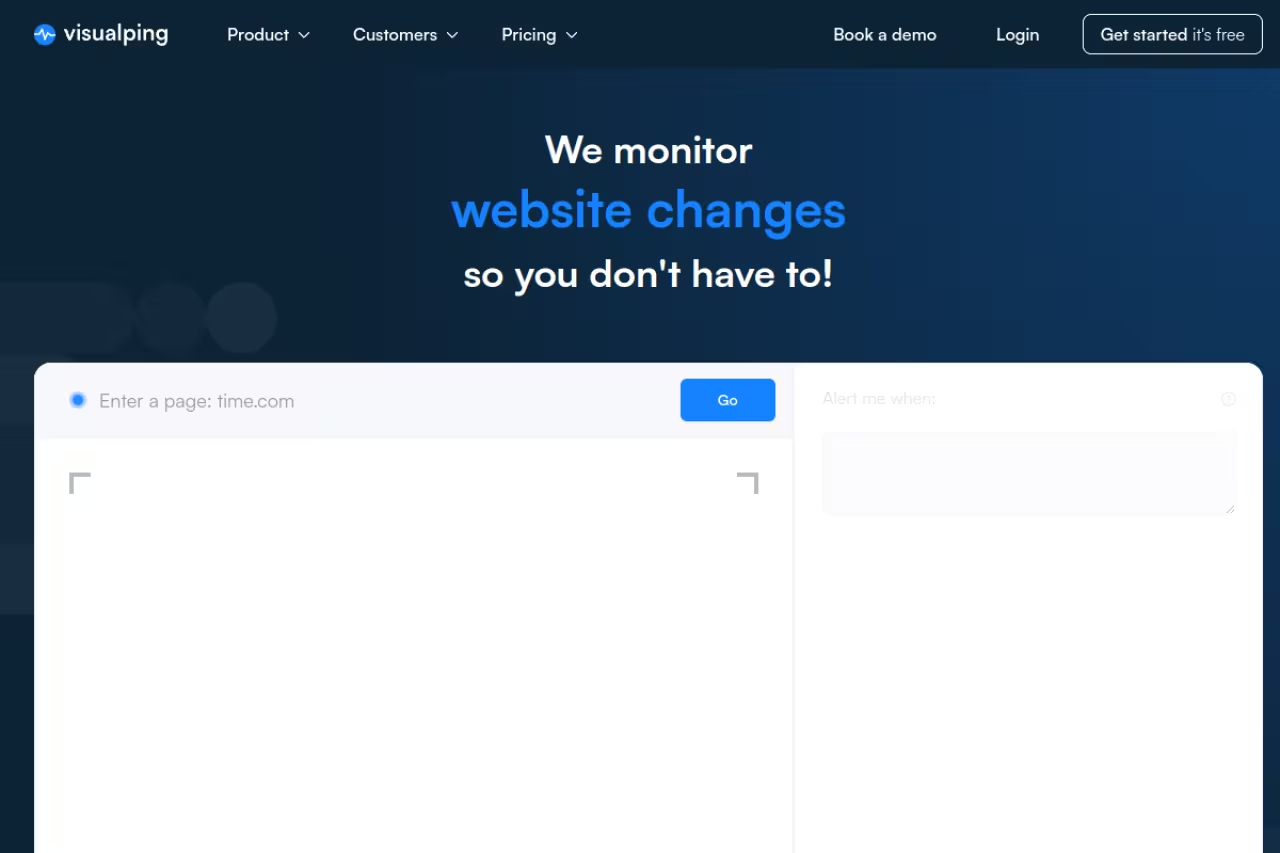
Visualping is where I send anyone who says "I just want to know when a competitor changes their pricing page." It monitors any web page for visual, text, or HTML changes and pings you when something moves. It's the highest-rated tool in G2's competitive intelligence category, and for good reason: it does one job well.
Who it's best for: marketers, founders, and small teams who want competitor monitoring without a CI platform's price tag or onboarding.
The AI layer is what makes it more than a diff tool. Every alert carries a binary "important" flag plus a plain-English summary of what changed, so you're not manually reading screenshots to spot a $2 price bump or a new headline.
Real pricing: the free plan covers 150 checks per month, and API access is included on every tier. Paid plans start around $14/month, and Business plans can check as often as every 30 seconds.
Where it falls short: it watches pages, it doesn't synthesize a strategy. You won't get battlecards or win/loss analysis. If you're tracking 50 pages across 10 competitors and want it all rolled into positioning, you'll outgrow it. For that, look at Kompyte or Crayon.
The simple way to watch competitor pages, and the one I send to anyone who just wants an alert when a pricing page changes. The free plan covers 150 checks per month, but it is not a full competitive intelligence platform.
If you're assembling a monitoring stack, our roundup of the best AI agents pairs well with tools like this for automating the follow-up.

AlphaSense: best for market and financial intelligence
AlphaSense plays a different game than the sales-led tools above. It's an enterprise market intelligence platform (roughly $500M ARR, $4B valuation) built for analysts who read SEC filings, earnings call transcripts, broker research, and expert call libraries. It uses NLP to understand query intent rather than just matching keywords.
Who it's best for: corporate strategy, finance, consulting, and life-sciences research teams who need depth across documents, not just competitor websites.
The standout is its AI suite. Generative Grid lets you ask natural-language questions across a large document set and get structured tables back, while Deep Research runs multi-step analysis across premium, paywalled sources and drafts reports. In October 2025 it added a Financial Data Suite that blends quantitative data with qualitative insight in one conversational view.
Real pricing: quote-based. Vendr's data shows a median contract around $18,375/year, ranging from roughly $12K to $51K and climbing past $100K for large teams. Pricing scales with seats and content library access.
The catch: this is the wrong tool if your goal is winning SaaS deals. There are no sales battlecards. You're paying for research firepower and a premium content library, which is wasted if you just want to track a competitor's homepage.
Built for analysts who need depth across SEC filings, earnings transcripts and broker research, not for winning SaaS deals. Generative Grid and Deep Research are powerful, but there are no battlecards, so it is wasted if you just track a competitor's homepage.
Kompyte: best budget option for mid-market teams
Kompyte was acquired by Semrush in 2022, which gives it a real edge: access to Semrush's web analytics and SEO data layered on top of its own monitoring. Its AI agent visits competitor sites daily, auto-classifies changes, and watches digital footprints across websites, reviews, social, ads, and job postings.
Who it's best for: mid-market companies that want automated competitor tracking and battlecards without enterprise CI pricing.
The standout is value. Kompyte offers unlimited battlecards and reports with no charge for swapping which competitors you track, and Kompyte GPT generates competitive analysis and battlecard drafts automatically. If you already pay for Semrush, bundling can lower the total cost.
Real pricing: Kompyte doesn't publish a rate card, but third-party data shows an Essentials tier starting around $300/year, with full deployments still sales-led. It's consistently cheaper than Crayon or Klue at comparable sizes.
Where it falls short: the cheap entry price is a teaser; serious deployments still go through sales and cost more. Reviewers note the UI feels less polished than Klue's, and the agentic features aren't as advanced as Klue's Compete Agent.
The budget-friendly option for mid-market teams that want automated tracking and battlecards without enterprise CI pricing, helped by Semrush data and unlimited battlecards. The cheap entry price is a teaser, though, and the UI and agentic features lag Klue.

Similarweb: best for traffic and market share data
Similarweb answers a question the CI platforms can't: how much traffic does my competitor actually get, and where does it come from? It estimates website and app traffic, traffic sources, audience overlap, and market share, which makes it the go-to for sizing a market or spotting a rival's growth channel.
Who it's best for: growth marketers, SEO teams, and strategy folks who need competitor traffic and channel data, not battlecards.
The standout is the breadth of its dataset. Beyond web traffic, Similarweb sells separate intelligence products for sales, apps, and shopper behavior, so you can see which keywords drive a competitor's organic traffic or which channels feed their funnel.
Real pricing: the self-serve Web Intelligence plans start at $125/month billed annually ($1,500/year) for the Competitive Intelligence tier, with no permanent free plan (just a 7-day trial). Enterprise deployments run from roughly $15K to $150K+.
The catch: the numbers are estimates, not ground truth, and accuracy drops for smaller sites with low traffic. Treat it as directional. And the genuinely useful data sits behind higher tiers, so the $125 plan can feel thin once you start digging.
The go-to for sizing a market or spotting a rival's growth channel, aimed at growth marketers and SEO teams rather than sales. The numbers are estimates that get shakier for small sites, and the $125 plan can feel thin once you dig in.
Contify: best for scaled market intelligence
Contify leans toward market intelligence over pure sales enablement. It aggregates and synthesizes data from over a million editorially curated sources covering 700,000+ companies and 100+ industry segments, then surfaces competitor moves and industry trends in real time. It was named a Visionary in the inaugural 2026 Gartner Magic Quadrant for Competitive and Market Intelligence Platforms.
Who it's best for: larger B2B organizations that need to track entire industries and competitor sets, not just a handful of rivals.
The standout is Athena, its agentic AI insights engine launched in 2025, which moves Contify toward generating intelligence autonomously rather than just collecting it. The editorial curation also means less spam in your feed than raw web scraping.
Real pricing: custom quotes only, generally in the $15K-$30K/year range depending on scope.
Where it falls short: it's less focused on the deal-level sales intel that Klue and Crayon nail. If your primary need is arming reps with battlecards mid-deal, Contify is more of a strategic radar than a sales weapon.
More strategic radar than sales weapon, suited to larger B2B organizations tracking whole industries from editorially curated sources. It is less focused than Klue or Crayon on deal-level battlecards, so reps mid-deal will want something else.
Hexowatch: cheapest way to monitor lots of pages
Hexowatch is the budget pick for monitoring many pages across many competitors. It tracks 13 types of changes (visual, content, source code, technology, availability, price, and more) and archives screenshots as proof, which is handy for pricing enforcement or compliance.
Who it's best for: solo operators and small teams who want to watch dozens of competitor pages cheaply and pipe alerts into their existing tools.
The standout is range plus integrations. It connects to Zapier, Slack, Telegram, Gmail, and Google Sheets, so you can route alerts into whatever workflow you already run, and the archived screenshots give you a paper trail.
Real pricing: there's a free tier with limited checks, and paid plans start at $29/month.
The catch: the AI summarization isn't as sharp as Visualping's "important" flagging, so you'll do more manual triage. It's a monitoring tool, full stop, with no battlecards or synthesis. Past a certain page count, the cheaper-than-everything math stops being cheaper.
The cheapest way for solo operators and small teams to watch dozens of competitor pages, with 13 change types, archived screenshots and plenty of integrations. It is a monitoring tool only, with weaker AI triage than Visualping and no synthesis.
How to choose the right tool
Start with the job, not the brand. Match yourself to one of these:
- You sell B2B software and need to win competitive deals. Go with Klue or Crayon. Pick Klue if live, in-deal agent intel is the priority. Pick Crayon if you want the strongest all-around blend of monitoring plus content for both marketing and sales.
- You just want to know when a competitor changes a page. Visualping for clean AI-summarized alerts; Hexowatch if you're monitoring many pages on a tight budget.
- You're doing market research or financial analysis. AlphaSense. It's a different category, built for document-deep research.
- You need traffic and market-share data. Similarweb. None of the CI platforms estimate competitor traffic this well.
- You're mid-market and price-sensitive but want a real CI platform. Kompyte, especially if you already run Semrush.
One honest note on budget: the enterprise platforms (Crayon, Klue, Contify, AlphaSense) all hide pricing and start in the five figures. If you can't commit $20K+ a year, start with Visualping or Hexowatch, build the monitoring habit, and graduate later. There's no shame in a $14/month tool that you actually check.
If you're building out a broader AI stack alongside your CI tooling, our top AI tools directory and the Dupple X bundle are worth a look for the adjacent pieces (writing, research, automation).
Want a weekly read on which of these tools are shipping real features versus marketing fluff? Dupple X tracks the AI tool space so you don't have to.
FAQ
What is the best AI competitive intelligence tool in 2026?
For most B2B teams, Crayon is the best all-around AI competitive intelligence tool because it combines daily multi-source monitoring, AI-summarized takeaways, and auto-generated battlecards in one platform. If your priority is winning live sales deals, Klue's Compete Agent edges it out. For market and financial research instead of sales enablement, AlphaSense is the stronger choice.
How much do AI competitive intelligence tools cost?
Dedicated enterprise CI platforms like Crayon, Klue, and Contify typically run $15K to $40K per year, with large deployments exceeding $100K. Pricing is usually quote-based and driven by how many competitors you track. Budget tools cost far less: Visualping is free up to 150 checks a month with paid plans from around $14, and Hexowatch starts at $29 a month.
Is there a free AI competitive intelligence tool?
Yes. Visualping offers a free plan with 150 page checks per month and AI summaries of what changed, and Hexowatch has a free tier with limited checks. Google Alerts is also free for basic news monitoring. The dedicated enterprise platforms (Crayon, Klue, Kompyte) don't offer free tiers and require a sales conversation.
What's the difference between Crayon and Klue?
Both are sales-led CI platforms in the same price range, but Crayon is the more balanced all-around choice for marketing plus sales, with strong automated monitoring and content generation. Klue is more focused on the sales deal itself, and its Compete Agent pushes real-time competitive intel to reps during active deals. Choose Crayon for breadth, Klue for in-deal sales firepower.
Can AI tools track competitor pricing changes automatically?
Yes, and this is one of the clearest wins for AI in competitive intelligence. Tools like Visualping and Hexowatch watch competitor pricing pages and alert you the moment a number changes, with screenshots as proof. Full CI platforms like Crayon and Kompyte fold pricing changes into broader competitor monitoring and flag them by importance, so you can act on a price move within hours instead of weeks.
Related guides
Some offers on this page may be paid placements or contain affiliate links.
