
The 8 Best AI Sales Assistants in 2026 (Compared and Ranked)

Key facts8 tools compared: Apollo.io, Clay, Gong, Lavender, 11x (Alice), HubSpot AI, Reply (Jason AI)…
- 8 tools compared: Apollo.io, Clay, Gong, Lavender, 11x (Alice), HubSpot AI, Reply (Jason AI), Salesforce Agentforce
- Apollo.io (best for: All-in-one outbound): $49-$119/user/mo
- Clay (best for: RevOps data orchestration): $185-$495/mo
- Gong (best for: Call coaching + forecasting): ~$1,600/user/yr + platform fee
- Lavender (best for: Email copy coaching): $29-$69/user/mo
The pitch for AI sales assistants in 2025 was simple: fire your SDRs, let the robot prospect while you sleep. By 2026 that story has quietly fallen apart. The tools that promised full autonomy mostly got walked back to "copilot" mode, and the teams that bought them learned an expensive lesson about reviewing AI-written emails before they hit a prospect's inbox.
So what actually works now? After running real outbound through most of the serious options this year, my answer is boring but true: the best AI sales assistant depends on which part of the job you're trying to automate. Finding contacts, enriching them, writing the message, sending the sequence, and coaching the call are five different problems, and no single tool nails all five.
If you want one starting point, I'd send most teams to Apollo.io first. It bundles a contact database, AI email drafting, and sequencing into one $49 to $119 per seat product, so you can run an entire outbound motion without stitching four subscriptions together. The rest of this list covers the tools that beat Apollo on a specific axis: data quality, signal-based targeting, call intelligence, or hands-off autonomy.
Quick comparison
| Tool | Best for | Price | Standout |
|---|---|---|---|
| Apollo.io | All-in-one outbound | $49-$119/user/mo | Database + AI + sequencing in one |
| Clay | RevOps data orchestration | $185-$495/mo | Signal-triggered enrichment |
| Gong | Call coaching + forecasting | ~$1,600/user/yr + platform fee | Conversation intelligence |
| Lavender | Email copy coaching | $29-$69/user/mo | Real-time email scoring |
| 11x (Alice) | Hands-off autonomous SDR | ~$5,000+/mo | Full outbound on autopilot |
| HubSpot AI | HubSpot-native prospecting | $1 per qualified lead | Pay-per-result pricing |
| Reply (Jason AI) | Multichannel sequencing | $49/user/mo + | Email, LinkedIn, calls in one flow |
| Salesforce Agentforce | Salesforce shops | $2/conversation | Native CRM agent |

Apollo.io: the best all-in-one for most teams
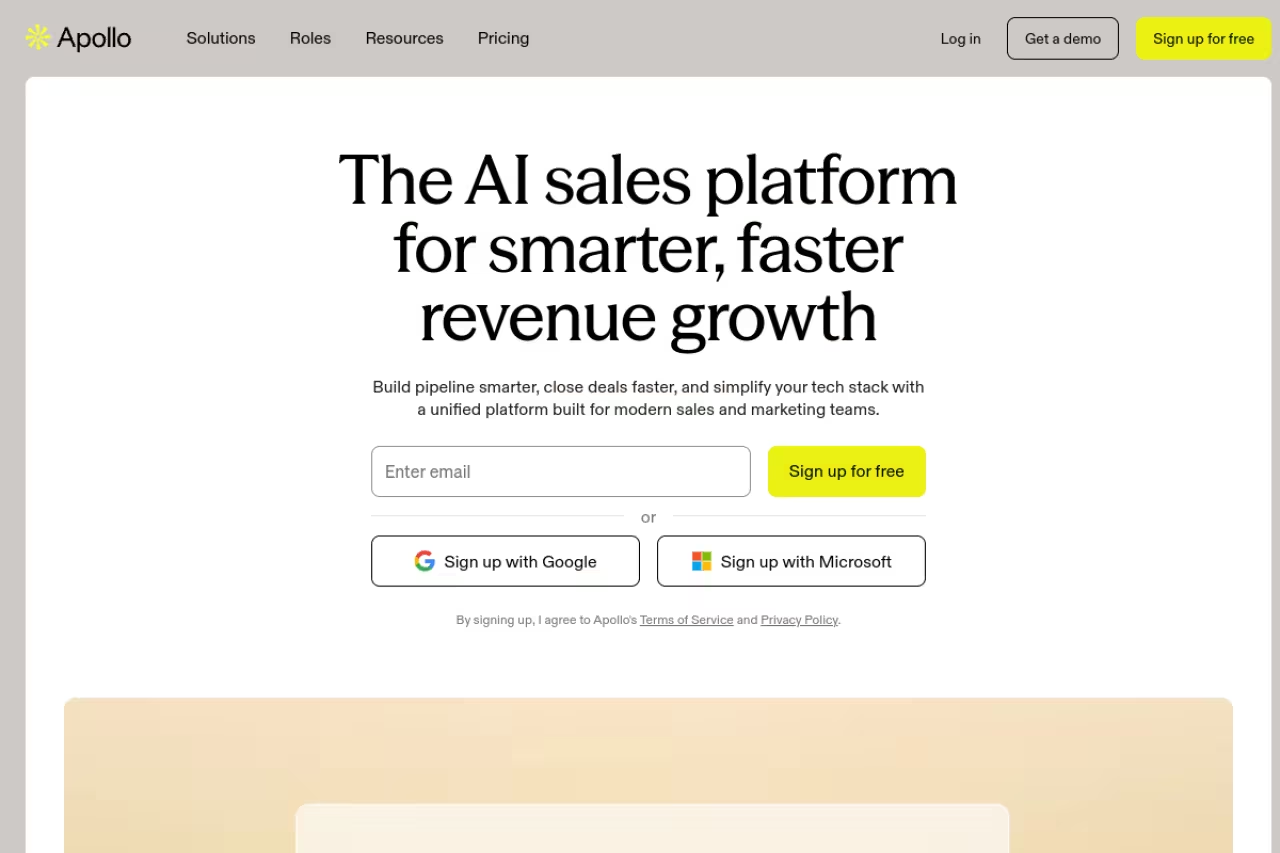
Apollo.io is the tool I'd hand a new sales team on day one. It pairs a contact database of roughly 275 million people with AI email writing, sequencing, and a built-in dialer, so you can go from "who do I email" to "the sequence is live" inside one tab.
The AI Assistant drafts personalized openers off a prospect's profile and recent activity, and the sequencing engine handles the follow-ups. It isn't the smartest writer on this list, but it's good enough, and the data-to-send loop being in one product saves you the integration headache that kills most stacks.
Who it's best for: Founders and small-to-mid outbound teams who want one bill instead of five.
The tool I'd hand a new sales team on day one, since the data-to-send loop lives in one product and one bill. Data accuracy is fine rather than elite, and you will burn through enrichment credits faster than expected.
A free forever Starter plan, then Basic at $49, Professional at $79, and Organization at $119 per user per month on annual billing (Apollo pricing). Monthly billing runs higher, up to $149 on Organization.
The catch: Data accuracy is fine, not elite. Apollo's emails and direct dials are weaker than a dedicated provider like ZoomInfo or Cognism, and you'll burn through enrichment credits faster than you expect. Treat the AI drafts as first drafts, not send-ready copy.

Clay: the data layer power users build on
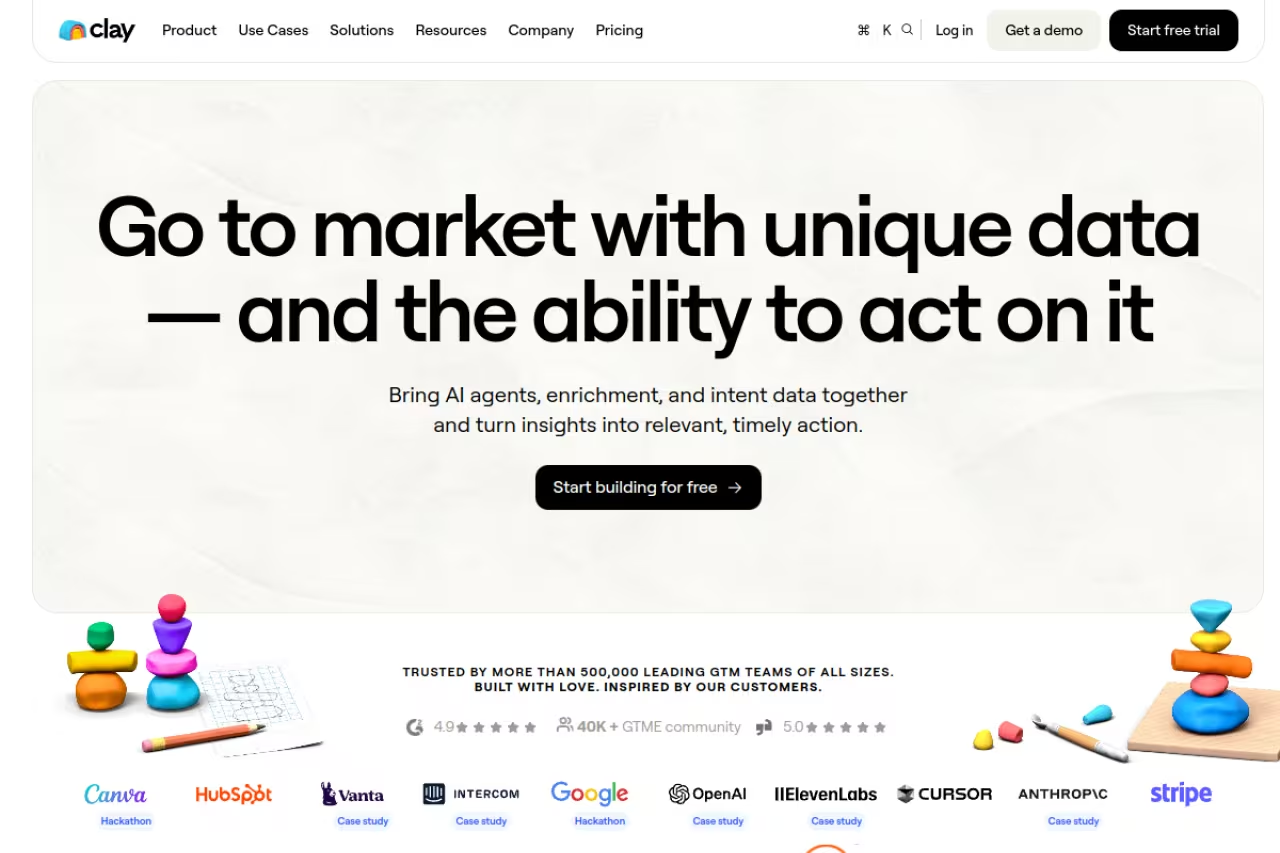
Clay is less a sales assistant and more the engine RevOps teams use to build their own. It pulls from 100-plus data providers, runs AI research on each account, and triggers outreach off signals like a new funding round, a job change, or a tech-stack switch. If your edge is targeting the right account at the right moment, nothing else comes close.
The key thing to understand: Clay enriches and orchestrates, but it doesn't send the email or run the cadence on its own. You wire it into a downstream sender (Apollo, Instantly, Reply, or an AI SDR) to actually deliver. That makes Clay infrastructure, not a turnkey tool.
Who it's best for: Technical operators and RevOps people who want custom, signal-based outbound instead of spray-and-pray.
Go with Clay if you are a technical operator or RevOps person who wants custom, signal-based outbound across 100-plus data providers. It enriches and orchestrates but does not send, and the steep learning curve and dual-credit pricing make costs hard to predict.
A free plan with 100 data credits and 500 actions, then Launch at $185/mo and Growth at $495/mo after Clay's March 2026 pricing overhaul, which split billing into separate Data Credits and Actions (Clay pricing breakdown). Enterprise contracts often land around $30,000 a year.
Where it falls short: The learning curve is steep, and the dual-credit system makes costs hard to predict. Run a heavy enrichment table and you can torch a month's credits in an afternoon. This is overkill for a two-person team that just needs to send 200 emails.

Gong: the assistant that lives on your calls
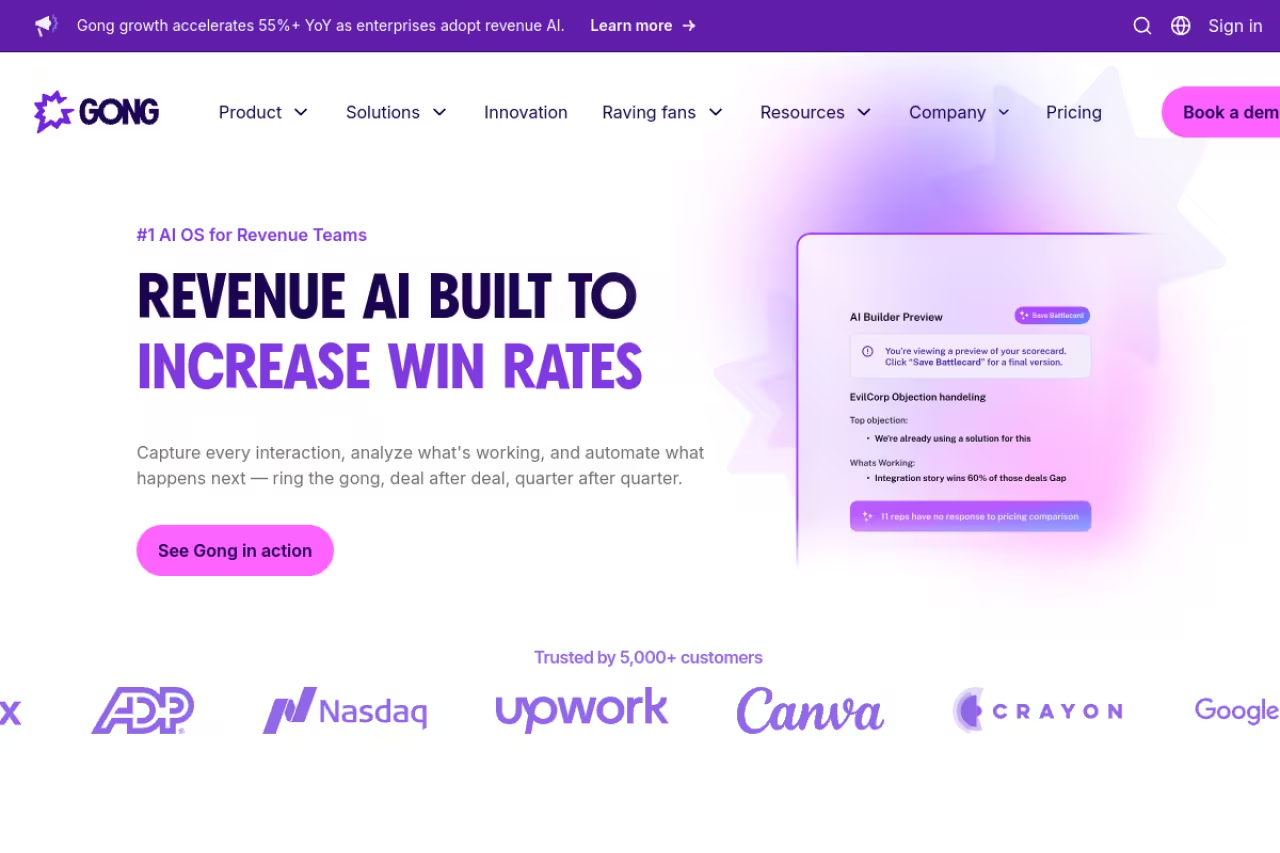
Everything above this point helps you start conversations. Gong helps you win the ones you already have. It records and transcribes every call, flags risks in open deals, surfaces which talk tracks actually close, and rolls it all into forecasting your VP of Sales will trust.
For managers, the coaching angle is the real value. Gong shows you exactly where reps talk too much, miss next steps, or fumble objections, and it does it across the whole team instead of the two calls you had time to listen to. By 2026 its deal-intelligence and forecasting features have gotten genuinely sharp.
Who it's best for: Sales managers and revenue leaders at teams with enough deal volume to justify the spend.
A coaching and forecasting platform for sales managers and revenue leaders with enough deal volume to justify the spend. The platform fee is brutal for small teams, so startups are better served by a lighter call recorder.
Gong doesn't publish list pricing, but reported 2026 figures put it around a $5,000 platform fee plus roughly $1,600 per user per year for teams under 50 seats (Gong pricing analysis). It gets cheaper per seat as you scale.
The catch: That platform fee makes Gong brutal for small teams. Under 20 reps, the base fee alone can push your effective cost above $4,000 per seat per year before add-ons. If you're a startup, Salesloft or a lighter call-recorder will cover 80% of the value for a fraction of the cost.
If your bottleneck is generating the conversations in the first place, that's a demand problem, not a sales-tool problem. Reaching the right buyers through a trusted channel like Dupple X often does more for pipeline than another seat of call software.

Lavender: the email coach that makes reps better writers
Lavender takes the opposite approach to the autonomous crowd: instead of writing emails for you, it teaches you to write better ones. It's a Chrome extension for Gmail and Outlook that scores every draft 0 to 100 in real time and flags issues with your subject line, length, reading level, and personalization as you type.
I like Lavender because it builds a skill instead of a dependency. Reps who use it for a month write tighter emails even when the extension is off, which is more than you can say for tools that just generate copy and hope.
Who it's best for: SDR teams that want to level up email quality and managers who want a measurable coaching baseline.
Lavender builds a skill instead of a dependency, which makes it a good coach for SDR teams and managers who want a measurable baseline. It only touches email, and following the scoring too literally can push everyone toward the same short, casual template.
A free tier capped at a handful of emails a month, then Starter around $29/mo, Pro around $49/mo, and Teams around $69/user/mo, with roughly 20% off on annual billing (Lavender pricing on G2).
Where it falls short: It only touches email. Lavender won't find your contacts, run your sequences, or help on calls, so it's an add-on to a stack rather than the stack itself. The scoring can also nudge everyone toward the same "short and casual" template if you follow it too literally.
11x (Alice): the closest thing to a hands-off SDR
11x is the headline act of the autonomous-SDR category. Its agent, Alice, is built to run the whole outbound loop: research prospects, write the messages, send them, handle replies, and book meetings on your calendar without a human in the seat.
When it works, it's genuinely impressive to watch a meeting land on your calendar from a sequence you never touched. The honest version is that it works less often than the marketing suggests, and the gap between demo and daily reality is wide.
Who it's best for: Funded teams with ops support and patience for a managed rollout, not solo founders.
The headline act of the autonomous-SDR category, suited to funded teams with ops support and patience for a managed rollout. It works less often than the marketing suggests, so treat it as added capacity, not a headcount swap.
11x doesn't publish pricing and negotiates per deal. Reported figures cluster around $5,000 per month and up, often with an annual commitment near $60,000 (11x pricing breakdown).
The catch: "Full SDR replacement" is still a claim, not a product reality. Most teams find Alice needs several hours of human review every week to stay on-brand, and users report the annual contracts are hard to exit even when results disappoint. A solid human SDR working the same list will usually out-book the bot. Treat 11x as added capacity, not a headcount swap.
HubSpot AI: the easy win if you're already on HubSpot
If your CRM is already HubSpot, HubSpot AI is the lowest-friction way to add AI prospecting. The Prospecting Agent works inside your existing data, identifies leads worth contacting, and runs outreach without you exporting anything to another tool.
What makes it interesting in 2026 is the pricing model. As of April 14, 2026, HubSpot moved the Prospecting Agent to outcome-based billing: you pay $1 for each lead the agent recommends outreach for, instead of a flat monthly seat fee (HubSpot announcement). That aligns cost with output in a way the rest of this list mostly doesn't.
Who it's best for: Existing HubSpot Pro and Enterprise customers who want CRM-native AI without a new vendor.
The lowest-friction AI prospecting if your CRM is already HubSpot, and the outcome-based billing of $1 per recommended lead aligns cost with output. It is only worth it if you live in HubSpot, and low-intent recommendations can get expensive fast.
$1 per qualified lead, available to Pro and Enterprise tiers, with a 28-day free trial.
Where it falls short: It's only worth it if you live in HubSpot. The agent is tied to your CRM data quality, so a thin or messy database produces thin results. And outcome pricing can get expensive fast if the agent recommends outreach on a lot of low-intent leads.

Reply (Jason AI): multichannel sequencing with an AI brain
Reply is a sales engagement platform, and its AI assistant Jason coordinates outreach across email, LinkedIn, calls, SMS, and WhatsApp in a single sequence. If your motion depends on touching prospects in more than one channel, Reply handles the choreography better than most email-only tools.
Jason can run in copilot mode (it drafts, you approve) or autopilot, which gives you a dial between control and automation that the all-or-nothing autonomous tools don't offer. That flexibility is the main reason I keep it on the list.
Who it's best for: Teams running true multichannel cadences who want one place to orchestrate them.
Pick Reply if your motion depends on touching prospects across several channels in one sequence, with a dial between copilot and autopilot. Pricing gets confusing quickly, and the AI will not save a burned sending domain.
Reply's core plans start around $49/user/mo, and Jason is included on paid plans. The dedicated AI SDR tiers start around $500/mo for 1,000 active contacts and scale up from there (Reply.io pricing).
The catch: Pricing gets confusing fast because Jason is sold both as an add-on and as standalone AI SDR plans, and the standalone tiers climb quickly. Deliverability also depends on you doing the inbox warm-up and domain hygiene work; the AI won't save a burned sending domain.

Salesforce Agentforce: the CRM-native agent for enterprise
Salesforce Agentforce is the obvious pick if your company already runs on Salesforce. Its SDR agent works natively inside your CRM data, so there's no syncing or export step, and it inherits whatever governance and permissions you've already built.
The pricing is unusual: Salesforce charges $2 per conversation rather than per seat, though it also offers Flex Credits (blocks of 100,000 for $1,000) and per-user licensing from $125/user/mo as alternatives (Agentforce pricing guide). For high-volume teams the conversation model can either save or sink you depending on how a "conversation" is defined.
Who it's best for: Enterprise Salesforce shops that want their AI agent inside the system of record.
Where it falls short: The per-conversation definition is slippery. Restarting outreach to a previously engaged lead can trigger a fresh charge, so costs are hard to model. And Agentforce realistically needs admin and consulting muscle to deploy well, which means it's not a tool a small team spins up on a Tuesday.
The obvious pick for enterprise Salesforce shops that want their AI agent inside the system of record, inheriting existing governance. The per-conversation definition is slippery, so costs are hard to model, and it needs admin and consulting muscle to deploy.
How to choose
Skip the "which tool is best" framing and ask which part of the funnel is your actual bottleneck.
- You have no contacts or no system. Start with Apollo. One product, fair price, covers find-to-send. Add a dedicated data provider later if accuracy bites.
- Your targeting is the weak link. Use Clay to build signal-based outbound, then wire it into a sender. This is for operators, not first-timers.
- You have plenty of conversations but lose deals. That's a Gong problem, not a prospecting one. Buy call intelligence, not more lead tools.
- Your reps write bad emails. Lavender is the cheapest high-impact fix on this list.
- You want to add capacity without hiring. Try 11x or Reply's AI SDR tier, but budget for human oversight and don't believe the "replace your team" pitch.
- You're committed to HubSpot or Salesforce. Use their native agent (HubSpot AI or Agentforce) before bolting on a third party.
One rule cuts through all of it: never let any of these tools send unreviewed copy at scale in month one. The fastest way to torch a sending domain and your brand is to trust autopilot before you've watched what it writes.
Frequently asked questions
What is the best AI sales assistant in 2026?
For most teams, Apollo.io is the best starting point because it combines a contact database, AI email drafting, and sequencing in one product from $49 per user per month. If your need is narrower, Clay wins on data orchestration, Gong wins on call coaching, and Lavender wins on email quality. There's no single best tool, only the best fit for your bottleneck.
Can an AI sales assistant fully replace a human SDR?
Not reliably yet. Despite the marketing, autonomous tools like 11x's Alice still need several hours of weekly human review to stay accurate and on-brand, and a competent human SDR usually out-books them on the same list. By 2026 the consensus has shifted to a hybrid model: AI handles volume and research, humans handle judgment and relationships.
How much do AI sales assistants cost?
The range is wide. Email coaches like Lavender start around $29 per month, all-in-one platforms like Apollo run $49 to $149 per user per month, data tools like Clay sit at $185 to $495 per month, and enterprise systems like Gong or 11x can exceed $5,000 per month once platform fees and contracts are factored in. Stacking several tools can push per-rep cost past $500 per month, so audit overlap before you buy.
Do I need a separate AI tool if I already use HubSpot or Salesforce?
Often not. HubSpot AI and Salesforce Agentforce both run native AI prospecting inside your existing CRM data, which avoids syncing headaches and usually deploys faster than a third party. Start with the native option, then add a specialist tool only if you hit a clear gap like better contact data or call intelligence.
What's the difference between an AI sales assistant and an AI SDR?
An AI sales assistant supports a human rep: it drafts emails, scores copy, surfaces accounts, or analyzes calls while you stay in control. An AI SDR, like 11x's Alice, aims to run the whole outbound workflow autonomously, from research to booking meetings. Assistants are lower-risk and more proven in 2026; full AI SDRs are improving fast but still need close supervision.
Want to go deeper on outbound? See our guides to the best AI tools for sales prospecting, the best AI lead generation tools, how to put generative AI to work in sales, and the broader roundup of the best AI agents. If you'd rather buy pipeline than build it, Dupple X puts your offer in front of a vetted audience of founders and operators, and our top tools directory tracks what's new across the stack.
Related guides
Some offers on this page may be paid placements or contain affiliate links.
Across our whole catalogue the median is $24 a month and 33% of tools advertise a free tier. Figures are the lowest recurring monthly price quoted in our own review of each tool, read on 2026-08-19. Full method and every category.
