
Best Customer Data Platforms in 2026

Key facts8 tools compared: Hightouch, Twilio Segment, RudderStack, Klaviyo Data Platform, Salesforce…
- 8 tools compared: Hightouch, Twilio Segment, RudderStack, Klaviyo Data Platform, Salesforce Data Cloud, Adobe Real-Time CDP, Census, Tealium
- Hightouch (best for: Teams with a data warehouse): Free tier, then usage-based
- Twilio Segment (best for: Product-led startups): Free (1K MTU), Team from $120/mo
- RudderStack (best for: Engineering-heavy teams): Free (250K events), Growth $265/mo
- Klaviyo Data Platform (best for: Ecommerce brands): From $500/mo (100K profiles)
Every company says it's "data-driven." Then you look under the hood and the customer record lives in nine places: Stripe, the product database, the email tool, the ad platforms, a Google Sheet someone swears is the source of truth. A customer data platform is supposed to fix that by collecting all of it, stitching it into one profile per person, and pushing that profile out to wherever you need it.
The problem is that "CDP" now describes two very different things. One camp copies all your data into a vendor's cloud and rents it back to you. The other sits on top of the warehouse you already own and just activates it. Picking the wrong camp can mean a six-figure contract you didn't need, or a homegrown mess you can't scale.
I compared the platforms that actually show up in real buying decisions, not the 150 names in the CDP Institute directory. If you have a Snowflake or BigQuery warehouse and a data team, my top pick is Hightouch for its composable, warehouse-native model. If you don't, the rest of this list has a fit for you. This is for founders, marketers, and data folks who want one customer profile they can trust, and who care what it costs.
Quick comparison
| Tool | Best for | Price | Standout |
|---|---|---|---|
| Hightouch | Teams with a data warehouse | Free tier, then usage-based | Warehouse-native, AI Decisioning |
| Twilio Segment | Product-led startups | Free (1K MTU), Team from $120/mo | Largest integration catalog |
| RudderStack | Engineering-heavy teams | Free (250K events), Growth $265/mo | Open-source, warehouse-first |
| Klaviyo Data Platform | Ecommerce brands | From $500/mo (100K profiles) | Built into Klaviyo's email/SMS |
| Salesforce Data Cloud | Salesforce-native orgs | Custom, $60K+/yr | Native to the CRM you already run |
| Adobe Real-Time CDP | Large enterprise marketing | Custom quote | Tied to Adobe Experience Platform |
| Census | dbt-centric data teams | Free tier, Pro from $350/mo | Reverse ETL with strong dbt support |
| Tealium | Compliance-heavy enterprise | Custom, $250K+/yr at scale | Real-time governance and consent |

Hightouch
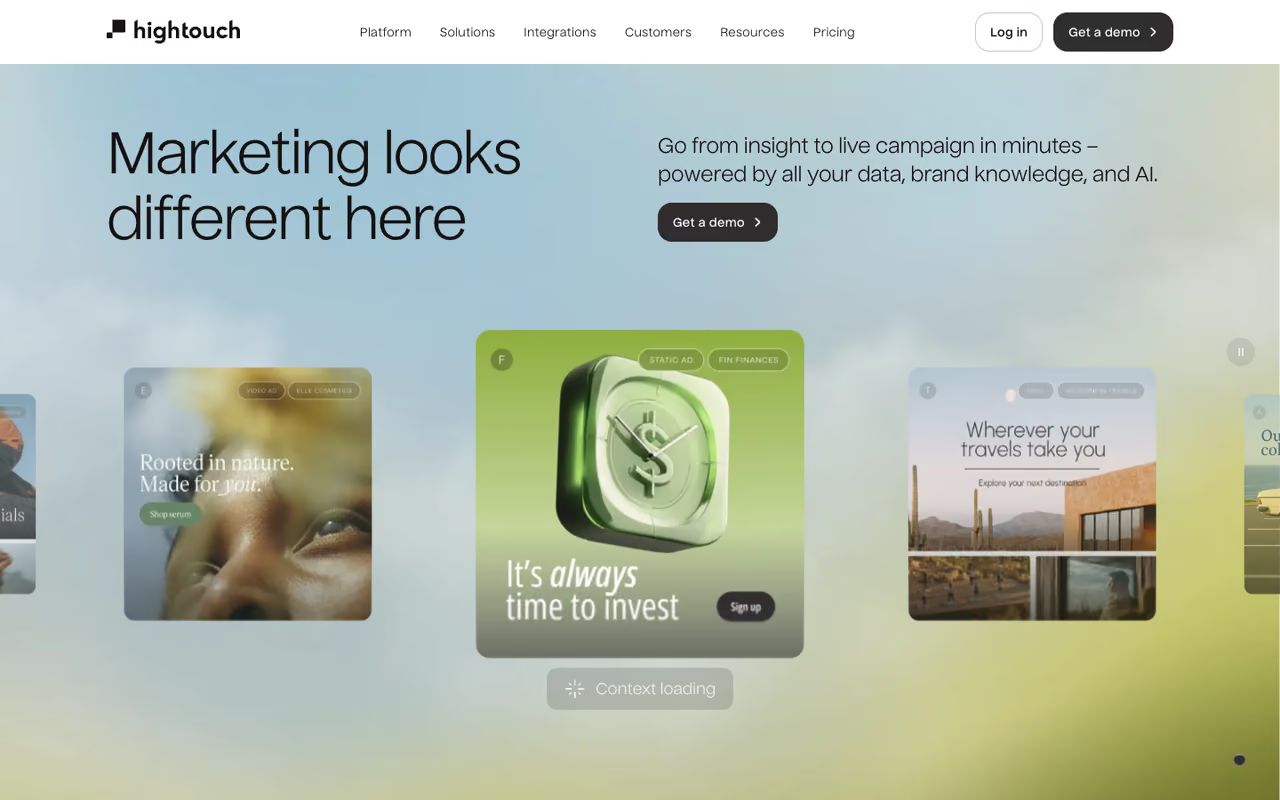
Hightouch is the composable CDP that started the warehouse-native movement and now leans hard into AI. Instead of duplicating your data into its own cloud, it runs customer 360 profiles, segmentation, and activation directly on top of Snowflake, BigQuery, Databricks, or Redshift. Your data never leaves your warehouse, which is a big deal for governance and a bigger deal for your bill.
Who it's best for: teams that already have a warehouse and a data engineer who knows their way around SQL or dbt. If that's you, this is the most flexible option on the list.
The standout is AI Decisioning. Hightouch's AI agents test channel, message, timing, and offer per individual customer and learn what wins, and the company reports a 52% increase in new customer acquisition from it. It also picked up a Gartner Magic Quadrant Leader spot and a $1.2 billion valuation, so this isn't a fragile startup bet.
The catch: there's a free tier for basic reverse ETL (2 active syncs), but real production use is usage-based and quoted by sales. Costbench pegs the Growth plan around $1,000/month, and it climbs from there. And if you don't have a warehouse, the whole pitch collapses. Hightouch assumes you've already centralized your data somewhere.
The most flexible option here for teams that already have a warehouse and a data engineer comfortable with SQL or dbt. Your data stays put and AI Decisioning is a real draw, but without a warehouse the whole pitch collapses.

Twilio Segment
Twilio Segment is the platform most people picture when they hear "CDP." It pioneered the analytics.js tracking snippet, has over 20,000 customers, and offers the deepest catalog of pre-built integrations you'll find anywhere. Drop one snippet, send data once, fan it out to hundreds of destinations.
Who it's best for: product-led startups and engineering teams that want event collection wired up in an afternoon without building pipelines themselves. The developer experience is still the benchmark everyone else gets compared to.
The standout is breadth. Segment's Connections pricing starts free for 1,000 monthly tracked users with 2 sources, and the Team plan begins at $120/month for 10,000 MTUs with unlimited sources. For a small team that wants to skip the infrastructure work, that's a genuinely good deal.
Where it falls short: pricing is per monthly tracked user, so costs balloon as you grow and you don't fully control them. The Business tier (Unify and Engage, the actual identity-resolution and audience features) is custom quoted and routinely lands in the $25K to $500K+ per year range. The free tier also caps you at 2 destinations, which you'll hit fast.
Twilio Segment is the developer-friendly benchmark for product-led startups and engineering teams that want event collection wired up in an afternoon. The free tier is generous, but per-user pricing balloons as you grow.

RudderStack
RudderStack is the open-source, warehouse-first answer to Segment. The API is close enough that migrating is mostly a config change, but the philosophy is different: your warehouse is the source of truth, and RudderStack treats it as a first-class destination rather than an afterthought. Teams that care about cost and control gravitate here.
Who it's best for: engineering-heavy teams that want maximum control, self-hosting options, and a pipeline they can inspect rather than trust blindly.
The standout is the free tier, and it's not a token gesture. RudderStack's Free plan gives you 250,000 events per month, 16 SDK sources, 200+ cloud destinations, and reverse ETL at $0. The Growth plan is $265/month for 1 million events with unlimited team members and tracking plans. Compared to Segment's MTU model, the per-event pricing is far more predictable.
The catch: this is a tool for technical teams. There's no marketer-friendly campaign builder, and Profiles plus the more advanced data apps live behind the Enterprise tier with custom pricing. If your data team is one overworked person, the operational burden is real.
The open-source, warehouse-first alternative for engineering-heavy teams that want control and self-hosting. The free plan is a real offer at 250,000 events per month, but there's no marketer-friendly campaign builder.
If you're already evaluating how to activate this data downstream, our guide to the best AI marketing automation tools pairs naturally with any of these top three.
Klaviyo Data Platform
Klaviyo built its name on ecommerce email and SMS, and the Klaviyo Data Platform extends that into a full CDP without forcing you to bolt on a separate system. It unifies marketing, commerce, and service data into a real-time profile, and because activation happens inside the same tool, there's no lag between "segment built" and "campaign sent."
Who it's best for: ecommerce and DTC brands, especially Shopify stores, that already run Klaviyo for messaging and want their data unification in the same place.
The standout is that the profile updates in real time and immediately drives campaigns, with no engineering handoff. For a marketer, that round trip from data to action is the whole point. Lifetime data retention and real-time segmentation come standard.
The catch: it's a packaged CDP, not composable, so your data lives in Klaviyo's system. Pricing scales by profile count and gets steep: roughly $500/month at 100,000 profiles, $1,250 at 250,000, and into the thousands per month past a million. It's also genuinely useful only if you're committed to Klaviyo's ecosystem. As a neutral data hub feeding other tools, it's the wrong shape.
A natural fit for ecommerce and DTC brands, especially Shopify stores, already running Klaviyo for messaging. Data goes straight into campaigns with no engineering handoff, though pricing climbs steeply with profile count and it's a poor neutral hub.
Salesforce Data Cloud
Salesforce Data Cloud (formerly Genie, then Customer Data Cloud, now folded into the Data 360 family) is the obvious move if your company already lives in Salesforce. It unifies data across Sales Cloud, Service Cloud, and Marketing Cloud into one profile and feeds Agentforce, Salesforce's AI agent layer.
Who it's best for: enterprises that are already Salesforce-native and want their CDP inside the CRM rather than wired to it.
The standout is gravity. If your reps, support, and marketing all run on Salesforce, having the unified profile native to that stack removes a category of integration headaches. Real-time activation into the tools your team already opens every day is a real advantage.
Where it falls short: the cost. A realistic enterprise stack (Data 360 at $60K+/yr, plus Marketing Cloud, Service Cloud, MuleSoft, and implementation fees) routinely totals $360K to $750K+ in first-year spend. This only makes sense if you're already deep in the ecosystem. For everyone else, it's overkill priced for the Fortune 500.
The obvious move for Salesforce-native enterprises that want the CDP inside the CRM rather than wired to it. Gravity is the advantage and cost is the problem, since a realistic first-year spend lands at $360K to $750K+.
Adobe Real-Time CDP
Adobe Real-Time CDP is the enterprise marketing heavyweight, built on Adobe Experience Platform. It's aimed squarely at large brands running Adobe's analytics, personalization, and journey orchestration tools, and it shines when you need to manage known and anonymous profiles at massive scale.
Who it's best for: large enterprise marketing teams already invested in Adobe Experience Cloud, especially in retail, media, and financial services.
The standout is the real-time profile management at scale and the tight loop with Adobe Journey Optimizer and Target for messaging and personalization. If you're running Adobe Analytics already, the data flows where you need it without a custom integration project.
The catch: there's no published pricing, and quotes are tied to the number of unified profiles under management. Buyers consistently report that costs escalate faster than expected if ingestion isn't planned carefully, and full functionality means licensing Journey Optimizer, Analytics, and Target on top. This is a platform you buy with a procurement team and a consultancy, not a credit card.
Adobe Real-Time CDP is for large enterprise marketing teams already invested in Adobe Experience Cloud, handling known and anonymous profiles at scale. Pricing is unpublished and tends to escalate, so expect procurement and a consultancy.

Census
Census is the other major reverse ETL platform and Hightouch's most direct rival. Acquired by Fivetran and now part of its activation suite, Census syncs modeled data from your warehouse into the business tools where teams actually work. It earns a 4.5/5 on G2 across 339+ reviews, with data teams praising its dbt integration in particular.
Who it's best for: data teams that live in dbt and want a clean, developer-friendly way to push warehouse models into Salesforce, HubSpot, and ad platforms.
The standout is the dbt experience. If your transformations already run through dbt, Census plugs in with less friction than most, and its developer experience is consistently rated a notch above. With Fivetran behind it now, the ingestion-plus-activation story under one roof is compelling.
Where it falls short: it's reverse ETL first, not a full CDP. Real-time sync and the Audience Hub features sit behind the Enterprise tier. There's a limited free plan, and the Professional plan starts around $350/month, but you'll want Enterprise for anything time-sensitive. Like Hightouch, it assumes you've already centralized your data in a warehouse.
A clean pick for data teams that live in dbt and want to push warehouse models into Salesforce, HubSpot and ad platforms. It's reverse ETL, not a full CDP, and real-time sync sits behind Enterprise.

Tealium
Tealium is the veteran enterprise CDP, anchored by AudienceStream and EventStream in its Customer Data Hub. It predates most of this list and has built its reputation on real-time data collection, strict governance, and consent management, which is why compliance-heavy industries keep it on the shortlist.
Who it's best for: large enterprises in regulated sectors (finance, healthcare, insurance) where data governance and consent are non-negotiable.
The standout is control. Tealium's real-time capabilities and its focus on governance and compliance are genuinely stronger than most marketing-led CDPs, and its tag management heritage means clean, auditable data collection. For a team that has to prove where every data point came from, that matters.
The catch: it's an enterprise commitment with enterprise pricing. At 10M+ monthly unique visitors, EventStream plus AudienceStream runs $250,000 to $600,000 a year, with implementation pushing first-year totals past $350K. It also requires annual prepayment on contracted volume, with overage charges if you exceed it. The interface feels dated next to newer composable tools.
Tealium suits large enterprises in regulated sectors where governance and consent are non-negotiable, with strong real-time collection and auditable data. It comes with enterprise pricing and prepaid volume commitments, and the interface feels dated.
How to choose
Start with one question: do you have a data warehouse and someone who can work in it? That single fork decides most of this.
If yes, go composable. Hightouch or Census let you keep data in the warehouse you already pay for and activate it, which is cheaper and safer than copying everything into a vendor cloud. Pick Hightouch for the broader CDP and AI features, Census if your team lives in dbt.
If no, go packaged. Twilio Segment is the safe default for product-led startups that need event collection fast. RudderStack is the better value if your team is technical and cost-conscious. Klaviyo wins for ecommerce brands that want data and messaging in one tool.
If you're a large enterprise already standardized on Salesforce or Adobe, the native CDP usually wins despite the price, because the integration cost you'd otherwise pay is brutal. Tealium is the pick when compliance and consent drive the decision over everything else.
One more thing: don't buy more CDP than your activation maturity justifies. A perfect unified profile is worthless if no one's using it to run campaigns. If you're earlier in the journey, our roundups of the best AI customer insights tools and best business intelligence tools might solve your problem at a fraction of the cost.
The CDP market moves fast (Census got bought by Fivetran, Segment by Twilio, mParticle by Rokt, ActionIQ by Uniphore, all in the last couple of years). To stay ahead of which platforms ship new AI features and which get acquired next, Dupple X tracks the moves week to week. You can start a trial here.
FAQ
What is a customer data platform and how is it different from a CRM?
A CRM manages your relationship with known contacts, mostly for sales and support. A customer data platform collects behavioral and transactional data from every source, including anonymous visitors, stitches it into one profile per person, and pushes those profiles to other tools. A CRM is a destination; a CDP is the plumbing that feeds it. Many companies run both.
What's the difference between a composable CDP and a packaged CDP?
A packaged CDP (Segment, Klaviyo, Tealium) copies your data into the vendor's own cloud and gives you collection, storage, and activation in one closed system. A composable CDP (Hightouch, Census) runs on top of your existing data warehouse, so your data stays where it is and you only license the activation layer. Composable is cheaper and better for governance if you already have a warehouse; packaged is simpler if you don't.
Are there any free customer data platforms?
Yes, a few have real free tiers. RudderStack offers 250,000 events per month free, Segment gives you 1,000 monthly tracked users with 2 destinations, and Hightouch and Census both have limited free reverse ETL plans. These are enough to prototype or run a small project, but you'll outgrow the caps once you're activating data across multiple channels at volume.
How much does a customer data platform cost?
It ranges enormously. Self-serve tools start free and climb to a few hundred dollars a month (RudderStack Growth at $265, Segment Team from $120). Mid-market packaged CDPs like Klaviyo run from $500/month into the thousands. Enterprise platforms (Salesforce Data Cloud, Adobe, Tealium) are custom quoted and routinely land between $250,000 and $750,000+ in first-year cost once you add implementation.
Do I need a data warehouse to use a CDP?
For composable platforms like Hightouch and Census, yes. They're built to sit on top of Snowflake, BigQuery, Databricks, or Redshift and won't function without one. Packaged CDPs like Segment, Klaviyo, and Tealium store data themselves, so no warehouse is required, though they can often sync to one if you have it. Your warehouse situation is the single biggest factor in which type fits.
Which CDP is best for a small startup?
For most early-stage product-led startups, Twilio Segment's free tier is the fastest way to get clean event data flowing, and RudderStack is the better pick if you're technical and watching costs. Save Salesforce Data Cloud, Adobe, and Tealium for when you have a procurement team and a six-figure budget. They're built for scale you probably don't have yet.
Related guides
Some offers on this page may be paid placements or contain affiliate links.
