
Best Conversational AI Platforms in 2026 (Compared and Ranked)

Key facts8 platforms compared: Sierra, Intercom Fin, Voiceflow, Botpress, Retell AI, PolyAI, Kore.ai…
- 8 platforms compared: Sierra, Intercom Fin, Voiceflow, Botpress, Retell AI, PolyAI, Kore.ai, Ada
- Sierra (best for: Large brands, full agent ownership): Custom, ~$200K+/yr
- Intercom Fin (best for: Customer support teams): $0.99 per resolution
- Voiceflow (best for: Designers and product teams): Free, paid from $60/mo
- Botpress (best for: Developers who want control): Free, paid from $89/mo
"Conversational AI platform" means five different things depending on who you ask. A support leader wants something that closes tickets. A founder wants a voice agent that books calls. A developer wants an SDK and zero markup on tokens. Same search term, completely different shortlists.
I compared most of these tools' documentation and pricing fine print, and looked at where the bills actually land once you go past the demo, based on public user reports. The gap between the marketing page and the monthly invoice is wide on almost every one of them.
If you want the short answer: Sierra is the strongest platform for large brands that can afford a real implementation, Intercom Fin is the cleanest pick for customer support because you pay per resolved conversation, and Voiceflow is where most teams should start if they want to design and ship an agent without a six-figure contract. Below is the full ranking, who each one is for, and where it falls short.
Quick comparison
| Platform | Best for | Price | Standout |
|---|---|---|---|
| Sierra | Large brands, full agent ownership | Custom, ~$200K+/yr | Outcome-based, full Agent OS |
| Intercom Fin | Customer support teams | $0.99 per resolution | Pay only when it resolves |
| Voiceflow | Designers and product teams | Free, paid from $60/mo | Visual builder, fast to ship |
| Botpress | Developers who want control | Free, paid from $89/mo | Open, zero markup on tokens |
| Retell AI | Phone and voice agents | From $0.07/min | Transparent per-minute voice |
| PolyAI | Enterprise voice at scale | Custom, six figures | 45+ languages, live at scale |
| Kore.ai | Regulated industries | Custom, often $300K+/yr | Governance and compliance depth |
| Ada | High-volume support deflection | Custom, ~$30K+/yr | No-code resolution engine |

Sierra: the best platform if you can afford it

Sierra is the platform people point to when they talk about where conversational AI is heading. Founded by Bret Taylor (ex-CTO of Facebook, ex-co-CEO of Salesforce) and Clay Bavor, it runs as a full Agent OS: you build, test, monitor, and improve agents across voice, chat, SMS, and email from one place.
Who it's for: Large brands that treat the AI agent as an extension of their team, not a deflection widget. Sierra now serves roughly 40% of the Fortune 50, with customers like WeightWatchers, SiriusXM, Sonos, and Chime.
The platform to point to for large brands treating the AI agent as part of the team, across voice, chat, SMS, and email. It is enterprise-only by design, with implementation measured in weeks, so small teams should look elsewhere.
There is no pricing page, no tiers, no self-serve. Sierra prices on outcomes, and according to Fin's pricing comparison, year-one costs land around $200K to $350K and up. That funds a real implementation team, not just software access.
The standout: Sierra agents handle genuinely hard conversations. The phone agents hold natural back-and-forth without the robotic turn-taking that gives most voice bots away, and the platform keeps tuning agent behavior after launch rather than leaving you with a static flow.
The catch: this is enterprise-only by design. There's no way to kick the tires for $50 a month, and the implementation timeline is measured in weeks. If you're a small team or want to ship something this week, Sierra isn't your starting point. It raised $950M at a $15.8B valuation in May 2026, so the company has the gravity to keep moving upmarket and stay there.
Intercom Fin: the support pick with honest pricing
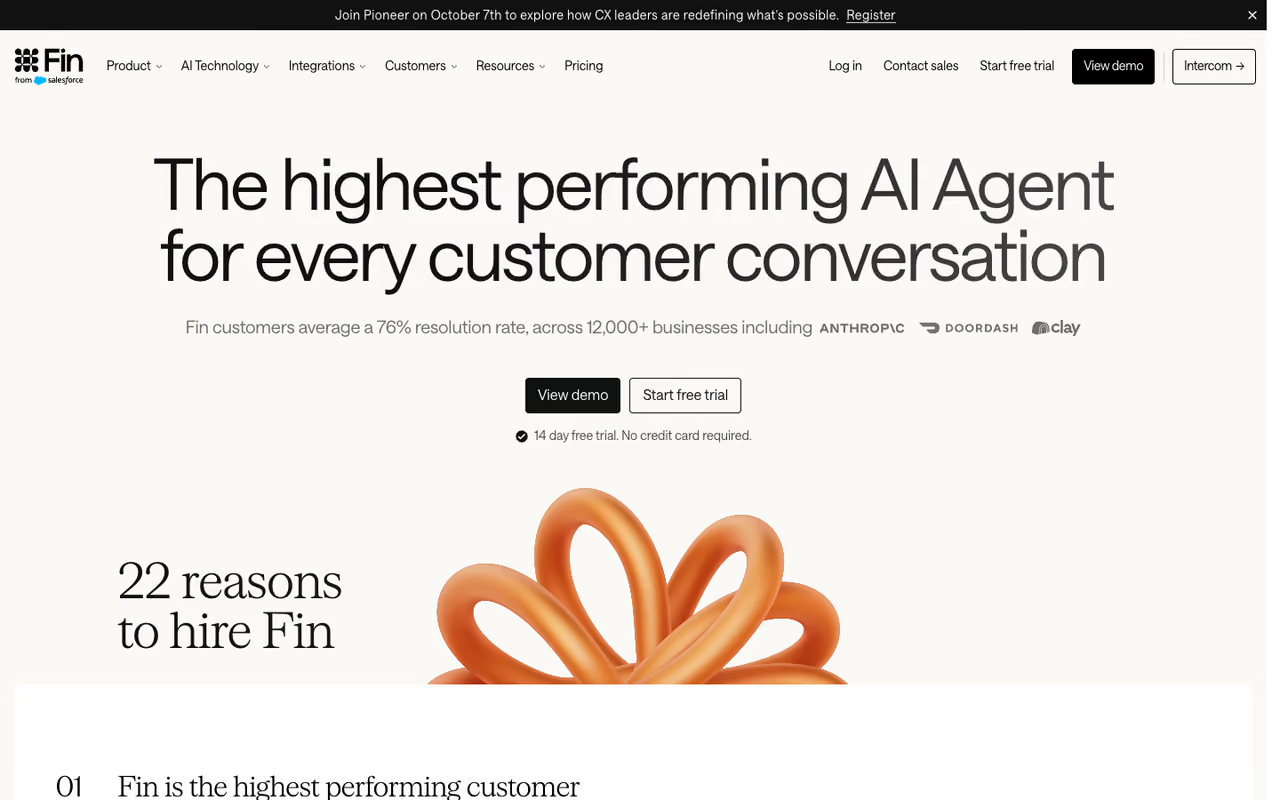
Fin is Intercom's AI support agent, and its pricing model is the reason it keeps winning bake-offs. You pay $0.99 per resolution, meaning Fin only charges when it actually closes a customer conversation end to end. No platform fee, no per-seat tax on the AI itself.
Who it's for: Support teams drowning in repetitive tickets who want a number they can model against deflection rate. If Fin resolves 10,000 conversations a month, that's $9,900. Easy to forecast, easy to defend to finance.
The support pick with honest pricing: $0.99 per resolution means you only pay when it closes a conversation. A thin knowledge base drops its resolution rate, and it is tied to support use cases.
$0.99 per resolution, with no setup or integration fees. Fin works on top of helpdesks like Zendesk, Salesforce, and HubSpot, or with Intercom's own helpdesk starting at $29 per seat per month.
The standout: It pulls answers from your existing help center and knowledge base, so setup is fast if your docs are decent. The outcome-based billing aligns Intercom's incentive with yours, which is rarer than it should be.
The catch: "resolution" is Intercom's definition, and the line between a resolved conversation and a deflected-but-unhappy customer can get blurry. If your knowledge base is thin, Fin's resolution rate drops and you still pay for the conversations it does close. It's also tightly bound to support use cases. Don't expect it to run sales outreach or internal IT workflows. For those, look at a general builder instead.

Voiceflow: where most teams should start
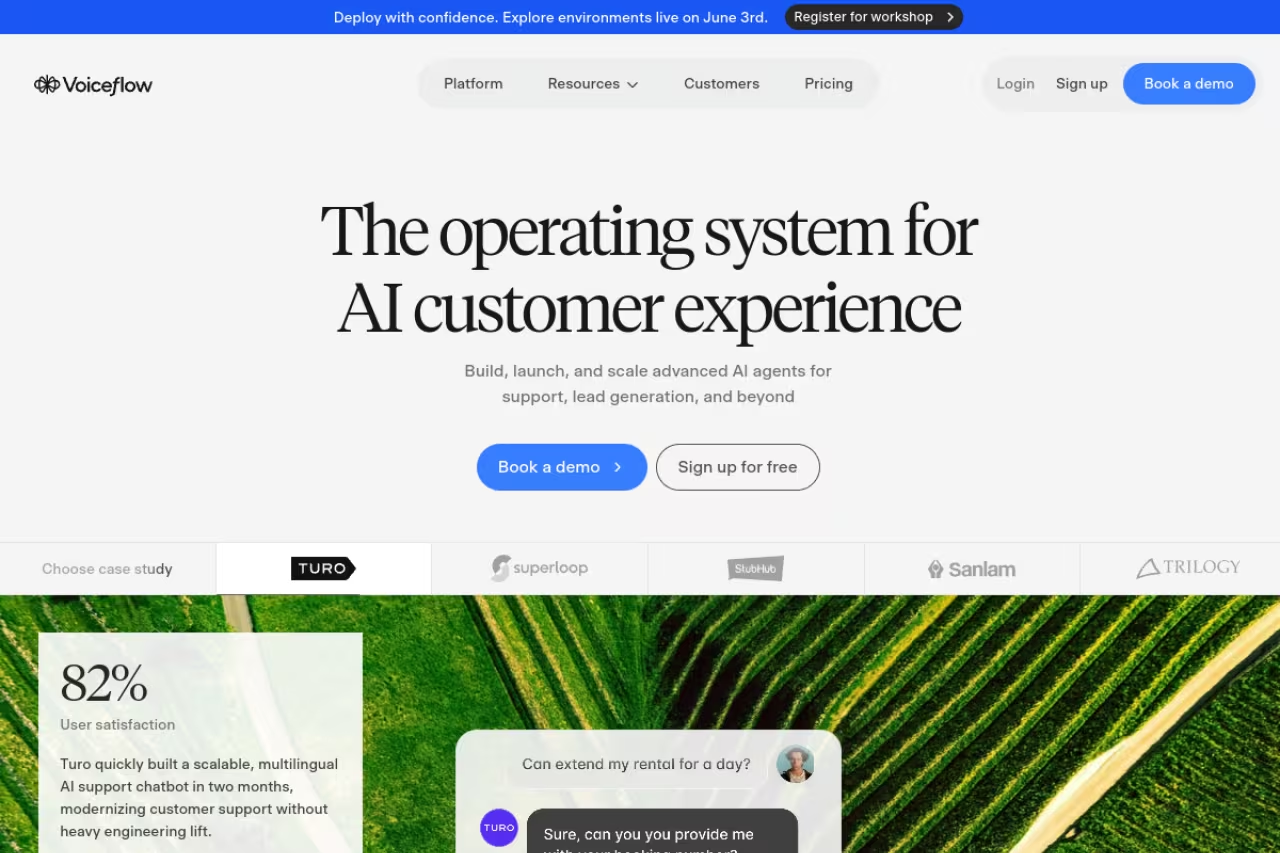
Voiceflow is the design-first platform, and it's the one I recommend to teams that want to ship an agent without a procurement cycle. You drag, drop, and wire up conversation logic visually, then deploy to web, voice, or wherever you need it. Product managers, designers, and engineers can all work in the same canvas.
Who it's for: Cross-functional teams that prototype fast and want to see the flow, not read it. It's also a favorite for agencies building agents for multiple clients.
Where most teams should start: a visual canvas for shipping an agent without a procurement cycle. Power users may hit the builder's ceiling, and developers who'd rather live in code should pick Botpress.
There's a free Sandbox tier. Paid plans historically started around $60/month for Pro and $150/month for the Team plan, though Voiceflow has been shifting toward usage-based and demo-gated pricing for businesses. For a five-editor team, real all-in spend tends to land around $450 to $500 a month, with LLM costs bundled into credits so your bill stays predictable.
The standout: Speed. You can go from idea to a working prototype in an afternoon, and the visual layer makes it easy to hand off to non-technical stakeholders. If you're weighing builders against code-first frameworks, my best AI agent platforms roundup shows where visual tools sit next to the developer stacks.
The catch: bundled credits are convenient until you scale, and heavy usage can burn through them faster than you'd expect. Power users sometimes hit the ceiling of the visual builder and want more raw control over prompts and logic. If you're a developer who'd rather live in code, Botpress is the better fit.
Most teams reading this don't need a $200K platform. They need to ship one good agent, measure it, and iterate. That's the same logic behind tools we cover in Dupple X: pick the tool that gets you to a working result fastest, then upgrade when the constraint actually bites.

Botpress: the developer's choice
Botpress is open, code-friendly, and built for people who want to own the stack. It passes through LLM costs at zero markup, which developers love because you're not paying a platform tax on every token.
Who it's for: Developers and technical teams who want self-hosting options, custom integrations, and full control over how the agent thinks.
The developer's choice for owning the stack, with self-hosting options and zero markup on LLM costs. Paying providers directly can produce bills you didn't model, so it is worth it for control and expensive if you don't need it.
The Pay-as-you-go plan is free and includes 500 incoming messages a month, one seat, and a small monthly AI credit. Paid plans run $89/month for Plus, $495/month for Team, and $1,495/month for Managed, on top of your actual AI spend. Botpress refreshed its pricing in May 2026 with unlimited bots and more storage for newer workspaces.
The standout: Flexibility and transparent token economics. You see exactly what the models cost, and you can plug in whichever provider you want. For teams wiring agents into live data and tools, the best MCP servers roundup pairs well with this kind of open setup.
The catch: that flexibility comes with unpredictability. Because you pay providers directly for AI consumption, a viral spike or a chatty agent can produce a bill you didn't model. For a five-person team at 50,000 messages a month, total spend can run 65% to 85% higher than the equivalent Voiceflow setup once tokens are counted. Worth it if you need the control, expensive if you don't.

Retell AI: the transparent voice option
If you specifically need phone agents, Retell AI is the one I'd test first. It's built for real-time, low-latency voice, and unlike most enterprise voice vendors it publishes its rates.
Who it's for: Small businesses and developer teams that want voice agents for appointment booking, lead qualification, or support calls, without signing a six-figure contract.
The one to test first for phone agents, with published rates starting at $0.07 per minute. That is the floor, as a typical setup lands nearer $0.11 to $0.15, and you assemble more of the stack yourself.
Starts at $0.07 per minute, scaling to roughly $0.31/min depending on the LLM, voice, and telephony you pick. A typical GPT-class setup lands around $0.11/min. Chat agents start at $0.002 per message. You get $10 in free credits to start, with no minimum.
The standout: Honest, modular pricing. You can see each component (LLM, speech-to-text, text-to-speech, telephony) and tune for cost or quality.
The catch: that advertised $0.07 is the floor, not the all-in. Once you add a good voice model and a capable LLM, real cost is closer to $0.11 to $0.15 a minute, and the per-minute math gets serious at call-center volume. You're also assembling more of the stack yourself than you would with a managed enterprise vendor.

PolyAI: enterprise voice that's actually live
PolyAI is the British company running enterprise voice assistants at genuine scale: over 2,000 live deployments across 45+ languages. When a large brand needs to automate millions of inbound calls without sounding like a 2015 IVR, PolyAI is on the shortlist.
Who it's for: Enterprises with high call volume and multilingual customers who need voice automation that handles messy, real-world conversations.
Enterprise voice that is actually live at scale, with over 2,000 deployments across 45+ languages and strong handling of interruptions and accents. It is voice-first and enterprise-only, so skip it for chat or a quick pilot.
Custom, six figures, per-minute billing. There's no public rate card, no free tier, no self-service. The price includes ongoing tuning, maintenance, and 24/7 support, which is part of why it's expensive.
The standout: Voice quality and language coverage. PolyAI handles interruptions, accents, and topic switches better than almost anything in the category, and the multilingual range is hard to match.
The catch: it's voice-first and enterprise-only. If you want chat, a self-serve plan, or a quick pilot, this isn't it. The contract and onboarding assume you're a serious enterprise buyer with real volume to justify the spend.

Kore.ai: built for regulated industries
Kore.ai focuses on structured dialogue management and workflow automation, and it's deployed heavily in banking, healthcare, and retail. If you operate under strict governance and need deep audit trails, this is the platform built for your compliance team.
Who it's for: Large enterprises in regulated sectors that need both customer-facing virtual assistants and internal employee assistants, with the governance to pass an audit.
Built for regulated industries that need governance, audit trails, and multi-step workflow orchestration. Expect complexity: a steep learning curve, pricing hard to pin down without sales, and overkill for simple ticket deflection.
Opaque and custom-quoted. Reported ranges run from around $50/month for basic chatbot features up to enterprise agreements that start near $300,000 a year, with session-based billing for automation.
The standout: Governance depth and workflow orchestration. Kore.ai handles multi-step processes across enterprise systems with the controls that compliance-heavy industries require.
The catch: complexity. The platform has a steep learning curve, the pricing is hard to pin down without a sales process, and it can be overkill for a team that just wants to deflect support tickets. You're buying enterprise governance, and you pay for it in both dollars and setup time.

Ada: high-volume support deflection
Ada is a no-code platform aimed squarely at deflecting repetitive support queries at scale. It has powered more than 6.4 billion interactions for brands like Square, Pinterest, and monday.com, and in 2026 it leaned into what it calls Agentic Customer Experience with a unified reasoning engine.
Who it's for: Support orgs with massive ticket volume that want a no-code builder and a system that can resolve over 70% of inquiries by understanding intent and pulling from internal knowledge.
A no-code option for support orgs with massive ticket volume, able to resolve over 70% of inquiries. The upfront volume commitment removes budget flexibility, and it is support-specific, not for sales or internal IT.
Custom and commitment-based. Ada experimented with per-resolution billing, then shifted toward a per-conversation model where you commit to a volume up front. Public signals put the entry point around $30,000 a year, with annual or multi-year deals common.
The standout: Resolution at scale with minimal engineering. Ada can check a policy in your CRM, validate a refund reason, and process it via API without a human touching the ticket.
The catch: the upfront volume commitment removes the budget flexibility that made per-resolution pricing attractive in the first place. If your ticket volume is lumpy or seasonal, you can end up paying for conversations you didn't use. It's also support-specific, so don't expect it to cover sales or internal IT.
How to choose
Start with the job, not the brand. Three questions get you most of the way:
What channel? If you need phone calls, the shortlist is Retell AI (transparent, self-serve) or PolyAI (enterprise, multilingual). If it's chat-based support, it's Intercom Fin or Ada. If you need to design custom flows across channels, it's Voiceflow or Botpress.
What's your budget and team? Under $1,000 a month and want to ship this week: Voiceflow or Retell AI. A support team that wants pay-per-result: Intercom Fin. A six-figure budget and a brand that needs a real agent: Sierra or PolyAI.
How much control do you need? Designers and PMs who think visually want Voiceflow. Developers who want to own the stack and control token costs want Botpress. Compliance teams in banking or healthcare want Kore.ai.
The mistake I see most often is buying the enterprise platform when a $60/month builder would have proven the use case first. Ship a small agent, measure resolution rate and cost per conversation, then upgrade when the data tells you to. If you want a faster way to test-drive the underlying models behind these platforms, Dupple X gives you access to the major AI models in one place, and our top AI tools roundup is a good map of the wider ecosystem.
FAQ
What is a conversational AI platform?
A conversational AI platform is software that lets you build, deploy, and manage AI agents that talk to people in natural language, over chat, voice, SMS, or email. It handles the hard parts: understanding intent, holding context across a conversation, connecting to your systems (CRM, helpdesk, knowledge base), and taking action like processing a refund or booking a call. The best platforms in 2026 go beyond scripted chatbots and use large language models to handle conversations they weren't explicitly programmed for.
Which conversational AI platform is best for customer support?
For customer support specifically, Intercom Fin is the strongest pick because it charges $0.99 per resolved conversation, which makes the ROI easy to model against your deflection rate. Ada is the other serious option for high-volume deflection at the enterprise level. If you need full ownership of the agent and have a large budget, Sierra is the premium choice. For teams that want to build their own support flow, Voiceflow is the most accessible starting point.
How much do conversational AI platforms cost in 2026?
It ranges enormously. Self-serve builders like Voiceflow start free and run $60 to $150 a month, and Botpress paid plans start at $89/month plus token costs. Voice agents on Retell AI start at $0.07 per minute. Support tools like Intercom Fin charge $0.99 per resolution. Enterprise platforms like Sierra, PolyAI, and Kore.ai are custom-quoted and typically run six figures a year, with Sierra deployments often starting around $200,000 annually.
What's the difference between a chatbot and a conversational AI agent?
A traditional chatbot follows a scripted decision tree: if the user says X, respond with Y. It breaks the moment someone phrases a question in an unexpected way. A conversational AI agent uses large language models to understand intent, hold context, and reason through requests it wasn't explicitly programmed for. Crucially, modern agents can also take action: an agent can check a policy, validate a refund, and process it through your CRM, while a basic chatbot can only point you to a help article. For more on autonomous agents, see our best AI agents guide.
Can I build a conversational AI agent without coding?
Yes. Voiceflow and Ada are both no-code or low-code platforms designed for teams without engineers. Voiceflow uses a visual drag-and-drop builder for designing conversation flows, and Ada offers a no-code resolution engine for support. If you do have developers and want maximum control over prompts, logic, and token costs, Botpress is the better fit because it's open and code-friendly while still offering a visual layer.
Are open-source conversational AI platforms worth it?
They can be, if you have engineering resources. Botpress passes LLM costs through at zero markup, which means you're not paying a platform tax on every token, and you get self-hosting options for data control. The trade-off is unpredictability: you pay AI providers directly, so a usage spike can produce a bill you didn't forecast. For a developer team that wants control, it's worth it. For a non-technical team that wants predictable spend, a managed platform like Voiceflow or Intercom Fin is the safer call.
Ready to test the models that power these agents? Try Dupple X and run the major AI models side by side before you commit to a platform.
Related guides
Some offers on this page may be paid placements or contain affiliate links.
