
The 8 Best LMS Platforms in 2026 (Compared)

Key facts8 tools compared: TalentLMS, Docebo, 360Learning, Absorb LMS, LearnWorlds, Thinkific, Moodle…
- 8 tools compared: TalentLMS, Docebo, 360Learning, Absorb LMS, LearnWorlds, Thinkific, Moodle, Litmos
- TalentLMS (best for: Small to mid teams, fast launch): From $119/mo (40 users)
- Docebo (best for: Enterprise with real budget): Custom, ~$25k+/yr
- 360Learning (best for: Collaborative, expert-led training): $8/user/mo (Team)
- Absorb LMS (best for: Mid-market to enterprise): Custom, ~$500/mo+
Picking an LMS looks simple until you open three pricing pages and realize none of them list a number. Half the market hides behind "contact sales," the other half quotes per-user rates that quietly triple once you cross 100 learners. Talk to anyone who has set up training for a sales team or run a customer-education academy and you'll hear the same story: a few of these tools get abandoned within a quarter because nobody could build a course in them.
So this is the honest version. I compared the platforms that matter in 2026, dug up real pricing where it exists, and noted where each one falls apart. The short answer: TalentLMS is the best starting point for most teams under a few hundred people. It's cheap, fast to launch, and you won't need a consultant to run it. Everything else here earns its place for a specific reason.
This is for anyone responsible for training people: founders standing up onboarding, L&D leads at scaling companies, marketers building a customer academy, and operators who just need employees to finish compliance courses.
Quick comparison
| Tool | Best for | Price | Standout |
|---|---|---|---|
| TalentLMS | Small to mid teams, fast launch | From $119/mo (40 users) | Setup in an afternoon |
| Docebo | Enterprise with real budget | Custom, ~$25k+/yr | Best-in-class AI |
| 360Learning | Collaborative, expert-led training | $8/user/mo (Team) | Authoring by your own people |
| Absorb LMS | Mid-market to enterprise | Custom, ~$500/mo+ | Absorb Create authoring |
| LearnWorlds | Selling courses to the public | From $29/mo | Course-as-a-business toolkit |
| Thinkific | Creators and small course shops | From ~$49/mo | Easiest to start selling |
| Moodle | Budget-conscious, technical teams | Free (self-host) | Open source, infinitely tweakable |
| Litmos | Fast compliance rollouts | Custom (per active user) | Huge off-the-shelf course library |

TalentLMS: the default for most teams
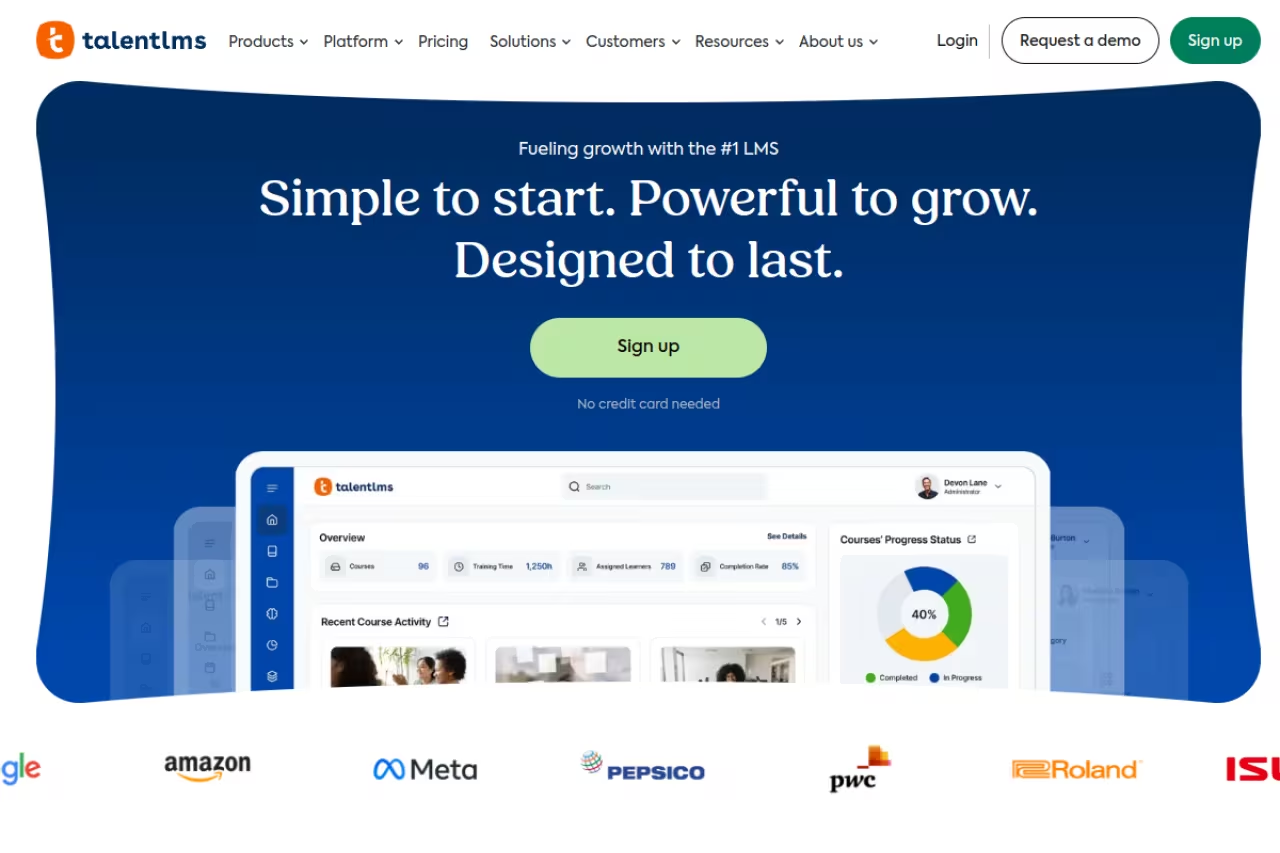
TalentLMS is what I recommend when someone asks "what should we just use." It does the boring things well: you can build a course, assign it, and pull a completion report in the same afternoon you sign up. No onboarding call required.
Who it's for: internal training teams, anyone rolling out onboarding or compliance for under 500 people.
The safe default for internal training teams under 500 people, since you can build a course, assign it and pull a completion report in one afternoon. The trade-off is per-seat cost that climbs as you grow and reporting that is functional rather than deep.
the Core plan is $119/month for up to 40 users, Grow is $229/month for 70, and Pro is $449/month for 100 (then $6 per extra user up to 500). Annual billing knocks 20% off. There's a genuinely usable free plan for 5 users and 10 courses with no time limit, which is rare.
The standout: speed. The interface is clean, the course builder (TalentCraft) now has AI generation baked in, and you don't fight the tool to get work done.
The catch: it gets pricey per-seat as you grow, and the reporting is functional rather than deep. If you need skills-gap analytics or sophisticated learning paths across thousands of people, you'll feel the ceiling.

Docebo: the AI-heavy enterprise pick
Docebo is what enterprises buy when they've outgrown the simple tools and have budget to match. Its AI is the real differentiator. Per Docebo's product materials, the system auto-tags content, recommends courses by role, translates across 40+ languages, and turns raw documents into structured modules with assessments.
Who it's for: mid-size to large organizations training employees, partners, and customers across multiple audiences.
A strong pick for mid-size to large organizations that want real AI personalization and separate branded portals for customers and staff. Expect an annual contract, an admin who owns the platform and heavier setup than anything else here.
Docebo doesn't publish numbers. Third-party estimates put a 100-user license around $8,000 to $16,000 a year, with most real deployments landing at $25,000+ annually. It's sized for 250+ learners.
The standout: the AI personalization engine genuinely works, and the extended-enterprise features (separate branded portals for customers vs. staff) are mature.
The catch: cost and complexity. You're signing an annual contract, you'll likely need an admin who owns the platform, and setup is heavier than anything else here. Overkill for a 30-person startup.

360Learning: training built by your own experts
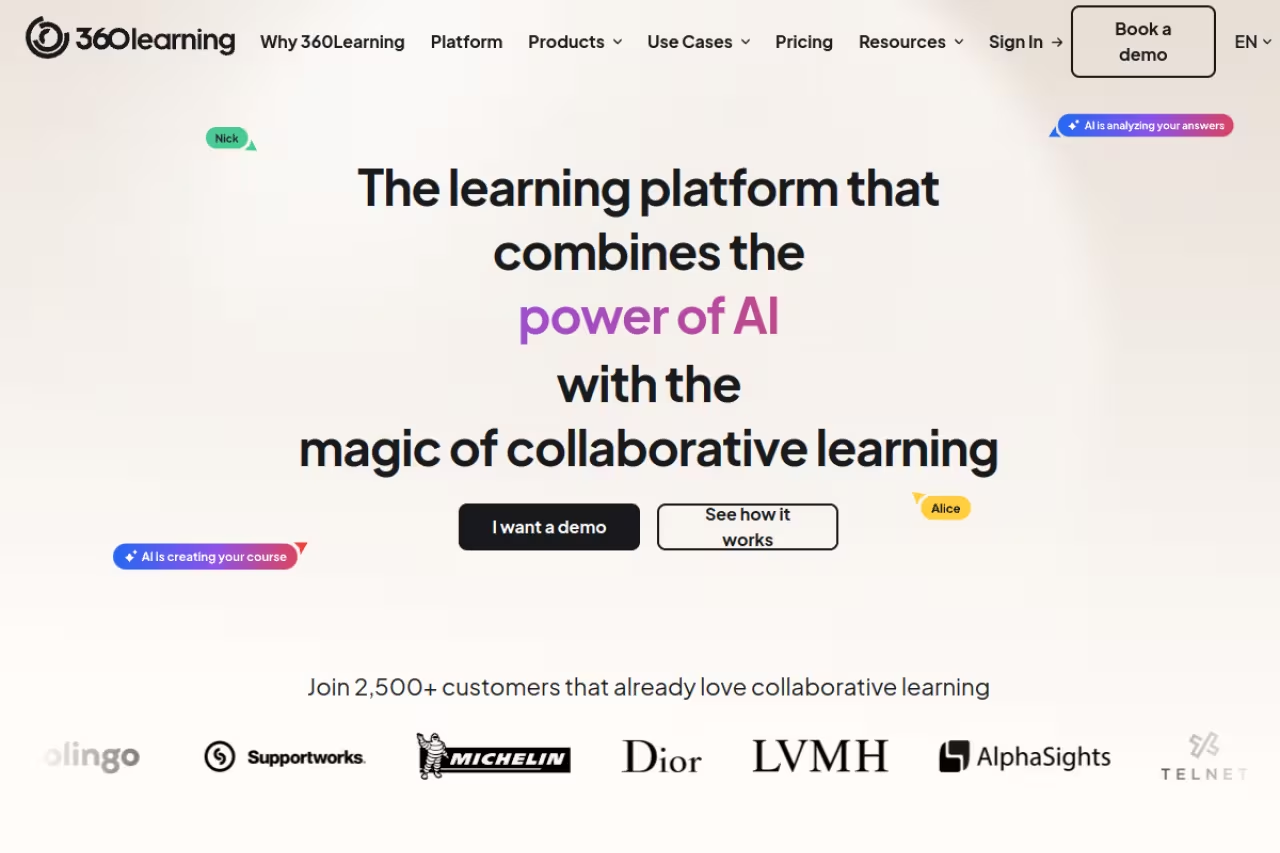
360Learning flips the usual model. Instead of L&D owning all content, it makes it easy for subject-matter experts on your team to author and update courses themselves. That collaborative authoring is the whole pitch, and it works well for companies whose knowledge lives in people's heads rather than a content library.
Who it's for: mid-sized and enterprise teams with strong internal expertise that want training to stay current.
Go with it if your company's knowledge lives in your experts' heads and you want them authoring and updating courses themselves. The catch is that this bottom-up model needs buy-in, or you pay for features nobody uses.
the Team plan is $8 per user per month for up to 100 users, billed monthly with no annual lock-in. Business and Enterprise are custom and use a flexible mix of registered and monthly-active users, so you're not paying for dormant accounts.
The standout: the authoring and feedback loop. Courses get built fast because the people who know the material are building them, and learners can flag outdated content.
The catch: that bottom-up model needs buy-in. If your experts won't contribute, you lose the main advantage and end up paying for features you're not using. The per-user Team pricing also climbs quickly past 100 seats.

Absorb LMS: polished mid-market workhorse
Absorb LMS sits between TalentLMS and Docebo. It's more capable than the small tools, less punishing than full enterprise software, and serves over 3,500 organizations across employee, customer, and partner training.
Who it's for: mid-market to enterprise teams that want a clean admin experience and strong authoring without a six-figure commitment.
A polished middle ground between TalentLMS and Docebo, with strong built-in authoring and a clean admin experience for mid-market to enterprise teams. Pricing is custom and active-learner based, so negotiate carefully to avoid surprise invoices.
custom quotes only, billed by active learners. Real-world figures suggest roughly $500/month at the small end (around 10 active users) scaling to $3,000+/month at 100 users. SMB deployments tend to average in the mid five figures annually.
The standout: Absorb Create, its built-in authoring tool with AI text-to-speech and auto-generated quiz questions. One customer cited saving over $400k in a year by building content in-house instead of outsourcing.
The catch: no public pricing means you're negotiating, and the active-learner model can produce surprise invoices if your usage spikes. Smaller features sometimes lag behind the marketing.

LearnWorlds: when the course IS the product
LearnWorlds isn't for internal training. It's for selling courses to the outside world, and it's the strongest option when education is your revenue line or your customer-acquisition engine.
Who it's for: course creators, coaches, and companies running paid academies or customer-education programs.
The pick when selling courses is the business, thanks to built-in checkout, memberships and a website builder. Skip it for internal training, and watch the per-enrollment fee on Starter, which pushes you up a tier once you have volume.
the Starter plan is $29/month ($24 annual) but charges a $5 fee per enrollment. Pro Trainer at $99/month drops the transaction fee. Learning Center at $299/month adds white-labeling, advanced analytics, and unlimited SCORMs. High Volume is custom.
The standout: the commerce stack. Built-in checkout, subscriptions, memberships, affiliate management, interactive video, and a website builder let you run a course business without bolting on five other tools.
The catch: that $5-per-enrollment fee on Starter eats margins fast, so you're pushed to the $99 tier the moment you have real volume. As a pure internal LMS, it's the wrong shape.

Thinkific: the easiest on-ramp for creators
Thinkific competes directly with LearnWorlds and wins on simplicity. If you've never built an online course and want to be selling one this week, this is the gentlest path.
Who it's for: solo creators and small teams selling courses, memberships, and digital downloads.
The gentlest path for solo creators and small teams who want to sell a course this week. It is lighter than LearnWorlds on advanced features, with SCORM and SSO only on the custom Plus tier, so growing companies eventually hit a wall.
plans run roughly $49/month (Basic), $99/month (Start), and $199/month (Grow), with 25% off annual billing. Thinkific Plus is custom. Thinkific Payments charges around 2.9% processing.
The standout: the learning curve, or lack of one. The course builder is the most beginner-friendly on this list, and the communities feature lets you bundle a course with a paying membership.
The catch: it's lighter on advanced features than LearnWorlds. SCORM, learning paths, and SSO live only on the custom Plus tier, so growing companies hit a wall and have to upgrade or migrate.
If you're building a customer academy as a growth channel, our take on AI onboarding tools and employee onboarding software overlaps with this stack. And if you're authoring courses, AI video generators handle the lessons most people dread recording.
Moodle: free, open, and yours to break
Moodle is the open-source giant that powers a huge share of universities and budget-conscious organizations worldwide. The software is free under the GNU GPL. You can modify it endlessly, host it anywhere, and plug in thousands of community plugins.
Who it's for: technical teams, education institutions, and anyone who wants total control and no per-user license fees.
Choose it for total control and no per-user license fees, as long as you have technical staff to run it. The software is free, but the cost moves into engineering hours and the interface feels dated next to commercial tools.
the core software is free to self-host. MoodleCloud, the official hosted version, starts around $130/year for 50 users and $410/year for 200. The honest number is total cost of ownership: self-hosting realistically needs 0.25 to 1.0 of a technical person, which cost analyses put in the tens of thousands annually.
The standout: no licensing fees and infinite customization. Nothing else here lets you own the whole stack.
The catch: the interface feels dated next to commercial tools, and "free" is misleading. The cost just moves from a software bill to engineering hours. Without technical staff, this gets expensive fast.

Litmos: compliance training at speed
Litmos (formerly SAP Litmos) is built to push training to a lot of people quickly, especially compliance and regulatory content.
Who it's for: companies rolling out standardized training in healthcare, retail, and anywhere with heavy compliance requirements.
Built for pushing standardized compliance training to many people quickly, with a large off-the-shelf course library. You trade flexibility and transparent pricing for speed, and it feels more rigid than 360Learning or Absorb for custom programs.
custom, billed per active user, with volume discounts. Mid-size estimates land around $6 per user per month, but you're talking to sales for an exact figure.
The standout: the off-the-shelf course library. Litmos ships thousands of ready-made courses on compliance, safety, and soft skills, so you're not authoring everything from scratch.
The catch: opaque pricing and a platform that feels more rigid than 360Learning or Absorb for custom programs. You're buying speed and a content catalog, not flexibility.
How to choose
Skip the feature checklists. Answer three questions instead.
Who are you training? Internal employees point you toward TalentLMS, 360Learning, Absorb, or Docebo. Selling courses to the public points you to LearnWorlds or Thinkific. These are two different products, and buying the wrong category is the most common mistake I see.
How many people, and how fast do you grow? Under 100 learners: TalentLMS or 360Learning's Team plan. A few hundred and climbing: Absorb. Thousands across multiple audiences with budget: Docebo. No budget but technical staff: Moodle.
Who builds the courses? If your subject-matter experts will author, 360Learning is built for that. If a small L&D team owns everything, Absorb Create or TalentCraft saves time. If you're buying compliance content rather than making it, Litmos.
Most teams overbuy. Start one tier below where you think you need to be. You can migrate up, and a free trial costs you nothing but an afternoon.
A good LMS pairs well with the rest of your enablement stack. If you're equipping a team with AI, our Dupple X yearly trial gets your people the tools and training to actually use it. Our roundup of the best AI tools for HR covers the systems that sit next to your LMS, and knowledge management software handles the docs your courses link out to.
FAQ
What is the best LMS platform for small businesses?
For most small businesses, TalentLMS is the best fit. It starts at $119/month for 40 users, sets up in an afternoon, and has a free plan for up to 5 users. If you're selling courses rather than training staff, Thinkific is the easier entry point at around $49/month.
How much does an LMS cost in 2026?
It ranges widely. Self-hosted Moodle is free (minus engineering time), creator tools like Thinkific and LearnWorlds start around $29 to $49/month, mid-market tools like TalentLMS run $119 to $449/month, and enterprise platforms like Docebo and Absorb are custom-quoted and commonly land at $25,000+ per year. Most enterprise LMS pricing is based on active learners.
What is the difference between an LMS for employees and one for selling courses?
Employee-training platforms (TalentLMS, Docebo, 360Learning, Absorb, Litmos) focus on assignments, compliance tracking, reporting, and learning paths. Course-selling platforms (LearnWorlds, Thinkific) focus on checkout, subscriptions, marketing, and a public-facing website. Buying the wrong type is the most frequent and costly LMS mistake.
Is Moodle really free?
The Moodle software is free and open source. But self-hosting requires servers, security maintenance, and a technical person to manage it, which several analyses estimate at tens of thousands of dollars per year in real cost. MoodleCloud, the official hosted version, starts around $130/year for 50 users.
Which LMS has the best AI features in 2026?
Docebo leads on AI maturity, with auto-tagging, role-based recommendations, document-to-course generation, and translation across 40+ languages. Absorb Create and TalentLMS's TalentCraft also offer solid AI authoring, including text-to-speech and auto-generated quizzes, at a far lower price point.
Related guides
Some offers on this page may be paid placements or contain affiliate links.
Across our whole catalogue the median is $24 a month and 33% of tools advertise a free tier. Figures are the lowest recurring monthly price quoted in our own review of each tool, read on 2026-08-19. Full method and every category.
