
8 Best AI Onboarding Tools for SaaS in 2026

Key facts8 tools compared: Userpilot, Appcues, Userflow, Chameleon, UserGuiding, Pendo, Amplitude…
- 8 tools compared: Userpilot, Appcues, Userflow, Chameleon, UserGuiding, Pendo, Amplitude Guides, Intercom Fin
- Userpilot (best for: Most product teams): $299/mo
- Appcues (best for: Non-technical teams): ~$249/mo
- Userflow (best for: Developer-led startups): $240/mo
- Chameleon (best for: Polished, on-brand UX): $333/mo
Most users decide whether your product is worth their time in the first session. If they can't reach the "aha" moment fast, they churn before they ever pay you. That's the whole reason onboarding tools exist, and in 2026 the good ones do something they couldn't do two years ago: build the flows for you.
The shift this year is real. Tools like Userpilot and Chameleon now ship AI agents that watch product behavior, spot where new users get stuck, and generate in-app guidance without a product manager touching the editor. That's a big deal when you're shipping features faster than you can write tooltips for them.
I compared the main contenders for a real SaaS onboarding stack. If you want the short answer: Userpilot is my top pick for most product teams because it pairs a no-code builder with an AI agent that actually does the work. But the right tool depends on your budget, your team's technical depth, and whether you care more about in-app flows or support chat. This guide is for founders, product, and growth people who need new users activated, not just signed up.
Quick comparison
| Tool | Best for | Price (entry) | Standout |
|---|---|---|---|
| Userpilot | Most product teams | $299/mo | Lia AI agent builds flows for you |
| Appcues | Non-technical teams | ~$249/mo | Easiest builder, mature AI agents |
| Userflow | Developer-led startups | $240/mo | Fast, clean, FlowAI insights |
| Chameleon | Polished, on-brand UX | $333/mo | Native-looking UI + Copilot Agent |
| UserGuiding | Budget-conscious SMBs | $174/mo | Cheapest, has a free forever tier |
| Pendo | Enterprise + analytics | $1,000+/mo | Analytics-first, deep behavioral data |
| Amplitude Guides | Amplitude users | Custom | Behavior-triggered AI nudges |
| Intercom Fin | Onboarding support chat | $0.99/resolution | AI answers setup questions live |

Userpilot
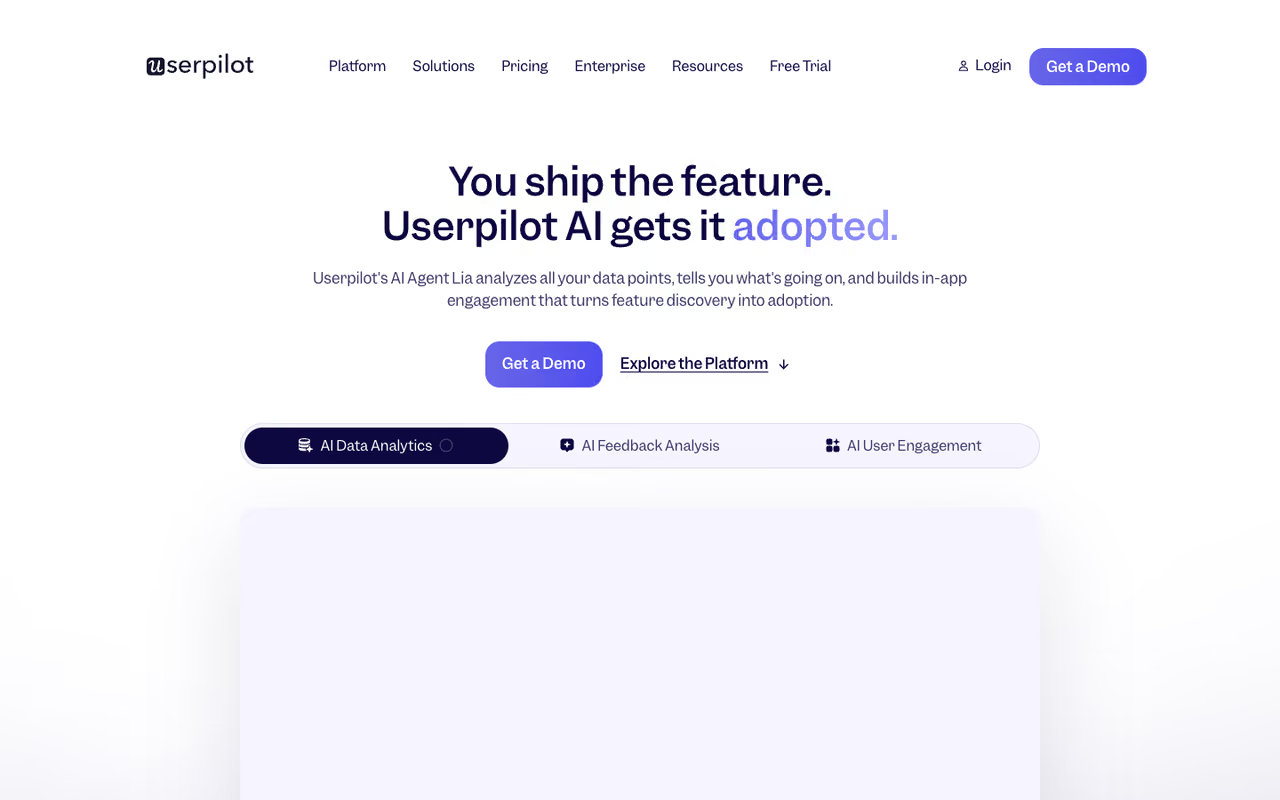
Userpilot is a no-code platform for building in-app onboarding: checklists, tooltips, modals, resource centers, and surveys, all targeted by user segment. It's been a category leader for a while, but what moved it to my top pick in 2026 is Lia, its AI agent.
Lia can build onboarding experiences on its own. You set a goal like "improve trial-to-paid conversion," and it monitors your product, finds drop-off points, and generates flows to fix them. It runs in three modes (Observe, Copilot, Autonomous) so you decide how much rope to give it, per Userpilot's own breakdown. For teams shipping features faster than they can manually document, that's the difference between onboarding that keeps up and onboarding that's always three releases behind.
Who it's best for: Product and growth teams at seed-to-Series-B SaaS companies that want one tool for onboarding, analytics, and feedback.
My top pick for product and growth teams shipping features faster than they can document them. Lia, its AI agent, builds flows to fix drop-offs, with three modes so you control how much autonomy it gets.
The Starter plan is $299/month billed annually, capped at 2,000 monthly active users. Growth (from 5,000 MAUs) is custom-quoted, and Enterprise adds SSO, data warehouse sync, and audit logs. Pricing scales with MAUs, so your bill grows as your product does.
The standout: Lia plus full product analytics in one place. You're not stitching together a builder and a separate analytics tool to figure out why a flow isn't working.
The catch: MAU-based pricing gets expensive fast once you're past a few thousand active users, and a lot of the heaviest AI features are still rolling out through 2026 rather than fully shipped. Read the contract carefully before you commit annually.

Appcues
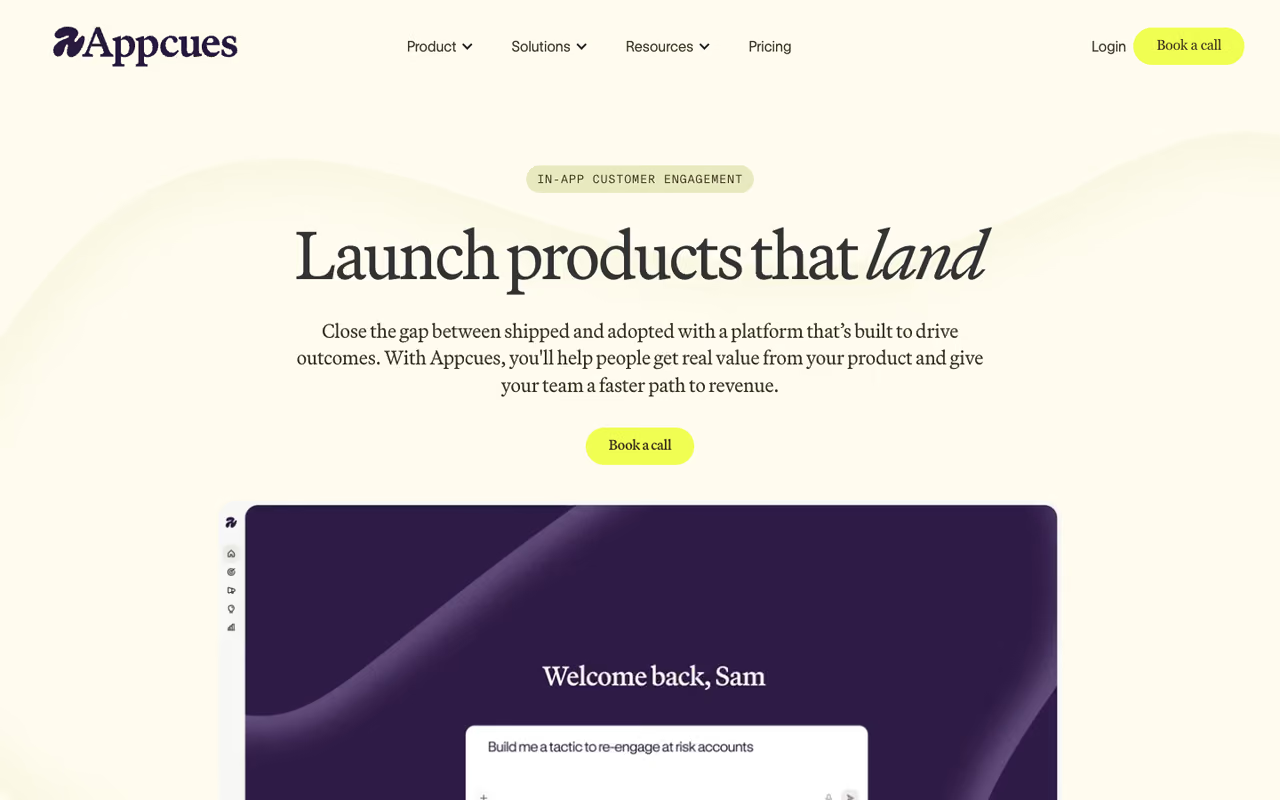
Appcues basically invented the no-code in-app onboarding category, and it's still the one I'd hand to a non-technical marketer and trust them to ship something good in an afternoon. The builder is the most forgiving of the bunch.
In 2026 Appcues leans into "a team of agents" baked into the platform that help you plan, build, and improve experiences. The AI handles the repetitive parts (drafting flow copy, surfacing which experiences are underperforming) so a small team can punch above its weight. If you've ever stared at a blank flow editor not knowing where to start, this is the tool that holds your hand.
Who it's best for: Non-technical product marketers and customer success teams that want a clean builder without engineering help.
The one I would hand to a non-technical marketer and trust to ship something good in an afternoon. The builder is forgiving, but it starts around $249/month.
Appcues starts around $249/month and scales by MAUs across three tiers (Start up to 3,000 MAUs, Grow up to 50,000, Enterprise custom). Exact numbers above the entry tier are quote-only, so budget for the demo dance.
The standout: The gentlest learning curve in this list. You'll ship your first onboarding flow the same day you sign up.
Where it falls short: Analytics are thinner than Userpilot or Pendo, so you'll likely pair it with a dedicated analytics tool. And like everyone here, the published-experience caps and MAU tiers mean costs climb quietly.

Userflow
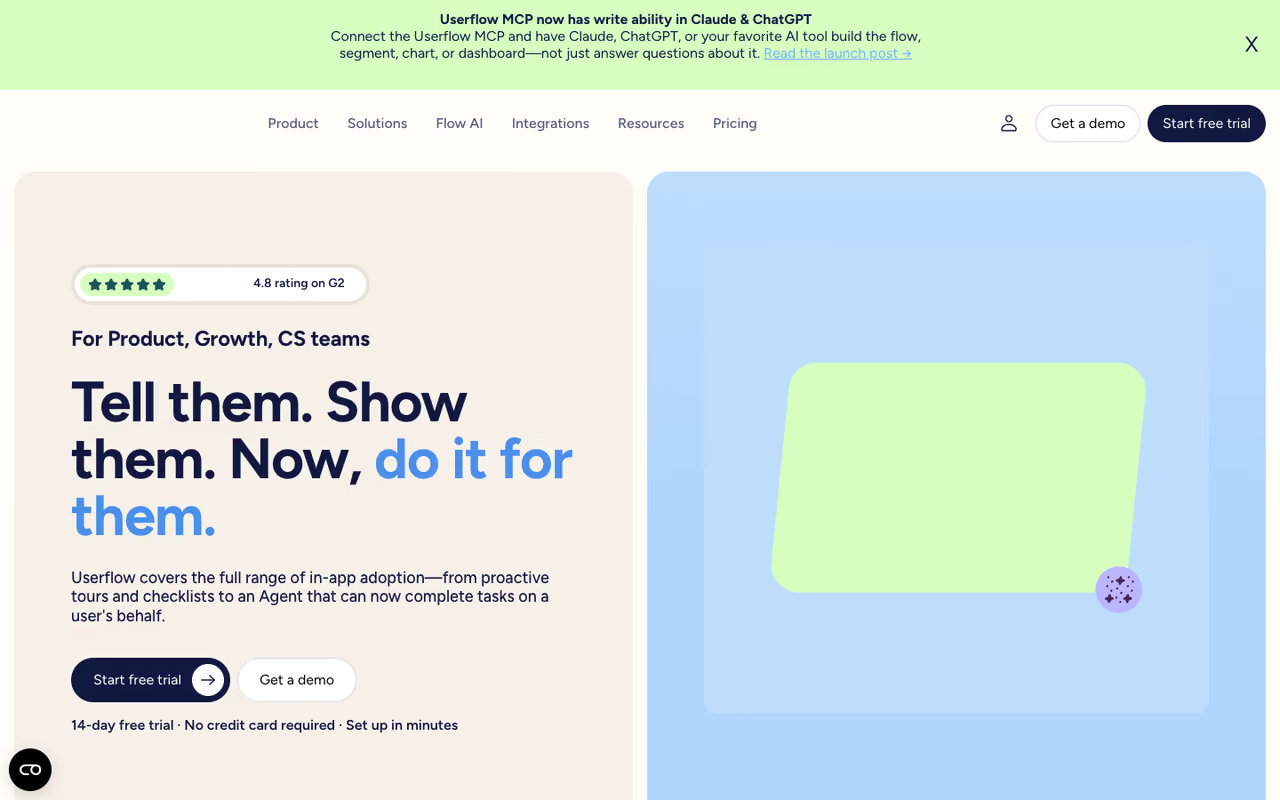
Userflow is the one developers and technical founders keep recommending to me. It's fast, the editor is clean, and unlike most competitors it includes unlimited team seats on every plan, so you're not penalized for adding people.
The AI angle here is FlowAI Insights and Smartflow, which surface where users abandon a flow and suggest fixes. It's less of an autonomous agent than Userpilot's Lia and more of a sharp analyst pointing at the leak. For a lean team that wants signal without a lot of dashboard noise, that trade is often the right one.
Who it's best for: Developer-led startups and product teams that value speed and don't want per-seat pricing.
A developer-friendly choice for lean teams that value speed and do not want per-seat pricing, since every plan includes unlimited team seats. Its AI is more sharp analyst than autonomous agent.
Startup is $240/month billed annually for 3,000 MAUs. Pro jumps to $680/month for 10,000 MAUs and unlocks FlowAI Insights, Salesforce and HubSpot integrations, and company-level targeting. Enterprise is custom.
The standout: Unlimited seats and genuinely fast performance. The whole tool feels built by people who hate slow software.
The catch: Advanced AI insights and the best integrations are gated behind the Pro plan, which more than doubles your entry cost. The Startup tier is solid but you'll outgrow it.

Chameleon
Chameleon is the pick when design matters. Its onboarding UI (tours, tooltips, microsurveys, launchers) looks native to your product instead of bolted on, which is why design-conscious teams keep choosing it over flashier competitors.
On the AI side, Chameleon ships a Copilot Agent on every plan, with Ranger AI and a Segments Copilot on Growth that help you target the right users and spin up segments in plain language. It's a thoughtful, polished tool rather than a kitchen-sink one.
Who it's best for: Teams that care deeply about brand consistency and want onboarding that doesn't look like a third-party overlay.
Pick Chameleon when design matters and onboarding should look native to your product. Polished and thoughtful, but it starts at $333/month, so it is not the budget route.
Startup starts from $333/month ($4k/year) with 6 seats and the Copilot Agent included. Growth adds Ranger AI and Segments Copilot with 15 seats. Both scale by monthly tracked users, and Enterprise is custom.
The standout: The most on-brand, native-feeling onboarding UI in the category.
Where it falls short: It's pricier at entry than UserGuiding or Userflow, and the most useful AI features (Ranger AI, Segments Copilot) sit on the Growth tier, not Startup.

UserGuiding
UserGuiding is the budget answer, and it's a genuinely good one. It does the core job (interactive walkthroughs, checklists, tooltips, surveys, a resource center) at the lowest entry price here, and it's the only tool on this list with a free forever tier.
Its AI Assistant ships on every plan, including 50 free AI resolutions on the lower tiers so new users can ask questions and get answers inside your app. For an early-stage SaaS watching every dollar, that's a lot of value for the money.
Who it's best for: SMBs and bootstrapped startups that need solid onboarding without four-figure monthly bills.
The budget answer, and a genuinely good one for SMBs and bootstrapped startups. It has the lowest entry price and a free forever tier, with an AI Assistant on every plan.
A free Support Essentials tier covers a knowledge base and AI Assistant with unlimited MAUs. Starter is $174/month billed yearly (2,000 MAUs), Growth is $349/month (5,000 MAUs) and adds A/B testing and localization. There's a 14-day trial with full access.
The standout: Cheapest serious option, plus a real free tier to test the waters.
The catch: Reviewers consistently note the builder and analytics feel a step behind Userpilot and Appcues. You're trading some polish and depth for the price.

Pendo
Pendo comes at onboarding from the analytics side. It's the choice when you want deep behavioral data first and in-app guides second, which is why it lands with bigger product orgs that already live in dashboards.
Pendo's strength is understanding exactly how users move through your product, then building guides off that data. Its AI features help analyze behavior and flag where onboarding breaks down. If your problem is "we don't actually know where users drop off," Pendo answers that better than the lighter tools above.
Who it's best for: Mid-market and enterprise product teams that prioritize analytics depth over a simple builder.
Choose Pendo if you want deep behavioral data first and in-app guides second. It suits mid-market and enterprise teams, but paid plans realistically start around $1,000/month.
Pendo has a free tier (up to a usage cap) but paid plans realistically start around $1,000/month and climb into five and six figures annually on MAU-based contracts. This is an enterprise buy, not a self-serve one.
The standout: Best-in-class product analytics paired with onboarding, so guidance is driven by hard data.
Where it falls short: Overkill and overpriced for small teams. The pricing is opaque, the contracts are long, and the builder is less friendly than Appcues. If onboarding is your only need, you're paying for a lot you won't use.

Amplitude Guides and Surveys
Amplitude folded the Command AI acquisition into its platform as Guides and Surveys, an in-product engagement module that delivers walkthroughs, tooltips, and nudges triggered by real behavioral data. If you already run Amplitude for analytics, this is the natural way to add onboarding without a second vendor.
The AI advantage is timing. Amplitude's AI Agents suggest the right nudge based on a user's behavior and past patterns, and the system measures whether a nudge helped or annoyed people. That behavioral context is hard for standalone onboarding tools to match because they don't sit on the same depth of analytics.
Who it's best for: Teams already invested in Amplitude analytics who want onboarding driven by the same behavioral data.
The natural add-on for teams already running Amplitude analytics, since guides are triggered by real behavioral data and no second vendor is needed. Pricing is custom and tied to your plan.
Custom, tied to your Amplitude plan. There's a free Amplitude tier, but Guides and Surveys at scale is a sales conversation.
The standout: Nudges timed by genuine behavioral signals, with automatic measurement of engagement vs. annoyance.
The catch: It really only makes sense if you're already an Amplitude shop. As a standalone onboarding tool, the dedicated builders are more focused and easier to start with.
Intercom Fin
Intercom Fin is a different shape of onboarding tool. Instead of building in-app flows, it answers new users' setup questions in real time through AI chat, so the people who get stuck during onboarding get unstuck without waiting on a human.
Fin resolves questions by pulling from your help docs and product knowledge, and it only charges when it actually resolves something. For onboarding specifically, it covers the long tail of "how do I do X" questions that no checklist anticipates. Pair it with one of the builders above and you've covered both guided flows and live help.
Who it's best for: Teams whose onboarding friction is support-driven, where new users have questions a tour can't answer. If support is your bottleneck, it's worth comparing it against other AI customer support tools first.
A different shape of onboarding tool, answering new users' setup questions in real time through AI chat. Best when onboarding friction is support-driven, and it works well paired with a flow builder.
Fin is $0.99 per resolution on all plans, with a minimum of 50 resolutions per month, per Intercom's pricing. Using it inside Intercom's helpdesk adds seats from $29/month, but Fin works on top of Zendesk, Salesforce, or HubSpot with no platform fee.
The standout: Outcome-based pricing. You pay for results, not seats or empty months.
Where it falls short: It's support automation, not in-app onboarding. It won't build your activation flows. Treat it as the live-help layer, not the whole stack.
Before you commit to any of these annually, it's worth understanding the AI mechanics that make them work. If you're building out a broader AI workflow, Dupple X gives you the playbooks and tooling to get more out of these agents than the defaults.
How to choose
Pick based on your actual bottleneck, not the longest feature list.
If you want the most AI to do the work for you: Use Userpilot. Lia's autonomous mode is the closest thing to onboarding that builds and fixes itself, and you get analytics in the same tool.
If a non-technical person owns onboarding: Use Appcues. The builder is the most forgiving and the AI agents fill in the gaps for a small team.
If engineers are involved and you hate per-seat pricing: Use Userflow. Unlimited seats, fast editor, and FlowAI tells you where flows leak.
If you're watching every dollar: Start with UserGuiding's free tier, upgrade to the $174/month Starter when you outgrow it.
If your real problem is "we don't know where users drop off": Use Pendo or Amplitude. You're buying analytics depth, and the onboarding rides on top of it.
If new users keep asking questions a tour can't answer: Add Intercom Fin as your live-help layer on top of any builder.
The honest truth is the best stacks usually combine two tools: one builder for guided flows, one AI chat for the questions you can't anticipate. Don't force one tool to do both jobs badly. Once users are activated, keeping them is a separate problem, and the AI customer success tools worth a look there overlap with this list. You can browse the full directory of AI tools if you want to go wider.
FAQ
What is an AI onboarding tool?
An AI onboarding tool uses machine learning and AI agents to guide new users (or new employees) through a product or process. For SaaS specifically, it builds in-app experiences like checklists, tooltips, and walkthroughs, and increasingly it can generate those experiences automatically, watch where users get stuck, and answer questions in plain language. The "AI" part is what separates 2026 tools from the rule-based onboarding software of a few years ago.
Which AI onboarding tool is best for a small SaaS startup?
For most small startups I'd start with UserGuiding (cheapest, with a free tier) or Userflow (fast, unlimited seats at $240/month). Both cover the core onboarding job without enterprise pricing. Move up to Userpilot when you want the AI agent and built-in analytics, usually once you have enough active users that the automation pays for itself.
How much do AI onboarding tools cost?
Entry pricing ranges from free (UserGuiding's Support Essentials, Amplitude's free tier) to roughly $174 to $333 per month for self-serve builders like UserGuiding, Userflow, Userpilot, and Chameleon. Enterprise tools like Pendo realistically start around $1,000/month and run into five or six figures a year. Most tools price by monthly active users, so your bill grows as your product does.
Can AI onboarding tools replace a customer success team?
No, and treat anyone who claims otherwise with suspicion. These tools automate the repeatable parts of onboarding (guided flows, answering common setup questions, flagging drop-off) so your team can focus on the high-touch accounts and edge cases that actually need a human. They make a small CS team more effective, not redundant. The same logic applies across most AI tools for productivity: they remove the busywork, not the judgment.
What's the difference between in-app onboarding and AI chat onboarding?
In-app onboarding (Userpilot, Appcues, Userflow, Chameleon) overlays guided flows directly on your product to walk users through key actions. AI chat onboarding (Intercom Fin) answers user questions in real time by pulling from your docs. They solve different problems: flows are proactive guidance, chat is reactive help. The strongest onboarding stacks use both.
Do I need a separate analytics tool with these?
It depends on the tool. Userpilot, Pendo, and Amplitude include strong analytics, so you may not need a separate one. Appcues, Userflow, Chameleon, and UserGuiding have lighter analytics, so teams often pair them with a dedicated product analytics tool to understand the full picture of why a flow works or doesn't.
Activate more of your signups without a bigger team. Start your Dupple X free trial →
Related guides
Some offers on this page may be paid placements or contain affiliate links.
