
Best Employee Onboarding Software in 2026 (Compared)

Key facts8 tools compared: Rippling, BambooHR, Gusto, Deel, Workday, Trainual, Connecteam, Camino
- 8 tools compared: Rippling, BambooHR, Gusto, Deel, Workday, Trainual, Connecteam, Camino
- Rippling (best for: Teams wanting HR + IT in one flow): From ~$8/user/mo (modular)
- BambooHR (best for: Small HR teams who want it simple): Core ~$10/user/mo
- Gusto (best for: SMBs running payroll + onboarding together): Plus $80/mo + $12/user
- Deel (best for: Hiring globally and compliantly): Free HRIS; EOR from $599/mo
A new hire's first week tells them whether they made a mistake. Paperwork that never arrives, a laptop with no logins, a Slack invite that shows up three days late: each one chips away at the excitement they walked in with. And it shows up in the numbers. Companies with a strong onboarding process see new hires stick around longer and hit productivity faster, while sloppy starts quietly feed early attrition.
The problem is that "onboarding software" means five different things depending on who you ask. For an IT-heavy startup it means provisioning accounts and devices automatically. For an HR team of one it means e-signatures and a checklist that doesn't live in a spreadsheet. For a company hiring across borders it means staying compliant in a country where you don't have a legal entity. No single tool wins all three.
I compared the major platforms' documentation and feature pages, cross-checked pricing against each vendor's own pages, and sorted them by who they actually fit. If you want the short version: Rippling is the strongest all-rounder because it ties HR, IT, and onboarding into one automated flow. But the right pick depends on your headcount and how much of the work you want the software to do for you. Here's the full breakdown.
Quick comparison
| Tool | Best for | Price | Standout |
|---|---|---|---|
| Rippling | Teams wanting HR + IT in one flow | From ~$8/user/mo (modular) | Auto-provisions apps and devices |
| BambooHR | Small HR teams who want it simple | Core ~$10/user/mo | Clean checklists and e-signatures |
| Gusto | SMBs running payroll + onboarding together | Plus $80/mo + $12/user | New hires self-enter their data |
| Deel | Hiring globally and compliantly | Free HRIS; EOR from $599/mo | Onboard in 150+ countries |
| Workday | Enterprises (1,000+ employees) | ~$34-42/user/mo (custom) | Onboarding tied to deep analytics |
| Trainual | Role-based training and SOPs | From ~$249/mo | Turns process into trackable courses |
| Connecteam | Deskless and frontline teams | Free up to 10; from $29/mo | Mobile-first onboarding on phones |
| Camino | Culture-first teams living in Slack | From ~$250/mo flat | Onboarding that feels human |

Rippling: the best all-around onboarding platform
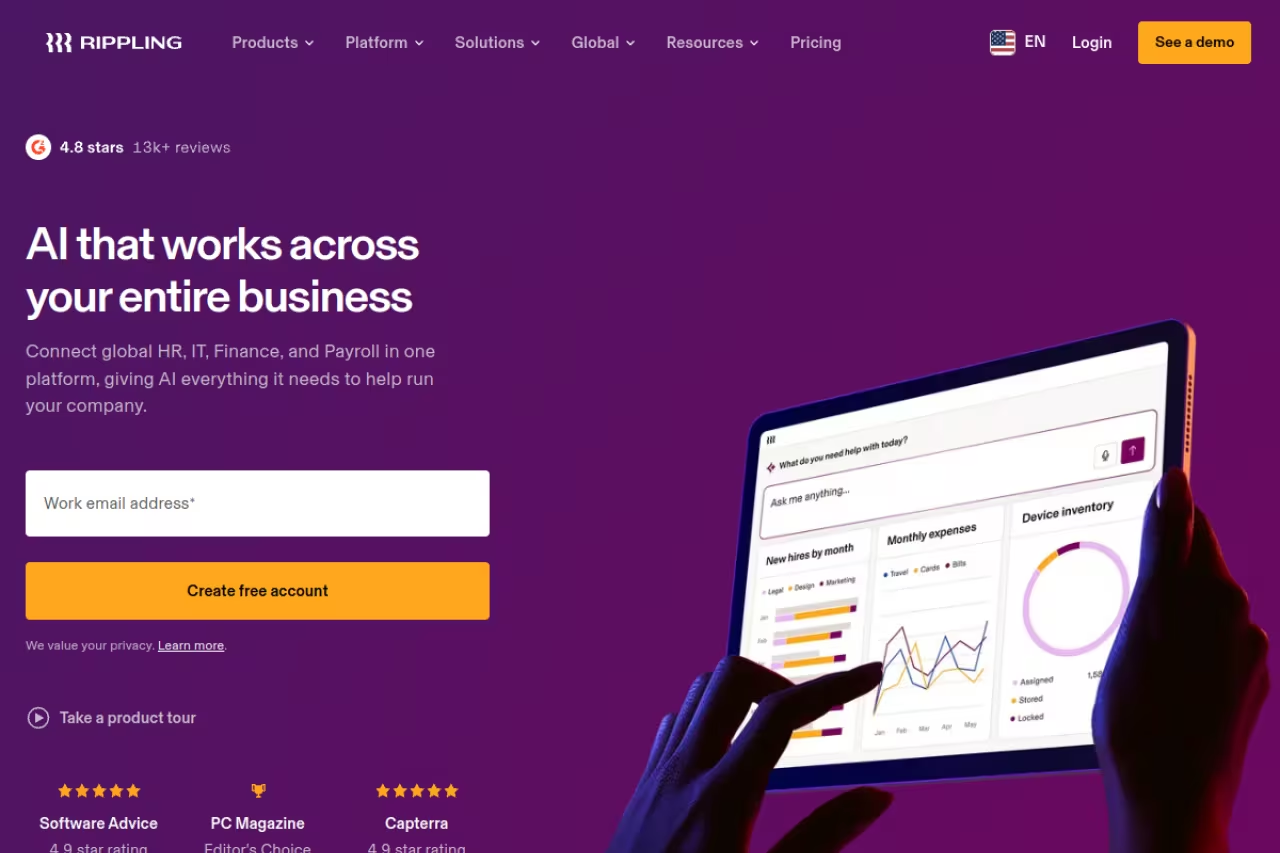
Most onboarding tools handle the HR paperwork and stop there. Rippling keeps going. When you hire someone, it can create their email and Slack accounts, assign the right software licenses, ship a pre-configured laptop, and run the payroll setup, all from one new-hire record. The pitch of "90-second onboarding" is marketing, but the underlying idea is real: one action triggers a chain of provisioning that used to take an IT ticket and three days.
Who it's for: Mid-market and fast-growing teams (roughly 50 to 1,000 employees) where HR and IT both touch every hire and nobody wants to chase the other one.
The strongest pick when HR and IT both touch every hire, at roughly 50 to 1,000 employees. One new-hire record triggers provisioning and clean de-provisioning, but modular pricing climbs fast and it is overkill for a 15-person company.
Rippling is modular and starts around $8 per user per month, but the real number depends on which products you bundle (HR, IT, payroll, device management). They don't publish a single sticker price, so you'll get a custom quote. Budget more than the headline if you want the IT provisioning that makes Rippling worth it.
The standout: Identity and access management. Account provisioning and de-provisioning are built in, so offboarding is as clean as onboarding. When someone leaves, access is revoked everywhere at once, which is a genuine security win, not a nice-to-have.
The catch: The modular pricing gets expensive once you've added the modules you actually wanted, and the platform is overkill for a 15-person company. You're buying an HR-IT operating system, not a checklist app. If you don't have devices and software to provision, you're paying for power you won't use.

BambooHR: the cleanest pick for small HR teams
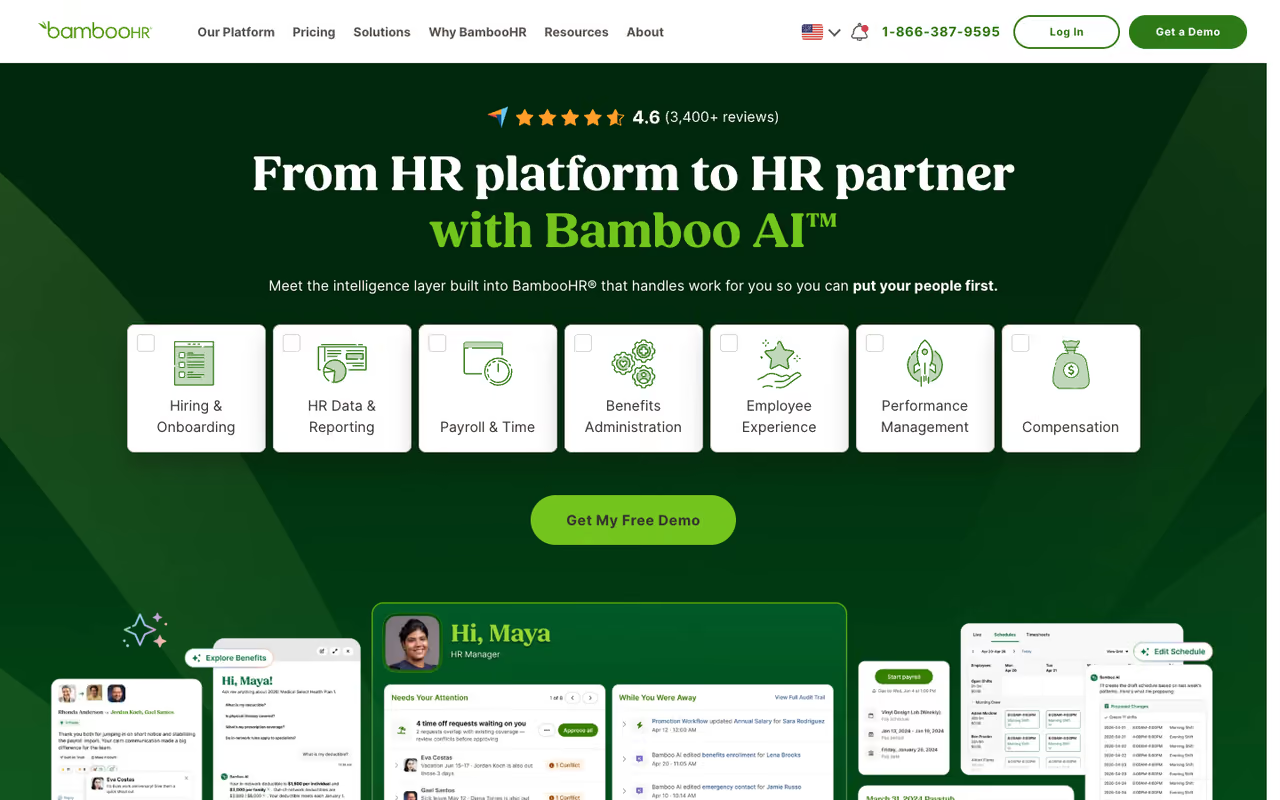
BambooHR has been the default answer for small and mid-sized HR teams for years, and onboarding is one of the reasons. You build new-hire packets, send pre-boarding documents, collect e-signatures, and track every task in a dashboard that a non-technical HR manager can run on day one. Nothing here will surprise you, and that's the point.
Who it's for: Companies with 25 to 250 employees that want HR basics handled without an implementation project. If your idea of onboarding is "make sure the offer letter is signed and the new person has their info in the system," this is the cleanest way to do it.
The cleanest choice for HR generalists at companies with 25 to 250 employees who want the basics handled without an implementation project. It has no IT provisioning, and opaque pricing plus an implementation fee of often 5 to 15% of annual cost can catch buyers off guard.
BambooHR doesn't publish list pricing publicly, but resellers and buyers consistently report Core around $10 per employee per month, Pro around $17, and Elite around $25. For teams under 25 people, expect a flat rate starting near $250 per month instead of per-head billing.
The standout: The onboarding experience itself. New-hire packets, welcome emails, e-signed documents, and task lists with progress tracking are all built in and genuinely pleasant to use. It feels designed for the HR generalist, not the systems admin.
Where it falls short: No IT provisioning. BambooHR won't set up accounts or assign software, so the technical side of onboarding still lands on someone else. Pricing is also opaque, and the onboarding implementation fee (often 5 to 15% of your annual cost) catches buyers off guard. For the IT side, pair it with something from our best AI tools for HR roundup.

Gusto: best when payroll and onboarding live together
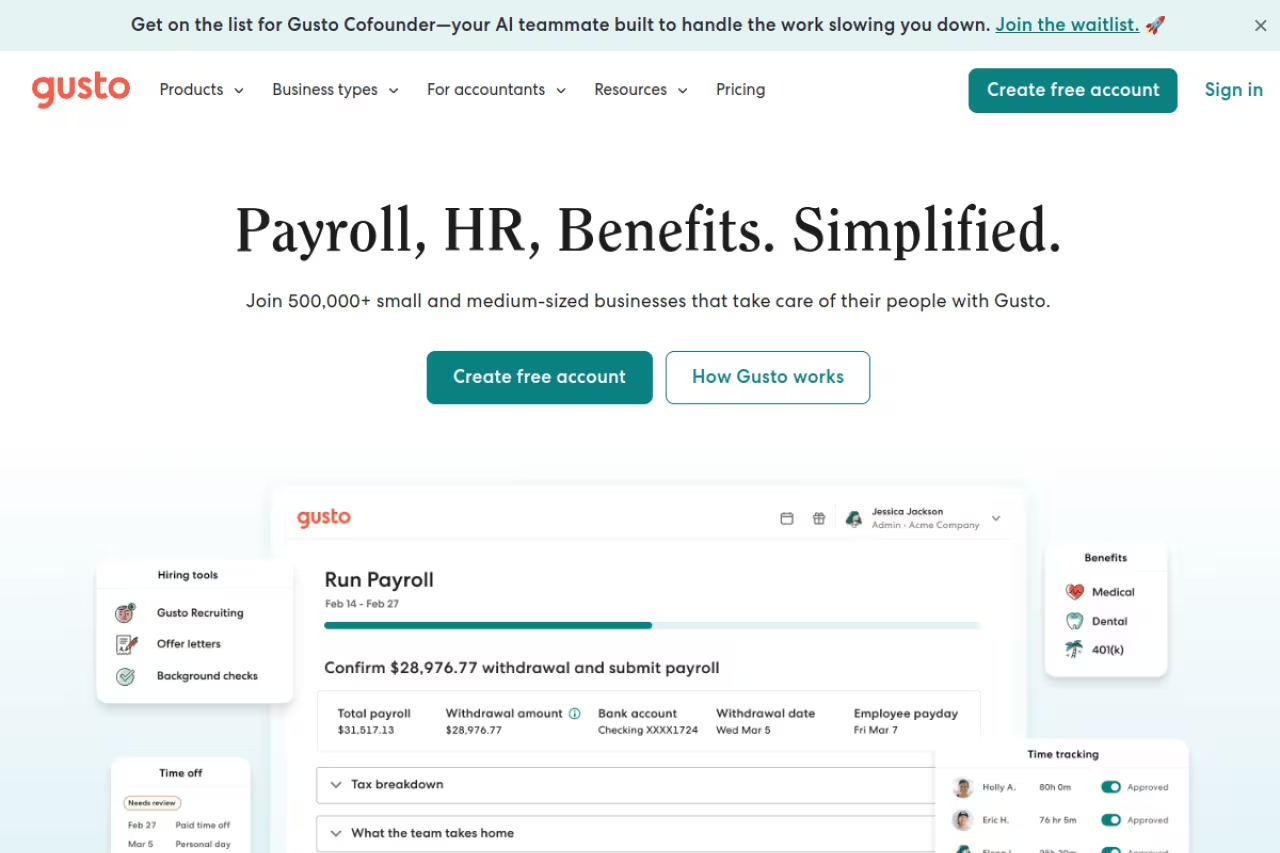
Gusto started as payroll and grew into a people platform, which means onboarding here is tightly wired to getting someone paid correctly. New hires complete their own I-9, W-4, and direct-deposit details before day one, e-sign their offer letter, and the data flows straight into payroll. For a small business, that single connection removes a whole category of manual re-entry errors.
Who it's for: US-based SMBs (under ~100 employees) that run payroll and want onboarding bundled in rather than bolted on. Especially good if you're currently doing this with a mix of PDFs and a payroll provider that ignores HR.
Best when payroll and onboarding should live together, for US SMBs under ~100 employees. New hires complete I-9, W-4 and direct-deposit details themselves and the data feeds payroll, but onboarding depth tops out fast and it is US-focused.
Gusto raised prices in 2026. The Simple plan is $49 per month plus $6 per employee, Plus is $80 per month plus $12 per employee (this is the tier with the real onboarding and time-tracking tools), and Premium is $180 per month plus $22 per employee. There's also a Contractor Only plan at $35 per month plus $6 per contractor. No setup fees, no contracts.
The standout: Self-service onboarding that feeds payroll. New hires do the data entry, the system handles compliance forms, and HR stops being a copy-paste machine. For a 20-person company, that's hours back every hire.
The catch: Onboarding depth tops out fast. There's no real role-based training, no device management, and it's US-focused, so if you hire internationally Gusto isn't your tool. It's a great SMB all-rounder, not a dedicated onboarding engine.

Deel: for hiring across borders
Deel solves a different problem: how do you onboard someone in a country where you have no legal entity? As an Employer of Record, Deel becomes the legal employer in 150+ countries, handling compliant contracts, local payroll, tax withholding, and statutory benefits while the person works for you. The onboarding flow is built around staying compliant, not just sending a welcome email.
Who it's for: Companies hiring international employees or contractors who can't (or don't want to) set up entities in every country.
The answer to hiring in countries where you have no legal entity, with Employer of Record coverage in 150+ countries. The free HRIS for up to 200 employees is a nice bonus, but EOR is expensive and pointless if every hire is in one country.
Deel HR, the core HRIS, is free for up to 200 employees. Contractor management runs about $49 per contractor per month, global payroll around $29 per employee, and full EOR starts at $599 per employee per month (dropping to roughly $350 to $500 with volume). Remember the platform fee excludes salary, employer taxes, and benefits, which add 13 to 40% on top depending on the country.
The standout: That free HRIS tier. For a distributed team under 200 people, you get an employee directory, org chart, and time-off tracking at no cost, which can replace a paid tool like BambooHR for core HR while you use Deel for the global hires.
Where it falls short: EOR is expensive by nature, and if all your hires are in one country you're paying for compliance infrastructure you don't need. Deel is the answer to "global," not the answer to "simple."

Workday: the enterprise standard
Workday is what large organizations run when onboarding is one module inside a full HCM platform that also handles workforce analytics, talent management, and complex org structures. Onboarding data connects directly to the analytics layer, so a Chief People Officer can see how onboarding correlates with retention and performance across thousands of employees.
Who it's for: Enterprises with 1,000+ employees and real organizational complexity. Below that headcount, this is the wrong tool.
The enterprise standard for organizations with 1,000+ employees that want onboarding tied to workforce-wide analytics. Cost, complexity and a months-long implementation make it the wrong tool for anyone under a few hundred people.
Custom and quote-only. Industry estimates put it around $34 to $42 per employee per month at scale, climbing to $80 to $150 for the largest deployments. Implementation is the real cost: often 100 to 200% of your annual subscription, paid to consultants over months.
The standout: Analytics depth. Nothing else on this list connects onboarding to workforce-wide reporting the way Workday does, which matters when you're managing thousands of people across regions.
The catch: Cost, complexity, and a months-long implementation. Workday is powerful and genuinely heavy. For anyone under a few hundred employees, it's like buying a freight train to commute to work.

Trainual: onboarding as trackable training
If your onboarding problem is really a knowledge-transfer problem, Trainual is built for you. It turns your processes, SOPs, and role-specific training into structured, trackable courses with quizzes and e-signatures. New hires move through a learning path, and you can see exactly who completed what. It's less "HR paperwork" and more "get this person productive."
Who it's for: Growing teams (franchises, agencies, operations-heavy businesses) where every role has documented processes that new people need to actually learn.
Pick it if your onboarding problem is really knowledge transfer, with SOPs turned into role-based learning paths and completion tracking. It is not an HRIS, with no payroll, benefits or IT provisioning, and plans start around $249 per month for 10 seats.
Trainual moved to quote-based pricing, with plans starting around $249 per month for a base of 10 seats and additional seats running roughly $3 to $5 each. Larger rollouts can reach $15,000+ per year, and there's sometimes an implementation fee around $1,000.
The standout: Role-based learning paths with completion tracking. It bridges onboarding and ongoing training, so the system you use in week one keeps working in month six. It pairs well with the platforms in our best AI knowledge management tools guide.
Where it falls short: It's not an HRIS. No payroll, no benefits, no e-signature on legal contracts in the HR sense, and no IT provisioning. Trainual is a training layer that sits on top of whatever HR system you already run.
Before the last few picks, a quick aside. If you're building out the rest of your tech stack alongside onboarding, Dupple X gives you a single subscription that bundles dozens of AI tools, which is a cheaper way to test what your team actually adopts than buying ten separate seats. Start a yearly trial here if you want to try before you commit.

Connecteam: built for deskless teams
Most onboarding software assumes your new hire sits at a desk with a laptop. Connecteam assumes the opposite. It's a mobile-first platform for frontline and deskless workers, the kind who clock in at a restaurant, a job site, or a retail floor. Onboarding, training courses, quizzes, and certifications all live in an app people run on their phones.
Who it's for: Businesses with hourly, frontline, or field staff: restaurants, construction, retail chains, healthcare, cleaning, and field services.
A deskless-first platform for restaurants, construction and retail, with a free plan for up to 10 employees that is one of the best deals here. If your new hires are software engineers, the desk-focused tools fit better.
Genuinely generous. The Small Business plan is free forever for up to 10 employees with full features. Paid plans start around $29 per month for up to 30 users on the Basic tier, scaling up to the Expert plan near $99 per month and beyond.
The standout: That free tier plus a mobile-first design frontline workers will actually use. For a small deskless team, this is one of the best deals on this list, full stop.
The catch: It's not built for corporate knowledge-work onboarding. If your new hires are software engineers, the desk-focused tools above fit better. Connecteam shines for the deskless majority that other HR tools tend to ignore.
Camino: onboarding that runs in Slack
Camino takes a culture-first angle. If your company lives in Slack, Camino runs onboarding there: messages that look like they come from real teammates, native meeting scheduling, and workflows that feel human instead of like a form to fill out. The bet is that a warm, personal first week does more for retention than a perfectly tracked checklist.
Who it's for: Mid-market, Slack-native teams that care about how onboarding feels and want it where people already work.
A good fit for Slack-native mid-market teams that want a warm, human first week, at around $250 per month flat. It is a layer, not a system of record, so pair it with a real HRIS, and much of the appeal disappears off Slack.
Around $250 per month flat, or a per-journey model that scales with hiring velocity rather than headcount, starting near $1,000 per year on the Starter plan. The flat structure is refreshing next to per-employee billing.
The standout: The native, human feel. Onboarding stops being a portal someone forgets to open and becomes part of the daily Slack flow.
Where it falls short: It's a layer, not a system of record. No payroll, no benefits, no IT provisioning. And if your team isn't on Slack, much of the appeal disappears. Pair it with a real HRIS underneath.
How to choose the right onboarding tool
Skip the feature checklists. Start with two questions.
First, what's the actual bottleneck? If new hires wait days for accounts and laptops, you have an IT provisioning problem and Rippling or Workday is your answer. If they show up but don't know how to do the job, you have a training problem and Trainual fits. If the paperwork is the mess, BambooHR or Gusto clears it.
Second, what's your headcount and geography? Under 100 people in one country: Gusto or BambooHR. Frontline or deskless: Connecteam. Hiring globally: Deel. Mid-market wanting HR and IT unified: Rippling. Enterprise with real complexity: Workday.
The expensive mistake is buying for the company you'll be in three years instead of the one you are today. Onboarding tools are easy to switch when you're small and painful to switch when you're big, so right-size for now and re-evaluate at your next growth stage. While you're auditing the stack, it's worth checking your best applicant tracking systems and best AI recruiting tools so hiring and onboarding actually hand off cleanly. You can also browse our full top tools directory to compare adjacent categories.
Frequently asked questions
What is the best employee onboarding software in 2026?
For most growing companies, Rippling is the strongest all-around pick because it combines HR, IT provisioning, and onboarding in one automated flow. But the best tool depends on your needs: BambooHR for simple small-team HR, Gusto if you want onboarding bundled with payroll, Deel for global hiring, and Workday for large enterprises.
How much does employee onboarding software cost?
It ranges widely. SMB tools run roughly $6 to $25 per employee per month (Gusto's Plus plan is $80 plus $12 per employee; BambooHR Core is around $10). Connecteam is free for up to 10 users. Enterprise platforms like Workday run $34 to $150 per employee per month with heavy implementation fees, and global EOR through Deel starts at $599 per employee per month.
What is the difference between an HRIS and onboarding software?
An HRIS (like BambooHR or Deel HR) is the system of record for all employee data: directory, payroll, benefits, time off. Onboarding software is the workflow for getting a new hire set up. Many HRIS platforms include onboarding modules, but standalone tools like Trainual (training) or Camino (Slack-based) focus only on the new-hire experience and sit on top of an HRIS.
What's the best onboarding software for remote and deskless teams?
For deskless and frontline workers (restaurants, retail, field services), Connecteam is the standout because it's mobile-first and free for up to 10 employees. For remote knowledge teams that hire internationally, Deel handles compliant onboarding in 150+ countries. For culture-first remote teams on Slack, Camino runs onboarding where people already work.
Can onboarding software handle IT setup like accounts and laptops?
Only some of them. Rippling is the clear leader here: it auto-provisions email, Slack, software licenses, and even ships configured devices, then de-provisions everything at offboarding. Workday offers provisioning at the enterprise level. Most other tools (BambooHR, Gusto, Trainual) handle HR paperwork and training but leave IT setup to a separate process or admin.
Related guides
Some offers on this page may be paid placements or contain affiliate links.
