
Best ITSM Software in 2026: 8 Platforms I'd Actually Recommend

Key facts8 tools compared: Freshservice, Jira Service Management, ServiceNow, GLPI, SysAid, InvGate…
- 8 tools compared: Freshservice, Jira Service Management, ServiceNow, GLPI, SysAid, InvGate, SolarWinds Service Desk, Zendesk
- Freshservice (best for: Fast time-to-value): $19 to $99
- Jira Service Management (best for: Atlassian / dev-heavy teams): Free, then ~$20 to $51
- ServiceNow (best for: Large enterprise): Custom (~$70 to $200+)
- GLPI (best for: Budget / self-hosted): Free (self-host)
Buying ITSM software is one of those decisions that looks simple on a feature matrix and turns into a six-month migration the moment you sign. Every vendor checks the same boxes: incident, request, change, problem, a CMDB, some flavor of AI. The differences only show up once you're three weeks into onboarding and realize the tool you picked needs two full-time admins just to stay configured.
This guide compares how service desks actually run on these platforms and spent the past month re-checking current pricing and AI features because the whole category shifted hard in the last year. AI agents that resolve tickets without a human are now the headline pitch, not a footnote. That changes what "best" means.
If you want the short version: most mid-market IT teams should start with Freshservice for speed or Jira Service Management if you already live in Atlassian. ServiceNow is the enterprise answer, and it earns the reputation, but it's overkill for a 15-person IT team. Below is who each tool is actually for, with real numbers.
Quick comparison
| Tool | Best for | Price (per agent/mo) | Standout |
|---|---|---|---|
| Freshservice | Fast time-to-value | $19 to $99 | Clean UX, quick rollout |
| Jira Service Management | Atlassian / dev-heavy teams | Free, then ~$20 to $51 | Free tier, dev integration |
| ServiceNow | Large enterprise | Custom (~$70 to $200+) | Depth, CMDB, AI agents |
| GLPI | Budget / self-hosted | Free (self-host) | Open source, real CMDB |
| SysAid | Mid-market customization | Custom (~$79 to $108) | Built-in AI copilot |
| InvGate | Teams wanting simple ITIL | From $17 | No-code workflows |
| SolarWinds Service Desk | Asset-heavy IT | $39 to $99 | Change mgmt on every tier |
| Zendesk | Internal IT via support stack | From ~$25 | Same tool for customers + staff |

Freshservice: the one I'd hand a new IT lead
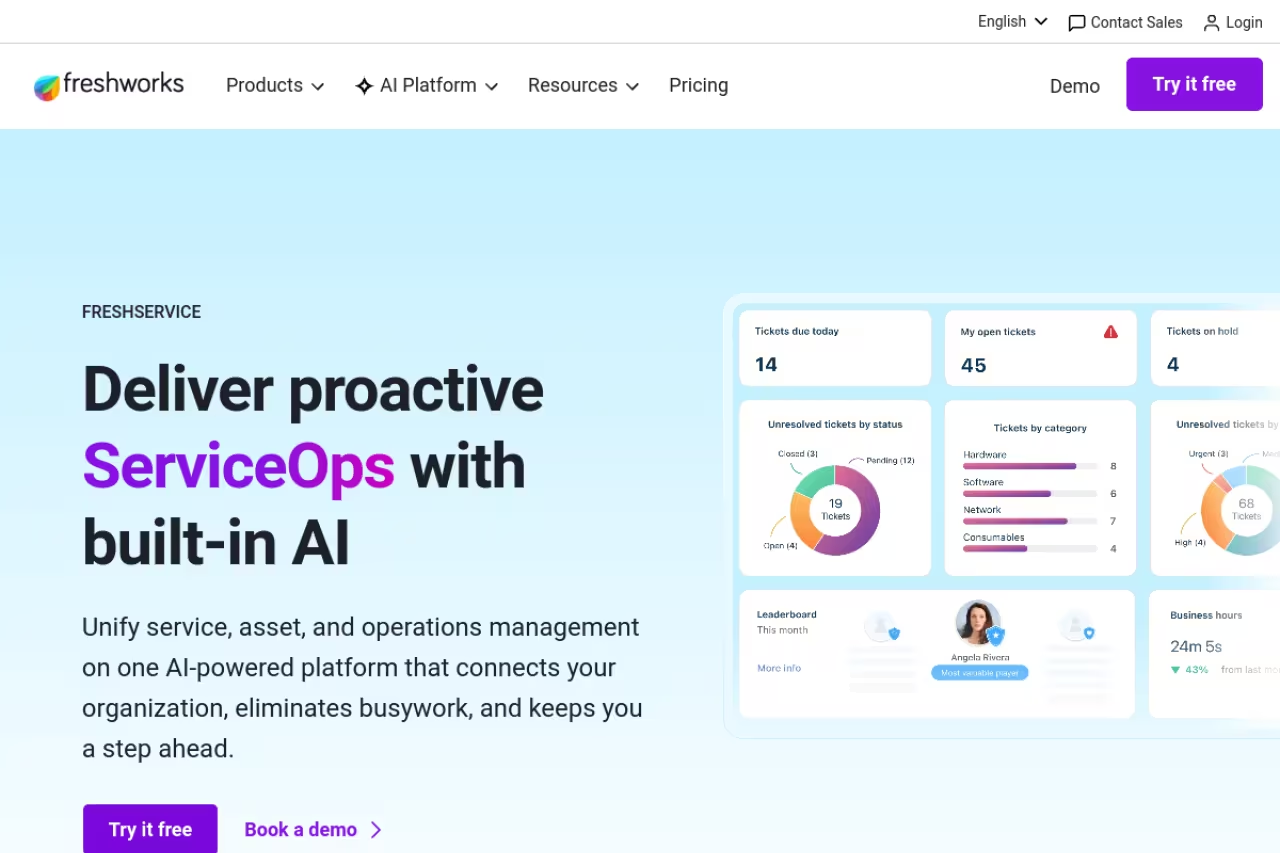
Freshservice is the tool I recommend first when someone asks where to start, because you can stand up a working service desk in days, not quarters. It covers incident, request, change, problem, asset management, and a self-service portal without the configuration tax that sinks heavier platforms.
Where I would start for small-to-mid IT teams that want to be live this month and grow into the advanced stuff later. Change management only arrives on the $49 Growth tier, and past a few hundred agents you will hit ceilings ServiceNow does not have.
Pricing is per agent, billed annually: $19 (Starter), $49 (Growth), $99 (Pro), and custom for Enterprise, with a 14-day free trial that unlocks everything. One thing to flag: change management lands on the Growth tier, so the real "ITSM" starting price is $49, not $19. The AI agent (Freddy) sits in the higher tiers.
The standout is genuinely the experience. Agents like using it, which sounds soft until you remember that a service desk nobody wants to open is a service desk that fills up with side-channel Slack requests.
The catch: as you scale past a few hundred agents and want deep CMDB relationships or heavy custom workflows, you'll start bumping into ceilings that ServiceNow doesn't have. It's a fast on-ramp, not an infinite one.
Jira Service Management: best if you're already on Atlassian
If your engineering team lives in Jira and Confluence, Jira Service Management is close to a no-brainer. The connection between a support ticket and the actual dev work that fixes it is the tightest in this whole list. A reported incident can link straight to the bug, the sprint, and the deploy.
Close to a no-brainer for Atlassian-native or DevOps-heavy teams, with the tightest link between tickets and the dev work that fixes them. Outside Atlassian the appeal fades fast, and the admin model is more fiddly than Freshservice.
There's a real free tier for up to 3 agents. Paid plans, billed annually, run roughly $20/agent/month for Standard and about $51/agent/month for Premium, with Enterprise on a quote. Atlassian's official pricing page is the source to check before you budget, since list price drops a bit at higher agent counts. Like the others here, you only pay for agents who work tickets; the people submitting requests are free.
The standout is incident management and on-call. The Opsgenie capabilities are folded in, so alerting, escalation, and post-incident review sit in the same place as your service desk.
The catch: outside the Atlassian world, the appeal fades fast. The admin model is more fiddly than Freshservice, and if your IT org doesn't already use Jira, you're adopting a whole ecosystem to get a help desk. That's a lot of rope.

ServiceNow: the enterprise standard, for better and worse
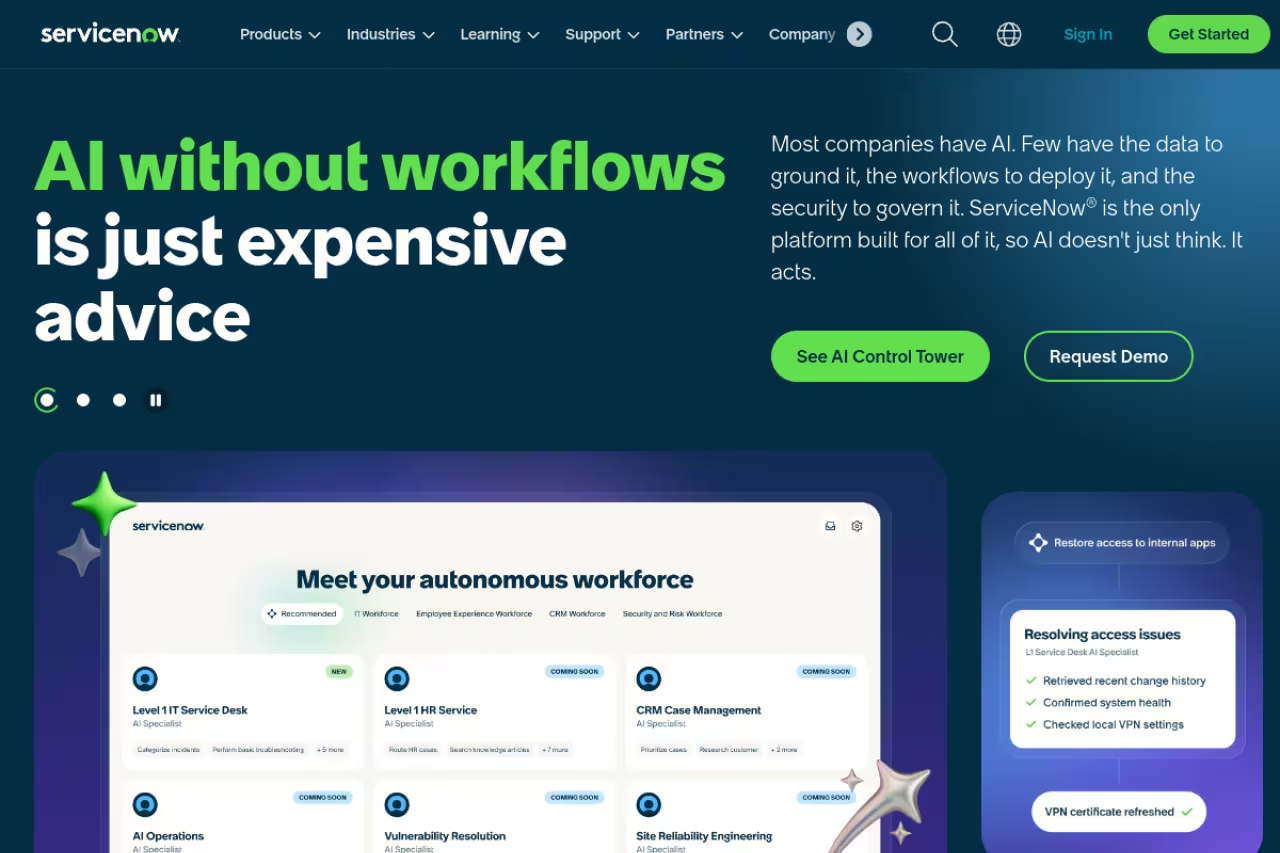
ServiceNow is the platform big enterprises standardize on, and there's a reason. The depth is real: a mature CMDB, every ITIL process you could name, IT operations management, and now a serious push into autonomous AI agents through Now Assist that can diagnose and close common requests end to end.
The enterprise standard for large organizations with thousands of employees and a dedicated platform team, with unmatched depth from CMDB to autonomous AI agents. Rollouts take three to nine months, so for a small or mid-size team it is a freight train for a commute.
Pricing is custom and ServiceNow won't post numbers, but industry estimates put ITSM at roughly $70 to $100 per fulfiller/month at the base tier and $200+ at the Enterprise tier that includes the full Now Assist AI, per breakdowns like eesel's license guide. The autonomous AI agents live only in the top Prime tier, and the AI add-on can carry a 50 to 60% uplift on top.
The standout is that ServiceNow does everything, and does it at a scale nothing else here matches. If you need one system of record for IT, HR, security ops, and customer service, this is it.
The catch: cost and complexity. A meaningful rollout takes three to nine months, usually needs a partner, and the platform expects ongoing admin investment. For a small or even mid-size IT team, that's like buying a freight train to commute to work.
GLPI: the best free, self-hosted option
GLPI is the open-source answer, and it's better than "free" usually implies. Self-host it and you pay nothing in license fees while getting incident and request management, a genuine asset inventory, and a CMDB. For budget-constrained teams, government, education, and Europe (it's French-built and popular there), it's a strong default.
The best free choice for teams with some technical capacity who would rather spend on people than per-agent licenses, with a strong asset inventory engine. The interface looks its age, and you own patching, backups and uptime.
Self-hosting is free. If you want managed cloud hosting or vendor support, GLPI Network plans start around €19/agent/month for cloud, with on-prem support subscriptions scaling by agent and asset count.
The standout is the asset management and inventory engine, which holds up against paid tools and is the main reason GLPI keeps showing up in serious comparisons.
The catch: the interface looks its age, and self-hosting means you own patching, backups, and uptime. The AI story is thin compared to the commercial crowd. You're trading polish and hand-holding for control and zero licensing cost.

SysAid: customization with AI baked in
SysAid has carved out a solid spot in the mid-market by being flexible without demanding a platform team. It leans hard into AI now, with SysAid Copilot handling ticket categorization, drafting replies, and powering end-user self-service.
A fit for mid-sized companies that want to shape workflows their own way without ServiceNow's overhead, with AI baked in through Copilot. Opaque pricing makes budgeting hard, and lower tiers gate the better AI behind upgrades.
SysAid doesn't publish prices, but third-party reporting puts the Help Desk plan around $79/agent/month and the ITSM tier near $108/user/month, depending on agent count and managed assets. Expect onboarding fees and asset-based charges on top, so get the full quote before comparing.
The standout is how much you can customize automation and workflows relative to the price band, with AI features that aren't bolted on as an afterthought.
The catch: opaque pricing makes budgeting hard, and the lower tiers gate the better AI behind upgrades. You'll want a detailed quote and a clear count of billable agents and assets before you sign anything.
InvGate Service Management: ITIL without the headache
InvGate Service Management targets teams that want proper ITIL-aligned processes but don't want to spend weeks configuring them. The no-code workflow builder is the hook: you can wire up approvals and automations by dragging boxes, not writing scripts.
Pick it for IT teams that want ITIL structure and reporting without a heavy implementation, from $17/agent/month. The integration ecosystem and marketplace are smaller than the giants', so a specific connector may not exist yet.
Pricing starts at $17/agent/month for the Starter tier, with Pro around $40/agent/month (annual), and a 30-day free trial. That makes it one of the cheaper entry points for a tool that still covers the core ITSM processes well.
The standout is the balance of approachable UX and real ITIL coverage, plus reporting that's stronger than the price suggests.
The catch: the integration ecosystem and third-party marketplace are smaller than the giants', so if you need a specific connector it may not exist yet. It's a clean core tool, not a sprawling platform.
SolarWinds Service Desk: when assets come first
SolarWinds Service Desk (formerly Samanage) pairs ticketing with strong asset and configuration management, which makes it a fit for IT shops where tracking hardware and software is half the job.
Suited to asset-heavy environments that want change management from day one, and it is included on every tier. It is less flashy on AI than newer entrants, and list pricing moves, so confirm with sales.
Plans run roughly $39/technician/month (Essentials), $79 (Advanced), and $99 (Premier) per third-party listings. The useful detail: change management is included on every tier, including Essentials, where some rivals push it to a mid plan. If change is core to your work, that affects the real comparison price.
The standout is the asset discovery and management, plus a clean change workflow that doesn't cost extra to unlock.
The catch: it's less flashy on AI than newer entrants, and it sits inside the broader SolarWinds ecosystem, which some buyers approach cautiously. Pin down current pricing with sales, since list figures move.

Zendesk: one tool for customers and staff
Zendesk isn't a born-and-raised ITSM platform, but plenty of teams run internal IT support on it, especially when the company already uses Zendesk for customer service. Running one tool for both means one set of skills, one set of integrations, one bill.
Sensible if you already run Zendesk for support and want internal IT on the same stack, from around $25/agent/month. It is not a true ITSM tool, so skip it if you need formal change and configuration management.
Pricing for the suite plans starts around $25/agent/month and climbs through higher tiers that add automation and AI. The AI agents and advanced routing live in the pricier plans.
The standout is the unified experience and the strong AI/automation Zendesk has built for support that carries over to internal tickets.
The catch: it's not a true ITSM tool. Change management, a proper CMDB, and ITIL process depth aren't its strengths. If your IT needs are mostly "answer questions and route requests," it's great. If you need formal change and configuration management, look elsewhere.
How to choose without regret
Skip the feature matrix for a second and answer four questions in order.
First, what's your scale? Under ~50 agents, start with Freshservice or InvGate. Thousands of employees with real complexity, ServiceNow. The middle can go either way.
Second, where does your team already work? If engineering lives in Atlassian, Jira Service Management saves you an ecosystem migration. If you run Zendesk for customers, internal IT on Zendesk is the path of least resistance.
Third, how much do you care about assets and change? If hardware tracking and formal change control are central, GLPI, SolarWinds, or ServiceNow have the strongest CMDB stories. If you mostly route requests, lighter tools win.
Fourth, what's your real budget, including people? GLPI is free in licenses but costs you engineering time. ServiceNow is expensive in both. Freshservice and InvGate keep total cost predictable.
One more thing: every modern tool now sells AI agents that resolve tickets autonomously. Treat those claims as something to test in a trial, not take on faith. The gap between the demo and your messy real-world tickets is where pilots live or die. If you're building automation around AI more broadly, our guides on the best AI workflow automation tools and the best AI agents go deeper than I can here, and you can browse vetted options in our top tools directory.
Want the AI tools landscape distilled weekly so you're not the last to hear what shifted? Dupple X sends the signal without the noise. Start a yearly trial and skip the part where you read 40 vendor blogs.
FAQ
What is the best ITSM software in 2026?
For most teams, Freshservice offers the best balance of capability and speed to deploy, while ServiceNow remains the standard for large enterprises with complex needs. Jira Service Management is the top pick if your organization already runs on Atlassian. The "best" depends on your scale, existing tools, and how much you value depth versus simplicity.
What is the difference between ITSM and a help desk?
A help desk handles incoming tickets and questions. ITSM is broader: it covers structured processes like incident, problem, change, and configuration management, usually aligned to the ITIL framework, plus asset and CMDB management. Most ITSM tools include a help desk, but not every help desk qualifies as ITSM. For lighter needs, see our guide to the best help desk software.
Is there free ITSM software?
Yes. GLPI is fully free and open source if you self-host it, and it includes incident management, asset inventory, and a CMDB. Jira Service Management offers a free tier for up to 3 agents. Freshservice and InvGate provide free trials rather than permanent free plans.
How much does ITSM software cost per agent?
List pricing typically runs $17 to $110 per agent per month depending on the tier and vendor. Most mid-market teams land between $25 and $50 per agent for a plan that covers incident, request, change, and asset management. Enterprise platforms like ServiceNow use custom quotes that often start near $70 to $100 per fulfiller and climb from there.
Do ITSM tools include AI agents now?
Most major platforms in 2026 ship AI features that can categorize tickets, suggest resolutions, and increasingly resolve common requests without a human. ServiceNow (Now Assist), Freshservice (Freddy), and SysAid (Copilot) all push autonomous AI agents, though the strongest capabilities usually sit in higher-priced tiers. Always test these in a trial against your real tickets before relying on them.
Which ITSM tool deploys fastest?
Freshservice and InvGate are consistently the quickest to stand up, often live within days to a few weeks. ServiceNow, by contrast, typically takes three to nine months for a meaningful rollout and usually requires an implementation partner. If speed matters more than maximum depth, favor the lighter, cloud-native options.
Related guides
Some offers on this page may be paid placements or contain affiliate links.
Across our whole catalogue the median is $24 a month and 33% of tools advertise a free tier. Figures are the lowest recurring monthly price quoted in our own review of each tool, read on 2026-08-19. Full method and every category.
