
Best Call Center Software in 2026: 8 Platforms I'd Actually Recommend

Key facts8 tools compared: CloudTalk, Five9, Talkdesk, RingCX, Genesys Cloud CX, Aircall, Nextiva…
- 8 tools compared: CloudTalk, Five9, Talkdesk, RingCX, Genesys Cloud CX, Aircall, Nextiva, Dialpad
- CloudTalk (best for: SMB sales & support teams): €19/user/mo
- Five9 (best for: Large enterprises): $119/user/mo (50-seat min)
- Talkdesk (best for: AI-first omnichannel CX): $85/user/mo
- RingCX (best for: Existing RingCentral users): $65/agent/mo
Picking call center software in 2026 is harder than it should be. Every vendor now slaps "AI-first" on the homepage, list prices hide three-year contracts and per-minute telecom fees, and the gap between what a 5-person sales team needs and what a 500-seat enterprise needs is enormous. We compared pricing pages, documentation and public user reviews for most of the platforms below, and the differences are real once you get past the marketing.
The short version: if you run a small or mid-size sales or support team, CloudTalk gives you the most useful features for the least money and headache. If you're an enterprise routing thousands of interactions a day across voice and digital channels, Five9 and Talkdesk are the heavyweights worth the cost. Everyone else fits somewhere in between, and I'll tell you exactly where.
This guide is for founders, ops leaders, and support managers who want to know what they'll actually pay and what they'll actually get.
Quick comparison
| Tool | Best for | Starting price | Standout |
|---|---|---|---|
| CloudTalk | SMB sales & support teams | €19/user/mo | Power dialer + CRM logging that just works |
| Five9 | Large enterprises | $119/user/mo (50-seat min) | Deep WFM, mature outbound, 3,000 AI min/seat |
| Talkdesk | AI-first omnichannel CX | $85/user/mo | Strongest no-code AI builder |
| RingCX | Existing RingCentral users | $65/agent/mo | Cheapest true omnichannel CCaaS |
| Genesys Cloud CX | Complex routing at scale | $75/user/mo | Best-in-class journey orchestration |
| Aircall | Fast-moving small teams | $30/user/mo (3-seat min) | 250+ integrations, dead simple setup |
| Nextiva | Teams wanting phone + CC in one | $15/user/mo | UCaaS and contact center bundled |
| Dialpad | Real-time AI coaching | $95/agent/mo | Live transcription and sentiment that's genuinely good |

CloudTalk: the best pick for most small and mid-size teams
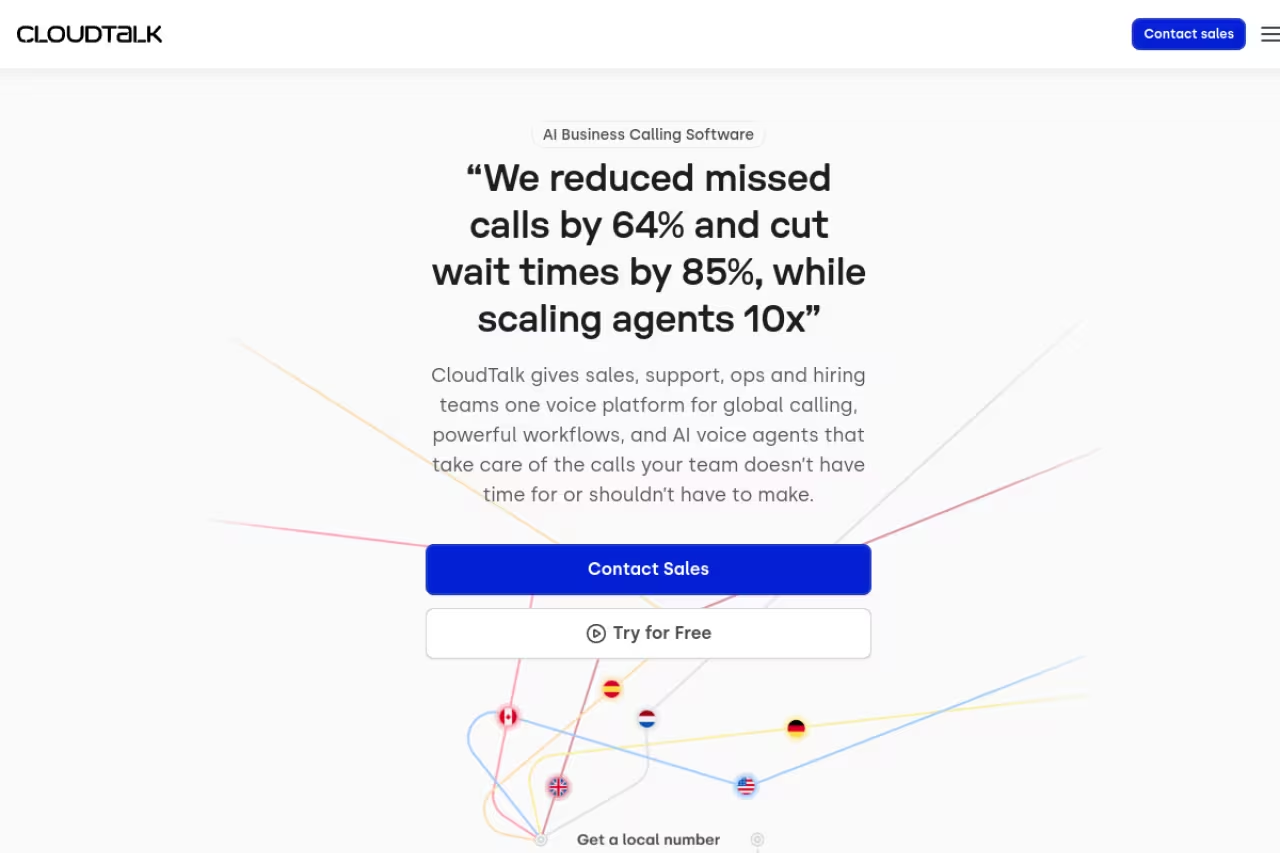
CloudTalk is what I recommend to most teams under 100 seats, and it's not close. It does the boring things well: outbound dialing, automatic call notes, two-way CRM sync, and call routing that you can configure without a consultant.
Who it's best for: outbound sales teams and lean support desks that want power-dialer throughput without enterprise overhead.
What I recommend to most teams under 100 seats, especially outbound sales and lean support desks. Expert at €49 bundles a power dialer, analytics and Salesforce integration, but international calling outside the US, Canada, EU and UK is metered.
plans run from Lite at €19/user/month up to Expert at €49/user/month (billed annually), per the CloudTalk pricing page. The Power Dialer is included on Expert, or €15/user/month as an add-on lower down. AI Conversation Intelligence is €9/user/month. There's a 14-day free trial with no card required.
The standout: the Expert plan bundles a power dialer, real-time analytics, and Salesforce integration at €49, which undercuts almost every "enterprise" tier on this list while covering 90% of what a sales team actually uses. The AI Receptionist add-on (from €99/month) handles inbound coverage in 60+ languages.
The catch: international calling outside the US, Canada, EU, and UK gets metered, and costs add up fast if your team dials globally. The cheapest Lite plan also caps you on smart routing, so most teams end up on Essential or higher.

Five9: the enterprise workhorse
Five9 has been doing cloud contact center since before "CCaaS" was a term, and it shows in the depth. Workforce management, outbound campaign management, and CRM adapters for Salesforce, ServiceNow, and Dynamics are all mature rather than bolted on.
Who it's best for: enterprises with 50+ seats running high-volume outbound or blended operations who need real workforce optimization.
The enterprise workhorse for 50+ seats running high-volume outbound or blended operations, with mature workforce management and dialing. The 50-seat minimum prices out small teams, and advanced AI features need a sales call to budget.
the Five9 pricing page lists Digital at $119/user/month and Core at $159/user/month, both with a 50-seat minimum. Plus, Pro, and Enterprise are quote-only. Every bundle includes AI Summaries, Live Transcription, AI Agent Assist, and 3,000 AI minutes per seat, with usage-based charges beyond that.
The standout: the 50-seat minimum is the gate, but past it you get genuinely deep outbound tooling and predictive dialing that smaller platforms can't match. The bundled 3,000 AI minutes per seat is also generous compared to vendors that meter every AI interaction.
Where it falls short: the 50-concurrent-seat minimum prices out anyone small, and the advanced AI features like Intelligent Virtual Agent aren't on the public price sheet, so budgeting means a sales call. This is overkill for teams under 30 agents.
Talkdesk: the AI-first CX platform
Talkdesk built its reputation on fast deployment and a no-code builder that lets non-engineers wire up AI flows. If your priority is automating front-line interactions with virtual agents and self-service, this is the platform I'd shortlist first.
Who it's best for: mid-market and enterprise CX teams that want to deploy AI agents and digital channels without a long implementation.
Shortlist Talkdesk first if you want to automate front-line interactions with AI agents through a no-code builder. True omnichannel only arrives on Elite, a three-year commitment is typical, and real cost lands well above list price.
per Nextiva's Talkdesk pricing breakdown and Talkdesk's published tiers, CX Cloud runs Digital Essentials at $85/user/month, Voice Essentials at $105/user/month, and Elite at $165/user/month. Industry-specific clouds (financial services, healthcare) start around $225/user/month.
The standout: the AI builder is the best no-code experience here. You can stand up a working virtual agent in a day, not a quarter. For teams that want to deflect routine tickets, that speed matters.
The catch: true omnichannel (voice plus digital combined) only lands on the Elite tier, and Talkdesk typically requires a three-year commitment. Add telecom, AI modules, and add-ons, and real total cost lands closer to $200-$300/user/month than the list price suggests. Read the contract carefully.
If you're weighing AI agents specifically, I'd compare options in our guide to the best AI voice agents before committing.
RingCX: the value omnichannel option
RingCX is RingCentral's AI-first contact center, and it's the cheapest way I've found to get true omnichannel routing. If your team already uses RingCentral for phones, it's close to a no-brainer.
Who it's best for: existing RingCentral customers and budget-conscious teams that want voice plus digital without enterprise pricing.
The value omnichannel option, close to a no-brainer if you already use RingCentral, at $65 per agent with a predictive dialer built in. Watch the fee small print, and the pull is weaker outside the RingCentral ecosystem.
Capterra lists RingCX at $65/agent/month (Standard) and $95/agent/month (Professional) on annual billing. Standard already includes call recording, IVR, a predictive dialer, and skills-based routing.
The standout: $65/agent for omnichannel with a predictive dialer built in is genuinely strong value. RingCentral's telephony backbone is reliable, and the unified comms tie-in means agents work in one app.
Where it falls short: watch the fee small print. There's a Compliance and Administrative Cost Recovery Fee, E911 charges, and per-call surcharges that don't show up on the headline price. If you're not already in the RingCentral ecosystem, the pull is weaker.

Genesys Cloud CX: routing at serious scale
Genesys is the platform I reach for when routing logic gets complicated. Journey orchestration, predictive routing, and workforce management are best-in-class, which is why large banks and airlines run on it.
Who it's best for: large operations with intricate routing rules and a real workforce-management need.
Reach for Genesys when routing logic gets complicated, since journey orchestration and predictive routing are a level above most rivals. The $2,000 monthly minimum and separately sold telephony mean small teams should look elsewhere.
Genesys Cloud CX runs four tiers per public pricing breakdowns: CX 1 at $75/user/month (voice), CX 2 at $115, CX 3 at $155 (adds WFM), and CX 4 at $240. All billed annually, with a $2,000/month minimum commitment.
The standout: the journey orchestration and predictive routing are a level above most competitors. If a customer's path through your funnel actually changes how you want to route them, Genesys handles it natively.
The catch: that $2,000/month floor means you need roughly 27 agents on the entry plan just to clear the minimum, and telephony minutes are sold separately on top. Small teams should look elsewhere.
Aircall: simplest setup for small teams
Aircall is the easiest platform here to get running. It's built around integrations, with 250+ connectors, and you can have a team dialing within an hour. I've onboarded a sales team on it in an afternoon.
Who it's best for: small, fast-moving sales or support teams that value simplicity and CRM integrations over deep contact-center features.
The easiest platform here to get running, with 250+ connectors and a clean interface for small sales or support teams. It is voice-first with thin digital channels, and the per-user price climbs once you add AI minutes.
Aircall runs Essentials at $30/user/month and Professional at $50/user/month on annual billing, with a 3-license minimum. AI Voice Agents are usage-based at $0.15-$0.25/minute with 50 free minutes monthly, and a Custom tier kicks in at 25 licenses.
The standout: the integration library is the widest on this list, and the interface is clean enough that reps don't fight it. Power Dialer and Salesforce CTI sit on the Professional plan.
Where it falls short: it's a voice-first tool, so digital channels are thin compared to Genesys or Talkdesk, and the per-user price climbs once you add AI minutes. The 3-seat floor and mandatory annual terms are minor friction but worth knowing.

Nextiva: phone system and contact center together
Nextiva is the pick if you want your business phone system and your contact center under one roof. The entry pricing is the most aggressive here.
Who it's best for: small businesses that want unified communications and a contact center without juggling two vendors.
Choose Nextiva if you want your business phone system and contact center from one vendor, starting at $15 per user. The useful routing and AI features sit on the $75 Scale plan or enterprise tiers, so the headline price undersells real cost.
Nextiva's small-business tiers start at Core ($15/user/month), Engage ($25), and Scale ($75), with enterprise contact center plans starting at $75/agent/month. The XBert AI Receptionist is available across plans and included on Scale.
The standout: at $15/user/month for the Core plan with inbound and outbound voice plus SMS, it's the cheapest serious entry point on this list, and you're not stitching together a phone system and a separate CCaaS tool.
The catch: the genuinely useful contact center features (skills-based routing, journey orchestration, AI transcription) live on the $75 Scale plan or the enterprise tiers, so the headline $15 price undersells what a real call center costs here.

Dialpad: real-time AI coaching
Dialpad bet early on real-time AI, and that bet aged well. Its live transcription and sentiment analysis are among the most accurate on this list according to user reviews, and the in-call coaching surfaces objection-handling tips while the rep is still talking.
Who it's best for: sales and support teams that want live AI assistance and coaching during calls, not just after-call summaries.
A strong pick for teams that want live AI assistance and in-call coaching, not just after-call summaries, which helps new reps ramp faster. The naming is confusing: most call centers need Support, which costs well above the $15 entry price.
Dialpad's AI Contact Center (the "Support" product, distinct from the cheaper Connect phone system) runs roughly $95/agent/month for the entry plan, with Advanced and Premium tiers above that.
The standout: real-time transcription with live sentiment is the differentiator. For new reps, the in-the-moment coaching shortens ramp time in a way that post-call analytics can't.
Where it falls short: the naming is genuinely confusing. Dialpad Connect is the phone system; Dialpad Support is the contact center, and most teams buying for a call center need Support, which costs meaningfully more than the $15 entry price people see first. Confirm which product you're quoted.
Building a customer-facing team that scales? The same operators who follow Dupple X use it to keep up with which AI tools are actually worth adopting before their competitors do.
How to choose
Skip the feature checklists and start with two questions: how many seats, and voice-only or omnichannel?
Under 30 seats, voice-heavy: CloudTalk or Aircall. CloudTalk if you want a power dialer and conversation intelligence at a low price, Aircall if integrations and setup speed matter most. Nextiva if you also need to replace your office phone system.
Already on RingCentral, or want cheap omnichannel: RingCX at $65/agent is hard to beat.
Mid-market, AI-forward: Talkdesk if you want to deploy virtual agents fast, Dialpad if live coaching is the priority.
50+ seats, complex operations: Five9 for outbound depth and workforce management, Genesys for advanced routing and journey orchestration. Both demand real budgets and implementation time, so plan accordingly.
One more thing: list price is never the real price at the enterprise tier. Telecom minutes, AI usage, and multi-year terms can double the per-seat number. Get a full quote with usage estimates before you sign. For tooling beyond the phones, our roundups of the best AI customer support tools and the best call center CRM software pair well with any platform here.
Frequently asked questions
What is the best call center software for small businesses?
For most small businesses, CloudTalk is the best fit. It starts at €19/user/month, includes a power dialer on higher tiers, and syncs with your CRM without custom work. Aircall and Nextiva are strong alternatives, with Nextiva winning on price if you also need a business phone system.
How much does call center software cost per user?
It ranges widely. SMB-focused tools like CloudTalk and Aircall run $19-$50/user/month. Mid-market platforms like Talkdesk and Dialpad sit at $85-$165/user/month. Enterprise systems like Five9 and Genesys start at $75-$159/user/month but often climb past $200 once you add AI usage, telecom minutes, and multi-year terms.
What's the difference between call center and contact center software?
Call center software handles voice calls only. Contact center software (often called CCaaS) adds digital channels like email, chat, SMS, and social messaging in one platform. Most 2026 tools are technically contact centers, though many teams still buy them just for voice. If you only need voice, you can save money on a voice-first tool like Aircall.
Which call center software has the best AI features?
Talkdesk leads on no-code AI agent building, Dialpad leads on real-time transcription and live coaching, and Five9 bundles the most included AI minutes (3,000 per seat). For dedicated AI voice agents and chatbots, it's worth comparing standalone options in our guides to the best conversational AI platforms and best AI chatbots for business.
Do I need a 50-seat minimum for enterprise call center software?
Five9 requires a 50-concurrent-seat minimum, and Genesys enforces a $2,000/month commitment (roughly 27 agents on the entry plan). If you're below that, you don't need enterprise software. Mid-market tools like Talkdesk, RingCX, and Dialpad give you AI and omnichannel without the seat floor.
Is cloud call center software better than on-premise?
For nearly every team in 2026, yes. Cloud (CCaaS) means no hardware to maintain, faster updates, and the vendor handles uptime and scaling. The only common reasons to stay on-premise are strict data-residency rules or legacy telephony you can't retire yet. Every platform in this guide is cloud-based.
Related guides
Some offers on this page may be paid placements or contain affiliate links.
Across our whole catalogue the median is $24 a month and 33% of tools advertise a free tier. Figures are the lowest recurring monthly price quoted in our own review of each tool, read on 2026-08-19. Full method and every category.
