
Best Enterprise Accounting Software (2026): 8 Platforms I'd Actually Recommend

Key facts8 tools compared: Oracle NetSuite, Sage Intacct, Microsoft Dynamics 365 Finance, Oracle Fusion…
- 8 tools compared: Oracle NetSuite, Sage Intacct, Microsoft Dynamics 365 Finance, Oracle Fusion Cloud ERP, SAP S/4HANA Cloud, Acumatica, Workday Financial Management, Ramp
- Oracle NetSuite (best for: Mid-market companies wanting one cloud system): ~$999/mo base + ~$129/user/mo
- Sage Intacct (best for: Multi-entity finance teams (services, nonprofits)): ~$12,000/yr
- Microsoft Dynamics 365 Finance (best for: Microsoft shops needing breadth): $180/user/mo (enterprise app)
- Oracle Fusion Cloud ERP (best for: Large enterprises, global complexity): ~$375/user/mo
Once your company crosses a few hundred employees, multiple legal entities, and a handful of currencies, QuickBooks stops being a tool and starts being a liability. The close drags into the second week. Intercompany eliminations live in a spreadsheet one person understands. Auditors ask for a trail you can't produce in under a day. That's when people start shopping for real enterprise accounting software, and that's who this is for: finance leaders at companies too big for SMB tools and not quite ready to hand a system integrator a seven-figure check.
I've sat through demos of every major platform here, talked to controllers who run them daily, and dug through current pricing instead of trusting the marketing pages. The short version: for most growth-stage and mid-market companies that want a true cloud financial system, Oracle NetSuite is still the default pick because it does accounting plus everything around it. But "best" depends heavily on whether you need a full ERP or just world-class multi-entity accounting, and how deep your Microsoft or Oracle ties already run.
Here's how the field shakes out, with the honest trade-offs nobody puts in a sales deck. If your company sits below the enterprise tier, the picks in our best accounting software for medium businesses guide will fit better, and there's a separate rundown for accounting software built for startups.
Quick comparison
| Tool | Best for | Price (starting) | Standout |
|---|---|---|---|
| Oracle NetSuite | Mid-market companies wanting one cloud system | ~$999/mo base + ~$129/user/mo | Full ERP, not just accounting |
| Sage Intacct | Multi-entity finance teams (services, nonprofits) | ~$12,000/yr | Dimensional reporting, fast close |
| Microsoft Dynamics 365 Finance | Microsoft shops needing breadth | $180/user/mo (enterprise app) | Power BI and Office integration |
| Oracle Fusion Cloud ERP | Large enterprises, global complexity | ~$375/user/mo | Deep AI and predictive finance |
| SAP S/4HANA Cloud | Global Fortune 500 operations | $180/user/mo (public) | Scale nothing else matches |
| Acumatica | Project and operations-heavy mid-market | ~$6,400/yr+ | Consumption pricing, unlimited users |
| Workday Financial Management | Large services and people-first orgs | Custom (enterprise) | Finance and HR on one model |
| Ramp | Spend, AP, and close automation layer | Free core; Plus ~$15/user/mo | Closes the books 75% faster |
Oracle NetSuite
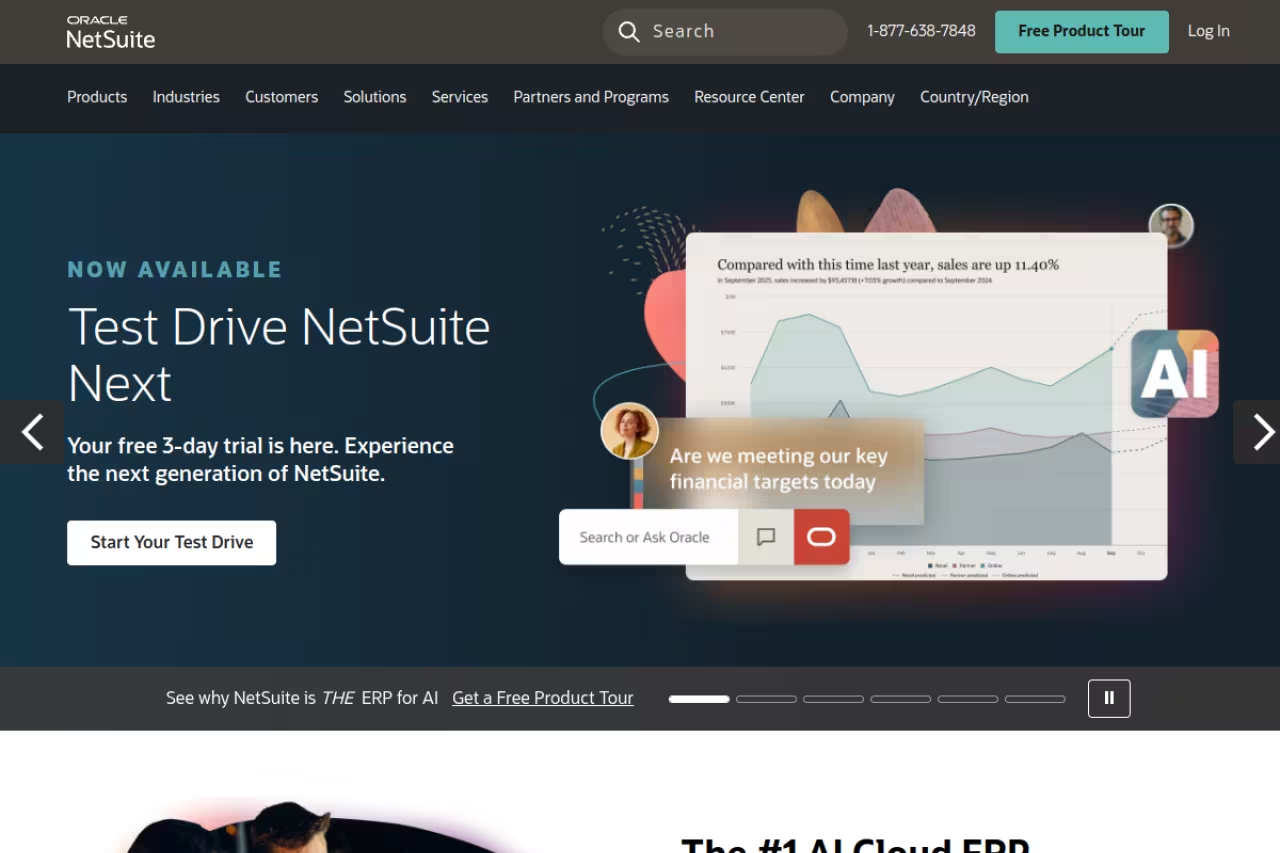
NetSuite is the platform I point most growing companies toward first, and it's been the cloud ERP default for a reason. It's a single system covering general ledger, AP, AR, fixed assets, revenue recognition, and (through OneWorld) multi-entity consolidation across currencies and tax jurisdictions. The accounting core is genuinely strong, and because inventory, orders, CRM, and ecommerce live in the same database, you stop reconciling between systems.
Who it's best for: companies in the $10M to $1B range that have outgrown SMB software and want accounting and operations under one roof rather than a bespoke SAP project.
The first stop for growing companies in the $10M to $1B range that have outgrown SMB software and want accounting and operations in one system. Implementation often runs $60,000 to $100,000 or more and renewals can bring steep increases, so negotiate a multi-year deal.
Pricing is the part people underestimate. NetSuite uses a layered model: a base platform fee that ERP Research pegs at roughly $999/month and up, plus per-user licenses (Oracle raised the full-user rate to around $129/user/month), plus module add-ons that run $550 to $1,550 per module monthly. Most mid-market deployments land near $1,800 to $3,000/month before implementation.
The catch: implementation is where budgets blow up, often $60,000 to $100,000 or more, and contract renewals have a reputation for steep increases. NetSuite's reporting is capable but the report builder feels dated next to Sage Intacct's, and you'll likely need a partner for setup. Go in with a negotiated multi-year deal or expect surprises.
Sage Intacct
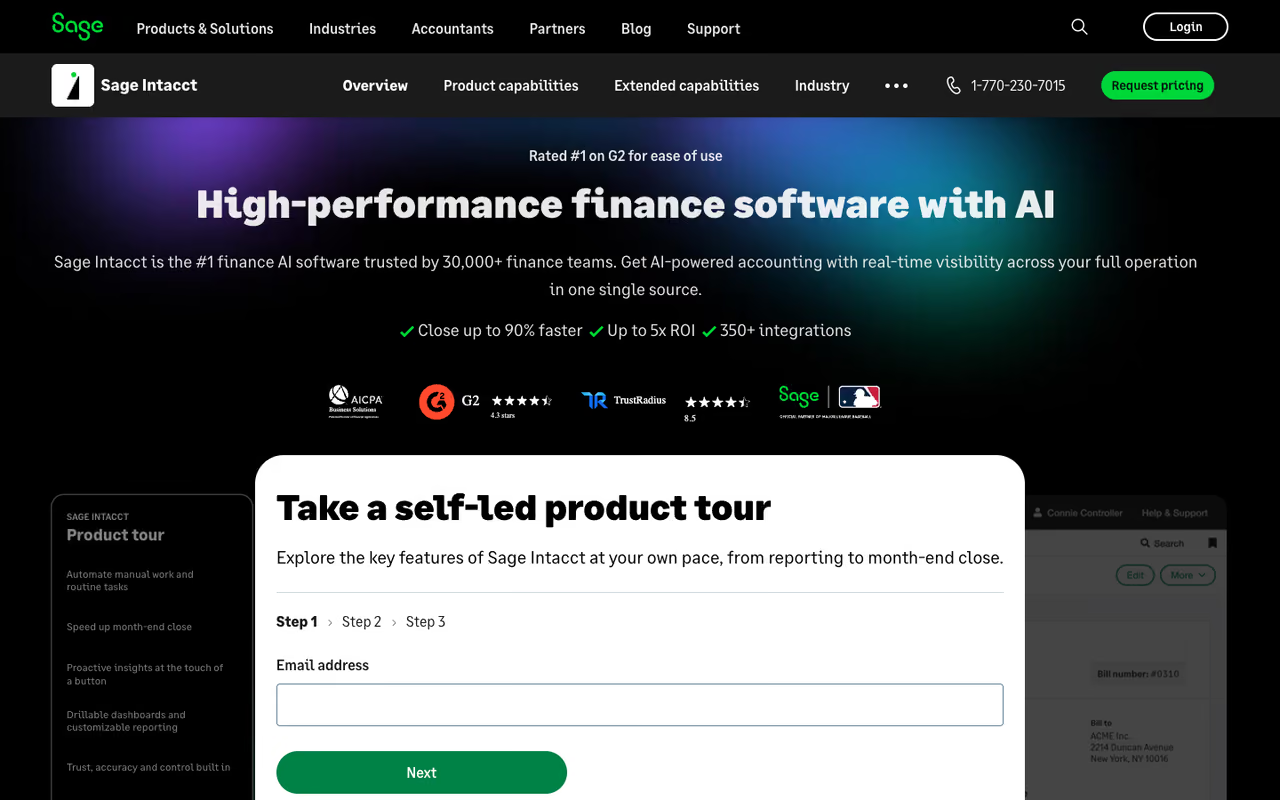
If you only need accounting done exceptionally well, not a full ERP, Sage Intacct is the one I'd put against NetSuite every time. It stays in its lane, financial management, and that focus shows. The dimensional general ledger lets you tag transactions by entity, department, location, project, and customer, then slice reports any way you want without rebuilding your chart of accounts. Multi-entity consolidation runs in minutes, and AICPA actually endorses it, which says something.
Who it's best for: services firms, SaaS companies, nonprofits, and any finance team where reporting depth and a fast close matter more than inventory or manufacturing. (If you specifically run a nonprofit, our best accounting software for nonprofits breakdown goes deeper on fund accounting.)
Pick it if you want accounting done exceptionally well rather than a full ERP. The dimensional ledger and fast multi-entity close suit services firms, SaaS and nonprofits, but it is not an ERP and opaque pricing typically lands between $25,000 and $75,000 a year.
Pricing starts around $12,000/year for one user and core financials, per multiple reseller estimates. Most organizations pay $25,000 to $75,000 annually depending on users and modules, and it's quote-based.
Where it falls short: it's not an ERP, so if you need deep supply chain or manufacturing, you'll be integrating other tools. The pricing is opaque (everything is custom), and add-on modules stack up fast. For pure multi-entity accounting, though, the close speed alone often justifies the switch.
Microsoft Dynamics 365 Finance
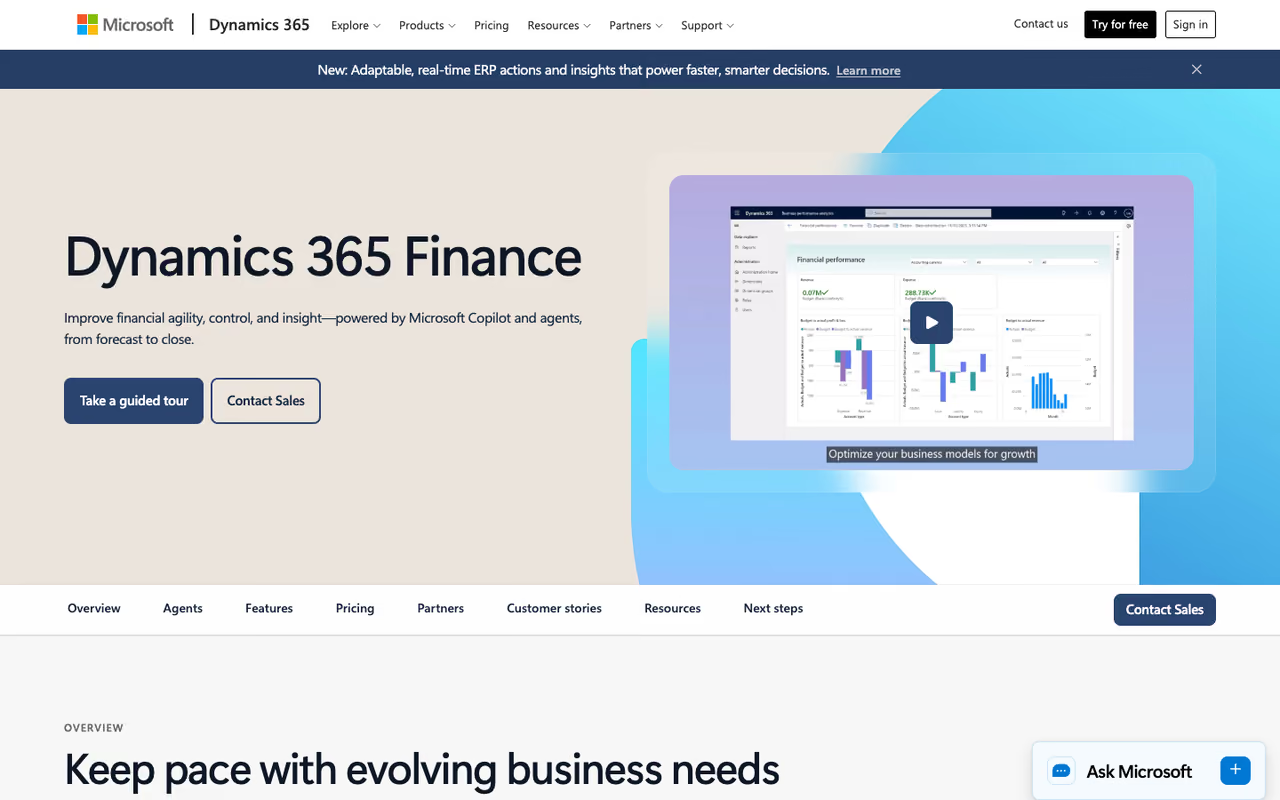
If your company already lives in Microsoft, Dynamics 365 Finance is hard to argue against. It handles core financials, budgeting, cash flow forecasting, and global compliance, and it plugs into Power BI, Excel, Teams, and Azure without middleware. For a CFO, native Power BI means financial dashboards without buying a separate BI stack. The AI-driven forecasting and Copilot features have matured a lot in the last year.
Who it's best for: mid-to-large organizations already standardized on Microsoft, especially those that want finance and operations breadth from one vendor.
On pricing, the enterprise Finance app runs $180/user/month, with the standard full-user license closer to $240/user/month, and "attach" pricing dropping a second Dynamics app to $30/user/month per Microsoft's published licensing. Note Microsoft changed how it enforces Finance & Operations user licenses as of January 2026, so confirm your count carefully.
The catch: it's powerful but heavy. Implementations stretch 6 to 12 months, the interface has a learning curve, and you'll almost certainly need a Microsoft partner. If you're not already a Microsoft shop, the integration advantage evaporates and NetSuite is usually the cleaner choice.
Hard to argue against if your company already lives in Microsoft, with native Power BI, Teams and Azure integration. It is heavy, though, with implementations stretching 6 to 12 months, and without the Microsoft stack NetSuite is usually the cleaner choice.
Oracle Fusion Cloud ERP
Oracle Fusion Cloud ERP is the step up from NetSuite within Oracle's own lineup, aimed at larger enterprises with serious global complexity. The Financials module covers general ledger, payables, receivables, fixed assets, cash management, expenses, and tax, and Oracle has poured AI into it: more than 50 AI assistants, AI-generated performance narratives, and predictive cash forecasting baked into the workflow.
Who it's best for: large enterprises (think thousands of employees, complex global structures) that have outgrown mid-market tools and want Oracle's depth without an on-premise SAP build.
The step up from NetSuite for large enterprises with serious global complexity, with more than 50 AI assistants built in. Implementation is long and costly, and if you are not already on Oracle or genuinely global, NetSuite gives you 80% of the value.
Pricing runs roughly $175 to $625 per user per month depending on module, with core Financials users generally in the $375 to $475 range, per ERP Research's breakdown. There's a 10-user minimum and a standard three-year term.
Where it falls short: this is enterprise software with enterprise overhead. Implementation is long and costly, the learning curve is real, and it's overkill for anyone under a few hundred million in revenue. If you're not already an Oracle customer or genuinely global, NetSuite gives you 80% of the value for a fraction of the lift.
SAP S/4HANA Cloud
SAP S/4HANA Cloud is what runs much of the Fortune 500, and nothing else on this list matches its scale. The Public Cloud edition is the more accessible, standardized version; Private Cloud (usually bought through RISE with SAP) is the fully customizable enterprise build. For finance, you get a real-time ledger, embedded analytics, and compliance coverage across nearly every country on earth.
Who it's best for: global enterprises with massive transaction volumes and operations spanning dozens of countries. If you're choosing SAP, you usually already know it.
Public Cloud pricing starts around $180/user/month and ranges to $400 depending on configuration, per ERP Research. Private Cloud is negotiated, with annual software costs starting around $500,000 for smaller enterprises and running into eight figures for global ones.
The catch: license cost is only 30 to 40% of the total. Implementation dominates the budget and timeline, and S/4HANA projects are famous for running long. It's the right answer for genuinely huge, complex operations and the wrong answer for almost everyone else.
Nothing else here matches its scale, so choose it for global enterprises with massive transaction volumes across dozens of countries. License cost is only 30 to 40% of the total and implementation dominates, which makes it wrong for almost everyone else.
If your finance team is spending more time wrangling these systems than analyzing the numbers, it's worth looking at how AI tooling can take work off their plate. A Dupple X membership gives your team the AI workflows and prompts to do exactly that.

Acumatica
Acumatica is the cloud ERP with the pricing model that actually makes sense for some teams: it charges by resource consumption, not per user, so you can add unlimited users without per-seat fees. The financial management suite handles GL, AP, AR, cash, reconciliations, and multi-currency, and it's particularly strong for project-heavy and operations-heavy businesses like construction, distribution, and professional services.
Who it's best for: mid-market companies where lots of people need light access to the system, and where project accounting matters.
A smart option for mid-market, project-heavy firms where lots of people need light access, since it charges by resource consumption rather than per user. That model can turn unpredictable when volume spikes, and the partner ecosystem is smaller than NetSuite's.
Pricing starts around $6,396/year for a base tier with core financials and a transaction cap, per Capterra's listing, though most mid-sized firms spend $25,000+ annually as they add modules and transaction volume. The consumption model means your bill scales with usage, not headcount.
Where it falls short: the resource-based pricing can get unpredictable if your transaction volume spikes, and the ecosystem of partners and integrations is smaller than NetSuite's or Microsoft's. For the right operations profile, though, "unlimited users" is a genuinely different value proposition.

Workday Financial Management
Workday Financial Management is built on the same data model as Workday's well-known HR suite, which is the whole point. If you run Workday HCM, getting finance on the same platform means headcount, payroll, and financial planning share one source of truth. It's strong on continuous accounting, real-time consolidation, and analytics for large, people-centric organizations.
Who it's best for: large services firms, higher education, healthcare, and any enterprise that already runs Workday for HR and wants finance to match.
The natural pairing for large services firms, higher education and healthcare already running Workday HCM, with one source of truth for headcount and finance. As a standalone choice it is expensive, heavy to implement and a tough sell against NetSuite or Intacct.
Pricing is enterprise and entirely custom; Workday doesn't publish meaningful numbers and quotes are negotiated per deal. Expect it to sit in the same league as Oracle Fusion and Dynamics, with implementation to match.
The catch: it's expensive, the implementation is a major undertaking, and it makes the most sense as a package deal with Workday HCM. As a standalone accounting choice for a company that doesn't already use Workday, it's a tough sell against NetSuite or Intacct.

Ramp
Ramp isn't a general ledger and won't replace any platform above. I'm including it because the close, AP, and expense layer is where enterprise finance teams actually lose hours, and Ramp is the tool that gives them back. It sits on top of your ERP (it syncs with NetSuite, Sage Intacct, QuickBooks, and Xero), automating receipt matching, expense coding, and accounts payable so the data flows clean into your books.
Who it's best for: finance teams on any ERP who want to automate the manual grind around it. Ramp says its customers close books 75% faster and collectively saved over 27 million hours. If accounts payable is the specific bottleneck, we cover dedicated options in our best accounts payable software guide.
A layer rather than a general ledger, ideal for finance teams on any ERP who want to automate receipt matching, expense coding and AP, with a free core platform. You still need real accounting software underneath, and it is strongest for US card and AP spend.
Pricing is the kicker: the core platform is free, with Ramp Plus adding advanced automation and controls at around $15/user/month plus a platform fee, and enterprise pricing for larger orgs.
Where it falls short: it's a layer, not a system of record, so you still need real accounting software underneath. And it's most powerful for US-based card and AP spend; international coverage is improving but not yet at NetSuite's global level. Paired with one of the platforms above, it's the cheapest meaningful upgrade to your close.
How to choose
Skip the feature checklists and answer three questions in order.
First, do you need a full ERP or just great accounting? If inventory, manufacturing, or order management belong in the same system, look at NetSuite, Dynamics 365, Acumatica, or SAP. If you need world-class multi-entity accounting and nothing else, Sage Intacct will close faster and report deeper for less money.
Second, what stack are you already on? Microsoft shops should price out Dynamics 365 before anything else. Workday HCM customers should look hard at Workday Financials. Oracle customers have a natural path to Fusion. Existing ties usually beat a marginally better standalone tool.
Third, how complex and global are you really? Genuinely global Fortune 500 operations need SAP or Oracle Fusion. A $50M services company that thinks it needs SAP almost never does, and will spend a fortune learning that. Right-size the platform to where you'll be in three years, not where the loudest vendor says you should be.
Whatever system of record you land on, add a spend and close-automation layer like Ramp. It's the highest-ROI piece of the whole stack. And if you're still mapping out the wider finance and operations stack, our top tools directory is a good place to compare options side by side.
FAQ
What is the best enterprise accounting software in 2026?
For most mid-market and growth-stage companies, Oracle NetSuite is the best all-around enterprise accounting software because it combines strong accounting with a full cloud ERP. If you only need accounting and reporting depth, Sage Intacct is often the better and cheaper fit. Truly global enterprises tend to land on SAP S/4HANA or Oracle Fusion Cloud.
How much does enterprise accounting software cost?
Expect real numbers, not the teaser prices. Mid-market NetSuite deployments commonly run $1,800 to $3,000 per month before implementation. Sage Intacct starts around $12,000 per year. Dynamics 365 Finance and Oracle Fusion run roughly $180 to $475 per user per month. SAP and Workday are custom and start in the high five or six figures annually. Implementation usually costs as much or more than the first year of licenses.
What is the difference between NetSuite and Sage Intacct?
NetSuite is a full ERP covering accounting plus inventory, orders, CRM, and ecommerce in one system. Sage Intacct focuses only on financial management, with a more mature dimensional report builder and faster multi-entity consolidation. Pick NetSuite if you need operations and accounting together; pick Intacct if you want best-in-class accounting and reporting without the ERP overhead.
Is QuickBooks Enterprise good for large businesses?
QuickBooks Enterprise works for larger small businesses, but it caps out fast. The Diamond tier supports up to 40 users and is custom-quoted (often $5,000+ per year before add-ons), and it lacks the multi-entity consolidation, dimensional reporting, and global compliance that true enterprise tools provide. Most companies with multiple entities or currencies outgrow it and move to NetSuite or Sage Intacct.
Do I need a full ERP or just accounting software?
You need a full ERP if inventory, manufacturing, supply chain, or order management should live in the same system as your books. If your operations are simpler (services, SaaS, nonprofits) and your pain is reporting, consolidation, and the close, dedicated accounting software like Sage Intacct will serve you better and cost less than a full ERP you only half use.
How long does enterprise accounting software take to implement?
Plan for months, not weeks. Sage Intacct can be live in 2 to 4 months for a focused financial rollout. NetSuite and Dynamics 365 typically take 6 to 12 months. SAP S/4HANA and large Oracle Fusion or Workday projects often run a year or more. The cleaner your data and the more standard your processes, the faster and cheaper the project goes.
Related guides
Some offers on this page may be paid placements or contain affiliate links.
