
The Best Gym Management Software in 2026: 8 Platforms I'd Actually Recommend

Key facts8 tools compared: PushPress, Mindbody, Gymdesk, Glofox, Wodify, Zen Planner, Mariana Tek…
- 8 tools compared: PushPress, Mindbody, Gymdesk, Glofox, Wodify, Zen Planner, Mariana Tek, Exercise.com
- PushPress (best for: Independent gyms & CrossFit boxes): Free, then $159/mo
- Mindbody (best for: Multi-location & member discovery): From $99/mo per location
- Gymdesk (best for: Small gyms wanting flat pricing): $75-$200/mo by member count
- Glofox (best for: Boutique studios needing a branded app): ~$110-$200/mo (quote-based)
Run a gym for more than a month and you learn that the software is the business. Billing, check-ins, class booking, the app members open at 5am, the report that tells you who's about to cancel. When that stack works, you barely notice it. When it doesn't, you spend Sunday nights chasing failed payments in a spreadsheet.
The problem is that "gym software" covers wildly different needs. A 40-member CrossFit box and a 12-location boutique chain have almost nothing in common, yet they get pitched the same demos. Price tags swing from $0 to $700+ a month, and the cheap option for one gym is the wrong tool for another.
I went through the main platforms with that gap in mind. Short version: PushPress is the one I'd point most independent gyms and CrossFit boxes to first, mostly because its free plan is genuinely usable. Below it, the right pick depends on your size and budget. Here's the full breakdown.
Quick comparison
| Tool | Best for | Price | Standout |
|---|---|---|---|
| PushPress | Independent gyms & CrossFit boxes | Free, then $159/mo | Real free plan, no member cap |
| Mindbody | Multi-location & member discovery | From $99/mo per location | Marketplace that sends you clients |
| Gymdesk | Small gyms wanting flat pricing | $75-$200/mo by member count | Predictable cost, no per-feature add-ons |
| Glofox | Boutique studios needing a branded app | ~$110-$200/mo (quote-based) | Polished custom-branded member app |
| Wodify | CrossFit & functional fitness | From $79/mo (promo), $179 standard | Best-in-class WOD and performance tracking |
| Zen Planner | Martial arts & rank-based programs | $99-$348/mo flat | Belt/rank tracking built in |
| Mariana Tek | High-end boutique chains | Custom, ~$179+/mo per studio | Premium booking and member experience |
| Exercise.com | Trainers selling online + in-person | Custom quote | Custom-branded app plus workout delivery |

PushPress: the free plan that isn't a trap
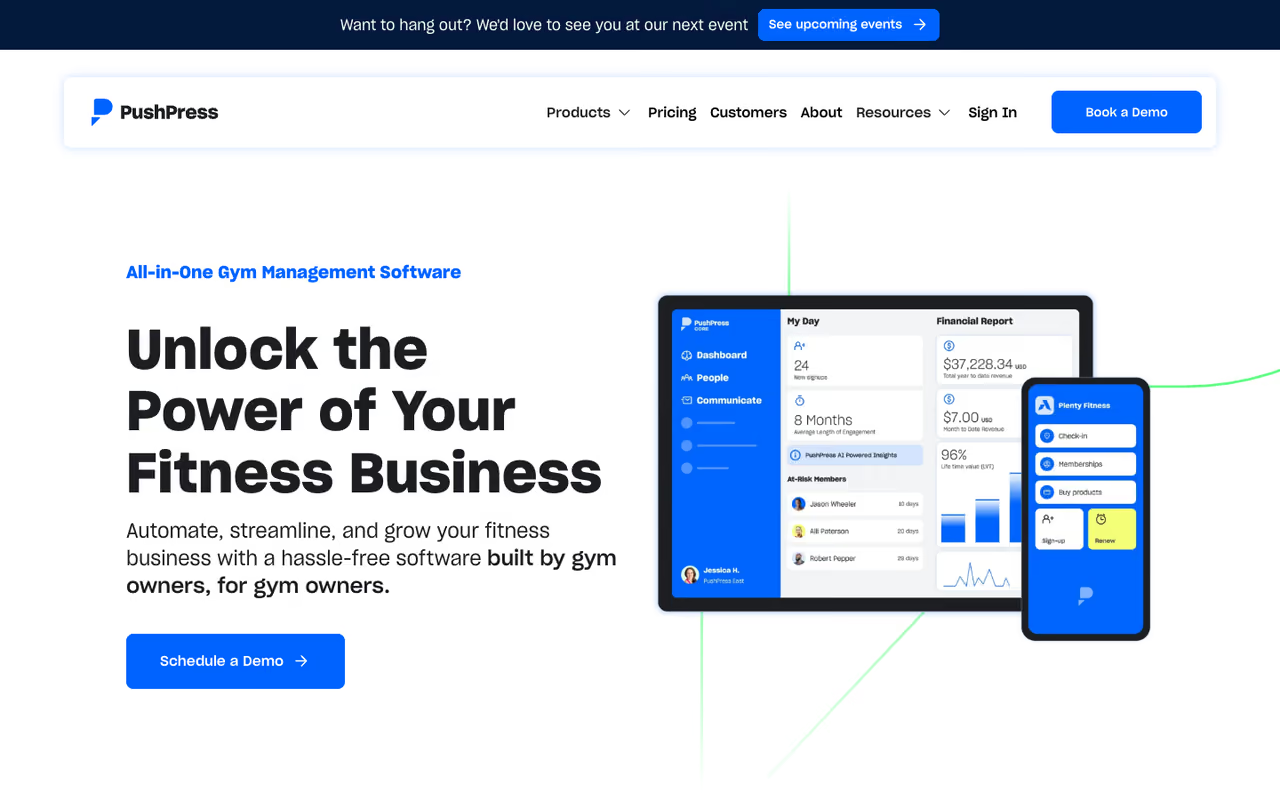
PushPress came out of the CrossFit community, and it shows. Class scheduling, member management, digital waivers, attendance, and billing are all there, and the free tier includes unlimited members, staff, and admins. That last part matters. A lot of "free" gym software caps you at 50 members or hides billing behind a paywall. PushPress doesn't.
The best starting point for independent gyms, CrossFit boxes and functional fitness studios that want to run lean. The free plan is a real product with unlimited members, but its 4.99% card processing fee pushes growing gyms onto a paid tier quickly.
The free Core plan is $0/month with card processing at 4.99% + $0.30. Core Pro is $159/month and drops processing to 2.89% + $0.30, plus 0.79% + $0.30 on ACH. Core Max is $229/month at 2.75% + $0.30. Add-on modules like PushPress Train (workout programming) run $79/month and Grow (retention and lead nurture) is $329/month.
The standout: the free plan is a real product, not a 14-day tease. Plenty of small boxes run on it for years and only upgrade when lower processing fees start saving them more than the subscription costs.
The catch: those free-plan processing fees are steep. At 4.99% per card transaction, a gym doing $15,000/month in card payments hands over roughly $750. Once your volume climbs, the math pushes you onto a paid tier fast, which is arguably the point.
Mindbody: the one members already search
Mindbody is the incumbent, and it earns the spot through reach rather than simplicity. The Mindbody app is a marketplace where people in your city go to find classes, which means listing your studio can bring in members who'd never have found you otherwise. For multi-location operators and studios that depend on discovery, that pipeline is hard to replicate.
Pick Mindbody if you run a multi-location club or larger studio and want the marketplace traffic that drives member discovery. The cost and complexity are the price: renewal hikes are common, and a small single-location gym will overpay.
The Starter plan begins around $99/month per location with scheduling, payments, and a marketplace listing. Accelerate and Ultimate climb from there, and Mindbody doesn't publish those numbers. Owners consistently report real-world costs of $400-$700/month per location once branded apps, marketing automation, and advanced reporting are stacked on.
The standout: the consumer marketplace. No competitor on this list drives member discovery the way Mindbody does.
Where it falls short: cost and complexity. The interface feels dated next to newer platforms, renewal price hikes are a common complaint, and small single-location gyms almost always overpay for features they never touch. It's overkill for a 60-member box.

Gymdesk: flat pricing with no surprises
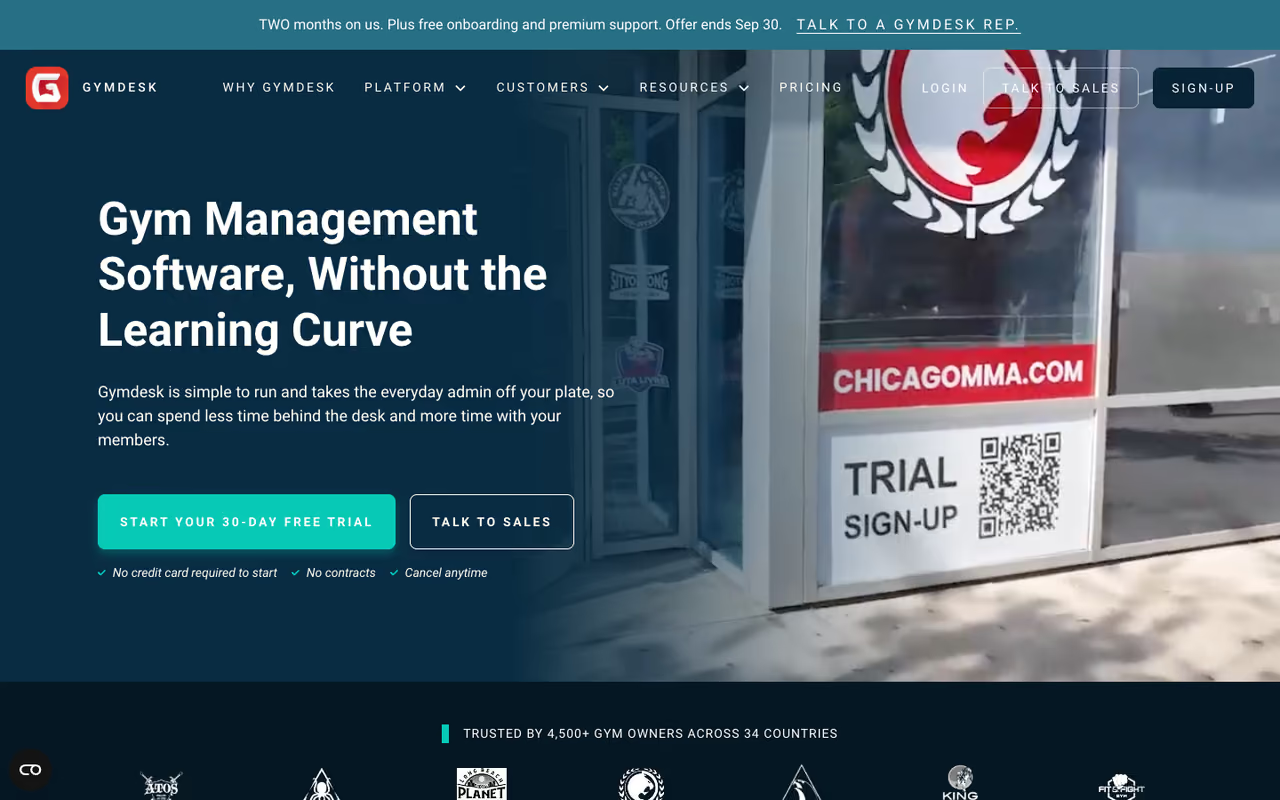
Gymdesk (formerly Martial Arts on Rails) won me over on one thing: you can look at the pricing page and know exactly what you'll pay. No "contact sales," no surprise add-on for the feature you actually need. It covers online membership management, recurring billing, tablet check-in with barcode scanning, and a responsive website, and every plan includes all features.
Go with Gymdesk if you are a small to mid-size gym or martial arts school that wants predictable, all-in pricing. Every plan includes all features, though the branded app and marketing automation are lighter than Glofox or Mariana Tek.
plans scale by active member count. Micro Gym is $75/month for up to 50 members, Small Gym $100/month up to 100, Medium Gym $150/month up to 200, and Large Gym $200/month up to 400. There's a 30-day free trial with no card required, and no long-term contract.
The standout: the pricing model. You're not paying separately for a CRM, a website, and an app the way you do with Zen Planner or Mindbody. It's one flat number tied to your size.
The catch: it isn't the flashiest option. The branded member app and marketing automation are lighter than what Glofox or Mariana Tek offer. If a fully white-labeled app is central to your brand, Gymdesk feels a step behind.

Glofox: the branded app boutiques want
Glofox (now under ABC Fitness) built its reputation on giving boutique studios a custom-branded app that looks like the gym built it themselves. For a spin studio or a Pilates brand where the app is part of the experience, that polish is worth paying for.
The choice for boutique studios that treat their app as a brand asset, since the white-label app is among the best-looking in the category. Pricing is quote-based and opaque, and some users report that support slipped after the ABC acquisition.
Glofox is quote-based and doesn't publish a clean price list. Reported figures put the base plan around $110/month, with the branded-app plan closer to $199/month, and multi-location pricing custom. Processing fees typically land in the 2.5-2.9% range.
The standout: the member-facing app. It's one of the better-looking white-label apps in this category, which is why design-conscious studios keep choosing it.
Where it falls short: the lack of transparent pricing. "Contact us for a quote" means you negotiate, and what you pay depends on how hard you push. Some users also report that support quality slipped after the ABC acquisition.

Wodify: built for the whiteboard
Wodify is the workout-tracking specialist. If your members care about logging their lifts, watching a benchmark WOD time improve, and seeing the leaderboard, Wodify does that better than general-purpose wellness software. It's purpose-built for CrossFit, functional fitness, and Brazilian jiu-jitsu.
Wodify suits CrossFit boxes and functional fitness gyms where performance data is the hook, with the most developed workout tracking and leaderboards in this group. The real cost is the full stack, and the pricing takes effort to decode.
the Essentials plan starts at $79/month per location during current promos, with standard pricing around $179/month. There's no free plan. Accelerate and Ultimate tiers add modules like the branded app, advanced retention tools, and performance tracking, and those are quoted on a demo.
The standout: WOD tracking and performance leaderboards. The class-and-workout experience is the most developed in this group.
The catch: the real cost is the full stack. Essentials alone is a thin slice of the platform, and once you add the app, retention, and performance modules, you're well past the headline price. The pricing structure takes effort to decode.

Zen Planner: rank tracking done right
Zen Planner is the go-to for martial arts schools, and the reason is belt and rank tracking baked directly into the member profile. Yoga studios and CrossFit boxes use it too, but the rank-progression features are what set it apart for BJJ academies and karate schools.
A natural fit for martial arts schools and programs built around rank progression, with belt tracking built into the member profile. The base price is real, but the modular upsell means a complete stack can run $348-$525+/month.
the Studio plan is $99/month flat, Essentials $198/month, and Ultimate $348/month, priced by active members rather than prospects or staff.
The catch: the modular upsell. The full CRM (Engage) and an integrated website are separate line items, so a complete stack can run $348-$525+/month. The base $99 number is real but rarely what a growing school actually pays.
Mariana Tek: premium experience, premium price
Mariana Tek was built by people who ran the tech behind Flywheel Sports, and it's aimed at the high end: spin, barre, and boutique chains where the booking flow and member experience need to feel premium. Spot-booking (members pick their bike or mat) and a refined app are core to it.
Aimed at established boutique chains and high-volume studios that compete on experience, with spot-booking and a refined app. It is the priciest platform here, so a single-location independent gym would be paying for chain infrastructure it does not need.
custom and on the expensive side, generally starting around $179/month per studio with add-on modules at $80-$100 per location stacked on top. You won't find a public price list.
The catch: it's the priciest platform here and built for scale. A single-location independent gym would be paying for infrastructure designed for chains. Wrong fit unless you're genuinely operating at that tier.

Exercise.com: for trainers selling beyond the gym floor
Exercise.com is the pick if your business blends in-person training with online coaching, workout delivery, and ecommerce. It gives you a custom-branded app to sell programs, deliver workouts, and manage members, which suits trainers and studios with a hybrid model.
The pick for personal trainers and studios that blend in-person sessions with online programs and ecommerce under a custom-branded app. Pricing is fully quote-based and setup is steeper, so expect onboarding time before it is running.
fully custom and quote-based. There's no public pricing, which makes upfront comparison hard, but the trade-off is a platform tailored to how you sell.
The catch: the lack of transparency and a steeper setup. This is more of a build-it-around-your-business platform than a sign-up-today tool, so expect onboarding time before it's running.
How to choose without overthinking it
Start with size and model, not features.
If you're a small independent gym or CrossFit box under 100 members, start free with PushPress. Run it, hit its limits, then decide whether lower processing fees justify a paid tier. Don't pay for Mindbody-tier software you won't use.
If you run a martial arts school, the question is rank tracking. Zen Planner and Gymdesk both handle it; pick Gymdesk for flat pricing, Zen Planner if you want the deeper martial-arts-specific tooling and don't mind the add-ons.
If you're a boutique studio where the app is the brand, Glofox or Mariana Tek. Glofox for single locations and smaller budgets, Mariana Tek once you're a chain competing on experience.
If you're multi-location or live on discovery traffic, Mindbody's marketplace is worth its cost. Below that scale, it usually isn't.
And if performance data is your members' reason to show up, Wodify is the most developed option for the actual training experience.
One more thing: the best software is the one your front desk and coaches will actually use. Pick two finalists, run the free trial with your real member data, and watch how your staff handle it for a week before you commit.
Building out the rest of your operations stack too? Our roundup of the best AI tools for small business and the top AI tools directory are good next stops, and Dupple X is where we track what's worth your attention.
FAQ
What is the best gym management software in 2026?
For most independent gyms and CrossFit boxes, PushPress is the best starting point because its free plan includes unlimited members and core features. For multi-location operators, Mindbody's marketplace reach justifies the higher cost. For small gyms wanting predictable pricing, Gymdesk's flat $75-$200/month model is cleanest. The "best" depends on your size and whether app branding or discovery traffic matters to you.
Is there free gym management software?
Yes. PushPress offers a genuinely free Core plan with no member cap, no contract, and no credit card required, covering scheduling, member management, billing, and check-ins. The trade-off is higher payment processing fees (4.99% + $0.30 per card transaction) versus paid tiers. Most other platforms offer only a free trial, not a permanent free plan.
How much does gym management software cost per month?
It ranges widely. Entry plans start at $0 (PushPress free) or $75/month (Gymdesk). Mid-tier platforms run $100-$200/month, and full-featured setups with branded apps and marketing automation can reach $400-$700/month, especially on Mindbody. Always factor in payment processing fees and per-module add-ons, which can quietly double the headline price.
What's the best gym software for a CrossFit box?
PushPress and Wodify are the two strongest CrossFit options. PushPress wins if you want a free or low-cost all-in-one with no member cap. Wodify wins if WOD tracking, benchmark times, and performance leaderboards are central to how your members train. Many boxes start on PushPress free and add a workout-tracking module later.
Do I need separate software for billing and member check-in?
No. Every platform here handles recurring billing, payments, class booking, and check-in in one system. The point of gym management software is to replace the spreadsheet-plus-payment-processor-plus-booking-app patchwork with one tool. If a vendor asks you to bolt on a separate billing provider, look elsewhere.
Ready to put the rest of your stack on autopilot too? Start a Dupple X trial and keep your tooling sharp.
Related guides
Some offers on this page may be paid placements or contain affiliate links.
