
Best Accounting Software for Accountants (2026)

Key facts8 tools compared: Intuit Accountant Suite, Xero (partner program), Karbon, TaxDome, Canopy…
- 8 tools compared: Intuit Accountant Suite, Xero (partner program), Karbon, TaxDome, Canopy, Financial Cents, Sage Intacct, FreshBooks
- Intuit Accountant Suite (best for: Firms with QuickBooks clients): Free (Core) to paid Accelerate
- Xero (partner program) (best for: Cloud-first firms): Free to join; clients from $25/mo
- Karbon (best for: Team workflow + email triage): $59/user/mo (annual)
- TaxDome (best for: All-in-one client portal): $800-$1,200/user/yr
There are two very different questions hiding inside "best accounting software for accountants," and most listicles blur them together. One is the ledger your clients keep their books in. The other is the system you run your firm on: workflows, client portals, document requests, the close. You need both, and the smart move is picking a ledger your clients tolerate and a practice layer your team actually lives in.
The pressure changed in 2025-2026. Every serious vendor shipped AI agents that touch reconciliation, anomaly detection, and the month-end close. Intuit went furthest, replacing QuickBooks Online Accountant with the AI-driven Intuit Accountant Suite and a fleet of agents. That reshuffles the rankings, because firm-management tooling used to be where Intuit was weakest.
If you want the short answer: for most firms whose clients already use QuickBooks, the Intuit Accountant Suite is the default, and it's free at the Core tier. If you run on Xero clients, the Xero partner program plus a practice tool like Karbon is the combination I'd build around. Below is what I'd actually use, with the catches.
Quick comparison
| Tool | Best for | Price | Standout |
|---|---|---|---|
| Intuit Accountant Suite | Firms with QuickBooks clients | Free (Core) to paid Accelerate | AI agents + free client management |
| Xero (partner program) | Cloud-first firms | Free to join; clients from $25/mo | Unlimited users per client file |
| Karbon | Team workflow + email triage | $59/user/mo (annual) | Kai AI coworker, email-to-task |
| TaxDome | All-in-one client portal | $800-$1,200/user/yr | Portal, e-sign, billing in one |
| Canopy | Modular practice management | $150/mo base + modules | Pay only for modules you use |
| Financial Cents | Small firms on a budget | $19-$69/user/mo | Cheapest real workflow tool |
| Sage Intacct | Multi-entity, mid-market clients | From ~$8,580/yr | AI consolidation + Close Agent |
| FreshBooks | Solo bookkeepers, simple clients | Free partner program; 15% off | Lowest learning curve |
Intuit Accountant Suite (and QuickBooks Online Accountant)
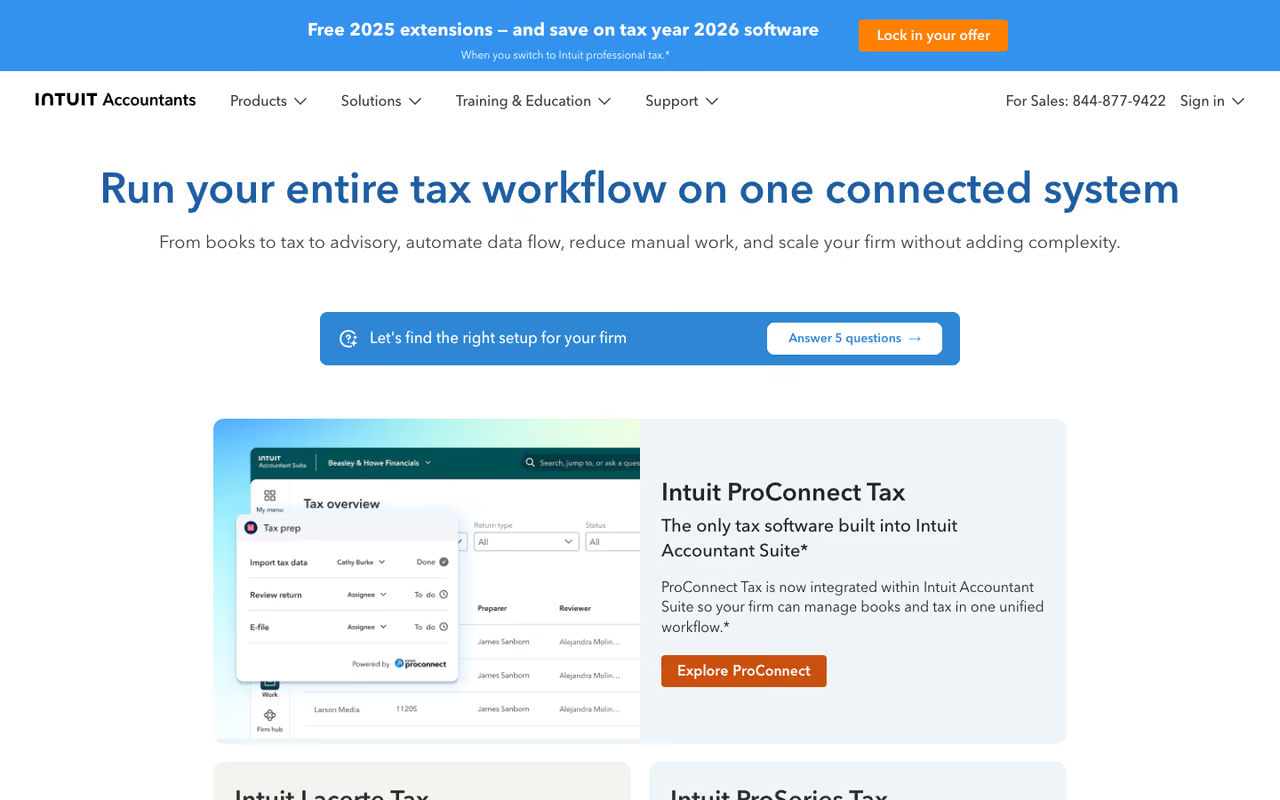
This is the one most firms can't ignore, because so many of your clients are already on QuickBooks. In October 2025 Intuit launched the Intuit Accountant Suite, an AI-powered hub that folds client management, team management, and firm analytics into the platform you already use to access client books. Intuit is sunsetting the old QuickBooks Online Accountant branding through 2026 and moving firms onto a free Core plan, with a paid Accelerate tier above it.
Hard to ignore if your clients already live in QuickBooks, since the free Core plan folds client and team management into the tool you already use. The agent stack is the draw, but Gold status now requires the paid Accelerate tier.
Pricing: firms get switched to the free Core plan between summer and December 2026 per Intuit's own rollout notes. Accelerate is the paid upgrade, and reaching Gold status in the successor to the ProAdvisor program now requires it. Your clients pay separately for their QuickBooks Online subscription, which starts around $38/month for Simple Start.
The standout: the agent stack. There's an Accounting Agent, Payments Agent, Payroll Agent, Sales Tax Agent, and a Business Tax Agent in beta, plus AI anomaly detection that flags odd movements across payroll and bill pay before you spot them. Client Insights gives firm-wide benchmarking that used to require a separate BI tool.
The catch: the transition is genuinely confusing right now. The program is mid-rebrand, Gold status now sits behind a paid plan, and some firms will feel pushed toward Accelerate. And it only makes sense if your clients are on QuickBooks. If half your book runs on Xero, you're paying for ecosystem lock-in you won't fully use.

Xero

Xero is the QuickBooks alternative I recommend to firms that want cleaner client files and don't want to fight per-user pricing on every engagement. The Xero partner program is free to join with no ongoing cost, and it's the backbone of how cloud-first firms run.
The QuickBooks alternative for firms that dislike per-seat limits, with unlimited users on every client file and a free partner program. US payroll and sales tax are weaker, and Practice Manager feels dated until you reach Silver.
Pricing: the partner program costs nothing. Xero HQ, the dashboard for managing all your client files, is free for every partner. Xero Practice Manager (jobs, time, WIP, invoicing) becomes free once you hit Silver partner status. Bronze and brand-new partners get a 14-day trial, then pay $149/month for up to 10 users. Client subscriptions start at $25/month and every plan includes unlimited users, which is the real differentiator versus QuickBooks Online's seat caps.
The standout: unlimited users on every client file. You're never rationing logins between the client, their assistant, and your three staff. Xero Workpapers is bundled in at no extra cost, which quietly replaces a tool a lot of firms pay for separately.
Where it falls short: US payroll and sales tax are weaker than Intuit's, so heavily US-domestic firms sometimes find gaps. Practice Manager's interface also feels dated next to Karbon or TaxDome, and you have to climb to Silver before it's free.

Karbon
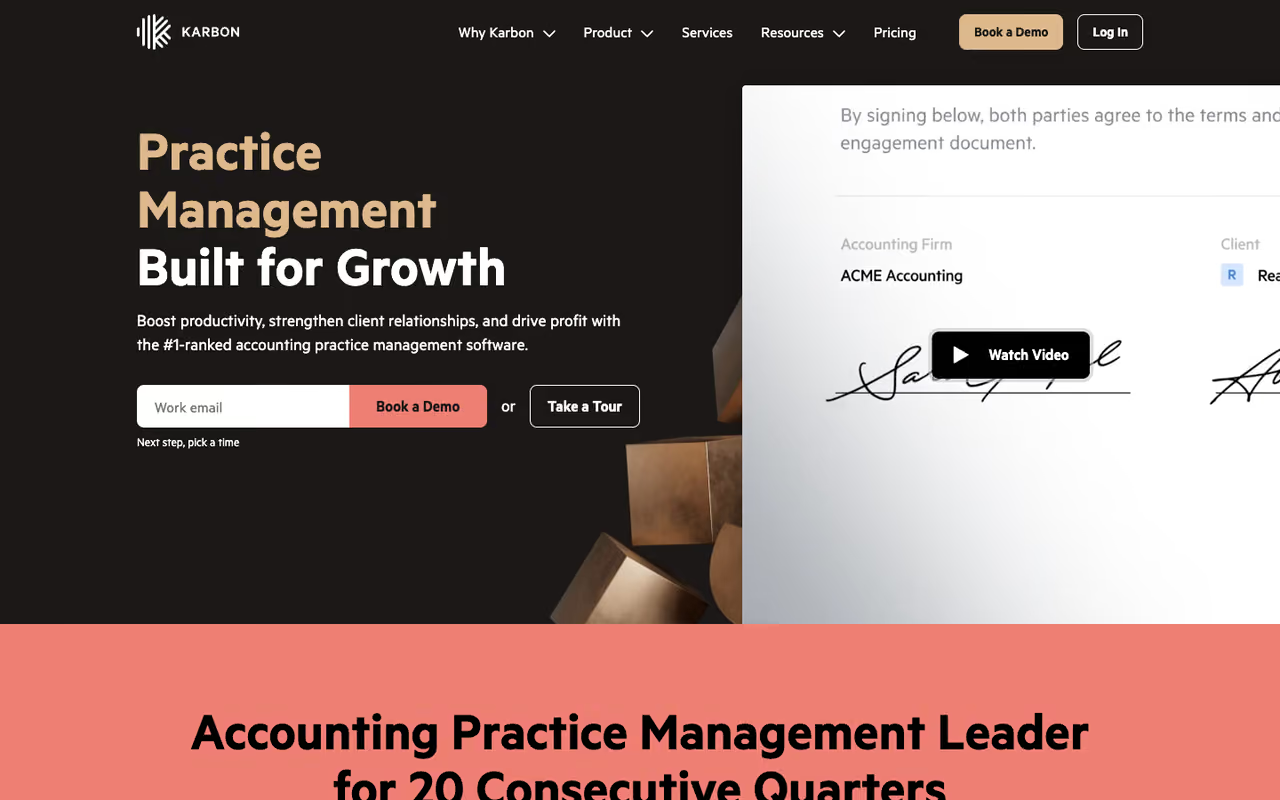
Karbon isn't a ledger. It's the practice-management layer that sits on top of whatever ledger your clients use, and it's the one I'd hand a growing team that's drowning in email. It ranks #1 for accounting practice management on G2 for a reason: the email triage and workflow design are genuinely better than the rest.
Best for: firms of 5 to 200 people where work falls through cracks because tasks live in someone's inbox.
The practice-management layer I would hand a growing firm drowning in email, because it turns inbox threads into assignable tasks. It is not a ledger, and per-user pricing starting at $59/user/month adds up for larger teams.
Pricing: per Karbon's pricing page, the Team plan is $59/user/month billed annually ($79 monthly), Business is $89/user/month annual ($99 monthly), and Enterprise is custom. Every plan includes the client portal, document management, and billing.
The standout: email becomes work. Karbon turns inbox threads into assignable tasks tied to a client, so nothing depends on one person remembering to forward something. The new Kai AI coworker and AI Agents draft replies, summarize threads, and push routine steps along, which is where the time savings show up.
The catch: it's a workflow tool, not your books. You still need QuickBooks, Xero, or another ledger underneath it, so Karbon is an added line item, not a replacement. At $89/user/month for Business across a 15-person firm, the bill adds up fast, and very small firms will find it overkill compared with Financial Cents.
If you're figuring out which AI tools to layer into a firm like this, our roundup of the best AI agents and the top tools directory are good companions to this list.

TaxDome
TaxDome is the all-in-one play: client portal, document management, e-signatures, workflow, and billing in a single system. It's popular with tax and bookkeeping firms that want one login instead of five subscriptions stitched together.
The all-in-one pick for firms that want one login for portal, e-signatures, workflow and billing. The client portal is the best here, but annual-upfront billing from $800/user/year bites small firms and you adapt to its workflow.
Pricing: per TaxDome's pricing page, plans run Essentials at $800/user/year, Pro at $1,000/user/year, and Business at $1,200/user/year, billed annually upfront. Pro also offers monthly billing at $100/user/month, useful for seasonal staff you add only during tax season.
The standout: the client portal and mobile app are the best in this list. Clients actually use them to upload documents, sign, and pay, which cuts the back-and-forth that eats your January. Folding portal, e-sign, and billing into one bill often beats paying for three separate tools.
Where it falls short: the annual-upfront commitment is a real cash bite for a small firm, and the all-in-one design means you adapt to TaxDome's way of working rather than the reverse. The learning curve is steeper than Financial Cents, and you don't get the modular flexibility Canopy offers.

Canopy
Canopy takes the opposite approach to TaxDome. Instead of one big bundle, you buy a base platform and bolt on only the modules you need, so you're not paying for features you'll never open.
A modular alternative to TaxDome, good for firms that only want two or three pieces of practice management, plus stronger tax-resolution tooling. The $150 base price misleads once modules stack up, and total cost is hard to predict.
Pricing: the base Client Engagement platform starts at $150/month, with add-on modules priced separately (document management and workflow each run in the $30-$40/month range per Canopy's pricing). You assemble the stack that fits.
The standout: you pay for what you use. A firm that only needs the client CRM and document management doesn't subsidize a workflow engine it won't touch. Canopy's tax-resolution tooling is also stronger than most rivals, which matters if IRS notice work is part of your service line.
The catch: those modules add up, and the "$150 base" number is misleading once you've added two or three of them. Pricing is harder to predict than a flat per-user tool, and small firms sometimes find the base fee steep before they've added a single module.
Financial Cents
Financial Cents is the budget pick that doesn't feel like a budget pick. It covers workflow management, a client CRM, and basic financial reporting at a price small firms can actually justify.
The budget practice-management tool that does not feel cheap, starting at $19/user/month. Ideal for solo practitioners and firms under 20 staff, though reporting is basic, automation is lighter and growing firms will migrate off it.
Pricing: the Solo plan is $19/user/month, Team is $49/user/month, and Scale (with more automation) is $69/user/month. That makes it the cheapest serious workflow tool here by a wide margin.
The standout: price-to-function ratio. You get client tasks, automated reminders, a client portal, and team collaboration for a fraction of what the premium tools charge. For a two-person firm, it's hard to argue with.
Where it falls short: it's not as deep as Karbon or TaxDome. The reporting is basic, the automation is lighter, and very large firms outgrow it. It's a starter practice-management tool, and you may migrate off it as you scale past 20 people.
Sage Intacct
Sage Intacct plays in a different weight class. It's a cloud financial management platform for mid-market and multi-entity clients, the kind that have outgrown QuickBooks and need real consolidation and revenue recognition.
Reserve Sage Intacct for the handful of larger clients with multiple entities or complex revenue rules, where consolidation and the new AI close agents earn their cost. Starting around $8,580/year, it is overkill for small-business clients.
Pricing: a single-user, single-entity subscription starts around $8,580/year and climbs with users, entities, and modules. This is client-grade financial software, not a per-seat firm tool, and pricing is quote-based.
The standout: multi-entity consolidation with AI. The 2026 release added five AI agents, including a Close Agent that auto-posts recurring entries and drafts preliminary statements, plus Sage Copilot to shorten close cycles. For firms running advisory work, the Sage Intacct Advisory program adds structured onboarding templates.
The catch: it's expensive and overkill for anyone serving small businesses. There's a real implementation project on the front end, and the cost only pencils out when your client's complexity demands it. Most firms will only touch this for a handful of larger clients.

FreshBooks
FreshBooks is the easy-button ledger for the simplest clients: freelancers, contractors, service businesses that mostly invoice and track expenses. The free Accounting Partner Program lets you manage those clients without the QuickBooks or Xero learning curve.
The easiest ledger for sole proprietors and small service firms, and the free partner program plus 15% discount are genuine perks. Anything with inventory, multiple entities or complex reporting outgrows it, so expect to move clients later.
Pricing: the partner program is free to join, certified partners get 15% off new subscriptions, and client plans run roughly $21 to $55/month with extra users at $11. There's a free accountant training session and a directory listing that can send you leads.
The standout: clients understand it on day one. The interface is the friendliest here, so onboarding a non-financial business owner takes minutes, not a training session. The 15% partner discount and lead directory are genuine perks for a growing bookkeeping practice.
Where it falls short: it's built for invoicing-first businesses, so anything with inventory, multiple entities, or complex reporting outgrows it quickly. Power-user accountants find it limiting, and you'll move those clients to QuickBooks or Xero eventually.
How to choose
Start with where your clients already keep their books, not with the prettiest demo. If most are on QuickBooks, the Intuit Accountant Suite is your default and it's free at Core. If they're on Xero, join the partner program and run on Xero HQ.
Then add a practice layer based on team size. Under 20 people on a budget: Financial Cents. A growing team buried in email: Karbon. A firm that wants one client-facing portal for everything: TaxDome. A firm that only needs a couple of pieces: Canopy.
Sage Intacct and FreshBooks are the edges of the spectrum. Reach for Intacct only when a client's multi-entity complexity demands it, and use FreshBooks for the simplest invoice-and-expense clients where anything heavier is friction. Most firms end up running two tools, not one: a ledger their clients use, plus a practice-management system their team lives in. Budget for both.
If your firm is also building out a broader AI stack, our guide to the best AI for finance teams and Dupple X cover the tools that sit alongside these. And if you want the AI news that's actually reshaping this software every quarter, join 780,000+ professionals reading Techpresso.
FAQ
What is the best accounting software for accountants in 2026?
For most firms it's the Intuit Accountant Suite, the AI-powered replacement for QuickBooks Online Accountant, because so many clients already use QuickBooks and the Core plan is free. Firms built on Xero clients should use the free Xero partner program with Xero HQ. The right answer depends on where your clients keep their books.
Is QuickBooks Online Accountant free for accountants?
Yes. In 2026 Intuit moved firms onto a free Core plan as it rolled out the Intuit Accountant Suite. There's a paid Accelerate tier above it, and reaching Gold status in the successor to the ProAdvisor program now requires that paid plan. Your clients still pay separately for their own QuickBooks Online subscriptions.
What's the difference between accounting software and practice management software?
Accounting software (QuickBooks, Xero, Sage Intacct) is the ledger where transactions, invoices, and financial statements live. Practice management software (Karbon, TaxDome, Canopy, Financial Cents) runs your firm: client tasks, workflows, document requests, portals, and billing. Most firms need one of each.
How much does accounting practice management software cost?
In 2026 it ranges from about $19/user/month (Financial Cents Solo) to $89/user/month (Karbon Business), with most firms landing in the $50 to $80 range. Canopy uses a $150/month base plus modules, and TaxDome runs $800 to $1,200 per user per year billed annually.
Should accountants use Xero or QuickBooks?
Use whichever your clients already run. QuickBooks dominates the US small-business market and now has the AI-heavy Intuit Accountant Suite. Xero offers unlimited users on every client file and a free partner program, which appeals to cloud-first firms. Many firms support both rather than forcing a switch.
Related guides
Some offers on this page may be paid placements or contain affiliate links.
Across our whole catalogue the median is $24 a month and 33% of tools advertise a free tier. Figures are the lowest recurring monthly price quoted in our own review of each tool, read on 2026-08-19. Full method and every category.
