
Best Accounting Software for Medium-Sized Businesses (2026)

Key facts7 tools compared: Sage Intacct, NetSuite, QuickBooks Online Advanced, Xero, Zoho Books…
- 7 tools compared: Sage Intacct, NetSuite, QuickBooks Online Advanced, Xero, Zoho Books, QuickBooks Enterprise, FreshBooks Premium/Select
- Sage Intacct (best for: Multi-entity finance teams): ~$15K-$60K/yr (quote)
- NetSuite (best for: Companies needing full ERP): $30K-$100K+/yr (quote)
- QuickBooks Online Advanced (best for: Smaller mid-size businesses): $275/mo, 25 users
- Xero (best for: Collaborative teams, unlimited users): ~$80/mo (Established)
The moment a business crosses about $5M in revenue, accounting software stops being a convenience and starts being a bottleneck. You hit user limits. The month-end close drags into the second week. Someone asks for revenue by entity, by department, by project, and the answer involves three exported spreadsheets and a prayer.
That's the gap this guide covers. Not the freelancer tools, not the full enterprise ERP suites that need a six-figure implementation budget. The middle: companies with multiple entities, real headcount, and a finance team that needs reporting it can trust.
If you want the short answer: Sage Intacct is the pick I'd hand most mid-market finance teams that have outgrown QuickBooks but don't need NetSuite's full operational ERP. If you need accounting plus inventory, manufacturing, and ecommerce in one system, NetSuite is the answer. And if you're a smaller mid-size shop that just wants more horsepower without leaving familiar ground, QuickBooks Online Advanced still does the job for a fraction of the cost. Here's how I'd think about each.
Quick comparison
| Tool | Best for | Price | Standout |
|---|---|---|---|
| Sage Intacct | Multi-entity finance teams | ~$15K-$60K/yr (quote) | Dimensional reporting, fast close |
| NetSuite | Companies needing full ERP | $30K-$100K+/yr (quote) | Accounting + inventory + CRM in one |
| QuickBooks Online Advanced | Smaller mid-size businesses | $275/mo, 25 users | Familiar, huge app ecosystem |
| Xero | Collaborative teams, unlimited users | ~$80/mo (Established) | Unlimited users at every tier |
| Zoho Books | Businesses on the Zoho stack | $50-$275/mo | Deep ecosystem at a low price |
| QuickBooks Enterprise | Inventory-heavy desktop users | ~$4,200+/yr (Diamond) | Advanced inventory, on-prem option |
| FreshBooks Premium/Select | Service businesses billing clients | $70/mo+ | Best-in-class invoicing |
Sage Intacct: the mid-market finance pick
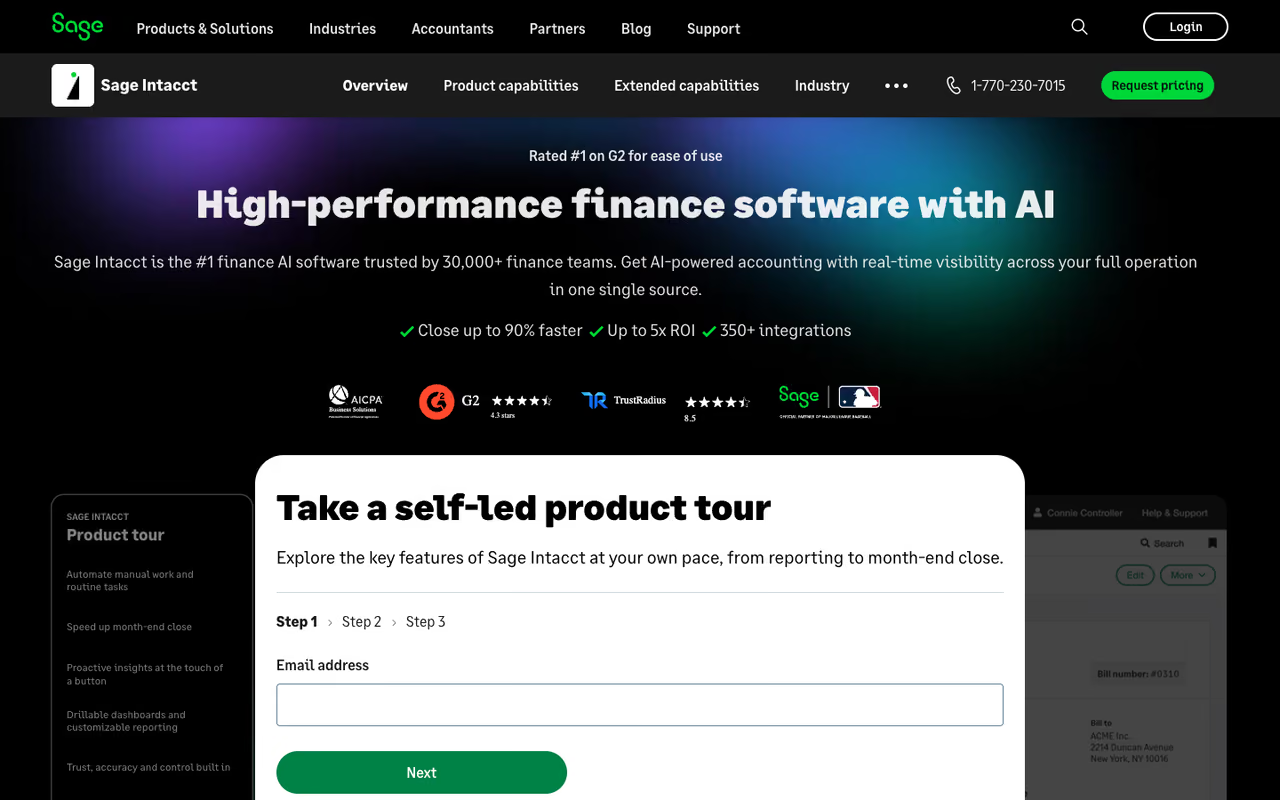
Sage Intacct is what I point most growing finance teams toward once they have more than one legal entity or need reporting that QuickBooks can't produce. It's a cloud financial management platform built around a dimensional general ledger, which is the part that actually matters. Instead of building a bloated chart of accounts with a separate code for every department-location-project combination, you tag transactions with dimensions and slice reports any way you want after the fact.
Who it's best for: Multi-entity companies, SaaS businesses that need revenue recognition, nonprofits, and any finance team where the monthly close is currently painful. Sage says customers close books up to 90% faster, and the AI agents it has been adding (a close agent, an AP automation agent, a financial assurance agent that flags unusual journal entries) push in that direction.
The finance team's pick once you have multiple entities or reporting QuickBooks cannot produce, thanks to its dimensional ledger and AI agents. It is quote-based, with most mid-market deployments in the $25,000 to $75,000 per year range.
Quote-based. Most mid-market deployments land in the $25,000-$75,000 per year range depending on user count and modules, per ERP Research's 2026 pricing data. Smaller setups with core financials can come in lower. Budget separately for implementation, usually $10,000-$30,000.
The standout: Real-time multi-entity consolidation. If you run several companies and currently consolidate in Excel, this alone justifies the switch.
The catch: You'll need a partner to implement it, and pricing is opaque until you talk to sales. It's also finance-first, so if you need inventory or manufacturing depth, you're bolting on third-party tools or looking at NetSuite instead.
NetSuite: the full ERP when accounting isn't enough
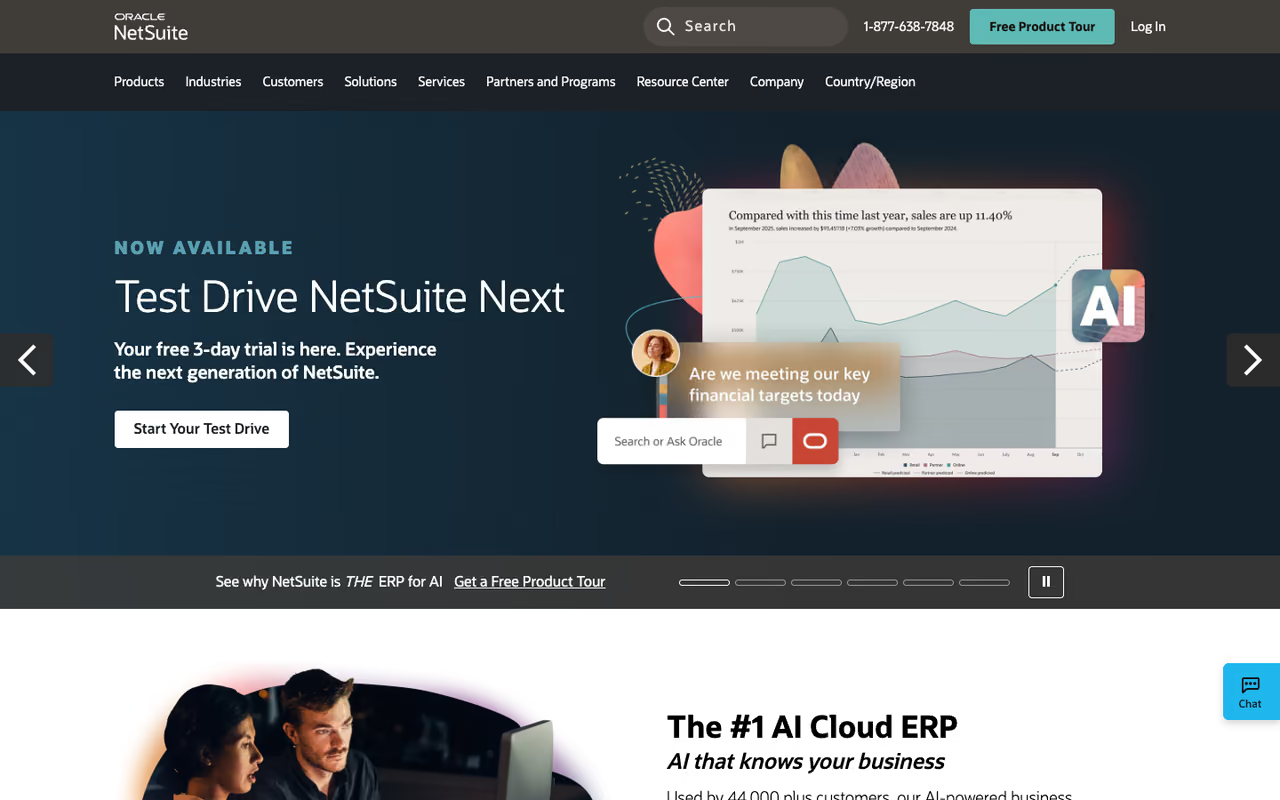
NetSuite is the one to reach for when "accounting software" undersells what you actually need. It's a full ERP: financials, inventory, order management, CRM, and ecommerce running off one database. For a mid-size company that's stitching together QuickBooks plus a separate inventory tool plus a CRM, consolidating into NetSuite removes a lot of duplicate data entry and reconciliation headaches.
Who it's best for: Product companies, wholesalers, and businesses where operations and finance are tightly coupled. If you ship physical goods, manage warehouses, or need real-time inventory tied to your books, NetSuite earns its keep here in a way pure accounting tools can't match.
Reach for NetSuite when accounting software undersells what you need and operations and finance are tightly coupled. Inventory, orders and CRM sit on one database, but a typical mid-market company spends $50,000 to $200,000 in year one.
Also quote-only, and meaningfully more expensive. The structure is a base platform license plus per-user fees plus modules. ERP Research data puts the base around $999-$5,000/month, with full-access users at roughly $129-$199/month each. A typical mid-market company spends $50,000 to $200,000 in year one (implementation included), then $50,000-$150,000 annually.
The standout: One system for the whole operation. The reporting and automation depth scales as you grow, so you're unlikely to outgrow it.
The catch: Cost and complexity. Implementations run long, customizations add up, and Oracle's annual price increases are real. For a company that only needs accounting, NetSuite is overkill, and you'll feel that in both the bill and the onboarding.
QuickBooks Online Advanced: familiar, and often enough
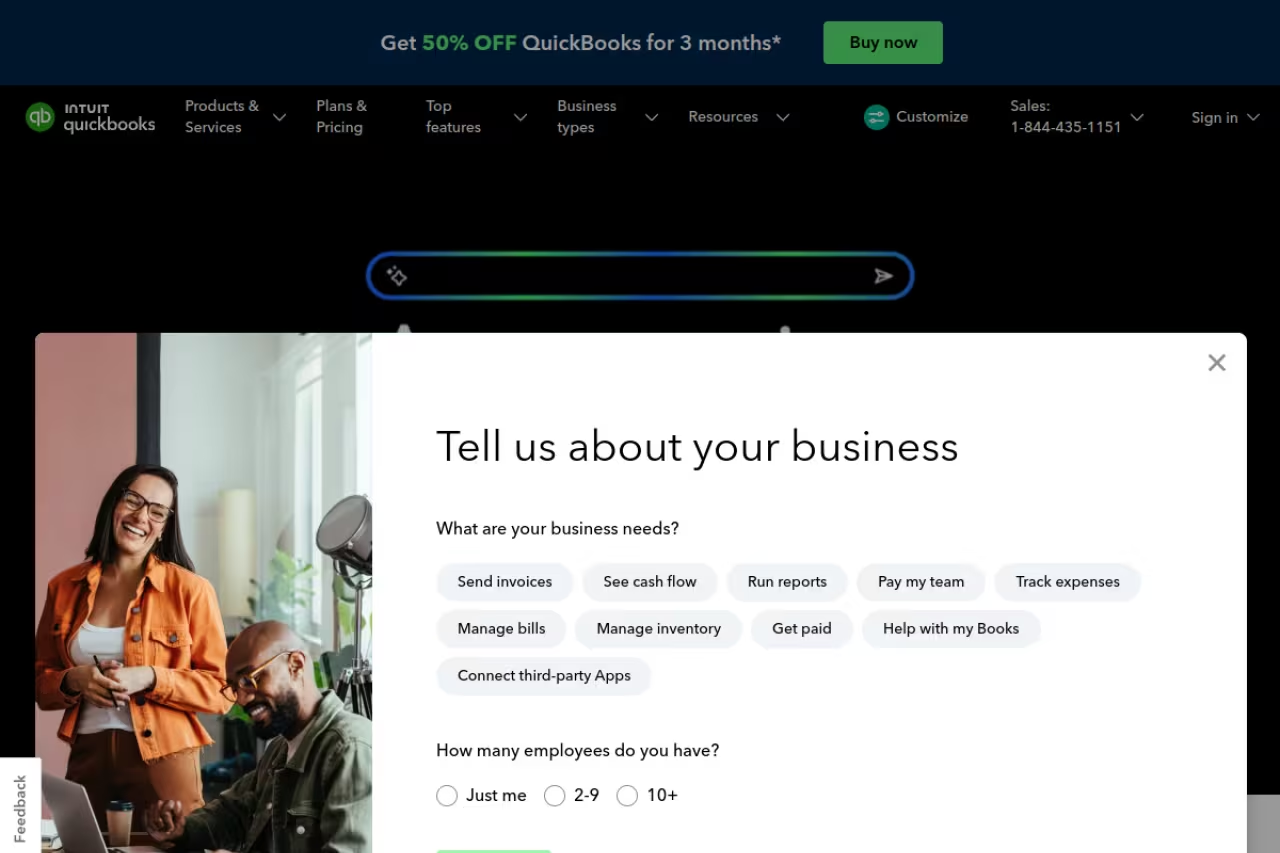
QuickBooks Online Advanced is the top tier of Intuit's cloud product, and for a lot of businesses in the lower mid-market it's the sensible answer. Your accountant already knows it. Your team already knows it. The app ecosystem is enormous. And the jump from Plus to Advanced buys you more users, batch invoicing, custom user roles, and better reporting without the cultural shock of moving to an ERP.
Who it's best for: Single-entity companies with up to 25 users that have outgrown QuickBooks Plus but aren't dealing with multi-entity consolidation or heavy inventory. It's the natural next step rather than a platform change.
The sensible lower mid-market answer for single-entity companies with up to 25 users that have outgrown Plus. It is familiar and predictable at $275/month, but skip it if you need multi-entity consolidation or heavy inventory.
$275/month for up to 25 users, per NerdWallet's 2026 pricing breakdown. No quote, no implementation partner, no negotiation. That predictability is a feature in itself when you're comparing against five-figure annual ERP contracts.
The standout: Value and familiarity. You get genuine mid-market features at a flat, knowable price, and onboarding is measured in days.
Where it falls short: It doesn't do true multi-entity consolidation, the 25-user ceiling is firm, and reporting, while improved, still isn't in Sage Intacct's league. The moment you add a second entity or need dimensional reporting, you've hit the wall.
If you're evaluating tools across your whole stack, not just finance, our roundup of the best AI tools for business and the best AI agents for automating back-office work pair well with whatever accounting system you land on.

Xero: unlimited users, clean interface
Xero is the strongest QuickBooks alternative for collaborative teams, and the reason is simple: every plan includes unlimited users. If you have a finance team plus department heads who all need access, you're not paying per seat the way you would almost everywhere else.
Who it's best for: Growing teams that value collaboration and don't want headcount to inflate the bill. It's especially popular with businesses that lean on bookkeepers and accountants who need their own logins.
The strongest QuickBooks alternative for collaborative teams, since every plan has unlimited users and the interface is clean. It is lighter than Sage Intacct or NetSuite on heavy finance features, and pricing has crept up in recent years.
The top US tier (Established) runs around $80/month, which adds multi-currency, project tracking, expense claims, and analytics. Compared to per-user pricing elsewhere, that's a strong deal once your team grows past a handful of people. Pricing has shifted upward over the past two years, so check the current page before committing.
The standout: Unlimited users at a flat price, plus one of the cleaner interfaces in accounting software. The third-party app marketplace is also deep.
The catch: It's lighter than Sage Intacct or NetSuite on the heavy-finance features. Multi-entity work is clunky, and US sales tax and payroll have historically been weaker spots than the QuickBooks ecosystem. For a true mid-market finance org, you may outgrow it.
Zoho Books: the value play if you live in Zoho
Zoho Books is the accounting piece of the broader Zoho One suite, and that context is the whole pitch. If you already run Zoho CRM, Zoho Inventory, or Zoho Projects, Books slots in with native connections you'd otherwise pay integration tools to fake.
Who it's best for: Cost-conscious mid-size businesses already standardized on Zoho, or teams that want a low monthly price with room to add modules as they grow.
A value play if you already run Zoho CRM, Inventory or Projects, with Professional at $50/month for 5 users. Outside the Zoho world the integrations thin out, and outside CPAs are less familiar with it than with QuickBooks.
Professional is $50/month (5 users), Premium is $70/month (10 users), Elite is $150/month, and Ultimate is $275/month, per Zoho's pricing page. Extra users are about $3/month each. For the feature depth, this is among the best value in the category.
The standout: Price-to-feature ratio, especially inside the Zoho ecosystem. You get multi-currency, project billing, and automation that costs a lot more elsewhere.
The catch: Outside the Zoho world, the integrations thin out fast, and accountant familiarity is lower than QuickBooks or Xero, so your outside CPA may push back. It also isn't built for true multi-entity consolidation at scale.
QuickBooks Enterprise: desktop power for inventory
QuickBooks Enterprise is the desktop-rooted sibling that still wins for inventory-heavy businesses that aren't ready to go cloud-native. Its Advanced Inventory module (FIFO, barcode scanning, bin location tracking) goes deeper than QuickBooks Online, and the Diamond tier scales to 40 users.
Who it's best for: Wholesalers, distributors, and manufacturers that need serious inventory features but want to stay in the QuickBooks world rather than migrate to an ERP.
Choose Enterprise if you are an inventory-heavy wholesaler, distributor or manufacturer who wants to stay in QuickBooks, with Advanced Inventory and up to 40 users on Diamond. Its desktop lineage is a long-term risk as Intuit pushes customers to Online.
Diamond, the only tier that reaches 40 users, starts around $4,200/year and is custom-quoted above that, per 2026 reseller pricing. It's monthly-subscription only at that tier.
The standout: Advanced inventory at a price well under NetSuite, with an optional on-premise/hosted model some businesses still require.
The catch: It's a desktop lineage product. The cloud experience is hosting-dependent, and Intuit has been steadily nudging customers toward Online. For a long-term bet, that direction matters.

FreshBooks: when invoicing is the whole game
FreshBooks earns a spot for service businesses, agencies, and consultancies where the core job is billing clients cleanly and getting paid. The double-entry accounting is solid enough for a mid-size services firm, and the invoicing, time tracking, and proposals are genuinely best-in-class.
Who it's best for: Agencies, consultancies, and professional services firms that bill by project or hour and don't carry inventory.
Best-in-class invoicing for agencies, consultancies and professional services firms that carry no inventory, with Premium at $70/month. Past a certain size you will outgrow it, since it lacks multi-entity support and has lighter reporting.
Premium is $70/month, and Select is custom-quoted (commonly negotiated in the $300-$500/month range for high-volume teams), per FreshBooks pricing coverage. Note that lower tiers cap billable clients and charge for extra team members.
The standout: The smoothest invoicing-to-payment flow in this list. Clients pay faster, and your team spends less time chasing.
The catch: It's not built for complex finance. No true multi-entity, lighter reporting, and inventory is an afterthought. Past a certain size or complexity, you'll need something heavier.
How to choose
Skip the feature checklists and answer three questions in order.
Do you need an ERP or just accounting? If your operations (inventory, manufacturing, ecommerce) are tightly coupled to your books, look at NetSuite first. If finance is the problem and operations live in their own tools, stay in the accounting lane: Sage Intacct, QuickBooks, or Xero.
How many entities? One entity, under 25 users, predictable needs: QuickBooks Online Advanced is the value pick and you can stop reading. Multiple entities or real consolidation requirements: Sage Intacct, full stop. This single factor decides more migrations than any other.
What's the trigger for switching? Don't migrate because a tool looks shiny. Migrate when a concrete pain (user limits, a close that takes too long, consolidation done in spreadsheets) is costing you real time. The implementation cost of Sage Intacct or NetSuite only pays off when it's solving a problem you can quantify.
One more practical note: budget for implementation and change management, not just the license. The five-figure annual cost of an ERP is rarely the part that bites. The migration, the retraining, and the parallel-running period are.
If you're building out the rest of your operations stack alongside accounting, Dupple X gives your team access to the top AI tools in one subscription, which is handy when finance, marketing, and ops are all evaluating software at once.
FAQ
What is the best accounting software for a medium-sized business?
For most mid-market finance teams, Sage Intacct is the strongest pick because of its dimensional reporting and multi-entity consolidation. If you need a full ERP with inventory and operations, choose NetSuite. If you're a smaller single-entity mid-size business, QuickBooks Online Advanced does the job at $275/month for far less complexity and cost.
When should a business move from QuickBooks to Sage Intacct or NetSuite?
The clearest triggers are adding a second legal entity, hitting QuickBooks' user limits, or a month-end close that consistently drags past the first week because you're consolidating in spreadsheets. If none of those apply, staying on QuickBooks Online Advanced usually saves money. If they do, the ERP cost starts paying for itself.
How much does mid-market accounting software cost per year?
It splits sharply. QuickBooks Online Advanced is fixed at $275/month (about $3,300/year). Zoho Books and Xero run from a few hundred to a few thousand dollars a year. Sage Intacct typically lands between $25,000 and $75,000 annually, and NetSuite ranges from $30,000 to over $100,000 with implementation, all quote-based.
Is NetSuite or Sage Intacct better for a growing company?
Sage Intacct is better if your need is finance-first: faster close, multi-entity consolidation, and strong reporting without operational modules. NetSuite is better if accounting is just one piece and you also need inventory, order management, and CRM in the same system. Sage Intacct is generally cheaper and quicker to implement; NetSuite does more but costs more.
Can a medium-sized business still use QuickBooks?
Yes, many do. QuickBooks Online Advanced supports up to 25 users and handles single-entity mid-size companies well. QuickBooks Enterprise (Diamond) scales to 40 users with advanced inventory. The limits show up with multiple entities or true consolidation, which is where dedicated mid-market platforms take over.
Ready to equip the rest of your team while you sort out finance? Start a Dupple X trial and get your whole stack of AI tools in one place.
Related guides
Some offers on this page may be paid placements or contain affiliate links.
Across our whole catalogue the median is $24 a month and 33% of tools advertise a free tier. Figures are the lowest recurring monthly price quoted in our own review of each tool, read on 2026-08-19. Full method and every category.
