
Best Accounting Software for Nonprofits (2026)

Key facts7 tools compared: Aplos, QuickBooks Online, Sage Intacct, Blackbaud Financial Edge NXT, Wave…
- 7 tools compared: Aplos, QuickBooks Online, Sage Intacct, Blackbaud Financial Edge NXT, Wave, Zoho Books, MoneyMinder
- Aplos (best for: Small/mid nonprofits & churches): From $79/mo
- QuickBooks Online (best for: Orgs whose accountant already knows QB): $80/yr via TechSoup
- Sage Intacct (best for: Large nonprofits, multi-entity): $15k+/yr (custom)
- Blackbaud Financial Edge NXT (best for: Large orgs needing donor + finance): Custom quote
Most accounting software was built for businesses that sell things. Nonprofits don't sell things. They take in restricted grants, designated gifts, and program revenue, then they have to prove every dollar went where the donor intended. That gap is why a generic ledger that works fine for a coffee shop falls apart the moment a board treasurer asks "how much is left in the youth program fund?"
That's the real test: fund accounting. Can the software track money by fund, grant, and program, then produce a Statement of Financial Position and a Statement of Activities your auditor will accept? Donor management, FASB-compliant reports, and Form 990 prep all sit on top of that foundation.
I've spent time digging into what actually works for nonprofits in 2026, comparing pricing pages, documentation, and public user reviews for tiny volunteer-run PTAs and for organizations running multi-million-dollar federal grants alike. The short version: Aplos is the best pick for most small and mid-sized nonprofits because it does true fund accounting without the enterprise price tag. But the right answer depends on your size and budget, so here's the full breakdown.
Quick comparison
| Tool | Best for | Price | Standout |
|---|---|---|---|
| Aplos | Small/mid nonprofits & churches | From $79/mo | Built-only-for-nonprofits fund accounting |
| QuickBooks Online | Orgs whose accountant already knows QB | $80/yr via TechSoup | Universal accountant familiarity |
| Sage Intacct | Large nonprofits, multi-entity | $15k+/yr (custom) | Dimensions-based grant tracking |
| Blackbaud Financial Edge NXT | Large orgs needing donor + finance | Custom quote | Deep Raiser's Edge integration |
| Wave | Micro nonprofits with simple books | Free | Genuinely free double-entry accounting |
| Zoho Books | Budget orgs already in Zoho | Free to $40/mo | Strong automation at a low price |
| MoneyMinder | Volunteer treasurers, PTAs, clubs | $299/yr | Designed for non-accountants |

Aplos: the best fund accounting for most nonprofits
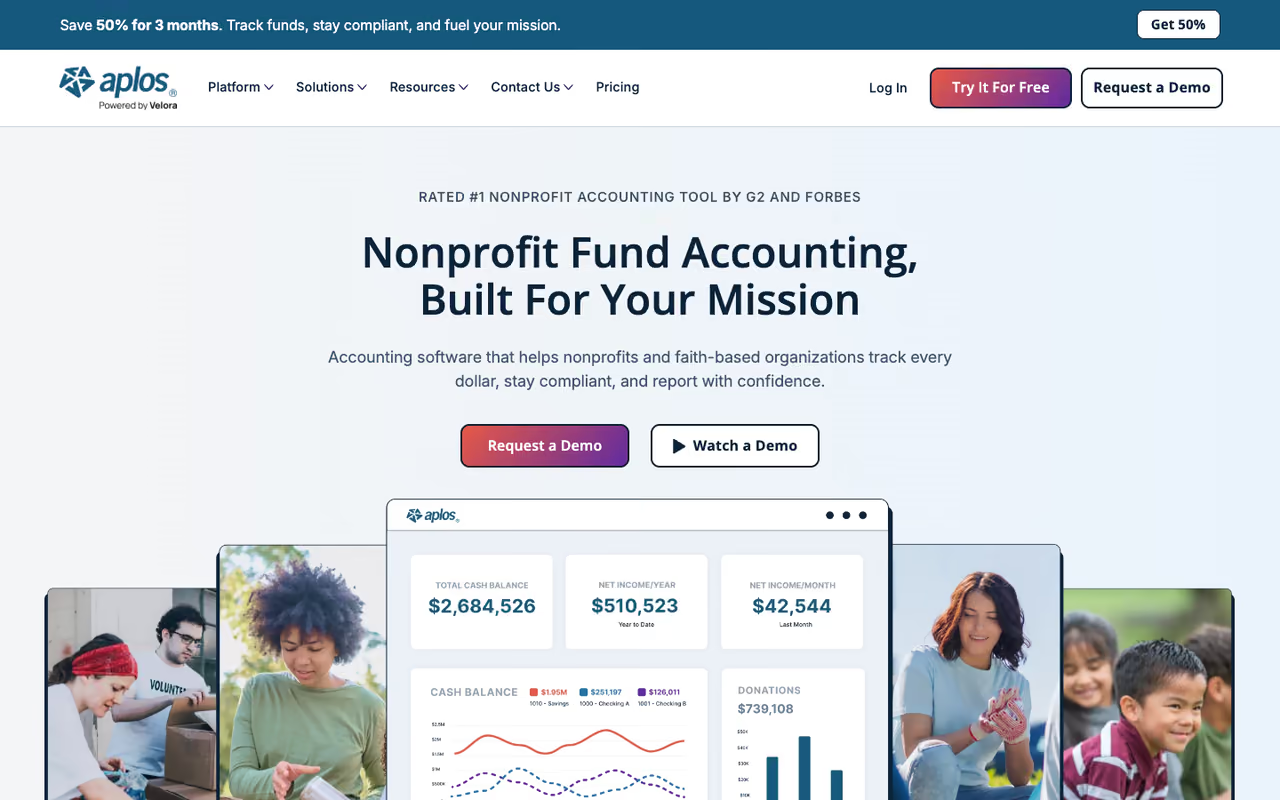
Aplos is the rare tool that was built from scratch for nonprofits and churches rather than retrofitted from a business product. That shows up everywhere. Instead of bending QuickBooks "classes" to fake fund tracking, Aplos treats funds as a first-class concept. You can see a real balance per fund, run a Statement of Financial Position, and hand your board reports that already look like nonprofit reports.
Who it's for: Small to mid-sized organizations that want proper fund accounting without hiring a consultant to set it up. Churches especially, since donation tracking and giving statements are baked in.
The default pick for small to mid-sized nonprofits and churches that want real fund accounting without a consultant. Donor management and the ledger live together, but it gets pricey for tiny volunteer groups and the reporting is less flexible than QuickBooks.
The Lite plan starts at $79/month with fund accounting, donation tracking, online giving forms, and reports. Core is $129/month and adds budgeting, accounts payable/receivable, and integrations. The Advanced tier starts around $229/month for budgeting by fund, project, or department plus fixed asset tracking. Aplos runs intro promos regularly, so check the pricing page before you commit.
The standout: Donor management and accounting live in the same place. You're not duct-taping a CRM to a ledger and reconciling two systems every month.
The catch: It's not cheap if you're a tiny all-volunteer group, and the giving/CRM features are overkill if you only need a clean ledger. Power users coming from QuickBooks sometimes find the reporting less flexible for complex custom views.
QuickBooks Online: the one your accountant already knows
QuickBooks Online isn't fund accounting software. I want to be honest about that up front. But it's the most widely used small-business accounting platform on earth, which means almost any bookkeeper or CPA you hire already knows it cold. For a lot of nonprofits, that familiarity is worth more than purpose-built features.
Who it's for: Nonprofits with an accountant or volunteer who already lives in QuickBooks, and orgs whose fund tracking needs are simple enough to handle with class and location tracking.
Pick QuickBooks Online if your accountant already lives in it and your fund tracking is simple. Through TechSoup the price is tiny, but classes make restricted funds messy, and you will outgrow it once grants take center stage.
Here's the part most people miss. Through TechSoup, eligible 501(c)(3) organizations get QuickBooks Online Plus (5 users) for an $80/year admin fee, or Advanced (25 users) for $170/year. Retail pricing for those same plans runs $115 and $275 per month, so the nonprofit discount is enormous. Note that Intuit raised retail prices 15-20% in mid-2025, which makes the TechSoup route even more appealing.
The standout: The ecosystem. Payroll, bill pay, bank feeds, and hundreds of integrations all plug in. And you'll never struggle to find someone who can help.
The catch: You have to fake fund accounting with classes, which gets messy as restricted funds multiply. There's no native FASB-compliant Statement of Activities, and donor management isn't included. If grants and restricted funds are central to your work, you'll outgrow this. To qualify for the TechSoup pricing, your org generally needs an operating budget under $10 million.
Sage Intacct: the gold standard for large nonprofits
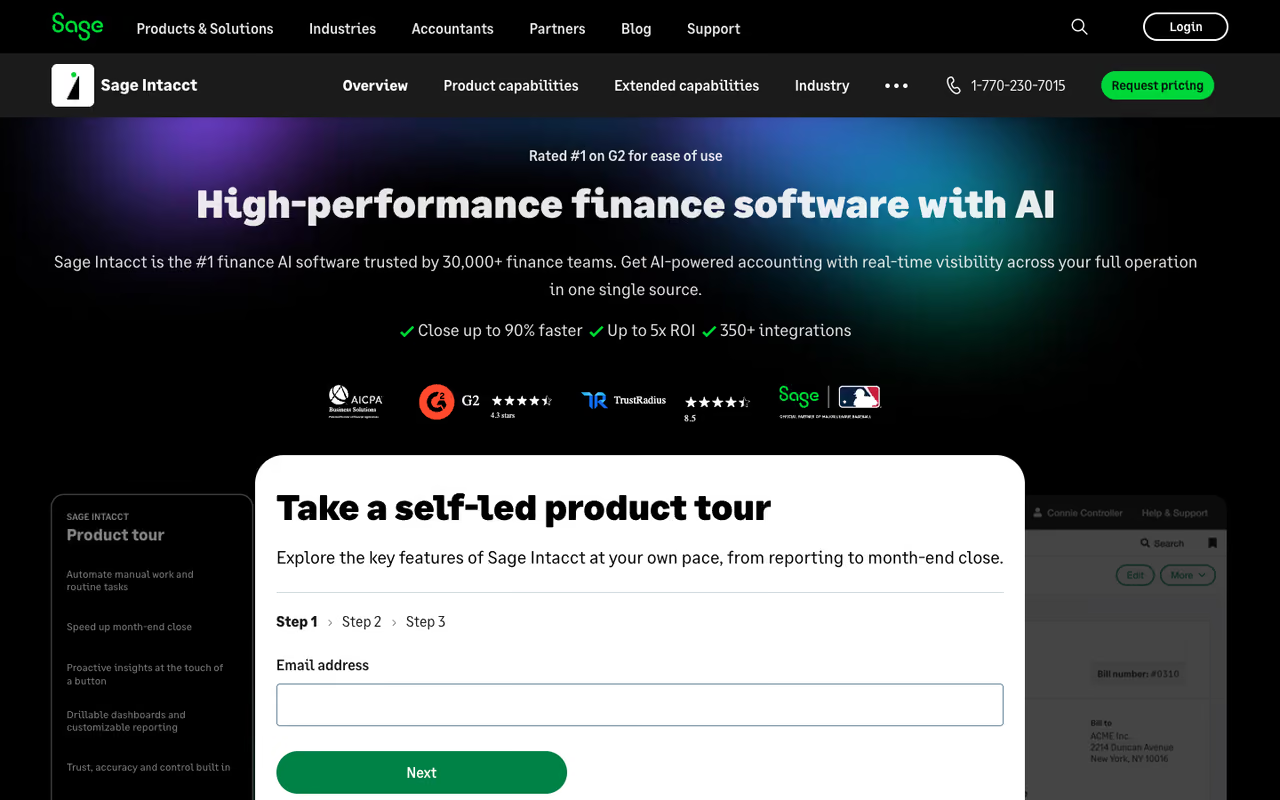
Sage Intacct is what big nonprofits graduate to. It uses a dimensions-based architecture, so instead of cramming everything into one chart of accounts, you tag transactions by fund, grant, program, location, and department. That makes multi-grant, multi-entity reporting that would be a nightmare in QuickBooks almost routine. The AICPA endorses it, which carries weight with finance committees.
Who it's for: Organizations with multiple entities, heavy federal grant reporting, or a real finance team. If you're running $5M+ and reconciling dozens of restricted funds, this is your league.
The league for organizations with multiple entities, heavy federal grant reporting and a real finance team. Dimensions make multi-grant reporting almost routine, but it is overkill, costly and slow to implement for a team of three.
Sage doesn't publish nonprofit pricing. Based on partner estimates, expect roughly $15,000 to $50,000 per year depending on modules and users, with year-one costs (including implementation) rarely under $17,000-$20,000. You'll buy through a partner and negotiate.
The standout: Real-time, drill-down dashboards and grant reporting that holds up to a federal audit. The automation around revenue recognition and allocations saves finance teams genuine hours.
The catch: Cost and complexity. This is overkill for small teams, and implementation takes months plus a partner budget. Don't buy Intacct because it's "the best" if you have three staff and one grant.

Blackbaud Financial Edge NXT: finance plus fundraising under one roof
Blackbaud Financial Edge NXT is the other heavyweight built specifically for nonprofits. Its biggest draw is the tight link to Raiser's Edge NXT, Blackbaud's fundraising platform. If your development team already lives in Raiser's Edge, having finance and fundraising data flow between them removes a lot of manual reconciliation.
Who it's for: Mid-to-large nonprofits, foundations, and higher-ed institutions that need serious fund accounting and already use (or plan to use) the Blackbaud fundraising suite.
Go with it if your development team already uses Raiser's Edge and you need serious fund accounting in the same ecosystem. Expect high cost, a dated interface and a steep learning curve, and switching later is painful.
Custom only, sold per total system user, usually on 1, 3, or 5-year terms. Expect mid-four-figures monthly and up, with implementation in the five-figure range depending on size. You'll need a quote.
The standout: Purpose-built grant and fund tracking with audit-ready reporting, plus the Raiser's Edge connection that no general-purpose tool can match.
Where it falls short: It's expensive, the interface feels dated next to Intacct, and users frequently mention a steep learning curve and support that varies. You're buying into an ecosystem, so switching later is painful.

Wave: free accounting that actually works
Wave is the answer when your nonprofit's budget for software is basically zero. Its core accounting, invoicing, and expense tracking are genuinely free, with no trial clock. For a brand-new org or a tiny all-volunteer group, that's a real lifeline.
Who it's for: Micro nonprofits with simple finances, a handful of transactions a month, and no restricted-fund complexity.
A real lifeline for micro nonprofits with simple finances and a handful of transactions a month. Genuine double-entry at no cost, but with no fund accounting you will hit the ceiling the moment a grant carries reporting requirements.
Free for the core accounting features. The optional Pro plan runs $19/month and adds receipt scanning and better payment processing rates. Payment processing is 2.9% + $0.60 per card transaction on the paid plan.
The standout: Real double-entry accounting at $0. Most "free" tools are stripped down to uselessness. Wave's isn't.
The catch: No fund accounting at all, no nonprofit-specific reports, and no dedicated nonprofit support. You can tag income and expenses, but you can't truly track restricted funds. The moment you take a grant with reporting requirements, you'll feel the ceiling.
If you're a small org doing more with less, pair your free tools with sharper curation. You can go deeper with Dupple X to keep your whole stack current without blowing the budget.
Zoho Books: automation on a budget
Zoho Books isn't nonprofit-specific either, but it punches well above its price. The automation is strong, the mobile apps are good, and if your org already uses other Zoho products (CRM, Mail, Campaigns), everything connects. For a budget-conscious org that needs more structure than Wave, it's a smart middle ground.
Who it's for: Cost-sensitive nonprofits that want solid bookkeeping, automation, and clean reports, and especially those already inside the Zoho ecosystem.
A smart, budget-friendly middle ground for cost-sensitive nonprofits, especially those already inside Zoho. Automation and the free tier are strong, but fund tracking is approximated with tags and it is less plug-and-play than Aplos.
There's a genuinely free plan for organizations with revenue under $50K/year. Paid tiers start at $15/month (Standard, billed annually) and $40/month (Professional), scaling up to higher plans for bigger teams. Zoho offers nonprofit discounts in some regions, so ask.
The standout: Workflow automation and bank-feed handling that usually cost a lot more elsewhere. The free tier alone covers a surprising amount.
The catch: You'll use Zoho's projects and tags to approximate fund tracking, which works but isn't true fund accounting. Support can be slow on lower tiers, and it's less plug-and-play for nonprofits than Aplos.
MoneyMinder: built for the volunteer treasurer
MoneyMinder solves a specific problem: the volunteer treasurer who isn't an accountant and never wants to be. PTAs, booster clubs, scout troops, HOAs, and small community groups need to track money, reconcile a bank account, and hand the next volunteer clean books. MoneyMinder does exactly that and nothing more.
Who it's for: All-volunteer nonprofits and community groups where the "finance department" is one busy parent with a spreadsheet they hate.
Made for the volunteer treasurer with no accounting background, such as PTAs, booster clubs and community groups. It is deliberately simple, so you will move on if you outgrow basic bookkeeping, but for its audience that is the point.
A flat $299/year, with free setup, included support, and no per-user fees. It's been serving volunteer treasurers since 2003.
The standout: It's designed for people with zero accounting background. Budgets, bank imports, reconciliation, and member/donor tracking are all framed in plain language.
The catch: It's deliberately simple. No deep fund accounting, no FASB Statement of Activities, no advanced grant reporting. If your org grows past basic bookkeeping, you'll move on. But for the group it's built for, that simplicity is the whole point.
How to choose
Start with two questions: how big is your budget, and how complex are your funds?
- Tiny org, simple books, no grants: Start free with Wave, or pay $299/year for MoneyMinder if a volunteer needs a friendly interface. Don't overbuy.
- Small to mid-sized, you have restricted funds or run a church: Go with Aplos. True fund accounting plus donor tools in one place is the sweet spot.
- You already have a QuickBooks-fluent accountant and simple fund needs: Grab QuickBooks Online through TechSoup for $80/year. The price is unbeatable and the familiarity is real.
- Large org, multiple grants, real finance team: Sage Intacct if you want best-in-class reporting, or Blackbaud Financial Edge NXT if your fundraising lives in Raiser's Edge.
One rule that saves money: don't buy enterprise software for capacity you won't use this year. It's far easier to migrate up from Aplos when you outgrow it than to justify a $25k Intacct contract to a board when three funds would have been fine in a $79 plan.
While you're modernizing the back office, it's worth a look at how AI is reshaping finance work. Our guides on the best AI tools and the best AI agents cover automation that pairs well with whatever ledger you pick.
Ready to make your whole stack sharper, not just your books? Try Dupple X and stay ahead of the tools that matter.
FAQ
What is the best accounting software for small nonprofits?
For most small nonprofits, Aplos is the best balance of real fund accounting, donor tools, and reasonable cost, starting at $79/month. If money is genuinely tight, Wave's free plan or QuickBooks Online through TechSoup ($80/year) are strong, cheaper starting points. The right pick depends on whether you handle restricted grants.
Do nonprofits need special accounting software?
Not always, but it helps. Nonprofits use fund accounting to track restricted versus unrestricted money and produce FASB-compliant reports like the Statement of Activities. Tools built for nonprofits (Aplos, Sage Intacct, Blackbaud) handle this natively. General tools like QuickBooks or Wave can approximate it with classes and tags, which works until your fund tracking gets complex.
Can I get QuickBooks free as a nonprofit?
Not free, but close. Through TechSoup, eligible 501(c)(3) organizations get QuickBooks Online Plus for an $80/year admin fee or Advanced for $170/year, versus retail prices of $115 and $275 per month. Your org generally needs an operating budget under $10 million to qualify.
Is there truly free accounting software for nonprofits?
Yes. Wave offers genuinely free double-entry accounting, invoicing, and expense tracking with no trial limit. Zoho Books has a free tier for organizations under $50K in annual revenue. Neither does true fund accounting, so they suit micro nonprofits with simple finances rather than grant-heavy organizations.
What's the difference between fund accounting and regular accounting?
Regular accounting tracks one pool of money for profit. Fund accounting splits money into separate "funds" tied to a purpose, such as a specific grant or restricted gift, and reports on each separately. Nonprofits need it to prove that restricted donations were spent as donors intended, which is a core requirement for audits and Form 990.
How much should a nonprofit budget for accounting software?
It ranges widely. Micro orgs can spend $0 to $300/year (Wave, MoneyMinder). Small-to-mid nonprofits typically spend $80/year (QuickBooks via TechSoup) to roughly $1,500-$2,700/year (Aplos). Large organizations running Sage Intacct or Blackbaud should budget $15,000+ per year plus implementation. Match the spend to your fund complexity, not your ambition.
Related guides
Some offers on this page may be paid placements or contain affiliate links.
Across our whole catalogue the median is $24 a month and 33% of tools advertise a free tier. Figures are the lowest recurring monthly price quoted in our own review of each tool, read on 2026-08-19. Full method and every category.
